
Differentiate Sunglasses With Temple Tips and Core Wires
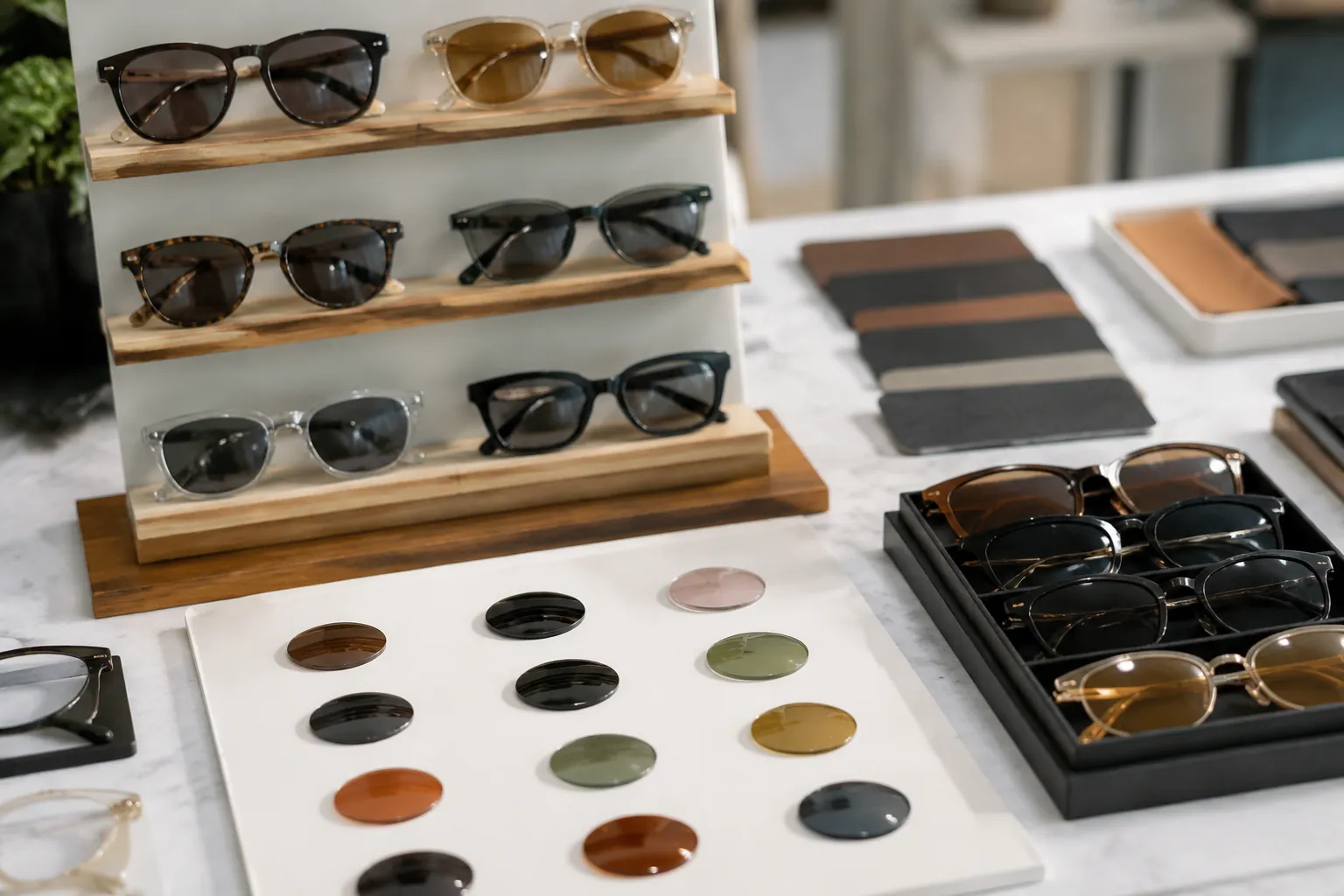
This guide is for brand owners, importers, distributors, and retailers sourcing custom sunglasses in volume. It focuses on three underused components: temple tips, core wires, and end pieces. Small parts. Big effect. They shape side profile, hand feel, perceived quality, and repeatable brand recognition. In many projects, changing these parts is enough to make a frame look less generic without opening a fully new front mold. That matters when you need stronger product identity but still have to control MOQ, tooling cost, and launch timing.
Why component-level changes work
Many buyers start with logo printing, laser engraving, or a metal badge. Those details are visible. They are also easy to copy. They do not change the structure of the product.
Component-level changes do. A shaped temple tip, a visible patterned core wire, or a well-integrated end piece changes how the frame feels in the hand, how it reads in side-view photography, and how it looks folded on a table.
The commercial logic is simple. Keep a frame architecture that already fits your price target and uses proven hinge geometry. Then modify the parts customers touch and inspect closely. Compared with a full new mold program, that usually reduces development scope and makes approvals easier because the front construction stays the same.
For overseas buyers, this is often the practical middle ground between a stock program and full custom development. MOQ still depends on the factory, material, and component. Some suppliers can support limited customization on selected programs at lower quantities. Custom trims, wire tooling, or new component shapes usually make more sense as volume rises. If you are not ready to fund a new front mold, temple-end customization is often the first place to look.
The point is straightforward: if the goal is perceived exclusivity, small engineered changes usually create more identity than one more printed logo.
Set the decision framework before specifying parts
Do not treat temple tips, core wires, and end pieces as decoration only. They affect comfort, assembly difficulty, cosmetic consistency, and QC. Start with the job each part needs to do.
- Premium visual signal: visible core wire patterns in crystal or translucent temples, or a flush metal end piece with engraved branding.
- Comfort improvement: temple tip length, inward bend angle, thickness at the ear-contact zone, or grip texture.
- Lower development risk: an existing frame platform with a color or finish change, or a modest temple-tip geometry adjustment.
- Collection-level recognition: repeating a signature wire pattern or a fixed temple-tip color code across multiple SKUs.
- Faster launch timing: avoiding new hinge-area hardware, new die-cast trims, or changes that require reworking the temple-hinge interface.
Lock four decisions early: target FOB price, target order quantity, target market compliance, and base material. These four choices narrow the workable options fast.
Material choice matters. Injection sunglasses are often preferred when unit cost, repeatability, and scaling efficiency matter most. Acetate usually gives stronger visual depth, a higher polish standard, and better presentation for visible core-wire work, but it is less forgiving in material handling and finishing. In acetate, transparency and polished edge depth help design details show. In injection, cost efficiency is often better, but the premium look depends heavily on resin selection, color, and finish quality.
As a working rule, if your target retail is entry-level promotional or mass channel, start with temple tips and molded side details. If your target is mid-market fashion or boutique private label, visible wires and refined end pieces are more likely to justify the added cost.
Temple tips: the lowest-risk way to look less generic
Temple tips are easy to ignore because they sit at the end of the frame. That is a mistake. Buyers and end customers notice them in unboxing, in side-view product images, and during try-on. They are also one of the safer places to differentiate a frame without upsetting the rest of the construction.
There are three practical levers: shape, material or finish, and brand cue. A paddle tip can make a fashion frame feel more substantial. A longer sport tip can improve retention. A slim tapered tip can make the same front look cleaner and more refined. Small dimensional changes matter here. Specify them in drawings, not in loose visual language.
Typical development checks should include total length, maximum thickness, bend start point, and left-right symmetry. Ask the factory what production tolerances it can actually hold for the chosen material and process. Then confirm those tolerances on approved samples. If the tip is too thick behind the ear, the frame feels bulky. If the inward bend is too aggressive, comfort drops.
Acetate and injection behave differently. Acetate tips can usually be heat-adjusted during fitting and final assembly. Injection tips rely more on mold geometry and material memory, so the approved shape needs to be right earlier in development. Soft-touch coatings can improve feel, but they also raise abrasion, chemical-resistance, and adhesion questions. Check those before approval.
Useful customization options include:
- Shape: paddle, tapered, angled, long sport, or a flattened underside to reduce pressure concentration.
- Finish: gloss polish, matte effect, crystal acetate, dual-layer lamination, or a rubber insert on sport styles.
- Brand cue: foil mark, laser code, molded line, contrast edge paint, or a color block repeated across the range.
Ask for side-view drawings with millimeter dimensions, not just renderings. A tip that looks clean on screen can turn clumsy in production if the cross-section thickness or bend position is wrong.
Core wires: small part, strong premium signal
Core wires matter most in acetate or transparent-injection temples where the internal metal stays visible. A standard straight wire is functional. A custom patterned wire looks intentional and can become a repeatable house detail across several styles.
Common options include stamped linework, herringbone textures, geometric repeats, subtle initials within a pattern, and shaped terminal ends visible near the tip. The common mistake is overdesign. Too much detail in too little space gets lost once the wire sits behind the temple wall and goes through finishing.
Function comes first. Wire thickness, hardness, corrosion resistance, and placement consistency matter more than decoration. If the wire is too light, the temple may twist and feel weak. If the pattern depth is too aggressive, it can show unevenly through thin acetate walls. In translucent temples, small misalignment becomes obvious fast.
For acetate temples, the process usually includes wire stamping or forming, temple cutting or CNC milling, slot preparation, insertion, fixing according to the factory's construction method, polishing, hinge alignment, and final fitting. CNC-milled temples generally give better control over visible-wire placement than less controlled routing methods, especially when the sidewall is thin or the wire must sit at a fixed distance from the outer surface.
Before approval, ask for two references: a loose wire sample and an assembled temple sample in the real acetate color. One without the other is not enough. A loose wire sample can hide visibility problems. A finished temple can hide stamping inconsistency.
| Core wire option | Best material context | Typical cost effect | Main QC point | Best MOQ logic |
|---|---|---|---|---|
| Standard straight wire | Opaque acetate or basic injection | Low | Rigidity and insertion consistency | Works across low and high volumes |
| Stamped pattern wire | Translucent or crystal acetate | Low to medium | Pattern clarity after polishing | Usually more efficient when volume can absorb setup |
| Custom branded wire motif | Premium acetate collections | Medium | Pattern visibility and left-right alignment | Best when repeated across several styles or larger runs |
| Shaped terminal wire end | Transparent temple-tip zone | Medium | End positioning near tip window | Best when repeated across several SKUs |
End pieces: where branding looks engineered or forced
End pieces sit at a critical visual junction: the temple-to-hinge area or the terminal hardware zone, depending on construction. Done well, they make the frame look purpose-built. Done badly, they look like trim added to justify a higher price.
Common executions include flush logo plates, inset metal caps, contrast pins, decorative hinge covers, and shaped hardware at the temple end. The strongest details do more than one job. They reinforce brand language, protect a wear point, and balance the side profile.
Control thickness carefully. If a metal part stands too proud of the surface, it can catch fingers, snag pouches, and increase chipping risk during handling or impact. On acetate, a recessed or flush insert is usually cleaner than a raised plate. On lower-price injection frames, a molded detail plus pad print can be more reliable than a heavy metal trim attached to a light structure.
Decoration method should fit the part and the wear zone:
- Laser engraving: durable on suitable metal parts and appropriate for monochrome branding.
- Pad printing: flexible for color fills, but less suitable for high-rub areas.
- Foil stamping: useful on some plastics and temple surfaces when registration is well controlled.
- Epoxy-filled metal logo: visually strong, but adds process steps and increases reject risk if filling or curing is inconsistent.
Ask how the part is fixed. Adhesive-only attachment may be acceptable for low-stress decorative trims, but buyers should confirm whether the factory also uses mechanical retention, undercuts, or pin positioning. Pull-off resistance and adhesion checks are worth discussing, especially when the part sits near a hinge where repeated opening and closing creates localized stress.
Cost, MOQ, and lead-time trade-offs to calculate early
Component customization is attractive because it can change the sales story without jumping straight into expensive frame tooling. But it still adds cost through setup, trim sourcing, manual assembly time, reject risk, and extra sample rounds. Buyers need to know where the economics stop working.
| Component change | Typical MOQ logic | Cost effect | Lead-time effect | Main risk |
|---|---|---|---|---|
| Temple tip color or finish change on existing shape | Can fit selected low-MOQ programs depending on material setup | Low | Low | Color inconsistency between lots |
| New temple tip shape using existing frame platform | Usually better economics when spread across a stable order quantity | Low to medium | Low to medium | Fit and comfort may require additional sample review |
| Custom visible core wire pattern | More sensible when setup can be absorbed across volume or multiple styles | Medium | Medium | Pattern visibility and placement variation |
| Metal end piece or inset logo plate | Usually stronger value once trim setup is spread over production volume | Medium | Medium | Assembly reject rate and adhesion issues |
| All three combined on one style | Works best when the order is large enough to justify multiple setups | Medium to high | Medium to high | Multiple tolerance stacks across parts |
Lead time varies by factory and by whether you are using an existing program or opening new component tooling. Standard color or finish changes on existing parts are usually faster than new metal trims, custom wire tooling, or multiple fitting revisions. Ask the supplier for a written timeline covering development sample, revised sample if needed, pre-production sample, and bulk production after approval.
The commercial test is simple. If a component upgrade adds visible value across a collection and can be repeated consistently, it may be worth the added cost. The common mistake is stacking several medium-cost details that the end customer will barely notice.
Compliance and QC checks buyers should not skip
These components do not replace lens and frame compliance requirements. They sit inside them. Change coatings, adhesives, inks, soft-touch paints, or metal trims, and you may need added review for the finished product file and supporting test documents.
For sunglasses, buyers commonly review compliance against CE EN ISO 12312-1, ANSI Z80.3, and AS/NZS 1067 depending on the destination market. Chemical compliance discussions often include REACH where applicable. FDA registration may appear in US paperwork discussions, but it is not a substitute for applicable product testing or performance compliance.
Factory-management credentials can also matter during supplier qualification. ISO 9001 can indicate a documented quality-management system, and BSCI may be relevant if your sourcing program includes social compliance screening. Neither replaces product testing, but both can help during factory assessment.
Component changes can also create indirect risk. New coatings may fail rub or adhesion checks. Poorly finished metal edges may trigger safety complaints. Badly fixed end pieces may loosen in wear long before formal lab testing becomes the issue. Visible wires can expose cosmetic inconsistency that would be much less obvious on opaque temples.
Ask the supplier for a control plan covering incoming material inspection, in-process checks, and final inspection. For these component-heavy projects, useful bulk criteria usually include wire position consistency, logo centering, flushness of metal inserts, hinge function, temple opening balance, cosmetic color match, and scratch or chip review after packing simulation. At approval stage, request signed golden samples for color, wire visibility, logo placement, and finish level. Then require that bulk inspection references those samples instead of a generic note.
A practical sourcing path that keeps risk under control
The best projects do not start from a blank page. They start from a proven frame, then add component changes in a controlled order.
- Select a stable base frame: choose a shape with known fit history and a material that matches your price target.
- Choose one hero modification: temple tip shape, visible core wire, or end piece. One strong idea usually reads better than three weak ones.
- Add one supporting detail: for example, a signature wire plus a restrained temple-tip color code.
- Review drawings and exploded views: confirm dimensions, fixing method, and whether the part is flush, inset, or raised.
- Approve samples in sequence: component sample first, assembled prototype second, pre-production sample in final color third.
- Set inspection criteria before bulk: define acceptable variation for wire position, decoration centering, temple symmetry, and finish defects.
Keep the brief disciplined. If you ask for a new tip shape, new wire, new hardware, new laminate, and new lens tint at the same time, it becomes harder to diagnose delays and quality problems. For most buyers, the practical route is to use an existing frame platform, customize one or two side-profile details, and make sure the volume is high enough for the engineering effort to pay back.
Good differentiation is specific, repeatable, and visible from arm's length. It does not need to be loud.
Have a custom sunglasses project in mind?
Send us your styles, target market and quantities and we will return a detailed quote with MOQ, lead time and a sample plan.
Get a QuoteWhy source this from Wenzhou with LumiShades
Wenzhou in Zhejiang Province is widely regarded as China’s eyewear manufacturing capital, producing a large share of the world’s sunglasses. That concentration matters to buyers: a deep local supply chain for acetate sheet, hinges, lens blanks, plating and packaging means shorter component lead times, easier color and material matching, and a workforce with decades of eyewear-specific skill. LumiShades has manufactured in this ecosystem since 2009, and our vertical integration — in-house injection molding, acetate cutting, CNC milling, lens tinting, decoration and quality control — means no part of your order is quietly subcontracted to a workshop you cannot audit.
For international buyers, that vertical control translates into accountability. When a single factory owns every step, defects are traced and fixed at source rather than bounced between vendors, and your specifications survive intact from first sample to bulk. We back this with 15+ years of experience, shipments to 60+ countries, more than 5 million pairs produced per year and a 98.5% on-time delivery rate. Our certifications — CE EN ISO 12312-1, FDA registration, ANSI Z80.3, AS/NZS 1067, REACH, ISO 9001 and BSCI audit — mean the compliance documentation your market requires already exists. Explore our manufacturing capabilities and quality control process to see how this works in practice.
Frequently asked questions
Can I customize temple tips or core wires without opening a full new mold? Often, yes, but it depends on the base construction. Temple-tip color or finish changes on an existing part are usually the easiest option. Minor geometry changes may be possible if the factory already has a compatible temple platform, but a new tip shape can still require component tooling. Visible custom core wires usually need development work and may require wire stamping or forming tooling. Ask the supplier three direct questions before quoting: can the existing frame platform accept the change, is new tooling required, and does the change affect hinge fit or temple assembly?
Which component gives the best premium effect for the lowest cost? In many programs, a temple-tip modification is the lowest-risk place to start because it changes side profile and hand feel without adding much structural complexity. If the frame uses translucent or crystal acetate, a visible patterned core wire can create a stronger premium signal, but it needs tighter process control and should be reviewed in real material, not only in CAD. The right choice depends on frame material, target retail position, and whether the detail will still be visible after finishing.
What MOQ makes component customization commercially sensible? There is no universal MOQ. It depends on the factory program, the material, and whether the change requires tooling, trim sourcing, or manual assembly. Small color or finish changes on existing parts may fit selected low-MOQ programs. New wire patterns, metal end pieces, and new component shapes usually make more sense when setup cost can be spread across larger volume or repeated across several SKUs. Ask for quotes in at least three quantity tiers and request that tooling, sample cost, and unit-price changes be shown separately.
Will these changes affect compliance testing? They can. The lens category and core sunglass performance requirements still need to meet the applicable market standard, such as CE EN ISO 12312-1, ANSI Z80.3, or AS/NZS 1067, depending on where the product will be sold. If you add new coatings, inks, adhesives, or metal trims, you may also need to review chemical and material-related documentation, including REACH where applicable. Ask the supplier to confirm which existing reports remain valid after the component change and which items need to be rechecked on the finished product.
How many sample rounds should I expect? For a controlled project, plan for at least two approval stages: a development sample to confirm the component concept and a pre-production sample to confirm the final construction, color, and finish. More complex work, such as custom wire patterns, new metal trims, or comfort-sensitive temple-tip changes, may require an extra revision round. To keep sampling efficient, ask for a clear approval sequence: drawing approval first, component sample second, assembled frame third, and pre-production sample before bulk.
Ready to start?
Explore our round sunglasses or request a quote — our sales team replies within 12 hours.
Request a Quote