
Build a Sunglasses Branding System on Budget
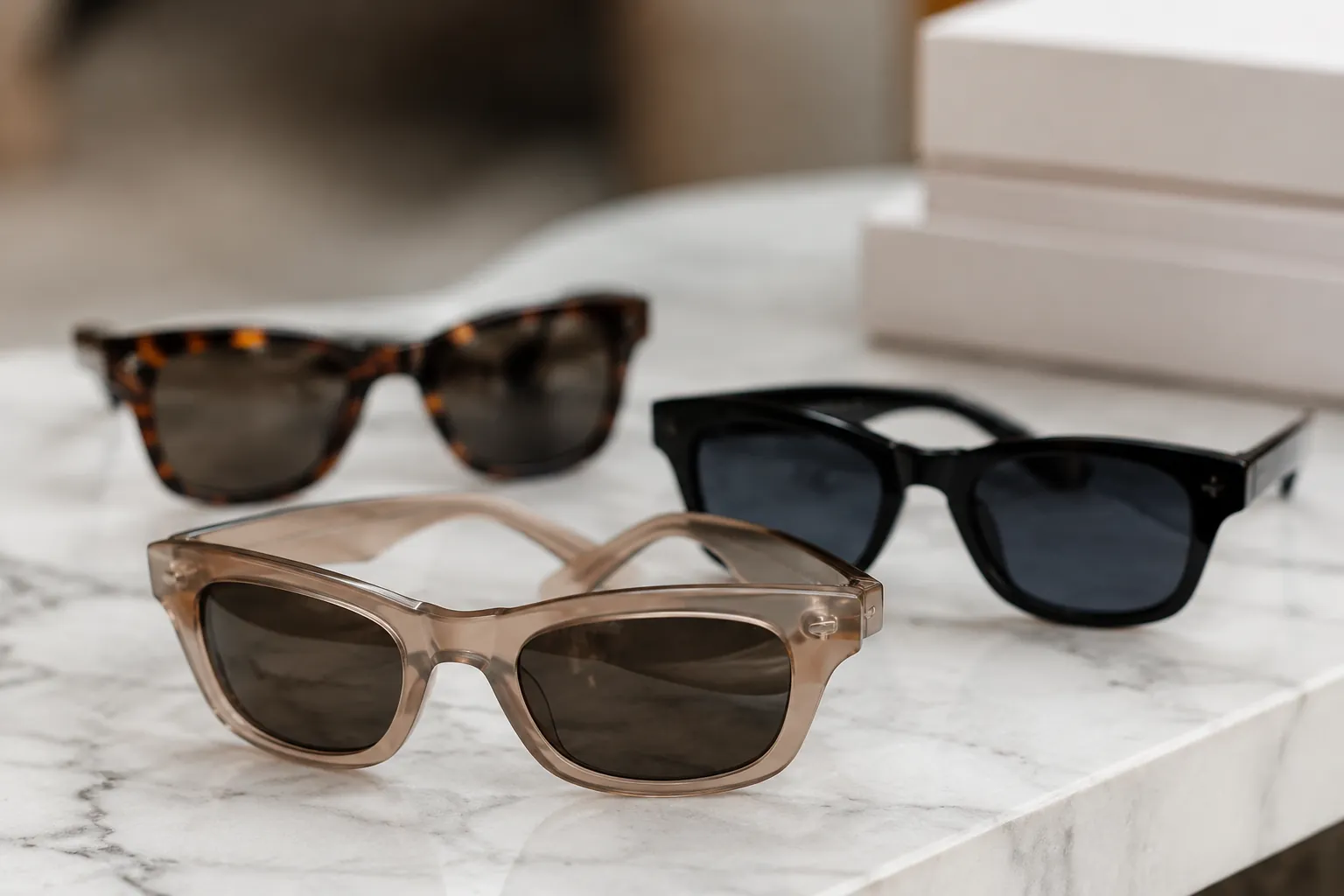
This guide is for brand owners, importers, distributors, and retailers buying custom sunglasses in volume. The goal is simple: build a branding system that stays consistent across frame, lens, pouch or case, box, and shipping carton without losing control of tooling, setup cost, unit cost, or approvals. Do not brand every possible surface. Set the hierarchy early, and reviews get faster, artwork changes drop, and the factory works from one approved standard instead of scattered instructions.
Start with a branding hierarchy, not a logo dump
Many branding problems start before sampling. A buyer sends one AI or PDF logo file and asks the factory to place it on the outer temple, inner temple, lens, hinge plate, pouch, box, cloth, hangtag, and carton. That usually creates three problems at once: a crowded result, more setup charges, and more approval points.
Start elsewhere. Rank each touchpoint by customer visibility, decoration cost, and technical risk. In many sunglass programs, the best result comes from one hero application plus one supporting packaging application, not from repeating a small logo everywhere.
- Primary branding: outer temple logo, pouch or case logo, front panel of retail box.
- Secondary branding: inner temple print, small lens mark, cleaning cloth, side label on box.
- Technical marking: size, material, model code, origin, barcode, carton mark, and market-specific compliance or traceability text.
For example, a mid-tier private-label program may use an outer temple logo, a one-color pouch print, and a sticker label on a standard folding carton. That is often enough. It looks coordinated without adding lens printing, custom rigid boxes, and extra logo tools all at once.
If you are launching multiple SKUs, set the branding rules at range level, not style level. Keep logo position, maximum logo size, print color logic, pouch construction, barcode panel, and carton label format consistent across the line. Then vary only the SKU details, such as frame color, lens tint, or lens category. The range looks tighter in distributor catalogs, retail displays, and ecommerce listings.
Use a simple filter. Is the branded point visible in normal handling? Does it support brand recognition or required product information? If not, it probably does not justify more setup, inspection, and rework risk.
Match each surface to the right branding method
Not every material behaves the same way. A logo that looks crisp on a flat acetate temple may fail on a curved TR90 sports frame or a textured EVA case. Pick the wrong method and you get weak adhesion, poor alignment, or lot-to-lot variation.
| Surface | Best methods | Typical setup range | Main trade-off |
|---|---|---|---|
| Injection-molded TR or PC frame | Pad printing, laser engraving, metal logo plate | Low to medium | Pad print is economical, but abrasion resistance is usually lower than engraving or a fixed plate |
| Acetate frame | Laser engraving, hot foil, inset metal logo, inner print | Medium to high | Premium look, but more handwork and tighter alignment control are usually required |
| Lens | Laser mark, corner print | Low | Subtle branding works best; oversized marks can affect appearance and user acceptance |
| Pouch or case | Screen print, deboss, foil stamp | Low to medium | Decoration is visible to buyers, but print quality depends on fabric grain or shell texture |
| Retail box | One-color print, CMYK print, label sticker | Low to high | Custom packaging can improve presentation but usually increases MOQ and inventory complexity |
On molded frames, pad printing is still common because it works on curved temples and usually stays cost-efficient in volume. But the artwork often needs adjustment. Very fine lines or reversed details that look clear in the original vector file may not print cleanly on a small curved part. Do not assume one logo file works everywhere. Ask for a production-ready artwork check for each application.
Laser engraving can be more durable than surface print, but the effect depends on substrate, color, and finish. On matte black TR90, contrast may be subtle. On glossy acetate, the same engraving may read as more decorative. Metal logo plates can create stronger shelf presence, but they add another component, another assembly step, and another QC point for left-right symmetry and plate angle.
Packaging has the same issue. Fine one-color print can look sharp on smooth PU pouch material and soft on coarse woven fabric. Debossing can read well on a PU-wrapped EVA case, but small letters may lose definition. Get substrate-specific artwork adaptation and a real sample on the intended material before approval.
Build cost tiers before sampling starts
You do not need premium branding on every part to create a strong retail impression. Buyers often overspend on hidden areas such as inner temple print or extra inserts while underinvesting in the parts customers actually notice first: the outer temple, the pouch or case, and the front of the box.
Set three branding tiers before you request samples.
- Base tier: one-color outer temple print, standard microfiber pouch with one-color logo, standard export carton label.
- Mid tier: laser or engraved temple branding, upgraded pouch or folding case, printed retail box with barcode panel.
- High tier: metal logo plate, small lens mark, rigid or custom-molded case, branded inserts, and more detailed retail presentation.
This helps you spend by sales channel. For a price-sensitive retail chain, visible frame branding plus standard packaging with a label may be enough. For a gift set, ecommerce launch, or boutique program, upgrading the pouch or box often changes perceived value more than adding another hidden logo.
MOQ and volume breakpoints matter because branding cost has two parts: setup cost and unit cost. On smaller runs, simple temple print and stock packaging are often the practical choice because fixed charges carry more weight. As volume rises, more durable branding methods or upgraded packaging become easier to justify because the setup cost spreads across more units. There is no universal break-even point. Ask for a side-by-side quote.
Also separate unit cost from program cost. A packaging upgrade may raise cost per set but cut relabeling, improve presentation, or simplify retail compliance. A lens logo may add cost without adding recognition. Ask the harder question: does this branding element create enough value to justify its setup, handling, and QC burden?
Set measurable logo specs before artwork approval
Factories can print or engrave the file you send. That is not enough. Production-safe branding needs measurable rules. A short specification sheet for each touchpoint reduces disputes because QC can inspect against dimensions and approved references, not opinion.
At minimum, define the following for every visible branding point:
- Temple logo: distance from hinge, maximum length, maximum height, approved color reference, and any minimum line thickness required by the chosen method.
- Lens mark: corner location, width, distance from outer edge, and whether the mark must remain outside the main sight line.
- Inner temple text: model code, size, material, origin text, and market-specific content order.
- Pouch and box: print area, substrate color, logo scale, and barcode panel size.
- Carton mark: SKU layout, quantity per carton, gross weight target, destination code, and shipping mark format.
For visible parts, agree tolerances during sampling and write them into the approval record. Tolerance depends on the decoration method, substrate stability, and product position. Do not rely on generic assumptions. Ask the supplier what is repeatable in bulk for each application, then approve against that written standard.
Lens marks usually work better when they stay small and consistent. Large or high-contrast lens logos can look overly promotional and may not fit every channel or style. Check the mark on the real lens color and finish. Visibility can change a lot between smoke, mirror, gradient, and other tints.
Approve from a full branded sample set, not isolated parts. Review the frame, pouch, box, and carton label together. If you approve them one by one, mismatch in logo scale, color perception, and branding hierarchy becomes much more likely.
Keep compliance marks separate from brand marks
Branding and compliance do different jobs. Keep them separate. A customer-facing logo is a marketing element. A compliance statement or technical mark is controlled product information. Mix them together and you raise the risk of incorrect claims, bad packaging copy, or unnecessary frame variations by market.
Depending on destination, sunglasses may need to align with standards such as CE EN ISO 12312-1, ANSI Z80.3, or AS/NZS 1067. Chemical control requirements may also involve REACH or buyer-specific restricted substance rules. If a program is sold in the United States and classified in a way that requires it, buyers may also need to confirm the supplier's FDA registration status and related documents. Management-system or social-audit credentials such as ISO 9001 and BSCI can support supplier qualification, but they do not replace product-level compliance.
The operating rule is straightforward:
- put brand identity on the outside of the product set,
- put traceability and technical text where warehouse, customs, and QC teams need it,
- localize labels and inserts instead of changing frame print for every market unless the market specifically requires product-level marking changes.
In many programs, the outer temple or case carries the visible brand, the inner temple carries model and origin information, the retail box or sticker carries barcode and local-language details, and the master carton carries shipping marks. This structure reduces artwork errors and makes multi-market planning easier.
If the same base style ships to several regions, it is often more efficient to keep one universal frame-branding specification and change only the box label, paper insert, or outer carton mark where legally allowed. Reprinting or retooling the frame for each destination increases the chance of mixed inventory and slower replenishment.
Plan backward from sampling, packaging, and bulk lead time
Branding systems often fail on timing, not design. A buyer approves the frame first, then changes the box artwork, then upgrades the pouch material after frame production starts. The sunglasses may be ready. Final packing is not.
Use one approval path with fixed gates. A workable timeline for many OEM sunglass programs is:
- Initial brief: confirm frame material, lens color, logo positions, packaging level, destination market, and barcode requirements.
- Pre-production sample review: review all visible branding points together, including frame, pouch or case, box, and label layout.
- Artwork freeze: lock artwork files, color references, carton mark, and packing sequence before bulk starts.
- Bulk production: compare production against one signed golden sample and one approved pack specification.
This order matters because the critical path is not always the sunglasses themselves. Frames may finish before custom paper packaging, hot-foil boxes, EVA cases, or outsourced inserts. Small programs are especially exposed because packaging suppliers often work with separate MOQs, lead times, and sampling schedules.
Ask early whether the packaging is stock-based, print-on-stock, or fully custom. A standard folding box with a sticker usually moves faster than a rigid magnetic box with foil and inserts. If the launch date is tight, the simplest protection is often to keep frame branding fixed and simplify the packaging structure before bulk starts.
Build one master pack spec that purchasing and QC both use
A branding system is not finished when design signs off. It is finished when sourcing, production, packing, and QC can work from the same document without guessing. That document should be a master pack specification, not just a folder of artwork files.
| Item | What to specify | Why it matters |
|---|---|---|
| Sunglasses | Style code, color code, logo method, logo position, lens color | Prevents mixed branding and wrong SKU assembly |
| Primary pack | Pouch or case type, material, logo position, insertion direction | Avoids wrong accessory pairing and handling marks |
| Retail box | Artwork version, barcode, label side, fold method, insert requirement | Reduces relabeling and repacking errors |
| Carton | Pairs per carton, carton size, shipping mark, destination code | Supports receiving, customs clearance, and warehouse accuracy |
At QC stage, branding should be treated as an inspection category, not as a matter of taste. Missing pouch print, wrong logo color, shifted plate, incorrect inner temple text, mixed carton labels, and wrong barcode placement should all appear on the checklist as defined fail points. If not, the factory will apply its own judgment. That is where avoidable misunderstandings start.
For repeat programs, the master pack spec should also record version control: artwork revision number, approval date, and which SKU families use the same packaging structure. That makes reorders faster because the buyer is not rebuilding the whole packaging logic each season.
Scale the branding system by order size, not by guesswork
The most efficient branding systems scale from small MOQ test orders to larger commercial runs without a full redesign each time. The priority is consistency first. Upgrades come later, when volume and channel economics support them.
For smaller runs: keep decoration simple. Use one-color temple print, a printed pouch, and sticker-based box labeling if retail information is needed. This controls setup charges, packaging MOQ exposure, and approval complexity.
For mid-volume runs: upgrade one visible element. In many cases, that means better temple branding or a stronger pouch or case. At this level, a metal logo plate or a more finished retail box may make sense if the sales channel supports the margin and the supplier can hold repeatable placement quality.
For larger runs: standardize the full system across the range. Fix logo placements, lock carton marks, use repeatable box dielines, and reduce unnecessary SKU-specific packaging changes. At this stage, savings often come less from cutting decoration and more from reducing variation, rework, and partial packaging holds.
The commercial point is blunt: do not maximize decoration. Maximize recognition per dollar spent. If the outer temple, pouch or case, and front of the box follow the same brand logic, you usually do not need extra logos on every component. Buyers who keep that discipline tend to get cleaner approvals, steadier production, fewer packing errors, and better margin control over the life of the program.
Have a custom sunglasses project in mind?
Send us your styles, target market and quantities and we will return a detailed quote with MOQ, lead time and a sample plan.
Get a QuoteWhy source this from Wenzhou with LumiShades
Wenzhou in Zhejiang Province is widely regarded as China’s eyewear manufacturing capital, producing a large share of the world’s sunglasses. That concentration matters to buyers: a deep local supply chain for acetate sheet, hinges, lens blanks, plating and packaging means shorter component lead times, easier color and material matching, and a workforce with decades of eyewear-specific skill. LumiShades has manufactured in this ecosystem since 2009, and our vertical integration — in-house injection molding, acetate cutting, CNC milling, lens tinting, decoration and quality control — means no part of your order is quietly subcontracted to a workshop you cannot audit.
For international buyers, that vertical control translates into accountability. When a single factory owns every step, defects are traced and fixed at source rather than bounced between vendors, and your specifications survive intact from first sample to bulk. We back this with 15+ years of experience, shipments to 60+ countries, more than 5 million pairs produced per year and a 98.5% on-time delivery rate. Our certifications — CE EN ISO 12312-1, FDA registration, ANSI Z80.3, AS/NZS 1067, REACH, ISO 9001 and BSCI audit — mean the compliance documentation your market requires already exists. Explore our manufacturing capabilities and quality control process to see how this works in practice.
Frequently asked questions
Should I put my logo on both lenses and both temples? Usually no. For most private-label programs, one visible outer temple logo is enough. Add a small lens mark only if it fits the product position, stays outside the main sight line, and reproduces clearly on the chosen lens color. Before approval, ask for a real sample on the exact lens tint and confirm three points in writing: mark size, location, and decoration method. If the lens mark does not improve recognition or channel value, leave it out.
What branding setup works best at a 50-pair MOQ? Keep it simple: one-color temple print, standard microfiber pouch with one-color logo, and carton or box labels instead of fully custom paper packaging. At this volume, fixed setup charges and packaging MOQs usually matter more than decoration variety. Ask the supplier to quote two options side by side: stock packaging with labels and custom packaging with print. Then compare total program cost, not just unit price.
How do I avoid color mismatch between frame branding and packaging? Approve one reference for each logo color and review all branded parts together during sampling. The same reference can look different on plastic, PU, fabric, and paper, so ask the supplier for material-specific strike-offs or pre-production samples. In the approval record, list the substrate, print method, and accepted visual standard for each part. Do not approve frame print and packaging color separately if they need to look coordinated at retail.
Can I use the same sunglasses for multiple markets with different compliance needs? Often yes, if the base product meets the required technical standard for each destination and the required labeling can be localized by market. First confirm which standard applies, such as CE EN ISO 12312-1, ANSI Z80.3, or AS/NZS 1067, and request the supporting test documents. Then check whether the market requires any product-level marking on the frame or whether box labels and inserts are enough. In many programs, the most efficient approach is to keep the frame branding universal and change only the retail label, insert, or carton mark where legally permitted.
What usually causes delays on branded sunglasses orders? The usual causes are late artwork approval, packaging changes after frame approval, incomplete barcode or carton-mark instructions, and custom boxes or cases with longer lead times than the eyewear itself. To cut risk, issue one complete branding brief at the start, review the full branded sample set together, and freeze frame, packaging, and carton artwork before bulk production begins. Also confirm whether packaging is stock-based, print-on-stock, or fully custom, because that often sets the real critical path.
Ready to start?
Explore our rimless sunglasses or request a quote — our sales team replies within 12 hours.
Request a Quote