
Injection, Acetate, or Metal: Pick for Margin and Risk
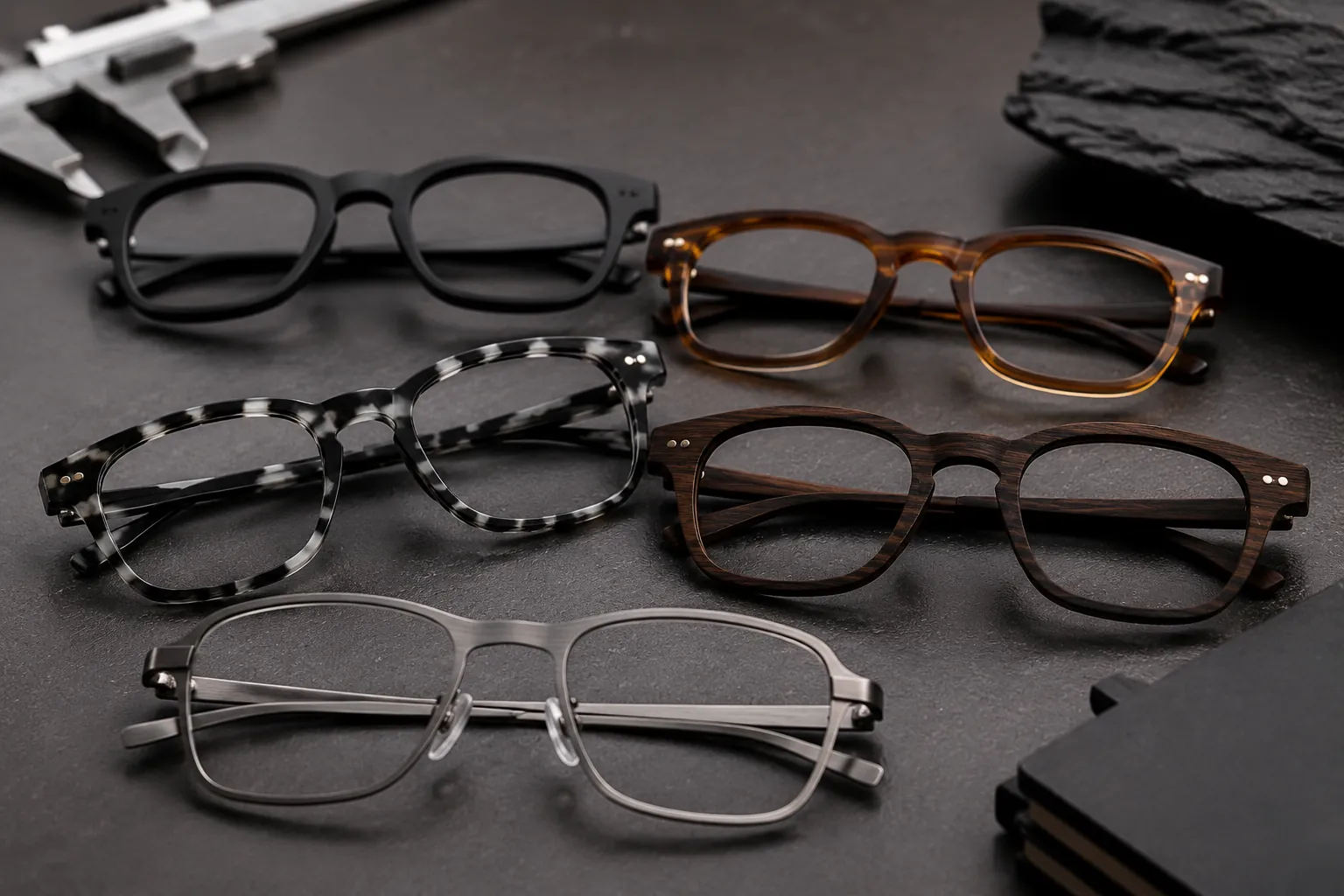
This guide is for buyers choosing frame material for private-label or OEM sunglasses. The real question is not which material sounds more premium. It is which one protects margin after unit cost, reject rate, returns, markdowns, and reorder speed are added up. Injection-molded, acetate, and metal frames can all make sense. They just carry different production and market risks. In practice, the right choice usually comes down to channel price point, design complexity, process control, and whether the material can support the intended retail position without creating avoidable claims.
Start with the channel, not the material
Bad material decisions often start with a sketch instead of a commercial brief. A beach kiosk, a chain retailer, a fashion DTC brand, an optical shop, and a corporate promo buyer are not buying the same risk. They need different ex-factory prices, different return tolerance, and different reorder speed.
Set the commercial brief first. Then pick the frame material:
- Low to mid retail, tourist, event, promo, convenience channels: injection-molded frames often fit best when cost control, color consistency, and repeatability matter most.
- Mid to premium fashion retail, optical boutiques, brand-led DTC: acetate often supports higher perceived value, richer color presentation, and stronger shelf impact.
- Minimalist fashion, slim silhouettes, lightweight unisex styles, sunglass-optical crossover: metal can be the right choice when thin profiles, low weight, and plated or painted finishes are central to the design.
Then test the numbers. A program with MOQ from 50 pairs per design can help test a new shape, logo placement, or colorway. It is not a sound model for annual margin planning. Buyers should request pricing at 50, 300, 1000, and 5000 pairs because labor efficiency, material buying, and line changeover loss can shift sharply across those volume bands.
Raw material rarely explains the full margin gap. Trim loss, hardware content, polishing labor, assembly time, and reject rate usually matter more.
A better buyer question is simple: which frame fits my channel at the lowest total commercial cost after claims, markdowns, and delayed repeats? Ask that first. It removes the wrong option fast.
Head-to-head: cost, lead time, durability, and margin
| Frame type | Typical commercial use | Cost position | Durability profile | Decoration and finish | Lead-time notes |
|---|---|---|---|---|---|
| Injection-molded | High-volume retail, promo, entry price points | Usually the lowest-cost option at higher volumes, depending on resin, lens, hardware, and decoration | Often good impact resistance for the price; hinge area, front warp, and lens-fit consistency must be controlled | Good color repeatability; commonly supports pad print, heat transfer, laser marking, and simple metal logo parts | Often the fastest for repeat orders once tooling and specifications are fixed |
| Acetate | Fashion retail, premium private label, boutique programs | Usually higher material and labor cost because of sheet processing, machining, polishing, and hand finishing | Strong perceived quality and rigidity; can chip, scratch, or warp if conditioning and finishing are weak | Well suited to depth of color, lamination effects, bevels, polished edges, and embedded logo details | New-style development and finishing are usually less forgiving because more manual steps are involved |
| Metal | Lightweight fashion, slim silhouettes, optical-inspired sunglass lines | Varies widely with alloy, plating or paint system, nose pad construction, and assembly complexity | Can deform under load; alignment, coating wear, corrosion resistance, and screw security are critical | Well suited to thin profiles, plated or painted finishes, engraved details, and welded or assembled logo parts | Approval cycles can be longer when finish, fit, and alignment standards are strict |
For straightforward unit margin at entry to lower-mid price points, injection often has the clearest edge. If the target shelf price is tight, acetate can add cost the channel will not recover.
For perceived-value margin, acetate can beat injection if the retailer or brand can support a higher retail with better color depth, finish, and presentation. That is the key test. Can retail move up faster than manufacturing cost?
Metal sits between the two. It can look refined and feel light. But it is less forgiving. If welding, plating, paint adhesion, or alignment control slips, the premium impression disappears and rework shows up fast.
How the process drives consistency
Material choice is process choice. Buyers should know the production route because the route usually determines consistency more than the sketch does.
Injection-molded frames depend on mold accuracy, resin flow, cooling balance, and hinge insertion or assembly. Typical controls include shot stability, mold temperature, cooling time, and post-ejection deformation checks. If those controls drift, factories can see front warp, inconsistent lens groove dimensions, or temple spread variation. That affects lens fit and frame alignment. The main advantage is repeatability. Once tooling and process windows are stable, large-volume consistency is often easier to hold.
Acetate frames commonly involve sheet cutting, CNC milling, beveling, polishing, hinge setting, and hand finishing. More steps mean more variation points. Buyers choose acetate for visual depth and tactile quality, but the process usually brings higher trim loss and more labor per frame. Sheet quality, lamination consistency, and conditioning time matter. If sheets are not stabilized before machining and finishing, fronts and temples can move after assembly.
Metal frames usually rely on stamping or wire forming, welding or brazing, polishing, plating or paint, and final assembly. The hidden issue is tolerance stack-up. A small deviation at the bridge, end piece, or hinge can turn into visible skew at final inspection. That is why metal buyers should watch alignment standards, weld integrity, finish thickness, and screw torque consistency closely.
Factories with more in-house processes often react faster when rework is needed because components are not moving through as many outside stages. That matters for sample-to-bulk matching too. One common complaint is simple: the approved sample is built slowly by senior technicians, while bulk follows a different route and pace. Buyers should ask whether sample and bulk production are materially the same.
Failure modes buyers actually pay for
Ex-factory price is only part of the cost. Returns, claims, and markdowns usually come from a short list of repeat failures:
- Injection: stress whitening near hinges, front warpage after heat exposure, logo adhesion failure, and lens-fit variation caused by inconsistent groove dimensions.
- Acetate: front-to-temple color mismatch, surface scratching from weak polishing control, hinge pull-out, and warpage if conditioning is rushed.
- Metal: plating wear at contact points, paint chipping at edges, bent temples, loose screws, unstable nose pads, and corrosion in high-sweat use conditions.
Good suppliers try to prevent these issues during production, not just sort them at final inspection. Buyers should ask what the critical checkpoints are, how they are measured, and how often they are recorded.
Useful examples include:
- Lens groove dimension checks before glazing, especially on injection fronts.
- Hinge retention checks after hinge insertion or setting.
- Temple opening and closing cycle checks to catch screw loosening or hinge fatigue.
- Alignment inspection before packing, not only during final audit.
- Print adhesion or abrasion testing after logo application.
- Salt-spray or sweat-related finish checks for plated or painted metal frames.
Small defect-rate differences matter. A frame with a lower unit price can still be the more expensive buy if it creates more replacement freight, customer service load, or retail markdown pressure.
Margin math by price tier
The material decision gets easier once it is tied to selling price and channel expectations.
Entry retail: if the channel needs a low ticket, broad color range, and fast replenishment, injection is often the practical choice. But not every injection style belongs in the lowest-cost band. Mirrored lenses, spring hinges, embedded logo parts, rubberized coatings, upgraded packaging, or complex geometry can narrow the cost advantage quickly.
Mid-market fashion: acetate often creates the strongest margin story when it supports a higher retail position more credibly than injection. Rich tortoise effects, crystal laminations, polished bevels, and thicker temples can raise perceived value in stores and online. If retail can absorb the step-up, acetate may generate stronger gross profit dollars despite higher unit cost.
Premium-lightweight segment: metal works when customers notice slimness, weight, and finish quality right away. But metal should not be chosen just to signal premium. If the product will be handled roughly in stores or worn in hot, wet, or high-sweat conditions, finish and deformation claims can cut into margin fast.
Volume breaks change the answer too. MOQ from 50 pairs per design is useful for pilot launches, influencer drops, or market tests. It should not be the only basis for annual forecasting. Serious planning should model 300, 1000, and 5000 pairs because line efficiency, yield, and raw-material buying often improve across those tiers.
The pilot is not the whole story. The reorder has to work too.
Lead time, MOQ, and design complexity: common traps
Lead time is often delayed less by factory capacity than by unresolved specifications. For standard custom programs, sample and bulk timing depends heavily on whether the drawing, color callout, lens category, logo method, and packaging spec are frozen early.
What usually slows the program down:
- Acetate lamination approvals and color matching across multiple sheet lots.
- Metal plating or paint approvals, especially for brushed, matte, or gold-tone finishes.
- Decoration changes after sample sign-off, particularly logo plate size, position, or temple artwork.
- Lens tint or mirror changes that affect performance category or supporting compliance documents.
- Mixed-material constructions that require multiple upstream processes before assembly.
MOQ also changes which material makes sense. A 50-pair acetate test can be valid for a boutique capsule because the higher retail may absorb the cost. The same 50-pair run in an entry-price channel can create the wrong cost base and lead to the wrong decision. By contrast, if the forecast is several thousand pairs, a clean injection program often benefits from lower repeat cost and easier replenishment.
Design complexity is another trap. A simple frame with stable geometry and one decoration method often makes more money than a technically ambitious frame with mixed materials, decorative hardware, mirrored lenses, and layered finishes. Every extra operation adds assembly time, reject risk, and more chances for sample-to-bulk mismatch.
Compliance is not optional
Sunglasses are not bought on frame material alone. Lens performance, labeling, chemical compliance, and market-specific documents must match the destination market and the exact product build. The standards and systems buyers commonly ask about are specific: CE EN ISO 12312-1, ANSI Z80.3, AS/NZS 1067, REACH, FDA registration where relevant, ISO 9001, and BSCI.
Buyers should verify:
- CE EN ISO 12312-1: commonly requested for non-prescription sunglasses sold into markets using this framework, covering performance and labeling requirements.
- ANSI Z80.3: commonly referenced for non-prescription sunglasses intended for the US market.
- AS/NZS 1067: relevant for Australia and New Zealand market requirements.
- REACH: important for chemical-substance compliance affecting frame materials, coatings, inks, and finishes sold into Europe.
- FDA registration: may be requested in the US context depending on product classification and import documentation needs; buyers should confirm the exact requirement for their program.
- ISO 9001: indicates a documented quality-management system, but it is not a substitute for product-specific test reports.
- BSCI: relates to social compliance expectations, not product performance or safety compliance.
Material and finish changes can affect compliance status. A new mirror coating, darker lens tint, different soft-touch coating, or new metal plating system may require updated documents or testing. Do not assume one approved sample covers every colorway forever. The paperwork should match the exact construction being purchased.
A practical decision framework buyers can use now
- Set the channel economics first. Write down target retail price, planned markdown rate, target gross margin, and acceptable return rate.
- Choose the material that fits that model. Injection for cost control and repeatability, acetate for stronger visual value, metal for slim lightweight styling.
- Quote multiple volume tiers. Request pricing at 50, 300, 1000, and 5000 pairs so the pilot does not distort the long-term decision.
- Reduce avoidable complexity. Every extra finish, logo process, hardware part, or mixed-material joint adds cost and reject risk.
- Ask for process-specific QC controls. Hinge retention, alignment, lens fit, abrasion resistance, plating wear, and color control are more useful than generic inspection claims.
- Verify compliance against the exact build. Match lens tint, mirror, coatings, materials, and destination-market documents before bulk approval.
- Use samples to test failure points, not just appearance. Check heat exposure, opening cycles, print abrasion, coating wear, and packing resistance before sign-off.
If the channel is broad and price-sensitive, start with injection. If the brand needs a stronger premium impression at retail, start with acetate. If the style depends on a thin, light silhouette, consider metal but budget tighter control for finish durability, screw security, and alignment. That sequence is often the most disciplined way to frame the decision.
Have a custom sunglasses project in mind?
Send us your styles, target market and quantities and we will return a detailed quote with MOQ, lead time and a sample plan.
Get a QuoteWhy source this from Wenzhou with LumiShades
Wenzhou in Zhejiang Province is widely regarded as China’s eyewear manufacturing capital, producing a large share of the world’s sunglasses. That concentration matters to buyers: a deep local supply chain for acetate sheet, hinges, lens blanks, plating and packaging means shorter component lead times, easier color and material matching, and a workforce with decades of eyewear-specific skill. LumiShades has manufactured in this ecosystem since 2009, and our vertical integration — in-house injection molding, acetate cutting, CNC milling, lens tinting, decoration and quality control — means no part of your order is quietly subcontracted to a workshop you cannot audit.
For international buyers, that vertical control translates into accountability. When a single factory owns every step, defects are traced and fixed at source rather than bounced between vendors, and your specifications survive intact from first sample to bulk. We back this with 15+ years of experience, shipments to 60+ countries, more than 5 million pairs produced per year and a 98.5% on-time delivery rate. Our certifications — CE EN ISO 12312-1, FDA registration, ANSI Z80.3, AS/NZS 1067, REACH, ISO 9001 and BSCI audit — mean the compliance documentation your market requires already exists. Explore our manufacturing capabilities and quality control process to see how this works in practice.
Frequently asked questions
Which material usually gives the best gross margin for entry-price sunglasses? Injection-molded frames are often the strongest starting point for entry-price programs because they can offer lower unit cost, good repeatability, and faster replenishment once tooling and specifications are stable. To judge margin properly, ask the supplier to quote the same style at 50, 300, 1000, and 5000 pairs with the same lens, logo, and packaging spec. Then compare not only ex-factory price, but also reject risk, replacement exposure, and reorder speed for your channel.
Is acetate always more durable than injection-molded plastic? No. Acetate often feels more premium and rigid, but that does not make it automatically more durable in use. It can chip, scratch, or warp if sheet quality, conditioning, polishing, or hinge setting are poorly controlled. Injection frames may perform better in impact-oriented entry-price programs. Buyers should ask for the exact frame construction, hinge method, and QC controls, then review samples for alignment stability, hinge security, surface resistance, and reaction to heat exposure.
How should I use a 50-pair MOQ without distorting my cost decision? Use a 50-pair MOQ to test shape acceptance, color response, branding placement, packaging, and early sell-through feedback. Do not use it as the only basis for annual margin planning. At the same time, request pricing and lead times at 300, 1000, and 5000 pairs for the same build, and ask which cost elements change with scale, such as labor efficiency, decoration setup, and material buying. That shows whether the pilot can scale commercially, not just whether the sample looks good.
What lead times are realistic for custom sunglasses? Lead times depend on the process route and how complete the specification package is. For standard programs, buyers should ask the factory for separate timelines for sampling, sample revision, bulk production, and compliance-document preparation. Timing usually extends when acetate color matching is not frozen, when metal finish approvals are still open, when logo details change after sample sign-off, or when lens tint and mirror specifications are revised late. The practical step is to lock drawing, color, lens category, decoration method, and packaging before requesting a final production calendar.
What compliance documents should I ask for before placing bulk orders? Ask for documents that match both your destination market and the exact build you are ordering. Depending on the program, that may include CE EN ISO 12312-1, ANSI Z80.3, AS/NZS 1067, REACH-related support, and FDA registration information where relevant. Also request confirmation that the documents correspond to the actual lens tint, mirror or coating, frame material, and finish in the approved bulk version. If the factory cites ISO 9001 or BSCI, treat those as supporting system credentials, not replacements for product-specific compliance evidence.
Ready to start?
Explore our aviator sunglasses or request a quote — our sales team replies within 12 hours.
Request a Quote