
How to Audit a Sunglasses Factory Before Peak Season
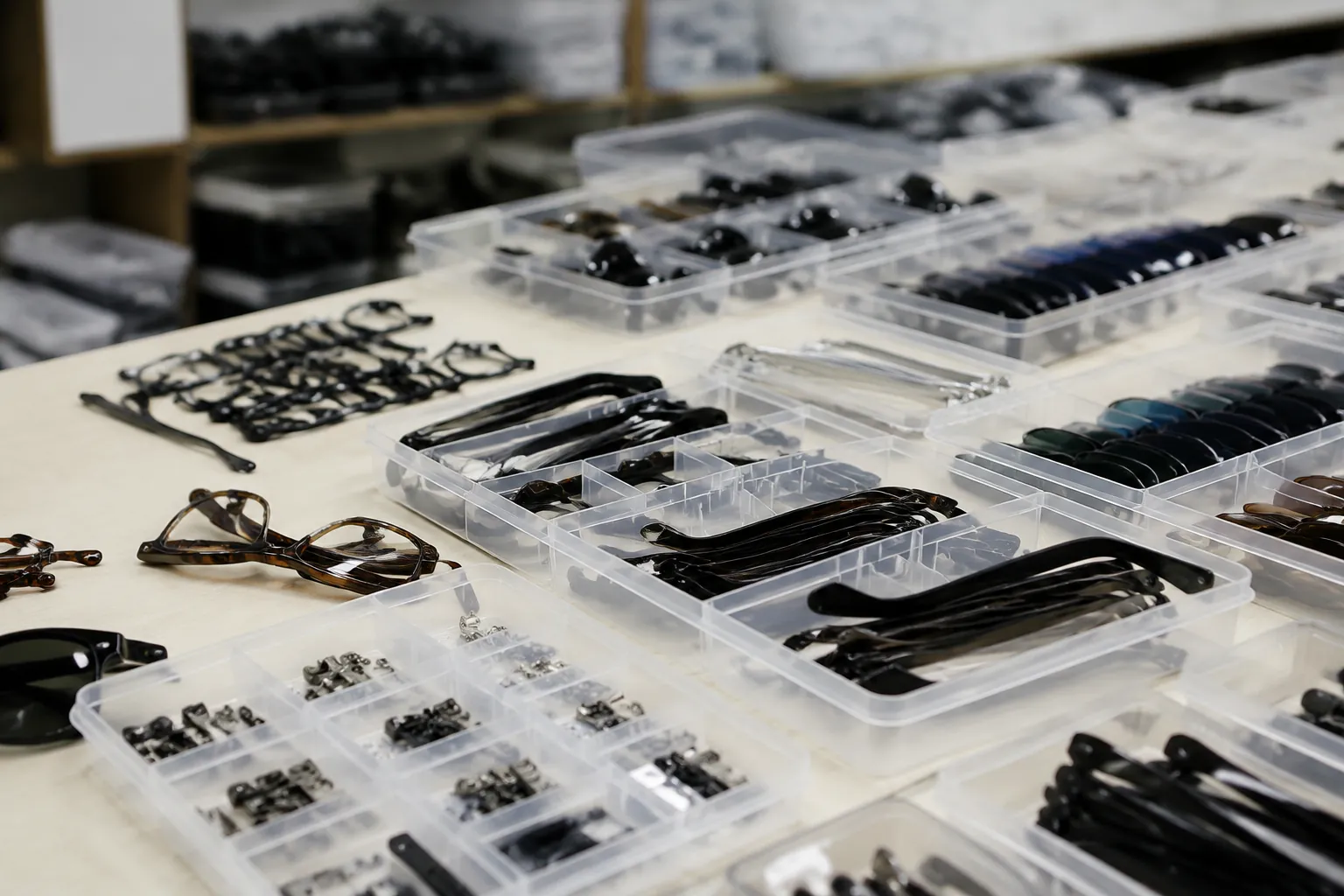
This guide is for brand owners, importers, distributors, and retail buyers placing custom sunglasses orders before peak season. The goal is simple: verify whether a factory can hold your lead time, run multiple styles at once, and keep quality stable as volume rises. Big output claims are not enough. A supplier can quote impressive annual capacity and still miss your ship date because one department is overloaded, one lens color needs repeated approval, or one branding step is stuck behind other orders. Check the production path style by style, process by process, and date by date.
Start with the bottleneck, not the annual capacity claim
Annual capacity claims are background information. Useful, but not decisive. They do not tell you whether your order can move through the limiting process during your shipping window. Sunglasses production is a chain of separate operations: frame forming, trimming or CNC machining, tumbling, hand polishing, lens cutting or tinting, decoration, assembly, inspection, and packing. The slowest constrained step sets the real delivery promise.
For custom sunglasses, the better question is not How many pairs can you make in a year? It is How many pairs of my exact style can you move through the constrained process per day or per week in the month I need to ship? That answer should be tied to machine count, shift pattern, setup time, yield, and rework rate.
In-house coverage can reduce handoff risk, but only if the relevant departments are available when your order is scheduled. A molded polycarbonate frame with a stock lens, one-color pad print, and standard packaging may move quickly. An acetate frame with hinge fitting, laser marking, gradient tint, and metal logo application usually touches more departments and uses more labor time.
- Injected styles: verify mold readiness, machine tonnage, cavity count, cycle time, and assembly staffing.
- Acetate styles: verify sheet availability, CNC spindle hours, tumbling capacity, hand-polish headcount, and hinge fitting yield.
- Complex branding: verify laser marking, pad print setup time, hot stamping, and metal logo application capacity.
- Multiple lens colors: verify tint batch control, recipe management, transmittance checks, and shade approval workflow.
Then ask one blunt question: which department is already heavily loaded in the month I need to ship? If one process is near full booking, even minor rework or one priority order can push your shipment back by days.
Map your order against the real production route
Serious buyers ask for a process map by style, not a brochure. Each SKU should be broken into main operations, internal handoff points, inspection gates, and outsourced steps, if any. This is one of the fastest ways to see where schedule risk sits.
A simple private-label run may follow this route: injection molded frame, gate trimming, lens cutting from stock material, single-color pad print, screw assembly, hinge torque check, cosmetic inspection, and packing. A fashion acetate style is slower and less forgiving: sheet cutting, rough shaping, CNC contouring, hinge slot milling, barrel tumbling, manual sanding, wheel polishing, lens edging, logo insertion, heating and adjustment, final inspection, and carton pack-out.
Ask the factory to split lead time by stage instead of quoting one total number. That matters. It lets you test whether the schedule reflects actual process time and queue time. A shorter lead time usually assumes stock raw material, approved artwork, standard packaging, a limited number of styles, and no tooling delays. A longer lead time often reflects extra decoration steps, more approvals, or several styles competing for the same departments.
Request a route card that covers at least these stages:
- Tooling, pattern, or counter-sample confirmation
- Raw material allocation and color confirmation
- Frame forming, cutting, or machining
- Lens production, edging, or tinting
- Logo or decoration process
- Assembly and adjustment
- QC, packing, and booking readiness
If the supplier cannot explain where a style waits, where it is measured, and where it can fail inspection, schedule control is probably weak. That is a risk before peak season.
Use order mix to test whether capacity is real
Factories can look strong on one repeat SKU and much weaker on mixed custom programs. Peak season exposes that fast. An order for 10,000 pairs of one molded style is operationally very different from 1,200 pairs split across six styles with different logos, lens categories, and cartons.
So test capacity using your actual order structure. Send a realistic purchase plan and ask the factory to respond by style, quantity, process route, and ship window. Ask what changes at 50, 300, 1,000, and 5,000 pairs. MOQ flexibility does not mean scheduling flexibility.
| Order Type | Main Risk | What To Verify | Typical Impact On Lead Time |
|---|---|---|---|
| 1 style, 5,000 injected frames | Molding slot availability | Mold readiness, machine schedule, cavity output, assembly line loading | Often the simplest schedule if resin and lenses are already available |
| 4 styles, 300 pairs each | Frequent changeovers | Artwork approval speed, print setup time, carton segregation, packing accuracy | Usually slower than a single-style run because setup loss is higher |
| 2 acetate styles, 1,000 pairs each | CNC and polishing bottlenecks | Sheet stock, spindle hours, tumbling queue, hand-polish headcount | Often slower than molded runs because more manual finishing is involved |
| Mixed styles with 3 lens tints | Lens color consistency | Tint batching, transmittance control, approval standard, rework handling | Can slip if shade approval or optical testing requires retesting |
Test price breaks against production logic too. A 50-pair order can carry high setup cost per unit and may need to wait for similar print, color, or packaging jobs. A 300-pair order is often easier to schedule because setup becomes more efficient. At 1,000 pairs and above, labor and machine planning may become more stable. The key question is whether the quoted price matches a credible route and a realistic ship window.
Audit the sample stage like a small production run
Samples show more than styling accuracy. They show whether the factory can interpret instructions, control revisions, and manage handoffs between departments. Treat the sample stage as a miniature production audit.
Use the sample process to judge discipline. Did the supplier confirm logo size in millimeters, temple position, hinge type, lens category, base curve, color reference, and packaging notes before starting? Did they provide intermediate updates when needed, or just one final image after everything was finished?
For sunglasses, ask for a sample record with measurable data: frame material, lens material, lens category, logo method, critical dimensions, and unit weight. Agree practical tolerances in writing before bulk production. Temple length and front width should follow the approved drawing tolerance. Lens insertion should be secure without visible stress whitening. Left-right logo placement should be consistent against an approved artwork position.
- Check opening and closing feel across all samples, not one selected piece.
- Measure lens fit and groove seating; loose or stressed lenses often become warranty claims.
- Review print, laser, or foil position consistency against a drawing.
- Ask what changed after your first comments and whether that change affects tooling or lead time.
- Confirm whether the approved sample becomes the sealed reference for bulk QC.
Many peak-season problems start here. If a factory spends days clarifying basic artwork or remaking avoidable errors during sampling, it is more likely to struggle when several buyers are requesting revisions at once.
Verify compliance and material control the practical way
Capacity without compliance is not usable capacity. If goods are stopped, returned, or reworked, the production advantage disappears. For sunglasses, buyers should verify which standards apply to the destination market and how those standards are maintained in routine production, not just supported by one old report.
Relevant documents may include CE EN ISO 12312-1, ANSI Z80.3, AS/NZS 1067, REACH, FDA registration, ISO 9001, and BSCI. The key is to tie each document to the exact product configuration and destination market.
Ask for the test scope linked to your product type. A fashion sunglass sold in the EU should be checked against the applicable parts of CE EN ISO 12312-1, including lens transmittance, UV performance, and category classification where relevant. US buyers often review ANSI Z80.3 and FDA registration records. REACH matters for restricted substances in plastics, coatings, paints, adhesives, and metal trims. If the lens tint recipe changes, if a new acetate supplier is introduced, or if an adhesive is substituted, you should know who approves the change and what needs to be rechecked.
Then look at incoming material control. Are lens lots checked against an approved transmittance range? Are acetate sheets traced by supplier batch? Are metal parts verified for finish adhesion or corrosion performance if those properties matter to the program? A serious factory should be able to show a traceable path from incoming inspection to in-process control to final release.
Check whether in-house processes really reduce risk
Buyers hear the phrase in-house all the time. In practice, it may mean one critical process is owned and several others are subcontracted nearby. That can still work. But you need clarity.
If a supplier claims in-house molding, acetate cutting, CNC milling, lens tinting, decoration, or QC, ask which operations are physically on site and which are handled by partner workshops. Then ask how orders move between those departments and how priority is set when two export orders need the same equipment.
Ask practical scheduling questions. Is work-in-progress tracked by style number, color, and due date? Is there a daily production meeting? How long does material typically wait between machining and polishing, or between tint approval and assembly? Who escalates a queue problem when one process falls behind plan?
A dependable factory can explain what is running before your order, what will run beside it, and what specific events could delay it.
Ask for examples from recent production. If a style needs acetate milling, tumbling, and logo insertion, where does rework usually occur? If pad printing rejects rise on certain finishes, how is that reflected in the schedule? Real capacity control is not a sales claim. It is scheduling discipline backed by records.
Use numbers that expose strain early
You do not need a full audit report to see whether a factory is stretched. A small set of operating numbers usually tells the story faster than a polished line tour. Focus on data that predicts late delivery or unstable quality.
- On-time delivery definition: ask whether the supplier measures ex-factory date, booking date, or customer requested ship date.
- Department output: ask daily or weekly capacity for molding, acetate machining, lens tinting, decoration, and assembly.
- WIP aging: ask how many orders are waiting between processes beyond the factory's internal target.
- Rework concentration: ask where defects most often occur: print position, lens fitting, color variance, hinge alignment, or polishing marks.
- Peak loading: ask what share of the relevant department capacity is already booked in the month you want to ship.
Now compare commercial terms with those numbers. If the factory offers aggressive pricing at 300, 1,000, or 5,000 pairs, ask whether the quote assumes one shipment, one packaging specification, one barcode set, and one inspection standard. Many delays are planning failures, not machine failures. Late insert-card changes, carton mark revisions, mixed-carton requests, or barcode updates after approval can force packing and final inspection to be repeated.
Finish with one direct question: What are the top three reasons this order could ship late if we confirm today? Strong suppliers usually answer with specifics such as material availability, lens tint approval, or decoration line loading. Weak suppliers tend to reply with generic reassurance.
A practical pre-peak decision checklist
Before placing the order, run a short gate review. This prevents a common sourcing mistake: approving a factory because the sample looked good and the sales response was fast, without testing whether the production floor can support repeat bulk orders under load.
- Confirm the production route for each style and mark every outsourced step.
- Identify the bottleneck process for your order mix: molding, CNC, lens tinting, decoration, polishing, or assembly.
- Match your requested ship date against that department's actual loading, not total factory capacity.
- Audit the sample stage for documentation, revision discipline, and consistency across multiple pieces.
- Verify market-specific compliance files and ask how material or process changes are controlled lot to lot.
- Review MOQ, price breaks, and lead-time logic together at 50, 300, 1,000, and 5,000 pairs.
- Ask what could delay the order today and who would escalate the issue internally.
If the supplier can answer these points clearly, with department detail and measurable controls, you are dealing with a manufacturer that understands its own process. If not, push for specifics early while you still have time to simplify the program, move the order, or add schedule protection.
Have a custom sunglasses project in mind?
Send us your styles, target market and quantities and we will return a detailed quote with MOQ, lead time and a sample plan.
Get a QuoteWhy source this from Wenzhou with LumiShades
Wenzhou in Zhejiang Province is widely regarded as China’s eyewear manufacturing capital, producing a large share of the world’s sunglasses. That concentration matters to buyers: a deep local supply chain for acetate sheet, hinges, lens blanks, plating and packaging means shorter component lead times, easier color and material matching, and a workforce with decades of eyewear-specific skill. LumiShades has manufactured in this ecosystem since 2009, and our vertical integration — in-house injection molding, acetate cutting, CNC milling, lens tinting, decoration and quality control — means no part of your order is quietly subcontracted to a workshop you cannot audit.
For international buyers, that vertical control translates into accountability. When a single factory owns every step, defects are traced and fixed at source rather than bounced between vendors, and your specifications survive intact from first sample to bulk. We back this with 15+ years of experience, shipments to 60+ countries, more than 5 million pairs produced per year and a 98.5% on-time delivery rate. Our certifications — CE EN ISO 12312-1, FDA registration, ANSI Z80.3, AS/NZS 1067, REACH, ISO 9001 and BSCI audit — mean the compliance documentation your market requires already exists. Explore our manufacturing capabilities and quality control process to see how this works in practice.
Frequently asked questions
What is the fastest way to tell if a sunglasses factory is overbooking peak season? Ask for department-level loading for your required ship month, not annual output and not a general promise. Request the booking status for the exact departments your order will use, such as molding, CNC, polishing, lens tinting, decoration, and assembly. Then compare that with your style route. If the supplier cannot explain which department is the current constraint, how many days of work are already queued there, and how your order would be slotted, treat the lead time as unverified.
Is a custom bulk lead time realistic for sunglasses before peak season? It can be, but only after the factory breaks the schedule into stages and confirms the assumptions behind it. Ask for separate timing for material allocation, frame production, lens processing, branding, assembly, QC, and packing. Then confirm whether the quote assumes stock raw materials, approved artwork, standard packaging, no tooling delays, and no outsourced bottleneck. A lead time is more credible when the supplier can show the route, the queue points, and the approval steps that could extend it.
Does low MOQ mean the factory has flexible capacity? No. Low MOQ mainly tells you the supplier is willing to accept a small order size. It does not prove that the factory can schedule mixed custom work efficiently. To verify flexibility, ask how lead time changes when you move from one style to multiple styles, from one logo method to several, or from one carton spec to mixed packing. Also ask whether small orders wait to be grouped with similar colors, print runs, or materials before production starts.
Which compliance documents should overseas buyers actually review? Review the documents that match both your destination market and your product configuration: CE EN ISO 12312-1 for applicable EU requirements, ANSI Z80.3 for the US market, AS/NZS 1067 for Australia and New Zealand, REACH for restricted substances, and FDA registration where relevant. ISO 9001 and BSCI can support broader system review, but they do not replace product-specific compliance. Ask for the latest reports or records tied to a comparable construction, lens type, and material set, and ask what triggers retesting when materials or processes change.
How can I use samples to judge bulk reliability? Use the sample phase as a controlled audit. Provide a clear tech pack, then check how the supplier handles clarification, revision tracking, and measurable output. Ask for recorded dimensions, material details, logo method, and lens category. Compare multiple sample pieces for lens fit, hinge feel, logo position, color consistency, and finishing quality. Finally, confirm whether the approved sample will be sealed as the bulk reference and whether any later change requires written reapproval. If the supplier cannot control details at sample stage, bulk consistency is at risk.
Ready to start?
Explore our aviator sunglasses or request a quote — our sales team replies within 12 hours.
Request a Quote