
How to Verify Sunglasses Factory Capacity
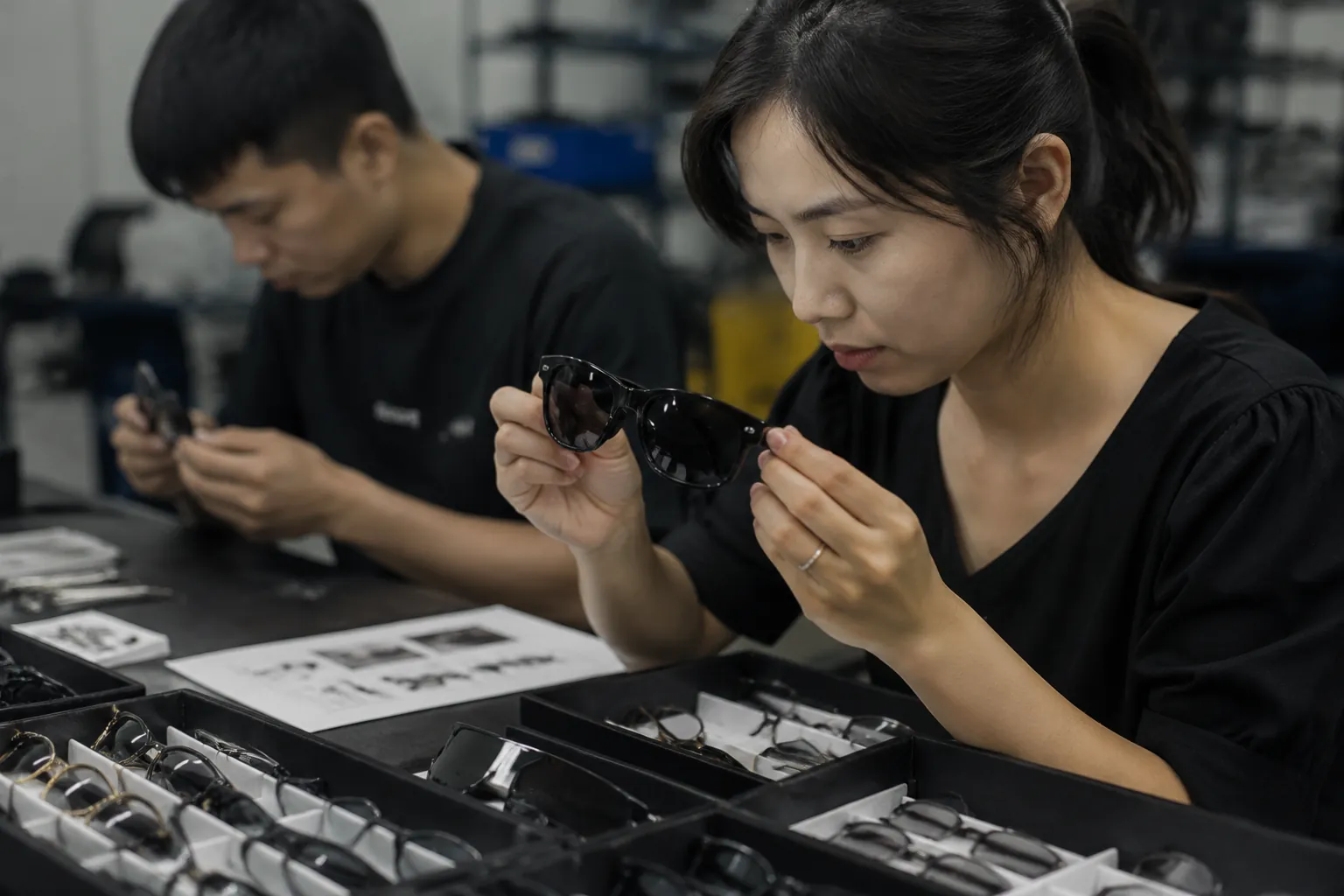
If you buy custom sunglasses in volume, a factory's claimed output is only useful if it survives an operational check. This guide is for brands, importers, distributors, and retailers that need to know what a sunglasses factory can actually ship each month before placing a larger order. The point is simple: do not overload a line that looks strong on paper but cannot hold lead time, color consistency, or defect control once volume rises.
Start With the Output Claim, Then Break It Apart
Ask the factory to state monthly output in pairs. Not "large capacity." Not "hundreds of thousands." A real answer uses numbers.
Then break that number down by product family, process route, and shift pattern. A factory reporting 5 million pairs per year across injected frames, acetate frames, and accessory assembly is not the same as a dedicated sunglasses line with in-house lens tinting and decoration. The better question is not "How much do you make?" It is "How many pairs of my exact build can you ship each month without overtime spikes, late sampling, or quality drift?"
Ask for the process map behind the number: injection molding, acetate cutting, CNC milling, lens tinting, logo decoration, assembly, in-line inspection, and final packing. Each handoff creates queue time. Each outsourced step adds risk. If shells are molded outside, lenses are sourced separately, and decoration is handled by a subcontractor, the factory's real monthly output is limited by the slowest outside party. Not by the size of the building.
Request three figures side by side: rated capacity, normal capacity, and actual shipment volume for the last 3 months. Rated capacity is the brochure number, usually based on ideal uptime. Normal capacity is what the plant can do with current labor and equipment. Actual shipment volume is what physically left the dock. If rated capacity is 500,000 pairs per month but recent shipments are 180,000 to 220,000 pairs, ask why. The gap may be seasonal. It may also mean the factory is counting output it cannot sustain.
Separate output by build complexity. A standard injected frame with a stock lens runs faster than an acetate frame with polishing, logo plate, custom tint, and retail packaging. Trimming, curing, sorting, and rework all add time. If the factory cannot distinguish those routes, its monthly output number is not good enough for a buying decision.
Buyer rule: if the factory cannot explain where each pair spends time, its monthly output claim is weak.
Check the Staffing Behind the Line
Output is a labor issue before it is a machine issue. A factory can own enough equipment and still miss volume because key stations are thinly staffed.
Ask for headcount by function: mold maintenance, injection operators, acetate cutting, polishing, lens tinting, printing or engraving, assembly, in-line QC, final QC, and packing. If one person is covering three stations, monthly output will swing as soon as the order mix changes.
The main bottlenecks in sunglasses production are not always obvious. Decoration often chokes the line, especially with pad printing, laser engraving, hot stamping, or metal logo plates. Pad print quality depends on ink viscosity, fixture accuracy, and drying time. A one-color logo may add little time per pair. Multi-position decoration with reprint checks can slow the line hard.
Laser engraving is cleaner, but it can still bottleneck if the machine is shared across several product families. Lens tinting can also slow flow when color matching is tight. Dark tints, mirrored coatings, and gradient tints may need different bath timing or coating parameters. Assembly is rarely the only issue. The queue before assembly and the rework after it are often the real constraint.
- Ask how many operators work per shift at each critical station.
- Ask which station runs overtime first when volume rises by 20%.
- Ask how many QC staff inspect incoming parts, in-process units, and final packed goods.
- Ask whether labor is fixed by line or shared across product families.
- Ask what happens when one decoration machine goes down for 4 hours.
Concrete staffing numbers matter. If a factory says it can make 300,000 pairs per month but has only 2 people in final QC across two shifts, that is a red flag. At high volume, even a small defect rate creates a large inspection and rework load.
A serious factory should be able to show staffing ratios, not just total headcount. If they need time to check internally, that is not proof of weakness. But press the point.
Use the Lead-Time Chain to Find Bottlenecks
Do not stop at "samples in 7–10 days" and "bulk in 25–35 days." Those ranges mean little unless you know what sits inside them.
Ask the factory to break lead time into sample development, raw material buying, production queue, processing, inspection, and packing. If bulk lead time is 25–35 days, find out whether 8 days are spent waiting for lens blanks, 5 days in decoration, 3 days in curing or coating, and 2 days in QC rework. That is the real capacity picture.
For custom sunglasses, lead-time risk usually sits in three places: lens availability, decoration complexity, and approval loops. Standard CR-39 or polycarbonate lenses are usually easier to source than a custom tint with exact color matching, mirrored finish, or special UV requirements. Acetate frames need more polishing and finishing time than many injection parts. A mixed-material frame with a metal logo plate, custom lens tint, and new packaging may require fixture changes, drying time, and extra inspection.
Material behavior matters too. Injection-grade polycarbonate can warp if the cooling cycle is rushed, which can affect temple or bridge fit. Acetate can look premium, but it is sensitive to polishing consistency and heat during storage. If the factory uses coating or tinting, ask how it checks batch consistency and shade tolerance. You are not looking for perfect claims. You are looking for a defined method: compare samples, record results, isolate out-of-spec lots, and correct the process.
| Order Type | Typical Capacity Risk | What to Verify | Buyer Signal |
|---|---|---|---|
| Standard injected frame + stock lens | Low to moderate | Line speed, QC pass rate, packing rate | Good for first scale-up |
| Injected frame + pad print / engraving | Moderate | Decoration loading, drying/curing time, rework rate | Check if decoration is in-house |
| Acetate frame + custom lens tint + logo plate | Higher | Changeover time, tint consistency, final inspection throughput | Ask for a weekly capacity plan |
| Multi-SKU private-label program | High | Changeover count, material queue, packing sequence | Expect longer lead time and higher MOQ efficiency pressure |
If the factory says every order takes 25–35 days regardless of complexity, be careful. That is usually a generic answer, not an operational one.
Ask for Proof, Not a Showroom Tour
Factory tours help, but they can mislead. A clean showroom does not prove output. A busy floor does not prove capacity. Ask for documents and floor evidence that connect to actual shipment volume.
- Monthly shipment summary for the last 6 months, grouped by product family and SKU count.
- Current work order list with quantities, due dates, line assignment, and station status.
- QC reports showing defect categories, first-pass yield, and rework rate.
- Machine list with model, age, uptime, and planned maintenance schedule.
- Staff roster by department, shift pattern, and overtime frequency.
For sunglasses factories, also check compliance handling. If a factory sells into Europe, the United States, Australia, or private-label retail programs, it should be able to show how its test and document flow maps to CE EN ISO 12312-1, ANSI Z80.3, AS/NZS 1067, REACH, FDA registration-related handling where applicable, ISO 9001, and BSCI where claimed.
Do not ask the factory to invent certifications. Do ask for current records for the ones it claims, including test reports, material declarations, batch traceability, certificate scope, and issue dates.
Dimensional control also affects output. If temple opening, hinge fit, lens groove depth, or bridge geometry drifts, assembly slows and rejects rise. A factory that tracks only final pass/fail without dimensional checks is missing a key part of capacity control.
If the supplier cannot show recent shipment logs, a current work-in-progress board, or a QC summary from the past month, treat the output claim as unverified.
Run a Capacity Math Check on Your Order
Before you scale, do the math from your side.
If the factory says MOQ is 50 pairs per design and price improves at 300, 1,000, and 5,000+ pairs, your question is not only price. It is whether the line can absorb your SKU count without wrecking batch efficiency. Ten designs at 300 pairs each are not the same as one design at 3,000 pairs. Setup time, labeling, pack-out, and QC sampling are spread very differently.
Use a simple formula: total monthly capacity minus current firm orders minus safety buffer equals realistic room for your program. The safety buffer matters. Good factories keep some slack for maintenance, defect correction, and urgent orders. If the factory says every line is booked solid, it may be genuinely busy. It may also be overcommitted. You need to know which.
Ask what percentage of capacity is committed by signed purchase orders and what percentage is only forecast. Forecast is not the same as booked production.
Price logic should tell you something about output. A meaningful price drop at 300, 1,000, and 5,000+ pairs usually reflects lower setup waste, better batching, steadier labor use, or more efficient packing. If a supplier cannot explain the changeover cost behind those tiers, the quote is incomplete. At scale, the cost driver is often not the frame shell. It is decoration time, sorting, packing, and QC rework.
- Estimate your split by color, lens tint, and logo method.
- Count changeovers, not just pair count.
- Ask whether packaging is line-fed or outsourced.
- Confirm whether samples and bulk run on the same equipment or separate teams.
- Ask how much time is lost per changeover, in minutes or hours.
Translate volume into labor hours. If one line can safely complete 1,200 pairs per shift with 8 operators, but your order needs 12 SKUs, the changeover burden may cut usable output far below the headline number. Cheap can become expensive once the real schedule is loaded.
Compare What Different Factory Types Can Handle
Not all eyewear suppliers scale the same way. Find out whether the supplier is a true manufacturer, a mixed assembler, or mainly a trading layer with some assembly. The difference shows up in control, speed, and how much volume the supplier can absorb without panic.
| Factory Type | Strength | Common Limit | Best For |
|---|---|---|---|
| In-house manufacturer | Better control over process, schedule, and quality | Capital tied up in equipment and staffing | Brand programs with repeat volume and tighter specs |
| Assembler with outside parts | Flexible on product mix and customization | Supplier delays on shells, lenses, or decoration | Simple orders with lower scale risk |
| Trading-led supplier | Can source a wide product range quickly | Weak visibility on actual capacity and process control | Low-MOQ tests, not heavy scale-up |
| Hybrid factory | Some in-house control with outside overflow | Capacity can vary by season and subcontractor load | Moderate growth if monitored closely |
In-house process stacks reduce external handoffs. Injection molding, acetate cutting, CNC milling, lens tinting, decoration, and QC under one roof usually mean fewer surprises. That does not make every order easy. It does make throughput easier to verify.
If a factory outsources shell production but keeps assembly in-house, real monthly output may depend on how those outside suppliers perform during the exact week your purchase order lands.
Still verify by product family. A factory may be strong in injected sunglasses and slow in complex acetate builds. It may handle standard private-label work well but struggle with premium decorative finishes. Ask the supplier to separate output by process, not by total pairs. If it cannot name its strongest and weakest lines, it probably does not manage capacity tightly enough for a major scale-up.
Red Flags That Usually Mean Capacity Is Inflated
Some signals repeat across weak capacity claims. If you see more than one, slow down.
- The factory answers every capacity question with the same round number.
- They give yearly output but cannot give monthly output by product family.
- They speak confidently about MOQ and price, but not about staffing or bottlenecks.
- QC is described as "strict," but defect data is not available.
- They promise short lead time on highly decorated orders without showing decoration scheduling.
- They cannot explain their overtime pattern or peak-season loading.
Another warning sign is a sharp price drop at 300, 1,000, and 5,000+ pairs with no clear explanation of what production constraint changes at each tier. Real scale pricing usually comes from better machine loading, lower setup waste, steadier labor use, and less handling. It does not come from nothing.
If the factory cannot tell you whether the savings come from batching, shared tooling, fewer color changes, or lower packing labor, the quote is not transparent enough for a serious buy.
Watch for answers that are too smooth. A real operator can usually tell you where the line struggles: color matching, lens sourcing, logo application, temperature-sensitive storage, hinge fit, or final inspection. If every answer sounds perfect, the output claim may be polished rather than real.
Lock These Details Before the Bigger PO
Once the output claim looks real, put the operational details in writing. Do not leave them in chat messages or side calls.
Lock the monthly target, delivery window, quality standard, inspection points, approval steps, and document requirements in the order file. If the product needs CE EN ISO 12312-1, ANSI Z80.3, AS/NZS 1067, REACH-related material control, FDA registration-related handling where applicable, ISO 9001, or BSCI, specify which documents must ship with each batch and which lot number they cover.
Before scaling, confirm three points. First, the factory has enough line space to absorb your forecast without pushing other orders into conflict. Second, the approved sample uses the same process path, fixtures, and QC criteria as bulk, or any differences are documented. Third, the factory can absorb a rework cycle without destroying the ship date.
That last point matters. A factory with a small rework rate can still perform if it has buffer time. A factory with no buffer is fragile.
Also lock the detail buyers often forget: packaging. If your order includes a pouch, cloth, barcode label, hangtag, and retail carton, confirm whether those items are line-fed or inserted separately. A simple packing sequence can add seconds per pair. Across 10,000 pairs, that becomes real labor and real time. The same applies to mixed cartons, mixed lens colors, and retailer-specific labeling.
The best supplier is not always the biggest factory. It is the one that can explain real monthly output in plain terms, show the constraint points, and hit the same number month after month.
Have a custom sunglasses project in mind?
Send us your styles, target market and quantities and we will return a detailed quote with MOQ, lead time and a sample plan.
Get a QuoteWhy source this from Wenzhou with LumiShades
Wenzhou in Zhejiang Province is widely regarded as China’s eyewear manufacturing capital, producing a large share of the world’s sunglasses. That concentration matters to buyers: a deep local supply chain for acetate sheet, hinges, lens blanks, plating and packaging means shorter component lead times, easier color and material matching, and a workforce with decades of eyewear-specific skill. LumiShades has manufactured in this ecosystem since 2009, and our vertical integration — in-house injection molding, acetate cutting, CNC milling, lens tinting, decoration and quality control — means no part of your order is quietly subcontracted to a workshop you cannot audit.
For international buyers, that vertical control translates into accountability. When a single factory owns every step, defects are traced and fixed at source rather than bounced between vendors, and your specifications survive intact from first sample to bulk. We back this with 15+ years of experience, shipments to 60+ countries, more than 5 million pairs produced per year and a 98.5% on-time delivery rate. Our certifications — CE EN ISO 12312-1, FDA registration, ANSI Z80.3, AS/NZS 1067, REACH, ISO 9001 and BSCI audit — mean the compliance documentation your market requires already exists. Explore our manufacturing capabilities and quality control process to see how this works in practice.
Frequently asked questions
What is the fastest way to check if a sunglasses factory's output is real? Ask for the last 3 months of shipment records by product family, current work orders, and staff count by station. Compare those records with claimed monthly capacity, shift count, and SKU mix. If the factory only gives annual totals or round numbers, treat the claim as unverified.
Should I trust yearly capacity figures? Not by themselves. Yearly numbers can hide seasonality, overtime, idle months, and subcontracted work. Monthly output by product family is more useful because it shows what the factory can ship now. Ask for monthly shipment totals, not only a capacity statement.
How do MOQ and volume pricing help me judge capacity? If price improves at 300, 1,000, and 5,000+ pairs, ask what operational change drives each step-down. Real pricing gains usually come from lower setup waste, better batching, steadier labor use, or simpler packing. If the supplier cannot connect pricing tiers to line setup or changeover work, the quote is incomplete.
What matters more for output: machines or labor? Both matter, but labor often limits sunglasses output first at decoration, QC, and packing. Machines without enough operators, fixtures, inspectors, and maintenance planning do not ship volume reliably. Ask for headcount by station and the shift pattern for each critical step.
Which certifications should a buyer verify for exported sunglasses? Verify only what the factory actually holds and can document: CE EN ISO 12312-1, ANSI Z80.3, AS/NZS 1067, REACH, FDA registration-related records where applicable, ISO 9001, and BSCI where claimed. Ask for the certificate or report, issue date, scope, and product family covered.
What lead time should I expect before scaling? There is no universal lead time. Ask the factory to break timing into sample development, material purchase, production queue, processing, inspection, and packing. A simple in-stock build should be faster than a highly decorated or multi-SKU program. The reliable answer is the factory's schedule for your exact build.
Ready to start?
Explore our cat-eye sunglasses or request a quote — our sales team replies within 12 hours.
Request a Quote