
Custom Temples, Hinges and Nose Pads for Premium Feel
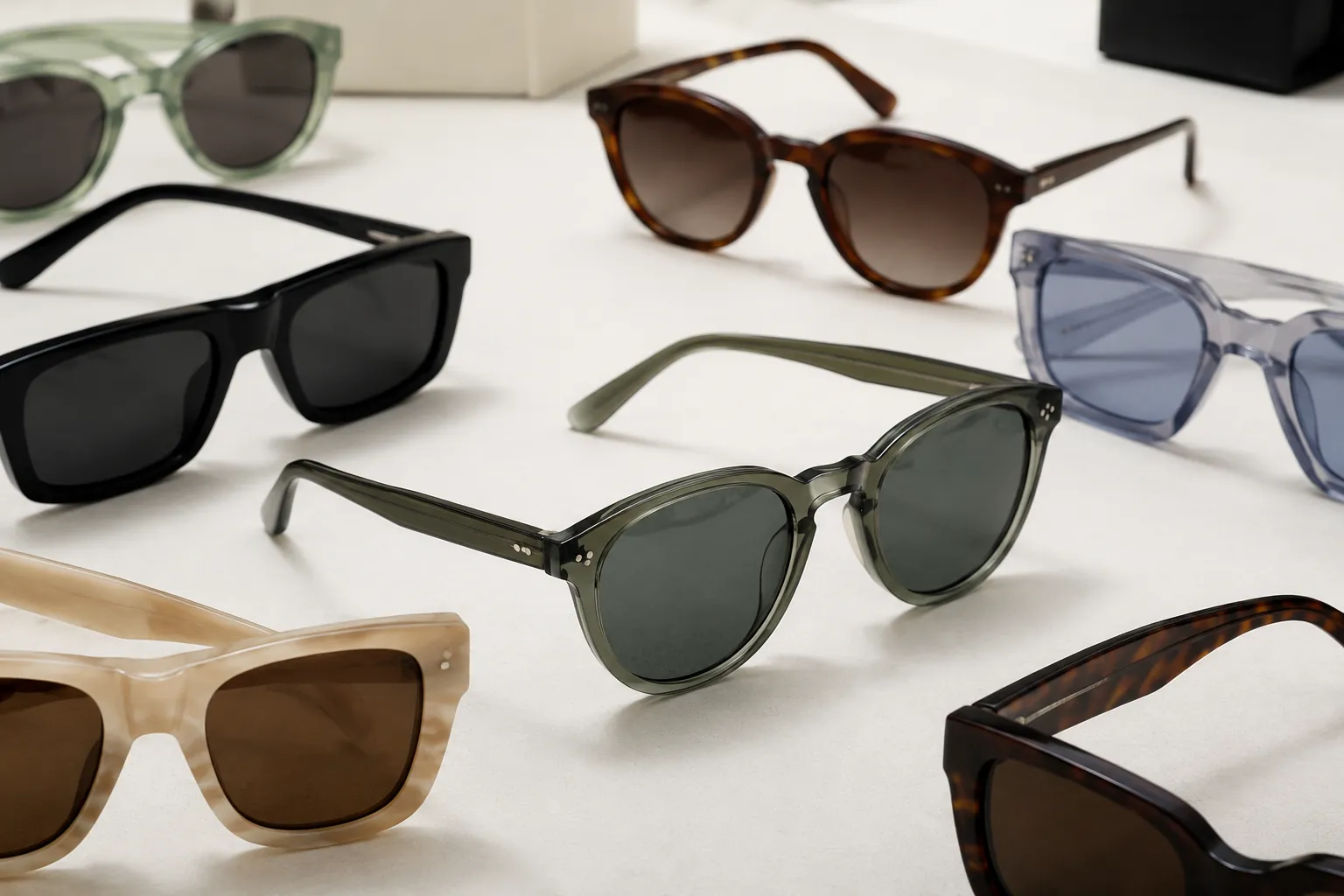
When you buy sunglasses in volume, the frame is judged by more than shape and lens color. Buyers notice the parts they touch first: temples, hinges, and nose pads. Those details affect fit, comfort, durability, and whether a product feels low-cost or worth a higher price point. This guide is for brands, importers, distributors, and retailers that want to improve perceived value without launching a full new frame platform.
Start with the parts buyers actually touch
Most private label sunglasses are sold on silhouette and lens color, then returned or discounted because the fit feels wrong. Hardware is where that problem becomes visible. A temple that flexes too much, a hinge that feels loose, or a nose pad that leaves a pressure mark can make a pair feel inexpensive even when the lens and frame material are acceptable.
For volume programs, the goal is not luxury theatrics. It is controlled feel. A good frame should open with consistent resistance, sit square on the face, and survive repeated handling in stores, during packing, and in transit. In practical terms, buyers should ask for hinge opening feel, left-right symmetry, and pad contact geometry early in development instead of waiting until the production sample.
At LumiShades, frame components can be handled through in-house processes such as injection molding, acetate cutting, CNC milling, lens tinting, and decoration. That lets a buyer revise a hardware specification without restarting the whole product line. In many programs, that is the difference between a small test order and a broader rollout.
A useful rule: if a defect is obvious by hand in a short inspection, it will usually show up later in returns, complaints, or markdowns. Hardware is not an accessory issue; it is part of fit and quality perception.
Temples: the quickest way to change how a frame feels
Temples do more than keep the frame on the head. Their thickness, curvature, end-tip shape, weight distribution, and surface finish affect the first impression immediately. A thin temple can look sleek but feel flimsy. A thicker temple can feel more substantial, but if the balance is off it may slide, rotate, or pinch behind the ear.
For custom sunglasses, common temple builds include injection molded, acetate, and mixed-material constructions. Injection molded temples usually offer tighter dimensional control and lower cost, especially when one tooling family supports several colorways. Acetate temples often provide a warmer hand feel and a stronger sense of value in fashion programs, but they depend heavily on polishing and edge finishing. Mixed-material temples with metal cores or inserts can improve stiffness and recovery, which helps on larger lens shapes or heavier front frames.
Temple specifications should be written in measurable terms. Ask for the length, the acceptable left-right match, and the target feel of the opening and closing action. Typical production expectations often include length tolerance within about ±0.5 mm and close side-to-side symmetry, but the supplier should confirm what is realistic for the chosen material and tooling. If the temple bend is too aggressive, pressure concentrates behind the ear; if it is too soft, the frame may shift forward when the wearer looks down.
Decoration also affects perceived value. Pad printing is economical for logos and linework, but it can wear faster on high-touch areas. Laser marking can provide a sharper and more durable result on suitable metal parts and coated components. Hot stamping can look polished on acetate, but registration must be clean because small misalignment is easy to see on a glossy surface. On textured finishes, matte or sand-blasted surfaces usually hide micro-scratches better than high gloss, especially after carton rubbing and warehouse handling.
If you want to move a style from entry-level pricing into a higher retail tier, temple design is one of the easiest places to add perceived value without adding a lot of part count. A slightly fuller profile, a better end-tip shape, and a finish that resists visible wear can make the product feel more deliberate. A polished temple can look strong in photography, while a well-controlled matte temple often holds up better after shipment.
One practical point: keep temple geometry stable across sizes if you want to reduce fit complaints. Small changes in wrap or down-angle can create noticeable pressure behind the ear. In sample approval, ask for side-view photos and a real wear check on different head widths. A short desk inspection is not enough.
Hinges: where low-cost hardware can undermine a premium program
Hinges are often the first place buyers notice whether a frame feels well made. A hinge that opens too easily can make a product feel disposable. A hinge that is too stiff can put stress on the front end-piece or temple attachment over time. Both issues create avoidable returns, replacements, or markdowns.
For sunglasses, the most common hinge options are standard metal hinges, spring hinges, and decorative reinforced hinges. Standard hinges are suitable for basic programs when screw fit and alignment are controlled. Spring hinges add comfort and some tolerance for wider heads, but they also increase part count, assembly time, and inspection points. Decorative hinges can raise perceived value, but only if plating, symmetry, and screw seating are consistent. Poor decorative hardware usually looks worse than no decoration.
Ask your supplier for a hinge specification, not just a photo. You need clear details: opening angle, pin or screw type, surface finish, and how the hinge is assembled and checked. A practical sample test is repeated manual opening and closing to confirm smooth action, no binding, and no visible shift in barrel alignment. The supplier should be able to describe the assembly and inspection steps used to control variation. If they cannot, expect batch inconsistency.
Material choice matters. Bare steel can provide strength but may corrode if surface protection is thin or damaged. Zinc alloy allows more decorative shapes at lower cost, but it depends heavily on tooling accuracy and finish quality. Stainless steel is usually a better choice when corrosion resistance matters. If your market includes humid storage conditions, coastal distribution, or heavy retail handling, poor plating is a common source of complaints.
Hinge finish should also match the brand position. Gloss finishes can look sharper in a display tray, while brushed or gunmetal finishes tend to hide small assembly differences. On custom programs, the hinge is a brand signal even when the customer does not consciously study it. They simply feel whether the frame opens cleanly and closes with control.
At LumiShades, hinge-related work can be coordinated with CNC milling and QC checks in the same production flow. That helps keep alignment under control and shortens the loop when a style needs a second sample round. The practical benefit is fewer reworks, less screw damage, and more repeatable sample-to-bulk output.
Nose pads: a small part that can decide fit and return rate
Nose pads are often overlooked because they are small and inexpensive. That is a mistake. They determine whether a frame sits high, slips down, or presses into the bridge. On heavier lens builds, that pressure is noticed quickly.
There are three common approaches, and each fits a different commercial goal. Integrated saddle bridges work well for lower-cost fashion frames and acetate styles where part count and assembly time should stay low. Silicone or soft pad arms are better for comfort and grip on metal frames. Adjustable metal pad arms are the most serviceable option and are usually the best choice when fit needs to be tuned across different face shapes or when a higher-priced program must feel adjustable.
Nose pad choice affects both tooling and QC. Fixed bridges require accurate front geometry in the mold or cut path. Adjustable pad arms need consistent arm angle, clean surface finishing, and secure pad fit. For premium programs, the left-right pad position should be closely matched so the frame sits level on a flat surface and on the face. If the bridge is uneven, customers notice it immediately.
Surface finish matters too. A slick pad may feel polished in a showroom but can slide during wear. A softer pad can improve grip but may collect dust more easily. Material hardness also changes performance. Softer compounds usually grip better at first, while firmer compounds are often easier to keep clean. The right choice depends on the bridge shape, frame weight, and the conditions where the product will be worn.
For export programs, the bridge and pad system should be aligned with the target market standard and with the material requirements of the destination. Ask for documentation showing compliance with the applicable standard for the finished eyewear, such as CE EN ISO 12312-1, ANSI Z80.3, or AS/NZS 1067, as relevant. If the product goes through regulated channels, request material information for the contact components as well as the lens system.
Short version: if the bridge is wrong, the customer blames the frame. They do not blame the pad.
How to choose hardware by price tier, not by habit
Do not specify premium-looking hardware on a frame that cannot support it. The result is unnecessary cost. Match the part choice to your target retail, order size, and expected margin. A better hinge or pad system only makes sense if the program can absorb the tooling, finishing, and assembly cost.
| Price tier / order size | Temples | Hinges | Nose pads | Typical sourcing logic |
|---|---|---|---|---|
| Entry, 50-300 pairs/design | Injection molded or basic acetate | Standard metal hinge | Integrated bridge | Keep the structure simple, limit MOQ risk, and validate shape and demand first |
| Mid-tier, 300-1,000 pairs/design | Mixed-material or better-finished acetate | Standard or reinforced hinge | Soft pads or improved bridge geometry | Improve touch points without adding too much assembly cost |
| Higher volume, 1,000-5,000+ pairs/design | Refined temple profile and better surface finish | Spring hinge or custom decorative hinge if the design supports it | Adjustable pad arms where the market expects them | Spread tooling and setup cost over volume and raise perceived value |
For pricing logic, think in layers. A basic hardware package can keep the landed factory price close to entry level. A better-finished temple, cleaner hinge, and upgraded pad system can add visible value without doubling cost, but the actual impact depends on finish steps, scrap rate, and assembly time. Every added operation creates some risk of rework, so the upgrade should be justified by retail uplift, not by appearance alone.
LumiShades' pricing improves at 300, 1,000, and 5,000+ pairs, with volume pricing down to about $2.10 per pair depending on specification. Use that only as a planning reference, not as a universal standard, because landed cost depends on material choice, finish, packaging, and the number of custom operations.
Samples are typically 7-10 days. Bulk production is usually 25-35 days. If you want to test a new hinge or temple treatment, use the sample round to verify assembly and wear, not just appearance. A frame that photographs well can still be uncomfortable in use.
What to ask your supplier before you approve a sample
Buyers waste time when they ask for "premium hardware" and leave the rest vague. Be specific. Ask for the following on the first sample round:
- Exact temple material and finish, including gloss, matte, textured, or two-tone treatment.
- Hinge type, opening feel, screw type, and how left-right consistency is controlled.
- Nose pad type, pad material, and whether the bridge contact point is fixed or adjustable.
- Photo and physical check of alignment, arm symmetry, and temple tip angle.
- Surface decoration method, such as pad printing, laser marking, hot stamping, or electroplating, and where the logo will be placed.
- Compliance document set for the target market, such as CE EN ISO 12312-1, ANSI Z80.3, AS/NZS 1067, REACH, FDA registration where applicable, ISO 9001, and BSCI where relevant to the program.
Do not approve based on the front view only. Check the side profile on a face. Check it again after opening and closing the temples several times. If the screw backs out or the hinge creaks during a short manual test, that issue is unlikely to improve in mass production. If the pad height shifts after wear, the customer will feel it immediately, especially on lightweight frames with narrow bridge support.
It also helps to request one intentionally handled sample: repeated opening and closing, light drop handling, and a quick wipe test on printed or plated areas. That gives you a more realistic view of how the decoration and hardware will age before you commit to bulk.
Practical rule: the sample should prove three things at once — fit, finish, and repeatability. If it proves only one, you are not ready to place bulk.
How these details affect tooling, lead time, and QC
Custom hardware is attractive because it can improve perceived value without a full new frame platform. But it still affects tooling. A new temple end-tip, hinge plate, or pad arm may require insert changes, revised molds, or updated assembly jigs. That is usually cheaper than redesigning the whole frame, but it is not free.
Good factories keep the change local. At LumiShades, in-house injection molding, acetate cutting, CNC milling, decoration, and QC help reduce handoffs. That matters for hardware because most failures happen at interfaces: hinge-to-front, temple-to-hinge, and pad-to-bridge. Fewer handoffs mean fewer chances to miss alignment or create visible mismatch between left and right sides.
Lead time is usually shaped by the slowest part of the chain. If a hinge or decorative insert requires plating, allow extra time for surface preparation and inspection. If the temple includes acetate polishing, expect the finish line to take longer than a plain molded part. In practical sourcing terms, a small logo change may add little time, while a new hinge or custom pad arm can add more because the assembly jig and QC criteria must be updated too.
For QC, use simple checks that catch expensive mistakes early:
- Hinge open/close cycle check on sample lots.
- Left-right temple symmetry check.
- Pad height and angle verification.
- Assembly torque spot check on screws and fasteners.
- Visual inspection under consistent light for plating, print, and laser mark quality.
- Random wear-fit check on at least a few faces or fit forms before bulk release.
If you are ordering mixed SKUs, lock the hardware specification before artwork finalization. Changing logo placement after the hinge or temple specification is frozen can force a second tool adjustment and add delay.
A simple sourcing checklist for premium feel without overbuilding
Use this checklist to keep the project moving and avoid over-specifying the wrong parts:
- Confirm the target market and the applicable compliance standard first.
- Decide whether the frame needs better grip, better comfort, or better visual weight.
- Choose temple material based on feel, durability, and price tier.
- Select hinge type based on durability, assembly tolerance, and expected use environment.
- Choose nose pad style based on bridge fit, skin contact, and wear time.
- Request a sample with real wear testing, not just photos.
- Lock the specification before bulk order release.
For many overseas buyers, the best upgrade is not a dramatic redesign. It is three small changes done properly: a better temple profile, a hinge that opens cleanly, and a pad or bridge that keeps the frame in place. Those details are often enough to move a style out of the cheap-bin look and into the range where customers complain less and reorder more.
If you are buying at scale, that is what matters: the feel in hand, the fit on face, and the return rate.
Have a custom sunglasses project in mind?
Send us your styles, target market and quantities and we will return a detailed quote with MOQ, lead time and a sample plan.
Get a QuoteWhy source this from Wenzhou with LumiShades
Wenzhou in Zhejiang Province is widely regarded as China’s eyewear manufacturing capital, producing a large share of the world’s sunglasses. That concentration matters to buyers: a deep local supply chain for acetate sheet, hinges, lens blanks, plating and packaging means shorter component lead times, easier color and material matching, and a workforce with decades of eyewear-specific skill. LumiShades has manufactured in this ecosystem since 2009, and our vertical integration — in-house injection molding, acetate cutting, CNC milling, lens tinting, decoration and quality control — means no part of your order is quietly subcontracted to a workshop you cannot audit.
For international buyers, that vertical control translates into accountability. When a single factory owns every step, defects are traced and fixed at source rather than bounced between vendors, and your specifications survive intact from first sample to bulk. We back this with 15+ years of experience, shipments to 60+ countries, more than 5 million pairs produced per year and a 98.5% on-time delivery rate. Our certifications — CE EN ISO 12312-1, FDA registration, ANSI Z80.3, AS/NZS 1067, REACH, ISO 9001 and BSCI audit — mean the compliance documentation your market requires already exists. Explore our manufacturing capabilities and quality control process to see how this works in practice.
Frequently asked questions
Can I improve perceived value without creating a fully new frame tool? Yes. Temple end design, hinge selection, surface finish, logo decoration, and nose pad style can often be changed with insert changes or limited tooling updates instead of a full new mold. Ask the factory exactly which parts require new tooling and which can be changed in the current platform before you approve samples.
What hardware changes usually give the biggest improvement in comfort? Temple curvature, hinge resistance, and nose pad or bridge contact usually have the largest effect. If the frame opens with controlled tension, sits level, and does not press on the bridge or behind the ear, it will feel better immediately. Ask for a real wear check on multiple face shapes before you approve bulk.
What tolerances should I ask for on custom hardware? Start by asking for measurable checks rather than a vague promise of quality. For example: temple length target and acceptable variation, left-right symmetry, pad height consistency, and smooth hinge action. The factory should confirm the practical tolerance for the specific material, finish, and tooling. Do not assume one tolerance works for acetate, injection molded, and mixed-material parts.
What is the safest order size for testing a new hardware spec? If the supplier accepts small runs, a limited test order is the safest way to verify fit and finish before scaling. Ask for the supplier's minimum order quantity for the exact specification, because MOQ can change with material, plating, and decoration. Use the test run to confirm opening feel, fit, and decoration durability before placing a larger order.
How long should I budget for samples and bulk production? A common planning window is 7-10 days for samples and 25-35 days for bulk production, but the actual schedule depends on the specification, decoration method, and whether hardware changes require new inserts or plating steps. Confirm the lead time in writing for your exact design before you commit to launch dates.
Which compliance documents should I request for export sunglasses? Request only the documents that apply to your product and market. Common examples include CE EN ISO 12312-1, ANSI Z80.3, AS/NZS 1067, REACH, FDA registration where applicable, ISO 9001, and BSCI where relevant to the factory system. Ask the supplier to identify which documents cover the finished product, which cover materials, and which relate to the factory.
Ready to start?
Explore our aviator sunglasses or request a quote — our sales team replies within 12 hours.
Request a Quote