
Add Premium Eyewear Details Without Breaking Cost
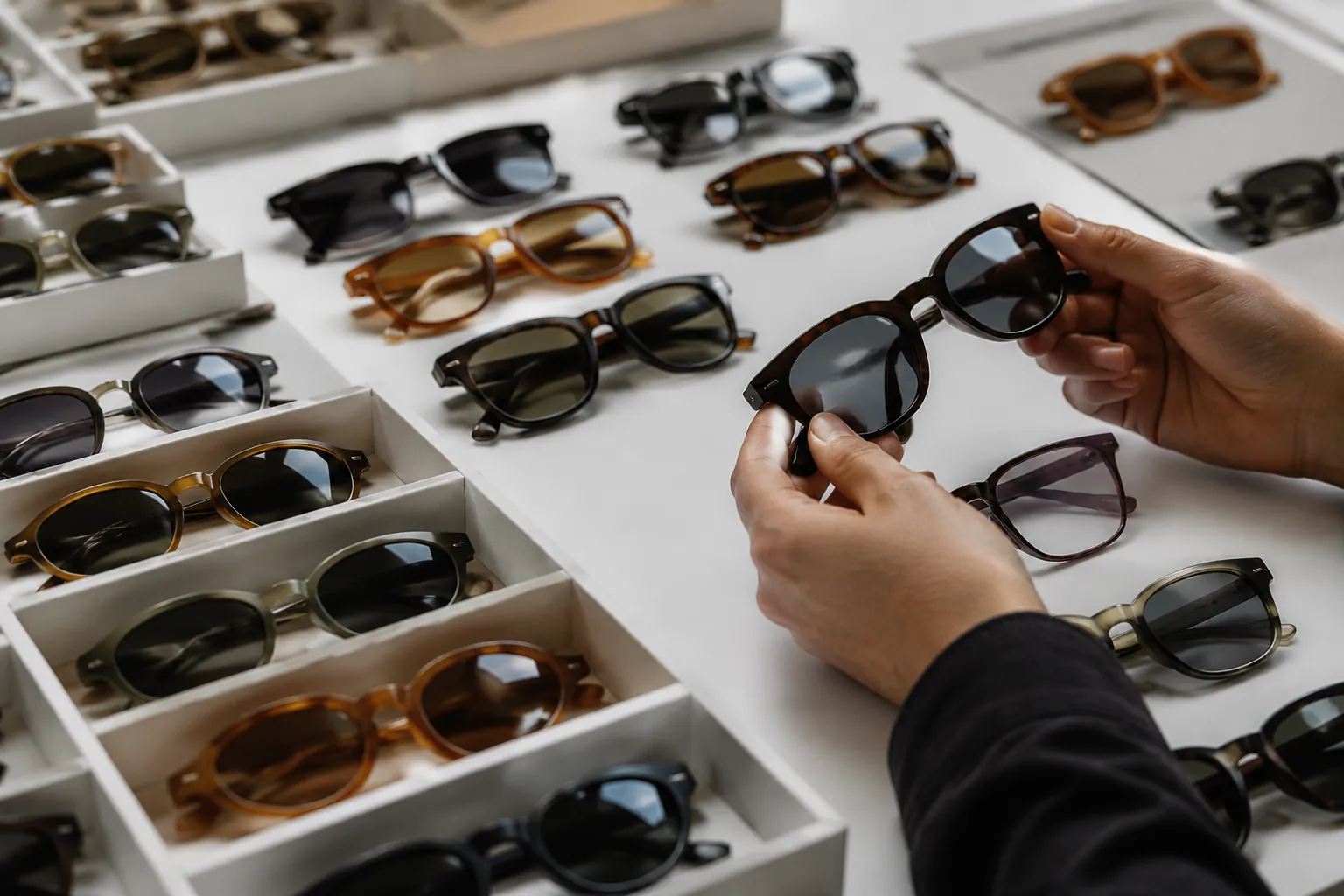
If you buy custom sunglasses for a brand, chain, or distribution program, the problem is usually the same: too many premium details in the wrong place. That pushes a workable FOB target into a build that looks good on paper and fails in sourcing. This guide shows which cosmetic upgrades actually change buyer perception, what they cost in production terms, and how to keep the build inside your target band. It is written for buyers who need volume, repeatability, and a clean margin.
Start with the build cost, not the decoration list
One strong premium cue beats three weak ones. Keep the design readable from one meter away.
Start with the price ladder. It tells you how much detail the market can absorb.
- 50 pairs/design: Prototype or small launch. Keep decoration simple.
- 300 pairs: First real production. One premium cue is usually safe.
- 1,000 pairs: Enough scale to justify a better finish package.
- 5,000+ pairs: Tooling discipline and repeatability matter more than setup cost.
Do not design from the render alone. A glossy mockup can hide cost and quality problems. The factory bill cannot.
Which premium details are worth paying for first
Not every upgrade adds the same value. Some are visible and durable. Some are just extra steps. The best details are the ones people can see fast and feel in hand.
| Detail | Buyer impact | Typical production note | Best use case |
|---|---|---|---|
| Laser engraving | Clean, permanent, low-clutter branding | Works well on metal, acetate, and some coated surfaces; no ink cure risk | Minimalist premium look, lower SKU risk |
| Pad printing | Low cost, flexible color branding | Good for logos and markings, but inks can wear if the spec is weak | Price-sensitive programs with visible brand color |
| Metal logo plates | Strong premium signal | Needs fit control and a repeatable attachment method | Fashion frames, gift sets, retail wall impact |
| Matte or soft-touch finish | Improves hand feel immediately | Depends on base material and coating discipline | Mid-tier and premium private label lines |
| Gradient or special tint lens | High shelf appeal | Lens tinting is in-house at LumiShades, so color control is easier than outsourcing | Retail sunglasses that need visual difference |
If you need only one upgrade, laser engraving is usually the safest choice. It avoids ink matching issues and does not look cheap when the color shifts. If you need stronger shelf presence, a metal logo plate can do more than a printed mark. But it must sit flush. A bad plate looks worse than no plate.
For acetate frames, edge quality matters. CNC milling helps produce sharper lines and cleaner bridge geometry. That often reads as quality faster than extra decoration. A frame that feels smooth at the hinge and temple end usually beats one with more branding and rough finishing.
Budget bands: what to add at 50, 300, 1,000, and 5,000 pairs
Use order size to decide how much detail can fit without breaking margin. The same upgrade can make sense at 5,000 pairs and fail at 50 pairs.
- 50 pairs: Treat this as a test build. Use one decoration method only. Keep lens color standard. Avoid mixed materials unless you are checking fit.
- 300 pairs: Add one premium cue that reads clearly in photos and in hand. Laser engraving or a single metal logo plate is usually the right call.
- 1,000 pairs: You can combine a refined finish with one strong branding element. Matte frames, special tints, or a metal accent become more practical here.
- 5,000+ pairs: The factory can justify tighter process control, more stable color matching, and more careful secondary decoration setup. Cost per pair drops enough to support better details without wrecking FOB.
Ask for the cost delta by process, not by vague "upgrade." Ask what laser engraving adds versus pad printing. Ask what a metal plate adds versus a molded logo. Ask how much extra polishing is needed for acetate edges. That is where the money goes.
At LumiShades, injection molding, acetate cutting, CNC milling, lens tinting, decoration, and QC are all in-house. That cuts handoff loss. If each step goes to a different factory, tolerances drift. Then you pay again in rework.
Where premium details usually fail in production
The buyer sees the design render. The factory sees the failure mode. The gap is usually in fit, finish, and repeatability.
- Logo placement drift: A logo 1.5 mm off-center may pass on paper, but not on a retail tray.
- Ink mismatch: Pad printing fails if the PMS target is too strict or the surface is inconsistent.
- Plate lift: Metal logo plates need stable attachment. If pocket depth or adhesive spec is loose, edges catch during packing.
- Uneven tint: Lens tinting must be controlled or you get visible shade variation across a shipment.
- Edge roughness: On acetate, a weak polish step kills the premium effect fast.
Do not hide a basic frame with decorative overload. Buyers who handle sunglasses every day notice hinge action, temple alignment, and nose bridge symmetry before they notice the logo. If the frame rocks on a flat surface, stop. Fix the structure first.
QC should check more than appearance. For sunglasses, the relevant compliance set for overseas buyers includes CE EN ISO 12312-1, ANSI Z80.3, AS/NZS 1067, REACH, FDA registration, ISO 9001, and BSCI where applicable to your sourcing policy. That does not mean every model needs every market claim. It means the factory should know the destination market and test accordingly. A decoration upgrade is not a compliance shortcut.
How to spec details so the factory can quote cleanly
Messy specs lead to expensive assumptions. You want one exact build quoted, not a guess at your intent.
Write the order spec in this order:
- Frame material: injection plastic, acetate, or mixed material.
- Finish: gloss, matte, soft-touch, translucent, or special color.
- Branding method: laser engraving, pad print, metal plate, or molded logo.
- Lens color: solid tint, gradient tint, mirrored, or clear demo.
- Hardware: hinge type, screw color, temple core if needed.
- Compliance target: destination market standard, not a generic label.
- Packing: pouch, box, insert card, cleaning cloth if required.
Give reference images, but do not rely on them alone. Put the logo size in millimeters. Put the lens color reference in plain language, and if possible use a physical sample. Put the acceptable tolerance in writing for placement and color variation. If you do not define tolerances, you will argue later about what "close enough" means.
For a launch order, ask for samples in 7-10 days. Bulk production at LumiShades is typically 25-35 days, depending on material, decoration, and order size. If the decoration package is complex, build in extra time. The frame may be fast. Secondary finishing and final QC are usually slower.
Which premium cues fit each market position
The right detail depends on where the product sits. Fashion, private label basics, and distributor work do not need the same treatment.
| Market position | Recommended detail | What to avoid | Why it works |
|---|---|---|---|
| Entry private label | Pad print or small laser logo | Multiple plates, custom hinges, complex mixed finishes | Low risk, clear brand ID, manageable MOQ |
| Mid-tier retail | Matte finish plus laser engraving or metal plate | Overly bright colors that look cheap under store lighting | Feels more solid without pushing tooling too far |
| Premium fashion | Acetate body, CNC detail, gradient tint, metal logo accent | Thin decoration that disappears in hand | Visible value on shelf and online |
| Promotional volume | Simple logo, standard tint, stable frame shape | Luxury cues that raise cost without resale value | Protects margin and simplifies reorders |
If your customer is a retailer, the product must photograph well on a card or tray. If your customer is a distributor, consistency matters more than fashion drama. If you are building your own brand, pick one signature detail and repeat it across SKUs. That is how buyers remember you.
A practical cost-control checklist before you approve tooling
Before you sign off, run this checklist. It saves money more often than a design revision.
- Confirm the base frame material first.
- Choose one primary branding method.
- Lock logo size and placement in millimeters.
- Ask for the cost difference between pad printing, laser engraving, and metal plates.
- Check whether the premium finish changes lead time.
- Verify the compliance target for the destination market.
- Request samples before bulk, even if the price is low.
- Inspect hinge alignment, temple symmetry, and lens tint consistency on samples.
Do not treat the lowest quote as the cheapest quote. A low quote with a bad decoration process can create packing rejects, customer complaints, and reorder pain. A slightly higher quote with stable in-house control is often cheaper over a full season. That is especially true when the factory can do injection molding, acetate cutting, CNC milling, lens tinting, decoration, and QC under one roof.
For overseas buyers, the goal is simple. Add premium where customers notice it fast. Keep the build stable. Keep the quote honest. That is how you get a product that looks more expensive without crossing into uneconomical territory.
Have a custom sunglasses project in mind?
Send us your styles, target market and quantities and we will return a detailed quote with MOQ, lead time and a sample plan.
Get a QuoteWhy source this from Wenzhou with LumiShades
Wenzhou in Zhejiang Province is widely regarded as China’s eyewear manufacturing capital, producing a large share of the world’s sunglasses. That concentration matters to buyers: a deep local supply chain for acetate sheet, hinges, lens blanks, plating and packaging means shorter component lead times, easier color and material matching, and a workforce with decades of eyewear-specific skill. LumiShades has manufactured in this ecosystem since 2009, and our vertical integration — in-house injection molding, acetate cutting, CNC milling, lens tinting, decoration and quality control — means no part of your order is quietly subcontracted to a workshop you cannot audit.
For international buyers, that vertical control translates into accountability. When a single factory owns every step, defects are traced and fixed at source rather than bounced between vendors, and your specifications survive intact from first sample to bulk. We back this with 15+ years of experience, shipments to 60+ countries, more than 5 million pairs produced per year and a 98.5% on-time delivery rate. Our certifications — CE EN ISO 12312-1, FDA registration, ANSI Z80.3, AS/NZS 1067, REACH, ISO 9001 and BSCI audit — mean the compliance documentation your market requires already exists. Explore our manufacturing capabilities and quality control process to see how this works in practice.
Frequently asked questions
What is the safest premium detail if I only have room for one upgrade? Laser engraving is usually the safest. It is permanent, looks clean, and avoids ink wear or color-matching problems.
Can I mix metal logo plates and pad printing on a low MOQ order? You can, but it usually adds setup complexity that does not pay back at 50 pairs. At 300 pairs or more, it becomes more practical if the design justifies it.
How should I decide between acetate and injection plastic for a premium look? Use acetate if you want deeper visual character and sharper edge finishing. Use injection plastic if you need cost control and repeatable volume more than tactile richness.
What lead time should I plan for decorated sunglasses? Samples usually take 7-10 days. Bulk is typically 25-35 days, but complex decoration or tighter QC can push that longer.
Which compliance standards should I ask about for export orders? Match the destination market. Common standards include CE EN ISO 12312-1, ANSI Z80.3, AS/NZS 1067, REACH, and FDA registration.
How do I stop a premium detail from hurting margin on reorder? Lock the spec early, use one primary decoration method, and ask the factory for the cost impact at 300, 1,000, and 5,000+ pairs before tooling.
Ready to start?
Explore our wayfarer sunglasses or request a quote — our sales team replies within 12 hours.
Request a Quote