
Specify UV400 Sunglasses Without Overbuilding the Lens
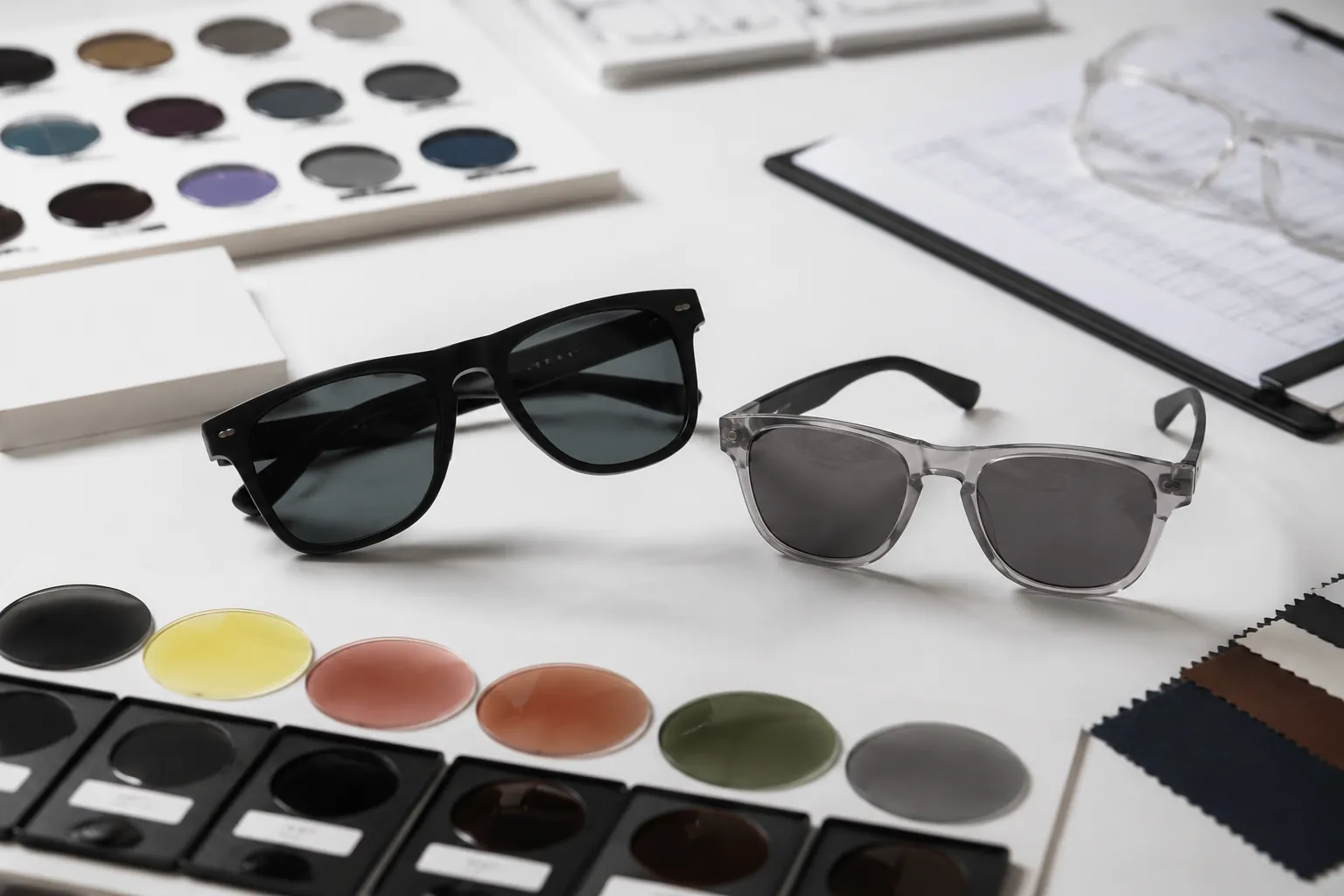
This guide is for brand owners, importers, distributors, and retail buyers sourcing custom sunglasses in volume. The goal is practical: write a lens specification that production can follow, compliance can review, and purchasing can cost correctly. Many buying errors start the same way. UV protection, tint darkness, lens category, polarization, and cosmetic finish get treated as if they mean the same thing. They do not. Leave those points vague, and the supplier has to guess. That leads to wrong samples, inconsistent bulk output, avoidable compliance risk, and unnecessary cost.
Start with what UV400 actually controls
UV400 means the lens is specified to block ultraviolet radiation up to 400 nanometers, covering both UVA and UVB. That is all it means. It does not mean the lens is dark, polarized, mirrored, or category 3. Those are separate properties and should appear as separate lines on the purchase order, sample approval record, and final bill of materials.
In production, UV400 can be achieved through the lens material itself, UV-absorbing additives, a surface treatment, or a laminated lens structure, depending on the build. The route varies by material and process. What matters to the buyer is the finished result: whether the lens meets the required product standard for the destination market.
This is where sourcing mistakes start. A dark lens does not prove UV protection. Visible light transmission controls how dark the lens looks. UV performance depends on the material system and the finished-lens result. If an order sheet only says dark smoke UV400, the factory still has to interpret the material, transmission target, lens category, and construction method.
For custom programs, use a simple format:
- Lens material: PC, TAC polarized, nylon, acrylic, or another approved build.
- UV requirement: UV400 plus the required destination-market standard.
- Visible light transmission: target percentage, approved range, or category requirement where applicable.
- Polarization: yes or no, with test confirmation if yes.
- Color and finish: smoke, brown, green, gradient, flash, mirror, or approved swatch reference.
- Surface treatment: hard coat, mirror layer, logo method, or other approved decorative requirement.
Separate the fields. Then the supplier works from measurable criteria, not assumptions.
Separate the four lens specs buyers mix up most often
Buyers should isolate four lens variables every time they brief a supplier:
- UV protection: the ultraviolet blocking requirement, such as UV400, tied to the required market standard where needed.
- Visible light transmission: the percentage of visible light that passes through the lens, which affects apparent darkness and lens category.
- Polarization: a glare-reduction function created by a polarized layer or film, not by dark tint.
- Tint and appearance: the cosmetic result, including smoke, brown, green, mirror color, flash coating, or gradient depth.
These items are often bundled together in ways that raise cost without improving fitness for use. A buyer may ask for polarized UV400 mirrored lenses because the description sounds more premium. But if the product is a fashion program and the customer promise does not include glare reduction, polarization adds cost and process complexity for no real gain. Mirror finishing adds another appearance-control step. Neither replaces compliance.
Visible light transmission is especially important. If you do not write down the target, one sample may come back much darker or lighter than another while both are called smoke. That is how sample approvals turn into bulk claims.
The split also matters operationally. A non-polarized PC lens and a TAC polarized lens do not follow the same production route. If you do not need the more complex build, say so. Explicitly.
Use a pre-sample decision framework that prevents rework
Most avoidable problems appear before bulk production. The best control point is the pre-sample brief. Use this sequence before approving any lens:
- Define the selling market. Europe, the United States, and Australia/New Zealand may require different standards, labeling, or supporting documentation.
- Define the use case. Fashion, promotional, driving, marine, outdoor, or sport-inspired lifestyle.
- Set the visible light transmission target. Do not write dark lens; write the target value, approved range, or lens category requirement.
- Decide whether polarization is functionally required. If the product promise does not mention glare reduction, do not assume it is necessary.
- Choose the lens build. Match the material and construction to durability, budget, curvature, and marketing claim.
- Write the compliance target on paper. Do not stop at UV400; add the relevant standard reference.
- Approve a retained sample. Keep a signed reference for color and construction, and keep supporting test documentation where required.
Each step removes ambiguity. If your approved sample is defined as a non-polarized PC smoke lens with a stated transmission target, hard coat, and compliance to CE EN ISO 12312-1 for the EU market, the factory has a clear benchmark. If the brief only says premium black lens, it does not.
Retained samples matter. For color-sensitive programs, especially brown, green, mirror, and gradient lenses, keep a sealed approval sample under the purchase order number. During bulk review, compare production lenses against that reference under consistent lighting and with the agreed acceptance standard.
Choose the lens build by function, durability, and cost
Different lens constructions can all be specified for UV400, but they do not behave the same way. Impact performance, cosmetic consistency, edge stability, decoration compatibility, and process control all vary by build. The right choice depends on the use case and the claims you plan to make.
| Lens build | Typical thickness | Common use | How UV400 is achieved | Relative cost | Buyer caution |
|---|---|---|---|---|---|
| PC non-polarized | Commonly around 1.8 to 2.0 mm, depending on design | Fashion retail, mass retail, promotions | Usually through the material system and/or UV-control additives | Low | Confirm hard-coat expectation and acceptable cosmetic standard |
| PC mirrored | Commonly around 1.8 to 2.0 mm, depending on design | Sport look, trend fashion | UV comes from the base lens system, not from the mirror layer itself | Low-medium | Mirror color and appearance require tight sample approval control |
| TAC polarized | Varies by laminated construction | Driving, marine, outdoor glare reduction | Through the laminated lens structure and its UV-control system | Medium | Check lamination quality, edge durability, and polarization consistency |
| Nylon sport lens | Varies by design and curve | Higher-performance wrap styles | Usually through the material system and additives | Medium-high | Validate curvature, tooling fit, and finished-lens performance early |
For many private label programs, non-polarized PC is the default because it is widely used, relatively simple to process, and suitable for many fashion-led products. TAC polarized lenses make more sense when the sales story includes glare reduction, such as for driving or marine use. Nylon can suit technical wrap styles, but it is not the automatic choice for casual retail programs.
Decoration changes the route too. Mirror coatings, flash coatings, lens logos, and other special effects add more appearance-control points. A lens logo may look minor on paper, but it can still drive rejects if adhesion, placement, or visual consistency is not defined. Every added step should earn its place in the brief.
Write a lens specification sheet your factory cannot misread
A workable lens spec should fit on one page and be usable by sales, production, quality control, and compliance teams. If it is full of design language but missing measurable criteria, it is not production-ready.
The most reliable format includes these fields:
- Material and build: for example PC, non-polarized, nominal thickness if relevant to the design.
- UV requirement: UV400, with destination-market compliance reference.
- Visible light transmission: target percentage, approved tolerance, or category requirement.
- Color reference: smoke, brown, green, gradient, mirror, or approved swatch number.
- Surface treatment: hard coat, mirror, flash, or other required treatment.
- Polarization: yes or no; if yes, require test confirmation.
- Decoration: no logo, pad print, hot stamp, or laser mark, with exact location and artwork reference.
- Cosmetic tolerance: allowable variation for color, print position, scratches, pits, dots, edge condition, and coating appearance.
- Compliance target: CE EN ISO 12312-1, ANSI Z80.3, AS/NZS 1067, and chemical requirements such as REACH where relevant.
Specific wording matters. Smoke lens per approved sample is stronger than dark grey. A defined logo location is stronger than logo at upper corner. If material substitution is not allowed, write that plainly. If mirror color or gradient depth is critical, state that any visible deviation from the signed approval sample requires buyer review before mass production continues.
If lens processing is split across subcontractors, traceability gets harder. Not impossible. Harder. In that case, define ownership of sample control, test records, and corrective action more tightly.
Know which features actually move cost and lead time
Buyers often assume UV400 itself is the expensive part. Usually, it is not. In standard commercial lens builds, cost is more often driven by material choice, polarization, mirror or flash coatings, decoration complexity, cosmetic sorting requirements, and order volume.
Polarized builds require extra material and tighter process control. Mirror and flash finishes add another appearance-sensitive step. Tighter cosmetic standards reduce yield because more units are held or rejected for minor variation. Small orders also tend to cost more per unit because setup, approval, and quality-control effort are spread over fewer pieces.
Lead time follows the same logic. Samples must cover frame construction, lens build, tint, decoration, and packaging claims where applicable. Bulk timing depends on approved samples, material availability, the lens processing route, and inspection requirements. Mirror finishes, gradients, and polarized constructions usually need more review points than a basic non-polarized tinted lens.
In practice, buyers overspend in three common ways:
- Adding polarization by default when the product is sold as fashion eyewear and no glare-reduction claim is needed.
- Adding mirror finishes without strict approval control and then facing appearance disputes in bulk.
- Stacking cosmetic requirements onto low-volume orders without checking whether the commercial return justifies the added process control.
If the market only needs compliant UV400 fashion sunglasses, a non-polarized lens with a defined transmission target and an approved cosmetic standard is often the cleanest route. Add complexity only when the product claim, channel expectation, or price point supports it.
Control compliance and quality before final shipment
Do not wait until the goods are packed to ask whether the lenses pass. By then, your options are worse. The right checkpoints happen earlier, while corrections are still manageable:
- Material confirmation: verify the agreed substrate, build, and nominal lens specification before sample production.
- Sample approval: review tint, transmission appearance, cosmetics, and polarization if required.
- Pre-production release: ensure the signed sample, bill of materials, artwork, and compliance target are attached to the work order.
- In-process QC: check tint consistency, print position, coating appearance, and surface defects during production.
- Final verification: confirm assortment, labeling, packaging claims, and supporting compliance paperwork before shipment.
Handle market standards accurately. Buyers commonly work against CE EN ISO 12312-1 for Europe, ANSI Z80.3 for the United States, and AS/NZS 1067 for Australia and New Zealand. REACH may also matter for chemical compliance depending on the market and materials. ISO 9001 and BSCI are factory-system credentials, not product-performance standards. FDA registration may come up in supplier documentation, but it is not a substitute for meeting sunglass product requirements or using the correct destination-market standard.
A simple buying scenario makes the point. If you are ordering fashion sunglasses for Europe and North America, and the product is not marketed for driving, fishing, or technical outdoor use, the brief may only need a non-polarized UV400 lens with a defined transmission target, a stable cosmetic standard, and compliance documentation aligned with the destination markets. A vague brief such as black lens, UV400, premium quality invites interpretation. Interpretation costs money.
Buy the protection level you need, the visible-light performance you intend to sell, the finish you approved, and the function the customer will actually pay for.
Have a custom sunglasses project in mind?
Send us your styles, target market and quantities and we will return a detailed quote with MOQ, lead time and a sample plan.
Get a QuoteWhy source this from Wenzhou with LumiShades
Wenzhou in Zhejiang Province is widely regarded as China’s eyewear manufacturing capital, producing a large share of the world’s sunglasses. That concentration matters to buyers: a deep local supply chain for acetate sheet, hinges, lens blanks, plating and packaging means shorter component lead times, easier color and material matching, and a workforce with decades of eyewear-specific skill. LumiShades has manufactured in this ecosystem since 2009, and our vertical integration — in-house injection molding, acetate cutting, CNC milling, lens tinting, decoration and quality control — means no part of your order is quietly subcontracted to a workshop you cannot audit.
For international buyers, that vertical control translates into accountability. When a single factory owns every step, defects are traced and fixed at source rather than bounced between vendors, and your specifications survive intact from first sample to bulk. We back this with 15+ years of experience, shipments to 60+ countries, more than 5 million pairs produced per year and a 98.5% on-time delivery rate. Our certifications — CE EN ISO 12312-1, FDA registration, ANSI Z80.3, AS/NZS 1067, REACH, ISO 9001 and BSCI audit — mean the compliance documentation your market requires already exists. Explore our manufacturing capabilities and quality control process to see how this works in practice.
Frequently asked questions
Does a darker sunglass lens automatically mean better UV protection? No. A darker lens only indicates lower visible light transmission. It does not confirm UV400 performance. To buy correctly, ask for both the visible light transmission target and the applicable compliance standard, then require supporting test documentation for the finished lens or finished product as appropriate for your market.
Should I always specify polarized lenses if I want UV400? No. Polarization and UV protection are separate requirements. Specify polarization only when the product needs glare reduction, such as for driving, marine, or certain outdoor uses. If your program is fashion-led and makes no glare-reduction claim, a non-polarized UV400 lens is usually simpler to source and easier to control.
What should I put on my purchase order besides UV400? Include lens material and build, nominal thickness if relevant, polarization yes or no, visible light transmission target or category requirement, color reference, surface treatment, decoration method, cosmetic tolerance, and the required standard such as CE EN ISO 12312-1, ANSI Z80.3, or AS/NZS 1067. Also reference the approved sample number and state whether material substitution is prohibited.
What compliance documents should I ask a supplier to provide? Ask for product-specific test documentation aligned to your destination market, plus the final approved specification and sample reference. Where relevant, request declarations or records for REACH compliance. Treat ISO 9001 and BSCI as factory-management credentials only. If a supplier mentions FDA registration, verify what it covers and do not treat it as proof that the sunglasses meet EU, US, or Australia/New Zealand sunglass performance standards.
How should I approve samples so bulk production matches them? Approve samples against a written lens specification, not against appearance comments alone. Keep a signed retained sample under the purchase order number, record the agreed color and transmission target, and link the approved sample to the production work order. Before shipment, compare bulk output to the retained sample under consistent lighting and check that the supporting compliance paperwork matches the approved build.
Ready to start?
Explore our square sunglasses or request a quote — our sales team replies within 12 hours.
Request a Quote