
How to Specify Lens Colors by Channel and Climate
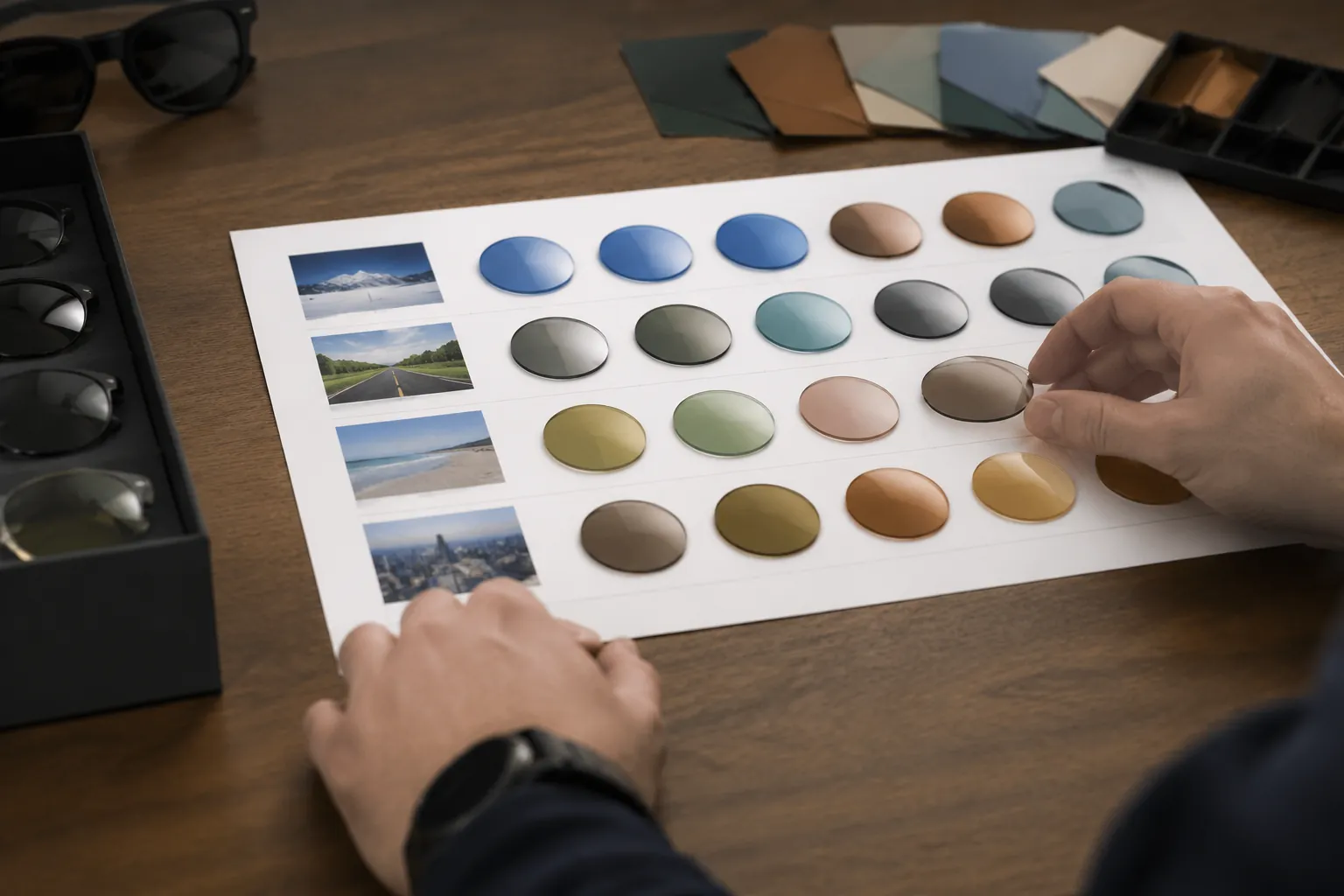
If you buy sunglasses for retail, wholesale, or private label, lens color is not a styling detail. It affects sell-through, returns, complaint rates, and fit for climate and channel. This guide shows how to spec tint colors by market, use case, and compliance target so you can order with fewer guesses and fewer dead SKUs.
Start with the channel, not the trend
The most common buying mistake is choosing lens color from a mood board instead of the sales channel. A resort shop, an urban fashion chain, a pharmacy program, and an outdoor distributor are solving different problems. One needs impulse. Another needs repeatable replenishment. A third needs glare control and low complaint risk. Lens color should support that channel logic first.
For fashion-led retail, black, smoke, brown, and gradient smoke are usually the safest commercial choices. They are easy to explain and easy to merchandise. For sport or outdoor programs, buyers need a functional story: glare reduction, contrast, and predictable performance in bright light. For promotional or high-volume private label programs, a narrow color set with low rejection risk is usually better. Distinctive tints can work. Too many of them create slow movers and reorder confusion.
Set the number of lens colors before you choose the colors. That is the cleaner order. A chain-store launch can often support 3 to 5 colors if the assortment is segmented by channel and price tier. A distributor reorder is usually easier to manage with 2 reliable tints. If you are testing a new market, start with one dark neutral and one warm tint. Enough data. Not too much risk.
In practical terms, the channel tells you how much variety you can support in inventory and tooling. A color that looks strong on a render can still be a weak commercial choice if the channel cannot support it. A good assortment is not the widest one. It is the one that can be reordered cleanly.
Match tint behavior to climate
Climate changes how a lens performs in the market, not just how it looks on a shelf. Strong sun, haze, snow glare, reflective water, and high UV exposure all push buyers toward darker or more functional tints. Overcast or coastal markets often tolerate lighter fashion tints because customers still want eye comfort without looking heavily shaded.
Smoke and gray are the default for hot, bright regions because they preserve a neutral view and are easy for shoppers to understand. Brown and amber often work better where contrast matters, especially for driving, mixed outdoor use, and markets with frequent light transitions. Green can work where buyers want a classic look with a softer color cast. Gradient lenses are useful for style-led channels, but they are not usually the first choice for sports, driving, or all-day outdoor wear. The fade changes how the upper and lower visual field feel.
Think of climate this way: bright and flat light points to neutral gray or smoke. Changing light and detail recognition point to brown or amber. Snow and water markets need a stronger glare strategy because reflections are more intense and sustained. In those cases, tint choice is part of the performance spec, not just the look.
Lens material matters too. Polycarbonate lenses are impact-friendly and common for mass programs. CR-39 is often chosen when optical clarity is the priority. Nylon and TAC-based constructions are common in sport-oriented programs. The substrate affects scratch behavior, edge finishing, and how evenly a tint can be held. If you want the same lens color across different materials, request controlled samples on each substrate. Do not assume the dye will read the same.
| Lens color | Best fit | Visual character | Buyer risk |
|---|---|---|---|
| Smoke / gray | General retail, hot bright climates | Neutral, easy to merchandise | Low |
| Brown / amber | Driving, mixed light, outdoor utility | Warmer, higher contrast feel | Low to medium |
| Green | Classic lifestyle programs | Balanced, softer color cast | Medium |
| Gradient smoke | Fashion and resort channels | Style-led, lighter in the lower field | Medium to high |
Use visible tint logic, not guesswork
Buyers often ask for "polarized dark lenses" without defining the job. That is too vague for a factory to execute well. A useful tint spec should answer three questions: how much light reduction is needed, whether color recognition matters, and whether the glasses are for all-day wear or occasional use. If you do not define the job, the supplier will fill in the blanks with a standard lens.
For general sell-through programs, the safest mix is one dark neutral, one warm tint, and one optional fashion lens. Neutral smoke covers the broadest base. Brown or amber adds a performance story without looking overly technical. A gradient or mirrored option can support shelf display, but it should be treated as a narrower SKU with higher visual risk and more approval sensitivity.
Spec the lens with measurable guardrails. If your supplier can support it, ask for a visible light transmission, or VLT, target range. For example, a dark fashion lens may sit in a low-VLT range, a medium brown may sit in a mid-range, and a lighter lifestyle tint may sit above that. Exact values depend on market rules and design intent. The key point is simple: "dark" is not enough. You want a target range plus an allowed tolerance tied to a signed sample.
Finish matters as much as tint. Solid tint, gradient tint, mirrored, flash-coated, and dual-layer effects all behave differently under light. Mirror films can increase visual impact, but they can also expose handling marks and edge defects more clearly. Gradient lenses need tighter process control because the fade line is one of the first places inconsistency appears. Keep the spec simple enough for the factory to repeat and clear enough for the buyer to inspect.
- Use smoke for broad retail acceptance and low complaint risk.
- Use brown or amber for driving, walking, and mixed-light use.
- Use green for a classic lifestyle look with moderate contrast.
- Use gradient or mirror only when the channel rewards visual novelty.
- State VLT, finish type, and acceptable visual range in the tech pack.
Build the line by sales channel
The smartest range is usually not the widest one. It is the one that matches how the channel sells, how often it refreshes, and how much education the sales team can support. Chain retailers want simple choices and low confusion. Importers and distributors want options that can be repeated. Fashion retailers can carry more visual variation, but only if they refresh often enough to avoid stale stock.
For mass retail, one core smoke lens and one warm tint is often enough for the first order. For optical-adjacent or premium lifestyle programs, a darker smoke plus a green or brown lens gives more credibility. For beach, resort, and gifting channels, mirrored smoke and gradient smoke can help sell in person because they read as more special. Still, each fashion-forward option should sit beside a plain option. A shelf made entirely of fashion tints is risky. It limits replacement logic and makes reorders harder to forecast.
Assortment planning should also follow unit economics. If a color requires separate approval photos, a separate sample run, and a separate packing setup, it behaves like its own mini-program. That is fine if the channel is strong enough to justify it. It is not fine if you are splitting a small order into five colors and each color becomes too thin to reorder profitably. That is why a hero color plus one support color works so often in private label.
Lifestyle programs also work better when frame finish and lens color are designed together rather than bought separately. A warm tortoise acetate often reads more coherent with brown or green lenses. A glossy black frame usually looks cleaner with smoke. A pale translucent frame may support lighter fashion tints, but check the whole look under store lighting, not only on screen.
| Channel | Recommended lens mix | Why it works | Stock risk |
|---|---|---|---|
| Mass retail | Smoke + brown | Simple, repeatable, low return risk | Low |
| Fashion boutique | Smoke + gradient + one mirror | Visual variety on shelf | Medium |
| Outdoor / sport | Dark smoke + brown/amber | Function-first buying logic | Low to medium |
| Resort / gift | Gradient + mirror + one neutral | Impulse purchase appeal | Medium to high |
Spec the color properly in the tech pack
Color names alone are not enough. "Blue mirror" or "tea lens" can mean different things at different factories, and even across different production lines inside the same factory. You need a controlled reference. Use a physical master sample, and use Pantone only where it actually adds value. For lenses, the sample matters more than a printed reference because surface finish, thickness, and lighting all affect perceived color.
A good tech pack should define the lens color target, finish type, base lens material, coating requirement, and any transmission target that matters for the compliance route. It should also specify what is not allowed. For example: no strong green cast in a smoke lens, no visible banding in a gradient, no mismatch between left and right lens, no uneven mirror edge, and no haze in the central viewing zone. If you expect a metallic mirror effect, say how strong it should be and whether slight variation is acceptable.
Sample control is what keeps a program repeatable. Ask for a pre-production sample first, then a signed approval sample, then bulk run. That sequence gives you a clear reference before the production slot is locked. The approval should happen under the same viewing conditions each time, ideally with the same light source and the same distance from the sample board.
Decoration methods should also be documented because they affect the final reading of the lens and frame together. Laser marking, heat transfer, pad printing, metal logo inserts, and coated mirrors all interact with the visual result. A brown lens can look richer next to matte acetate, while the same lens can feel dull next to a glossy frame if the finishes are not balanced. Treat the frame, lens, and decoration as one system.
- Define the use case and channel.
- Choose 1 to 3 lens colors only.
- Lock finish, mirror, and gradient requirements.
- Approve a physical sample under agreed lighting.
- Retain the sample as the production reference.
Connect color choice to compliance
Lens color is not the same as certification, but it still affects what you can sell in each market. Your product line should be designed around the real compliance route, not the other way around. For overseas buyers, the relevant references to request from the supplier are CE EN ISO 12312-1, ANSI Z80.3, AS/NZS 1067, REACH, FDA registration, ISO 9001, and BSCI. Do not ask a factory to invent a certificate it does not hold.
For Europe, CE EN ISO 12312-1 is the key sunglasses reference. For the US, buyers often care about ANSI Z80.3 and FDA registration. For Australia and New Zealand, AS/NZS 1067 matters. REACH is relevant for restricted substances. ISO 9001 and BSCI are quality and social compliance references, not product performance certifications, so they should be reviewed as part of supplier qualification rather than as proof that a specific lens color passes market testing.
Color can influence QA work even if the standard stays the same. Very dark tints may hide surface defects on first glance, which can delay detection of coating issues. Mirror finishes can make tiny scratches more obvious under strong light. Gradient lenses need tighter process control because the fade line exposes inconsistency quickly. That is why a serious buyer should ask not only whether a lens is certified, but also what process controls are used on the chosen finish.
Ask for the complete file set where relevant: test report, material declaration, logo or mark placement requirements, and the approved sample archive. If the lens changes from solid tint to mirror or from gray to brown, confirm whether the change is purely aesthetic or whether it affects the testing scope. A good supplier should answer that clearly before production begins.
Control risk with MOQ, pricing, and QA
Lens color strategy should respect factory economics. A custom lens color with low volume is more expensive because tint setup, material loss, and approval time are spread over fewer pairs. That is why MOQ and price ladder logic matters. If you want five colors, every color becomes its own cost center.
Do not split volume across too many tints unless the channel truly needs it. If you are testing, choose one hero color and one backup. Run the first order, sell it, then reorder the winner. That is better than carrying dead inventory in three nearly identical shades. A low MOQ can help you test, but a bad color decision still burns time, shelf space, and working capital.
QA should cover more than visual color. Check left-right lens match, tint uniformity, coating defects, scratch resistance in handling, and frame-to-lens appearance under normal store lighting. Define acceptable variation before production, not after rejection. Many buyers use a simple acceptance standard such as "no visible mismatch at arm's length under daylight-equivalent light" plus a tighter internal check for critical accounts. The more specific your tolerance, the fewer arguments you have later.
For repeat orders, keep the approved master sample, lot records, and a short defect log. If your supplier has in-house QC, use it, but still require your own sign-off standards. That is the difference between a factory claim and a buyable program. Fewer lens colors. One channel per color. Locked sample. Then scale.
Short version: pick fewer lens colors, tie them to one channel, lock the sample, and only then scale the run.
A practical buying template
If you want a clean first order, start with a narrow specification sheet. Use one neutral, one warm, and one optional fashion lens. Match each one to a clear channel. Keep the order plan aligned to MOQ and price breaks, not to a long wish list of colors that look attractive in isolation.
A useful starting template looks like this:
- Core retail: smoke lens, black frame, CE/ANSI-ready build.
- Utility add-on: brown or amber lens, same frame family.
- Style SKU: gradient smoke or mirror, limited run only.
- Region split: darker tints for bright markets, warmer tints for driving and mixed-light markets.
If you want a more disciplined first buy, add a simple launch matrix: one color for the widest channel, one color for contrast-driven markets, and one fashion option only if the retailer has enough turnover to support it. That makes the line easier for sales teams to explain and easier for operations teams to replenish. It also matches how custom sunglasses are actually made: sample, review, lock, bulk.
Buyers often get better results by treating lens color as a controlled product decision instead of a decorative one. When the tint, finish, compliance file, and MOQ logic all point in the same direction, the range becomes much easier to sell through. That is the goal: a specification the buyer can defend internally and the customer can understand at shelf level without extra explanation.
Have a custom sunglasses project in mind?
Send us your styles, target market and quantities and we will return a detailed quote with MOQ, lead time and a sample plan.
Get a QuoteWhy source this from Wenzhou with LumiShades
Wenzhou in Zhejiang Province is widely regarded as China’s eyewear manufacturing capital, producing a large share of the world’s sunglasses. That concentration matters to buyers: a deep local supply chain for acetate sheet, hinges, lens blanks, plating and packaging means shorter component lead times, easier color and material matching, and a workforce with decades of eyewear-specific skill. LumiShades has manufactured in this ecosystem since 2009, and our vertical integration — in-house injection molding, acetate cutting, CNC milling, lens tinting, decoration and quality control — means no part of your order is quietly subcontracted to a workshop you cannot audit.
For international buyers, that vertical control translates into accountability. When a single factory owns every step, defects are traced and fixed at source rather than bounced between vendors, and your specifications survive intact from first sample to bulk. We back this with 15+ years of experience, shipments to 60+ countries, more than 5 million pairs produced per year and a 98.5% on-time delivery rate. Our certifications — CE EN ISO 12312-1, FDA registration, ANSI Z80.3, AS/NZS 1067, REACH, ISO 9001 and BSCI audit — mean the compliance documentation your market requires already exists. Explore our manufacturing capabilities and quality control process to see how this works in practice.
Frequently asked questions
How many lens colors should I launch in one custom sunglasses program? Start with 2 to 3 colors. That is usually enough to compare sell-through without splitting MOQ too thin or creating avoidable inventory risk. If you are entering a new channel, one dark neutral and one warm tint is a strong first test.
What lens color is safest for general retail? Smoke or gray is usually the safest default. It is easy to merchandise, works across many climates, and is typically simpler to reorder than a trend-driven tint.
Should I use brown or amber for driving-oriented programs? Yes, when the channel values contrast and comfort in mixed light. Brown and amber are often a better fit than fashion tints for utility use, but you should still confirm the final appearance and compliance route with your supplier.
Do I need separate compliance tests for each lens color? Not always, but changes in tint, mirror coating, or gradient finish can affect the product file and may change what needs to be reviewed. Confirm the exact testing scope for the target market before bulk production.
How fast can a custom lens color be sampled and produced? Lead time depends on the material, finish, and approval cycle. Ask the supplier for a written sample timeline, a bulk production timeline, and the date the approval sample becomes the production reference.
What should I lock in before approving bulk? Lock the physical master sample, lens color target, finish type, coating or mirror requirement, substrate, and the acceptance limits for tint uniformity and left-right match. Also confirm the compliance documents that will ship with the order.
Ready to start?
Explore our shield & oversized sunglasses or request a quote — our sales team replies within 12 hours.
Request a Quote