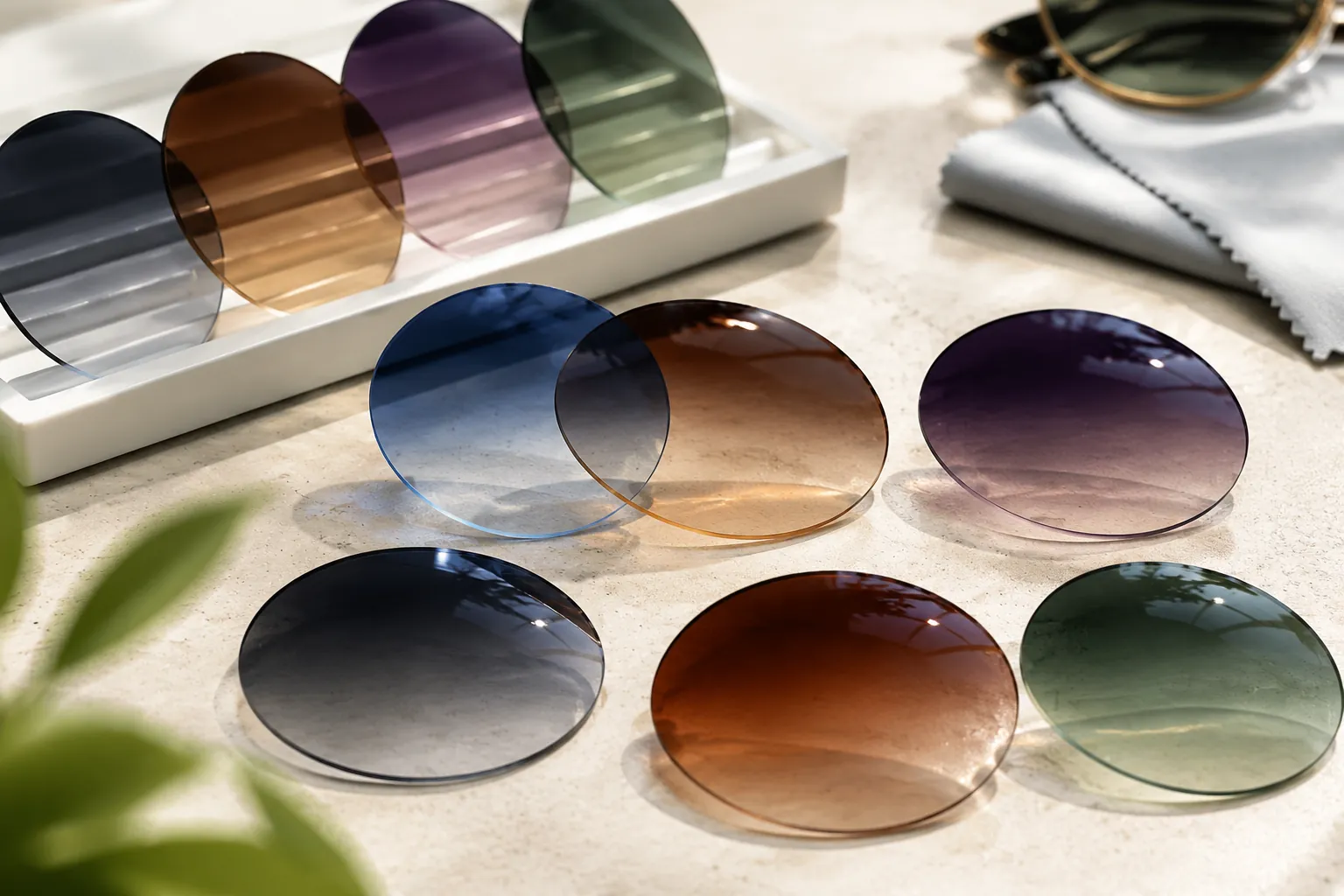
Gradient Polarized Lenses for Private-Label Sunglasses
Lens Technology · Jun 2026 · 9 min read
Gradient polarized lenses are not for every channel. They work best when buyers want glare control without a fully dark look: fashion retail, resort shops, driving assortments, and some premium private-label programs. If you buy sunglasses in volume, the question is not whether a sample looks good. It is whether the tint density, polarization, frame shape, and product position fit the channel and price tier. Get that right and the product sells. Get it wrong and it sits.
Where Gradient Polarized Lenses Sell Best
Gradient polarized lenses work best in channels where appearance matters as much as sun comfort. Good fits include fashion retail, resort and travel stores, car accessory assortments, airport and duty-free shops, and private-label lines that need a clear step up from basic smoke lenses.
They are a weaker fit for categories that prioritize maximum sun blocking over looks. Fishing, snow, and other high-glare uses usually favor a full-density polarized lens. A gradient tint leaves the lower portion lighter. That can help with dashboards, phones, menus, and mirrors. It is still not the same as a fully dark sun lens.
The practical test is simple. Does the product need to look premium on shelf while still working for everyday outdoor wear? If yes, a gradient polarized lens can fit. If the channel expects performance first, standard polarized is usually the safer call.
Best customer age band: broad adult retail, especially 18-45
Best price position: mid-tier and above, where lens appearance affects conversion
What the Lens Does and Why Buyers Care
A gradient polarized lens does two things. It reduces reflected glare through polarization, and it uses a tint that is darker at the top and lighter at the bottom. The darker upper area cuts glare from bright sky and reflective surfaces. The lighter lower area keeps the near field easier to see.
That matters at retail. Shoppers can see the effect in a mirror. No technical pitch needed. The product reads as more premium right away. For private-label buyers, that visual difference can support a trade-up from a basic polarized sunglass.
Control matters. If the fade is too abrupt, the lens looks cheap. If the lower section is too light, it feels weak. The gradient has to repeat from sample to bulk. Ask for a real spec, not a vague note like "dark to light."
For volume programs, define the transition zone in millimeters from the top edge or another fixed reference point. Keep it measurable. That is what the factory can repeat.
Channels and Customer Segments That Buy Best
Think in terms of use situation, not just customer type. The same lens can work in a boutique and fail in a sporting-goods chain. The split below is the one that matters.
Channel
Why It Works
Spec Direction
Risk
Fashion retail
Looks premium on display; easy to trade up from basic smoke
Medium-to-high top tint, smooth fade, clean mirror finish if used
Too dark and it loses the everyday-wear appeal
Driving / travel
Reduces glare while keeping lower field clearer for dashboards and navigation
Moderate gradient, reliable polarization, neutral gray or brown base
Over-light bottom zone can feel weak in strong sun
Resort / gift shops
Impulsive purchase; visual appeal matters more than technical talk
Poor color consistency hurts replenishment confidence
Premium private label
Higher perceived value can support better margin
Controlled tint density, precise logo decoration, strong QC
Any defect is obvious because the buyer pays more
The sweet spot is the buyer who wants something nicer than a basic polarized sunglass but does not need full-performance sport optics. That is a large retail segment. Packaging and frame shape matter there too. More than most buyers expect.
How to Spec the Lens for Retail Appeal
Buyers should define the lens in plain terms. Start with base color, gradient depth, polarization requirement, and intended use. Then lock the visible features. If you leave them open, sample and bulk orders will drift.
Choose the base tint: gray for neutral color control, brown for warmer contrast, green only if the line already uses that look.
Set the gradient depth: make the top visibly darker than the bottom, but not so light below that the lens stops reading as sunglasses.
Specify the fade position: define where the transition begins on the lens, measured from the top edge or another agreed reference point.
Confirm polarization: require polarization across the full lens area, not only the dark top zone.
Match frame shape: oversized and rectangle shapes usually show the gradient more clearly than very small lenses.
Request paired consistency: left and right lenses should match in tint and fade. Uneven pairs are easy to reject on shelf.
For private label, decoration matters too. Laser engraving, pad printing, and metal logo plates are all common. Keep the logo away from the strongest visual part of the gradient. If decoration fights the lens effect, the product looks busy.
Production Details Buyers Should Ask For
Gradient polarized lens production is a chain, not a single step. The lens base is made, the polarization requirement is confirmed, the tint is applied or controlled, and then the gradient effect is checked during finishing. After that comes inspection for color balance, optical clarity, coating condition, and pair matching.
At LumiShades, the relevant manufacturing flow includes injection molding, acetate cutting, CNC milling, lens tinting, decoration, and QC. That integrated flow reduces handoff errors and helps keep the spec stable across multiple frame materials.
For volume orders, ask these questions before you place the PO:
What is the exact top and bottom tint target?
How is the gradient created and controlled during production?
What is the acceptable color variation between samples and bulk?
How are lens orientation and pair matching checked?
What is the inspection standard for scratches, bubbles, haze, and uneven fade?
If the supplier cannot answer clearly, the bulk run is more likely to vary. Gradient lenses reveal defects fast. The eye catches uneven fade right away.
Compliance and What to Put in the File
Do not treat gradient polarized lenses as a style-only purchase. The lens still has to follow the compliance route for the target market. Use only the certifications and registrations that are actually documented for the product and supplier. Relevant references here are CE EN ISO 12312-1, FDA registration, ANSI Z80.3, AS/NZS 1067, REACH, ISO 9001, and BSCI.
Match the document set to the destination market before production starts. For Europe, ask for the appropriate CE eyewear compliance route and supporting documents. For the United States, buyers commonly request FDA registration and evidence aligned with ANSI Z80.3. For Australia and New Zealand, AS/NZS 1067 is the relevant eyewear standard. REACH matters for chemical compliance on materials and substances.
Ask the supplier to tie the compliance file to the exact lens and frame specification, not just to a product family. That avoids confusion when two versions look similar but differ in tint, coatings, decoration, or frame construction.
Do not assume a good-looking lens is compliant. Ask for the paper trail before the bulk order, not after the cartons are shipped.
MOQ, Price Breaks, and Lead Times
For private-label programs, the commercial logic is straightforward. LumiShades states a 50-pair MOQ per design. Pricing improves at 300, 1000, and 5000+ pairs. Sample lead time is 7-10 days. Bulk production is 25-35 days.
That matters because gradient lenses are often used as a margin step-up, not a loss leader. They usually belong in a line where the customer accepts a modest price increase for better appearance and comfort. At low volume, the per-pair cost is higher, so the product should sit in a stronger retail position. At higher volume, it can support wider distribution.
Order Level
Typical Use
Commercial Impact
Planning Note
50 pairs/design
Sampling, launch tests, small store programs
Higher unit cost; useful for validation
Good for shape and tint approval before scaling
300 pairs
Small chain orders or trial rollout
Better pricing; enough volume to test sell-through
Use this level if you need feedback from several doors
1000 pairs
Established private-label SKU
Stronger cost position; better margin room
Lock specs tightly before PO release
5000+ pairs
Large retail or distributor program
Best unit economics; pricing can be most competitive at scale
Plan forecasting, packaging, and QC carefully
Budget for sample iterations. Gradient lenses often need one or two visual adjustments before approval. That is normal.
Common Mistakes That Kill Sell-Through
The biggest mistake is over-darkening the lens. Some buyers think darker automatically means more premium. It does not. If the lower half is too dark, the lens loses the everyday usefulness that makes gradient polarized attractive in the first place.
Second mistake: mixing channels. A lens that looks right in a fashion shop may underperform in a performance category. Keep the assortment honest. Retailers do not want returns from a product-channel mismatch.
Third mistake: ignoring frame and finish. Gradient lenses need a frame that supports the story. Rough polishing, weak hardware, or sloppy logo application can drag the whole product down. The lens cannot carry weak construction by itself.
Fourth mistake: allowing color drift across replenishment orders. If the first batch sells and the second batch looks different, the buyer is left with uneven shelves. Put the lens tint target, polarization requirement, and decoration position in writing.
Use gradient polarized lenses where they create a visible upgrade and a usable daily-wear function. Keep them out of categories that demand maximum darkness. That avoids most bad buys.
Have a custom sunglasses project in mind?
Send us your styles, target market and quantities and we will return a detailed quote with MOQ, lead time and a sample plan.
Wenzhou in Zhejiang Province is widely regarded as China’s eyewear manufacturing capital, producing a large share of the world’s sunglasses. That concentration matters to buyers: a deep local supply chain for acetate sheet, hinges, lens blanks, plating and packaging means shorter component lead times, easier color and material matching, and a workforce with decades of eyewear-specific skill. LumiShades has manufactured in this ecosystem since 2009, and our vertical integration — in-house injection molding, acetate cutting, CNC milling, lens tinting, decoration and quality control — means no part of your order is quietly subcontracted to a workshop you cannot audit.
For international buyers, that vertical control translates into accountability. When a single factory owns every step, defects are traced and fixed at source rather than bounced between vendors, and your specifications survive intact from first sample to bulk. We back this with 15+ years of experience, shipments to 60+ countries, more than 5 million pairs produced per year and a 98.5% on-time delivery rate. Our certifications — CE EN ISO 12312-1, FDA registration, ANSI Z80.3, AS/NZS 1067, REACH, ISO 9001 and BSCI audit — mean the compliance documentation your market requires already exists. Explore our manufacturing capabilities and quality control process to see how this works in practice.
Frequently asked questions
Are gradient polarized lenses good for driving sunglasses? They can be, if the tint is specified for the use case. Ask for a sample that is dark enough to feel like sunglasses in direct sun, while still leaving the lower field comfortable for dashboards and navigation. Check the product in the vehicle type and lighting conditions where it will actually be sold.
What base tint sells best: gray or brown? Gray is the safest all-round choice because it is more color-neutral. Brown can feel warmer and may work well in fashion and driving lines. Choose based on the channel, frame style, and the look you want the buyer to see on shelf.
How do I keep the gradient consistent across bulk orders? Lock the tint target, fade position, and pair-matching criteria in the spec sheet. Ask the supplier how the fade is controlled in production and how left-right consistency is checked before packing. Approve a physical sample before releasing bulk.
What MOQ should I expect for a private-label run? In this program, the stated MOQ is 50 pairs per design. If you are testing the concept, start there and use the sample stage to confirm tint, frame shape, and decoration. If the style is moving, plan the next order around the supplier's next pricing tier.
Which certifications matter for export buyers? Use the documents that match the destination market and the exact product spec. Relevant references here are CE EN ISO 12312-1, FDA registration, ANSI Z80.3, AS/NZS 1067, REACH, ISO 9001, and BSCI. Ask for the paperwork before production, and verify that it matches the exact lens and frame version you are ordering.
Can gradient polarized lenses be decorated with a logo? Yes. Laser engraving, pad printing, and metal logo plates are common options. Place the logo so it does not interfere with the strongest visual part of the gradient, and approve a decorated sample before bulk production so you can confirm visibility and shelf appearance.