
PC, TAC, or Nylon: Which Sunglass Lens to Spec
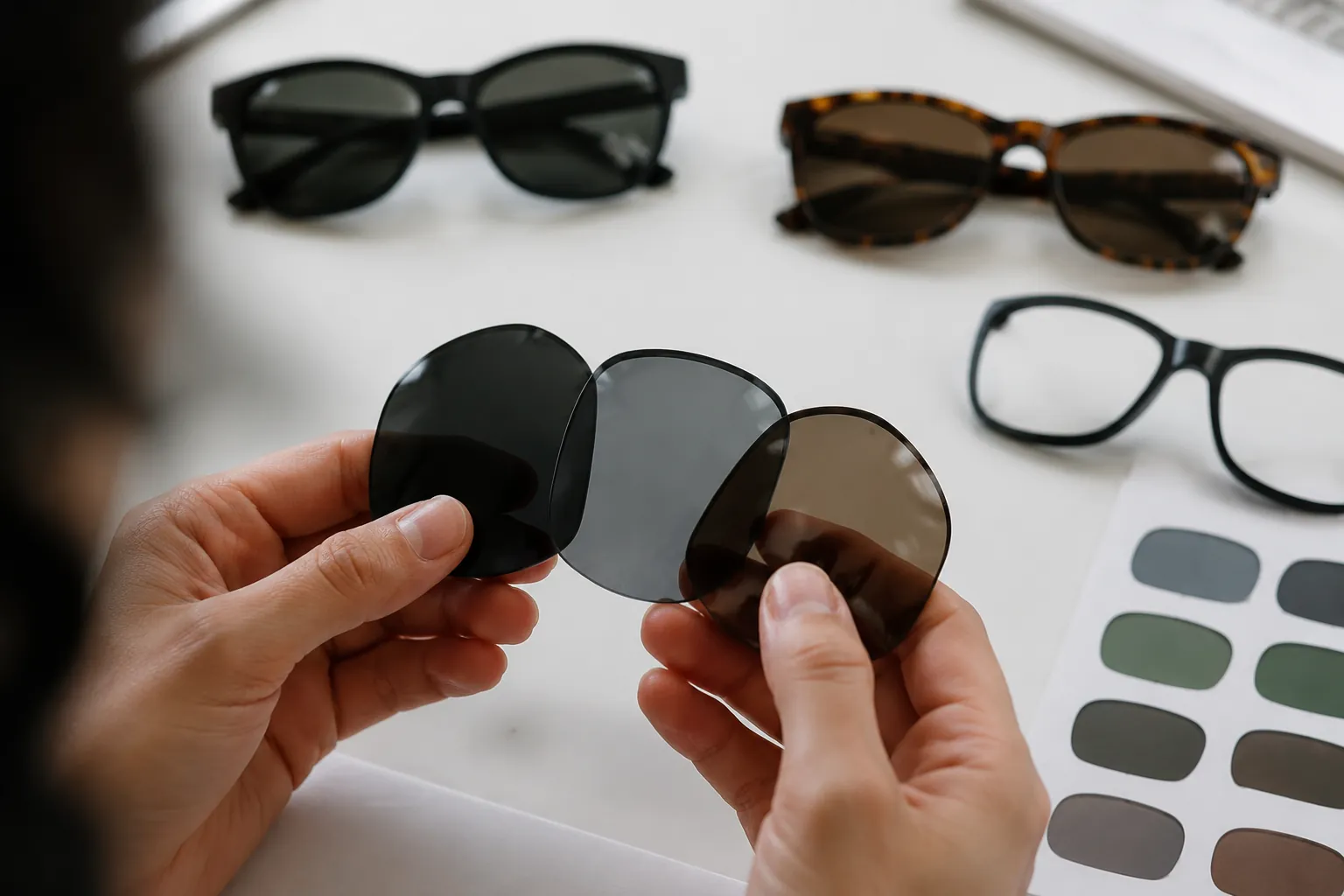
This guide is for importers, brand owners, distributors, and retail buyers sourcing custom sunglasses at volume. The goal is not to rank PC, TAC, and nylon in the abstract. It is to match each lens material to a real commercial brief: target price, sales channel, product position, complaint risk, and destination market. Get that match right and you avoid two common mistakes: overspecifying low-price programs and underspecifying retail or performance lines where returns, complaints, or compliance problems erase margin. Decide lens material early. It affects construction, edging, tint control, coating options, frame fit, QC checkpoints, and the test basis for the final product.
Start with the channel, not the lens brochure
Bad lens decisions usually start with habit. A buyer asks for TAC because a competitor says "polarized." A promo program gets pushed to nylon because it sounds premium. A sport-style frame stays on cheap PC to save cost even though the line is being sold on function. That is backward.
Start with the sales channel. Then choose the lens material that reduces the most likely source of returns, claims, or weak sell-through.
Map the brief to the main post-delivery risk:
- Promo / giveaway: price, on-time delivery, handling durability, and branding usually matter more than premium optics.
- Value retail: the product needs decent everyday performance inside a hard shelf-price target.
- Fashion ecommerce and chain retail: returns often come from scratches, visible distortion, uneven tint, or weak perceived quality.
- Sports / outdoor: lens performance under movement, low weight, wrap compatibility, and comfort matter more.
- Distributor programs: repeat-order consistency matters. A slightly better lens spec can cost less than repeated dealer claims.
This choice affects more than the BOM. It changes lens thickness, edging method, groove fit, frame tension, polarization control, coating selection, and whether the approval sample actually reflects bulk production.
One blunt rule: if the frame design is approved but the lens material is still undecided, the program is already at risk. Fix the channel, price band, and complaint tolerance first. Then lock the lens spec in writing.
What PC, TAC, and nylon actually do differently
These three options are not interchangeable. Each solves a different mix of cost, optics, durability, and product positioning.
PC (polycarbonate) is the commercial workhorse. It is light, impact resistant, widely available, and usually the most cost-efficient option for a functional sunglass lens. It is common in kids, promo, value retail, and many sport-inspired lines. The main watchpoint is surface hardness. Without a reliable hard coat, PC scratches more easily than harder lens constructions.
TAC in trade use usually means a laminated polarized lens construction, not a single resin category in the same sense as PC or nylon. Exact structures vary by supplier. For buyers, the key point is simple: TAC is often chosen because it gives you a polarized feature story at a controlled cost. But performance depends heavily on lamination quality, adhesive control, thickness consistency, and finishing. Two TAC offers can differ a lot even if both are sold as "polarized TAC."
Nylon is common in performance eyewear because it is light and often delivers better optical performance on curved lenses and wrap shapes. That is why it shows up in cycling, running, fishing, golf, and shield-style sunglasses worn for longer periods and under active use.
| Lens material | Typical commercial use | Strengths | Risks / watchpoints | Typical cost position |
|---|---|---|---|---|
| PC | Promo, kids, value retail, non-polarized ecommerce | Widely available, good impact resistance, light weight, cost-efficient | Needs reliable hard coat; optical quality varies by grade and lens geometry | Lowest to mid |
| TAC | Polarized fashion, driving, chain retail, distributors | Clear polarized feature story, broad commercial availability, attractive value position | Lamination quality matters; not usually the first choice for demanding wrap-performance use | Mid |
| Nylon | Sports, outdoor, premium activewear, wrap frames | Low weight, strong optical performance, well suited to curved lenses | Higher cost; unnecessary for many low-price channels | Highest |
Cost differences depend on construction, coatings, tint, mirror finish, and volume. Do not judge value by material name alone.
How to spec lenses for retail and ecommerce
Retail and ecommerce buyers are not just buying a lens. They are buying a complaint profile. The right spec cuts the issues customers mention in reviews and returns: scratches, glare behavior, visible distortion, uneven tint, or poor finish.
For value retail, PC is usually the right starting point. If the shelf price is tight, spend the money on details customers notice first:
- a reliable hard coat,
- consistent tint density across the production lot,
- clean lens edge finish, and
- stable lens fit in the frame.
For fashion chains and DTC ecommerce, TAC is often a practical call on polarized styles because the polarized claim is easy to explain and easy to merchandise. If the style is non-polarized and sells mainly on shape, color, logo, and trend, good-grade PC may be the better margin choice.
Do not send the factory a vague note saying "good quality lens." A usable retail spec should include:
- Market destination and applicable standard basis.
- Polarized or non-polarized requirement.
- Tint category or transmission target if relevant to the market and use case.
- Coating expectation, especially hard coat and mirror finish where applicable.
- Primary complaint risk: scratches, distortion, color inconsistency, or breakage.
- Target cost band and expected order volume.
Clear briefs cut sample rounds. Vague lens instructions do the opposite. First sample: looks fine but is not polarized. Second sample: hits the feature claim but misses cost. Third sample: still does not match the intended production build. That waste is avoidable.
How sports and outdoor programs should spec differently
Sports buyers should not use fashion logic. In active use, lens performance becomes much more obvious, especially on wrapped frames and shields. Distortion that may pass on a flatter fashion style can become a real problem during cycling, running, fishing, or golf.
This is where nylon often earns its price. On higher-wrap geometries, it is commonly chosen for better optical performance and low weight. It is also a more credible material fit for products sold as functional sports eyewear rather than sports-look fashion.
Use nylon when most of the following are true:
- The frame has strong wrap, shield construction, or a higher base curve.
- The end user is expected to be active, not casual.
- The line will be compared with performance brands, not just fashion brands.
- The retail price can absorb the material upgrade.
- The brand wants fewer compromises on optics and long-wear comfort.
PC still has a place in sport-inspired products, especially where the frame is only moderately wrapped and the price target is strict. But ask the direct question: are we selling a sports look or sports function? Those are different briefs. Spec them honestly.
For sports programs, go deeper with the factory. Confirm:
- Lens base compatibility with the frame geometry.
- Edging method and target tolerance.
- Lens thickness suitable for the frame design.
- Frame groove fit tolerance to avoid stress, rattle, or assembly damage.
- Polarization alignment checks if the style is polarized.
Get the tolerance and approval method in writing. Do not assume the supplier's default standard is good enough for a performance line.
Promo programs need a cost brief, not a premium brief
Promo sunglasses are where buyers most often overspec. If the program is an event giveaway or a mass branded item, a premium performance lens usually adds little channel value unless the customer is clearly paying for that story.
For promo, PC is usually the right answer. It balances cost, handling durability, and sourcing flexibility. Keep the brief tight. Protect the economics.
- Limit lens colors to standard smoke, brown, green, or one approved fashion tint.
- Specify the target market's UV and category requirements.
- Choose one primary decoration method where possible: pad print, laser engraving, or metal logo plate.
- Use simple packaging unless presentation is part of the sales case.
- Avoid low-volume custom extras that do not improve brand impact or compliance.
Decoration choice matters too. Pad print is often the cheapest option for simple logos and larger runs. Laser engraving can create a more durable premium impression on compatible parts. Metal logo plates can raise perceived value, but they also add parts, assembly steps, and failure points. On deadline-driven programs, every extra process adds execution risk.
The best sourcing question here is blunt: if the customer asks for "better quality," what exact problem are they trying to avoid? In promo, the answer is usually not premium optics. It is on-time delivery, acceptable appearance, and clear branding.
Compliance and testing: confirm this before bulk
Lens material selection has to match the destination market and the exact product configuration being sold. Do not accept generic compliance claims without checking the actual test basis.
For sunglasses, common commercial references include CE EN ISO 12312-1, ANSI Z80.3, AS/NZS 1067, and REACH where applicable. System certifications such as ISO 9001 and social compliance frameworks such as BSCI can be useful supplier indicators, but they do not replace product-level validation. FDA registration is not a substitute for sunglass performance testing.
A few practical points matter:
- CE EN ISO 12312-1 is commonly used as a basis for general-purpose sunglasses in relevant markets.
- ANSI Z80.3 is a commonly referenced standard basis for the US market.
- AS/NZS 1067 is relevant for Australia and New Zealand programs.
- REACH addresses applicable chemical compliance requirements for the European market.
- ISO 9001 and BSCI show management-system or social-compliance status, not product pass status.
Also note this: changing the lens after sample approval can change the compliance assumptions. A shift from PC to nylon, or from non-polarized to TAC polarized, is not just a costing update. It can affect optical behavior, light transmission, assembly method, labeling, and the test basis. The safest approach is to tie compliance review to the exact frame + lens + tint + coating configuration being ordered.
At minimum, ask the factory to confirm:
- Which standard basis applies to your destination market.
- Whether the report or test basis matches the actual lens material, tint, and polarized status.
- Whether changes to mirror finish, polarization, or category require revalidation.
- What incoming, in-process, and final QC records are kept for the order.
Factory process details that change the final result
Experienced importers know this already: the same material can perform very differently depending on process control. Good resin does not fix weak edging, inconsistent tinting, poor coating control, or careless assembly.
A basic factory flow for custom sunglasses typically runs like this:
- Confirm CAD, lens material, lens color, coating, and artwork files.
- Adjust tooling or fit prototype as needed.
- Produce frames by injection molding, acetate processing, or CNC machining, depending on construction.
- Prepare, tint, coat, and edge lenses to the approved geometry.
- Apply branding such as pad print, laser engraving, or metal logo plates.
- Assemble, align, clean, inspect, and pack.
The predictable failure points are also the right places to push for detail:
- Lens curvature drift can affect both fit and visual perception.
- Tint variation can create visible lot inconsistency.
- Polarization orientation errors can happen if assembly controls are weak.
- Coating inconsistency can increase scratch complaints or cosmetic defects.
- Lens edge quality affects both appearance and retention in the frame.
Do not ask, "Do you have QC?" Ask operational questions:
- What lens thickness is approved for this style?
- What tolerance is allowed on lens fit into the frame groove?
- How is tint checked against the approved sample?
- How is polarization orientation verified during assembly?
- What are the QC checkpoints before final packing?
Suppliers that keep more of the process in-house may reduce handoff risk. That helps. It does not remove the need for a clear spec sheet and configuration-based approval.
A simple buying matrix importers can use
If you need a quick decision, use the matrix below. Then check it against your complaint history, target retail price, and product position.
| Sales channel | Default lens recommendation | Upgrade trigger | Why |
|---|---|---|---|
| Promo / giveaway | PC | Upgrade only if the product story requires polarized or active-use positioning | Best fit for cost control and practical durability in mass distribution |
| Value retail | PC | Upgrade to TAC for polarized programs or if returns show scratch or quality sensitivity | Balances shelf price with acceptable everyday performance |
| Fashion ecommerce | TAC for polarized, PC for non-polarized | Upgrade to nylon only if the frame is truly performance-led | Keeps feature claims clear while controlling unnecessary cost |
| Chain retail / distributors | TAC or good-grade PC | Upgrade based on retailer requirements, complaint history, and target margin | A small lens-cost increase may be justified by lower claims |
| Sports / outdoor | Nylon | Use PC only on lower-price sport-inspired lines | Better match for wrap geometry, active wear, and performance positioning |
One practical tactic: sample two lens constructions on the same frame before final signoff if the channel fit is not obvious. That lets you compare optics, appearance, fit, and cost on the actual product rather than in the abstract.
Short version. Use PC for cost-driven channels, TAC where a polarized value story matters, and nylon where real performance use justifies the premium.
Have a custom sunglasses project in mind?
Send us your styles, target market and quantities and we will return a detailed quote with MOQ, lead time and a sample plan.
Get a QuoteWhy source this from Wenzhou with LumiShades
Wenzhou in Zhejiang Province is widely regarded as China’s eyewear manufacturing capital, producing a large share of the world’s sunglasses. That concentration matters to buyers: a deep local supply chain for acetate sheet, hinges, lens blanks, plating and packaging means shorter component lead times, easier color and material matching, and a workforce with decades of eyewear-specific skill. LumiShades has manufactured in this ecosystem since 2009, and our vertical integration — in-house injection molding, acetate cutting, CNC milling, lens tinting, decoration and quality control — means no part of your order is quietly subcontracted to a workshop you cannot audit.
For international buyers, that vertical control translates into accountability. When a single factory owns every step, defects are traced and fixed at source rather than bounced between vendors, and your specifications survive intact from first sample to bulk. We back this with 15+ years of experience, shipments to 60+ countries, more than 5 million pairs produced per year and a 98.5% on-time delivery rate. Our certifications — CE EN ISO 12312-1, FDA registration, ANSI Z80.3, AS/NZS 1067, REACH, ISO 9001 and BSCI audit — mean the compliance documentation your market requires already exists. Explore our manufacturing capabilities and quality control process to see how this works in practice.
Frequently asked questions
Is TAC always better than PC for fashion sunglasses? No. TAC is often the better option when the style is sold as polarized, especially for driving or casual outdoor use, because the polarized feature is easy to explain at retail. But for non-polarized fashion styles, PC may be the better commercial spec if the SKU has to stay in a lower cost band. Action point: decide first whether polarization is a real selling claim for that SKU. If yes, compare TAC against a polarized PC alternative if the supplier offers one. If no, request a good-grade hard-coated PC sample and judge it on tint consistency, cosmetic finish, and frame fit.
When should I pay extra for nylon lenses? Pay extra for nylon when the product is genuinely performance-oriented: wrap frames, shields, cycling, running, fishing, golf, or other active-use eyewear where low weight and optical performance matter in use. Nylon is usually hard to justify on low-price fashion or promo programs. Action point: if the frame has significant wrap or the line will be marketed as true sports eyewear, ask the factory to quote nylon and a backup option on the same frame, then compare optics, weight, and cost before approving the final build.
Can I switch lens material after sample approval? Yes, but treat it as a new configuration, not a minor change. A lens-material change can affect fit, edging, transmission, optical behavior, coating selection, labeling, and the compliance basis. Action point: if you switch from PC to TAC, PC to nylon, or non-polarized to polarized, ask for a revised sample, revised quotation, and written confirmation that the compliance basis still matches the exact frame and lens combination being ordered.
What compliance documents should I ask for on sunglasses? Start with the destination market and ask for the relevant basis: <strong>CE EN ISO 12312-1</strong>, <strong>ANSI Z80.3</strong>, <strong>AS/NZS 1067</strong>, and <strong>REACH</strong> where applicable. You can also ask whether the supplier holds <strong>ISO 9001</strong> or <strong>BSCI</strong>, but those do not replace product-level validation. <strong>FDA registration</strong> is not a substitute for sunglass performance testing. Action point: request documents that match the exact product configuration you are buying, including lens material, tint, polarized status, and any mirror coating if relevant to labeling or performance.
How do MOQ and volume pricing affect lens choice? Lens upgrades are easiest to absorb when the retail channel supports them and order volume is high enough to spread setup and material cost. At lower MOQs, a move from standard PC to TAC or nylon can change SKU economics more sharply. Action point: ask suppliers to quote at your actual expected volume and at the next volume break, using the same frame with alternative lens options. That shows whether the upgrade improves channel fit enough to justify the added cost.
Ready to start?
Explore our round sunglasses or request a quote — our sales team replies within 12 hours.
Request a Quote