
Hard-Coated vs Scratch-Resistant Lenses: Proof Buyers Need
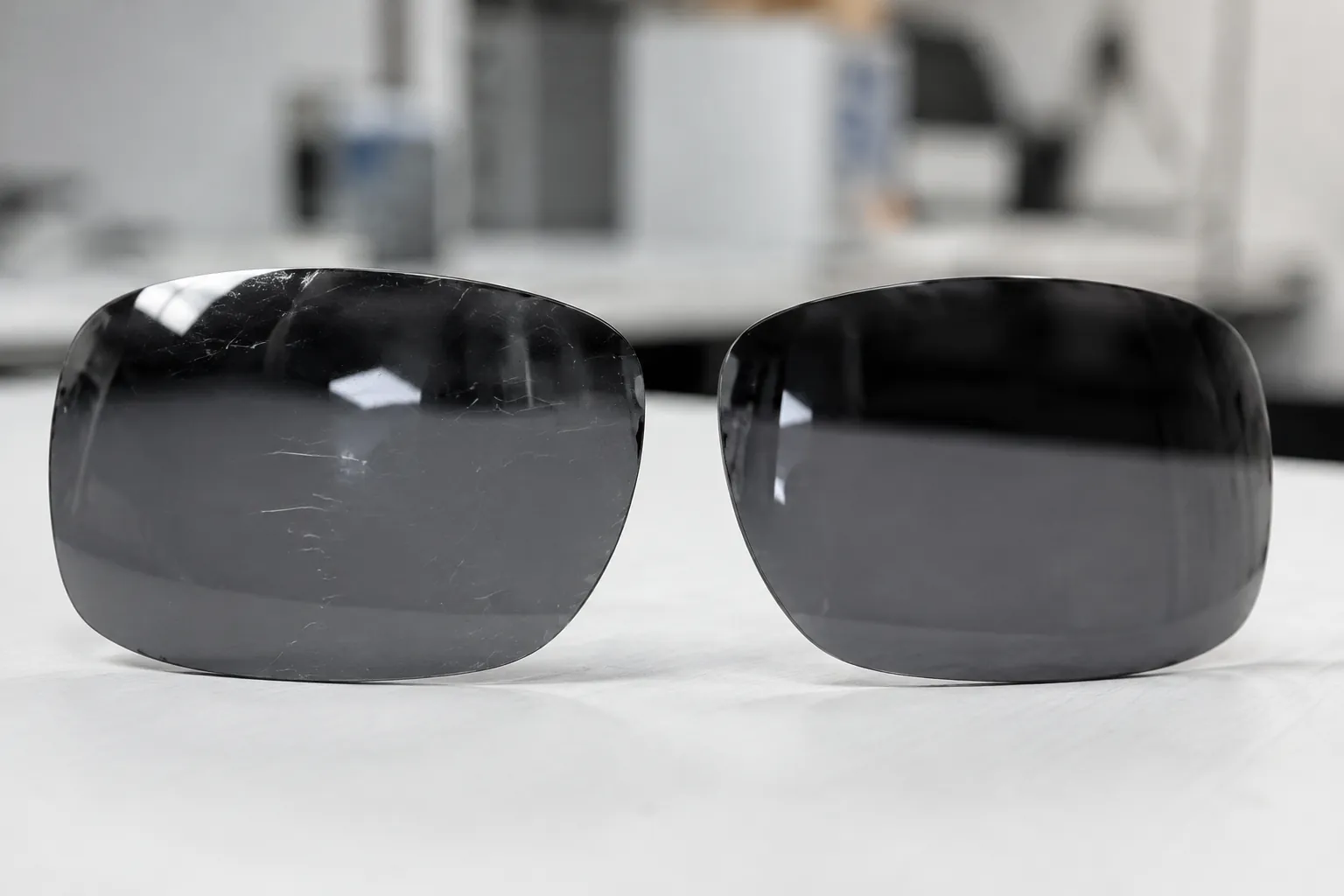
This guide is for brand owners, importers, and procurement teams buying custom sunglasses at volume. It strips vague wording out of lens claims, shows which abrasion evidence matters, and explains how to write a coating requirement the factory can execute and verify.
Why buyers mix up these terms
"Scratch-resistant" is usually sales language. It describes a claimed result, not a defined lens build. On its own, it tells you nothing about the substrate, whether a coating was added, which side was coated, or how the claim was tested. "Hard-coated" is narrower. It means a surface coating was applied to improve abrasion resistance. But that still is not enough unless the factory can name the substrate, coated side, process route, and test method.
That gap matters in bulk buying. A quote that says only "scratch-resistant lens" still leaves basic questions open: polycarbonate, TAC, CR-39, or something else; front side, back side, or both; and whether the claim was checked on the same finish stack you will actually ship.
Keep one rule in every PO review: scratch-resistant is not scratch-proof. A hard coat can reduce damage from normal cleaning and handling. It will not stop marks from grit, poor packing, or abrasive cloth.
Base material matters more than the label
Start with the substrate. The same coating claim can perform very differently across lens materials. Surface hardness, impact behavior, lamination structure, and coating adhesion all affect what happens in real use.
| Lens build | What usually drives abrasion performance | What to confirm with the factory | Buying implication |
|---|---|---|---|
| PC lens | Polycarbonate is light and impact resistant, but it marks easily if the hard coat is weak or missing | Whether a hard coat is applied, on which side or sides, and whether the tested sample matches your final tint and finish | For most sunglass programs, make the coating requirement explicit rather than assumed |
| TAC polarized lens | Abrasion performance depends on the outer layers, lamination quality, and any mirror or flash layer; polarization alone tells you little | What the outer sheets are made of and where any mirror or flash layer sits in the stack | A generic "polarized TAC" label does not support an abrasion claim |
| CR-39 or cast resin lens | Base surface performance can differ from PC, but coating quality still affects day-to-day marking and cleanability | Whether the quoted lens includes a top coat and how the factory checks adhesion and abrasion performance | Do not assume the substrate removes the need for a coating requirement |
| Nylon or polyamide sport lens | Flexibility and sports use make coating fit and adhesion more application-specific | Whether the supplier has tested the coating on that exact material and lens geometry | Ask for adhesion and abrasion evidence on the real build, not a different substrate |
Make the supplier write the full lens stack in plain language: material, nominal thickness and tolerance if controlled, tint or filter category, polarization, mirror or flash finish, and any printing or laser marking added after coating. If you approve only a generic description, the report may be real and still not match the goods you receive.
What a controlled hard-coat process looks like
A real hard-coat program is a controlled process, not a verbal promise. The factory or its coating partner should be able to identify the coating type, surface preparation steps, application method, cure route, and inspection criteria used before the lens goes to assembly.
Process details vary by coating chemistry and substrate. That is normal. What you should not accept is "standard hard coat" as technical proof. Ask whether the approved sample was made on the same production route planned for bulk, including any mirror deposition, lens marking, edging, cleaning, and final packing done after coating.
If coating is outsourced, request two records: the coater's batch or test record, and the finished-goods factory's own inspection and traceability record for the assembled sunglasses. The shipper owns the final result.
Evidence to request before approving production
Do not accept "passed scratch test" as evidence. Ask for the method, sample description, date, acceptance criteria, and actual result, all tied to your lens build. A demo sample is weak evidence unless you agreed it was only for early screening.
- Request an abrasion report on the actual lens construction, not a generic report from another color, substrate, mirror finish, or polarization stack.
- Ask for the method by name. Methods used in industry include Taber abrasion, Bayer comparison, and defined steel-wool or rub protocols. If the method is internal, require the exact media, load, cycle or rub count, inspection condition, and grading rule.
- Ask what was measured: haze change, Bayer ratio, visible scratch count, coating breakthrough, or pass/fail against a visual standard. Those outputs are not interchangeable.
- Require a post-conditioning adhesion or durability check if the lens will face heat, humidity, sweat, sunscreen, long transit, or other relevant exposure. Write the conditioning method into the requirement.
- Define the sample count in the approval requirement. The report should state how many lenses were tested and which batch they came from.
- Match the report to the production lot. The document should identify lens material, tint or filter category, finish stack, coating date or lot, and any post-coating decoration.
An internal steel-wool or rub method can still help for supplier comparison, but only if it is written tightly enough to repeat. "Rubbed by hand, no issue" is not a method. A usable protocol names the media, load, number of rubs or cycles, inspection light, and reject threshold.
How proof should scale with order risk
There is no magic pair count. The right proof level depends on order value, finish complexity, and the cost of failure after goods are packed, shipped, and distributed. Simple rule: the larger or riskier the order, the more formal the evidence should be.
| Order stage | Minimum coating proof | Why it matters | Main risk if skipped |
|---|---|---|---|
| Prototype or sales sample | Named lens material, coated side, and at least one defined internal comparison method | Shows the supplier is describing a real lens build rather than repeating a generic claim | Marketing language hides the actual construction |
| Pilot or pre-production order | Production-intent abrasion report on the final lens construction and finish stack | Locks the recipe before volume starts | Bulk lenses do not match the approved sample |
| First full production order | Abrasion evidence plus an adhesion or durability check after the conditioning method stated in your spec | Tests the lens as it will be shipped and used | Coating haze, peeling, or early marking appears after transit or retail handling |
| Repeat high-volume order | Golden sample, lot traceability, retained control samples, and an incoming QC plan | Controls process drift across repeat batches | Small variation becomes large return or rework cost |
If your team wants numeric thresholds, put them in your own sourcing SOP. Do not treat a copied threshold from another supplier template as an industry rule. Evidence standards should follow failure cost, not habit.
Put the coating requirement in the PO
If the coating requirement is not in the PO or approved specification, it can disappear on the reorder. Keep the wording short, specific, and measurable. Tie it to the actual lens build.
Lens: smoke PC lens, nominal thickness and tolerance per approved drawing, filter category and UV requirement per approved sample, hard coat on both sides. Finish stack to match approved sample, including any polarization, mirror, flash coat, and lens marking. Visual quality standard, inspection light, abrasion method, adhesion check, and packing method to follow approved specification. Supplier to provide reports on production-intent samples, retain approved control samples from bulk, and maintain lot traceability.
- State the base material first, plus thickness and tolerance if they are controlled.
- State whether the hard coat is on the front, back, or both sides.
- Name the full finish stack, including polarization, mirror, flash coat, and any print or laser mark applied after coating.
- Cite the exact abrasion method and any conditioning or adhesion check, or attach the protocol.
- Define the visual reject standard, inspection condition, pack-out method, and final sign-off sample.
A temple pad print rarely affects lens durability. Lens printing, mirror deposition, final cleaning, peel film, pouching, or lens-to-lens contact can. If packing drives scuff risk, write it into the approved specification.
Compliance files do not prove abrasion resistance
Buyers often lump regulatory compliance and coating durability into one approval folder. They are different. For market access, the supplier may need evidence tied to CE-marking obligations and EN ISO 12312-1 for the EU market, ANSI Z80.3 for the United States, or AS/NZS 1067 for Australia and New Zealand, depending on the product and destination. REACH covers restricted substances. FDA registration is administrative for certain U.S. eyewear activities; it is not proof of abrasion performance. ISO 9001 and BSCI may show management-system or social-audit controls, but neither says a lens coating will resist scratching.
Request compliance files and coating evidence as separate approval items. Then check that each document describes a sample close enough to your SKU to matter: same lens material, same filter category or tint, same polarization or mirror construction, and the same post-coating branding or cleaning steps where relevant.
How to approve bulk without surprises
Before bulk starts, approve a golden sample and keep a matching counter-sample on your side. It should be production-intent, not a hand-finished prototype. Ask the supplier to retain lot samples too, so any later claim can be checked against a known reference.
For receiving QC, keep the method simple and repeatable:
- Inspect lenses under the same lighting and viewing conditions defined in the specification, and compare them with the approved sample.
- Verify filter category or tint, polarization effect if applicable, mirror color, and logo position on a sample from each lot.
- If you use a rub or handling check, use only the pre-agreed method. Do not invent a harsher method after shipment and treat it as a pass/fail standard.
- Inspect packing for sources of secondary damage such as dirty bags, missing tissue, loose parts, or lens-to-lens contact.
- For larger shipments, apply an AQL-based incoming inspection plan so acceptance rules stay consistent from lot to lot.
On-time delivery does not fix a bad lens build. If the shipped construction does not match the approved sample, the lot is nonconforming even if it arrived on schedule.
Have a custom sunglasses project in mind?
Send us your styles, target market and quantities and we will return a detailed quote with MOQ, lead time and a sample plan.
Get a QuoteWhy source this from Wenzhou with LumiShades
Wenzhou in Zhejiang Province is widely regarded as China’s eyewear manufacturing capital, producing a large share of the world’s sunglasses. That concentration matters to buyers: a deep local supply chain for acetate sheet, hinges, lens blanks, plating and packaging means shorter component lead times, easier color and material matching, and a workforce with decades of eyewear-specific skill. LumiShades has manufactured in this ecosystem since 2009, and our vertical integration — in-house injection molding, acetate cutting, CNC milling, lens tinting, decoration and quality control — means no part of your order is quietly subcontracted to a workshop you cannot audit.
For international buyers, that vertical control translates into accountability. When a single factory owns every step, defects are traced and fixed at source rather than bounced between vendors, and your specifications survive intact from first sample to bulk. We back this with 15+ years of experience, shipments to 60+ countries, more than 5 million pairs produced per year and a 98.5% on-time delivery rate. Our certifications — CE EN ISO 12312-1, FDA registration, ANSI Z80.3, AS/NZS 1067, REACH, ISO 9001 and BSCI audit — mean the compliance documentation your market requires already exists. Explore our manufacturing capabilities and quality control process to see how this works in practice.
Frequently asked questions
Is "hard-coated" enough wording on a quotation? No. Add the missing technical fields before approval: lens material, nominal thickness or drawing reference, coat side or sides, full finish stack, test method, and the report or batch record behind the claim. If the supplier cannot provide that detail, treat the wording as incomplete, not as proof.
Should I specify coating on both sides of the lens? Usually yes for polycarbonate fashion sunglasses. The back surface often picks up marks during cleaning and pouch use. If cost forces a one-side coating, specify exactly which side is coated and accept the trade-off in writing. Then make sure the abrasion evidence matches that one-side construction, not a double-coated sample.
Can I use a generic report from a similar lens? Only for supplier screening or early development. Final approval should use a production-intent sample that matches the material, filter category or tint, polarization or mirror stack, edging state, and any printing or laser marking applied after coating. Ask the factory to print that build description on the report so it can be tied to your SKU.
At what order size should I insist on formal abrasion and adhesion reports? There is no universal order-size trigger. At sampling stage, require at least a named internal method and a clear lens build description. Before the first real production order, the safer minimum is a production-intent abrasion report on the final construction. Add post-conditioning adhesion or durability checks when the order value, finish complexity, or return risk is high.
What if the factory says the coating supplier owns the test data? Ask for both records: the coating supplier's test data and the finished-goods factory's own traceability and final inspection record. The sunglasses supplier should be able to link the coating batch to your lens build and shipment lot. If that link is missing, hold bulk approval until traceability is shown.
Ready to start?
Explore our square sunglasses or request a quote — our sales team replies within 12 hours.
Request a Quote