
How Importers Check Sunglass Lenses Before Bulk
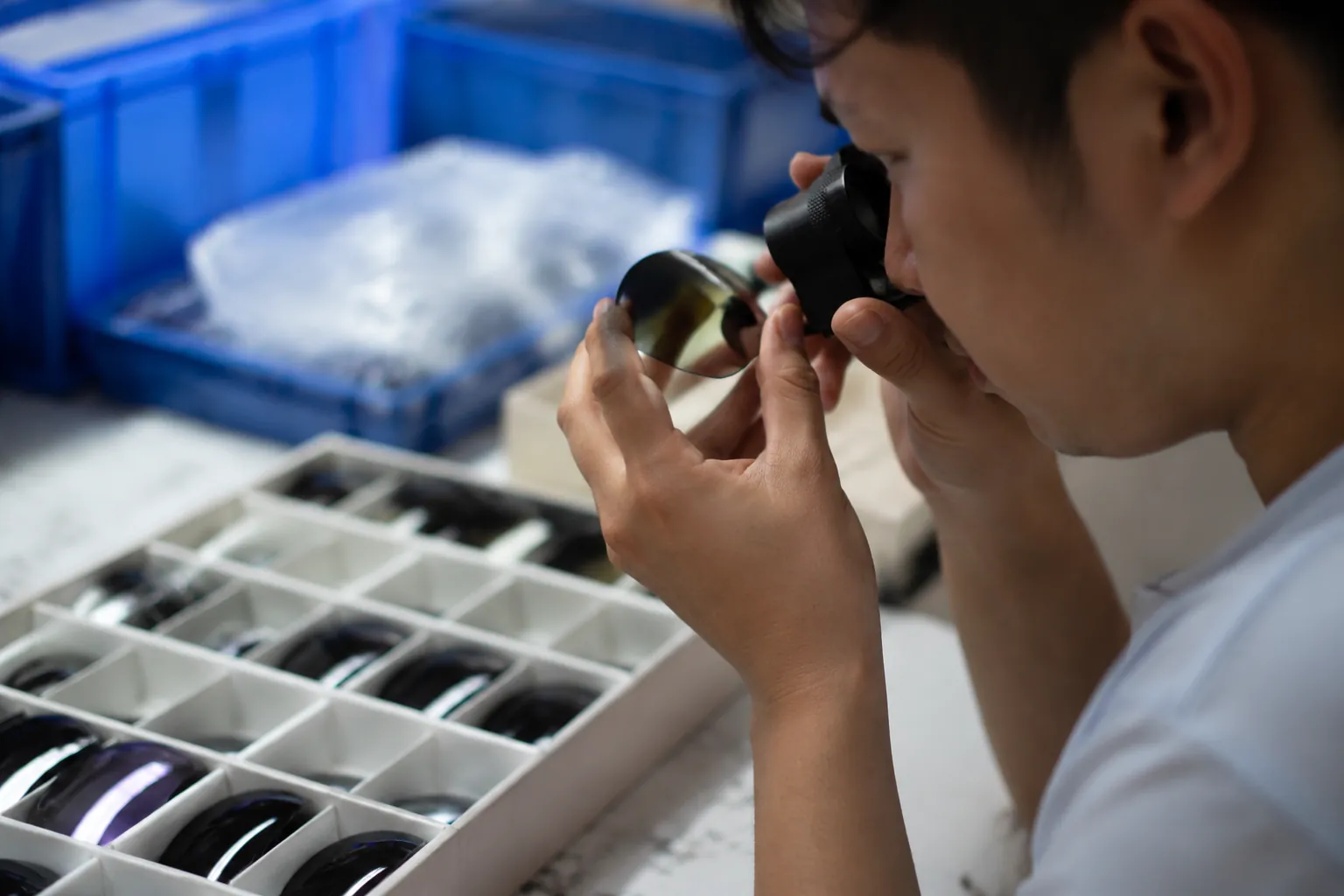
This guide is for buyers approving custom sunglasses before bulk production. It covers practical checks on production-intent samples and pilot units. It does not replace laboratory testing to CE EN ISO 12312-1, ANSI Z80.3, or AS/NZS 1067. Its job is narrower: confirm that the approved lens material, coating, edging, and frame assembly still deliver clear, comfortable vision in the finished pair before mass production starts.
Compliance Is Baseline, Not Protection
Buyers often treat compliance paperwork as proof that a sunglass program is safe to release. That is too broad. CE EN ISO 12312-1, ANSI Z80.3, and AS/NZS 1067 matter because they set market-specific requirements for sunglasses. REACH evidence covers restricted substances. FDA registration may matter for US paperwork, depending on classification and entry route. ISO 9001 and BSCI say something about systems or social compliance. They do not tell you whether a finished pair is comfortable to wear.
That is a separate question. And it matters. A lens can meet UV and labeling requirements and still show local distortion, haze, or assembly-induced stress after edging and mounting.
So importers need a separate pre-production optical approval routine on production-intent parts. This routine does not replace accredited testing. It closes a different risk: the gap between a valid compliance file and a finished pair people can actually wear.
Four Defects Behind Fast Complaints
These problems drive complaints because they may look minor on the desk, then become obvious outdoors or during head movement.
| Defect | What the wearer may notice | Typical factory cause | Buyer-side screening rule |
|---|---|---|---|
| Wave or local distortion | Straight lines bend, ripple, or seem to move during head movement | Mold or polish inconsistency, unstable cooling, lens warpage, excessive edging heat, or distortion during insertion | Check each lens against a consistent line grid at a fixed distance; reject visible local distortion in the primary viewing area |
| Prism or left-right optical imbalance | Eye strain, pulling, unusual fatigue, or a sense that one eye is working harder | Left-right decentration, mismatched lens geometry, poor seating depth, or frame twist after assembly | Compare left and right lenses together against the same vertical reference and request instrument readings where the supplier has that capability |
| Haze | Milky veil, weak contrast, or reduced clarity in bright light | Contamination in resin or lamination, coating defects, trapped dust, or heat damage during processing | Inspect on-axis under bright diffuse white backlight and compare with an approved retain sample |
| Assembly stress or comfort issue | Pressure, rapid fatigue, or unusual discomfort even when the lens looks cosmetically acceptable | Tight groove fit, front twist, aggressive wrap, over-tightened rim screw, or stress introduced during glazing | Recheck the finished pair after assembly and require a short wear trial for higher-risk styles |
Write these up as functional defects, not cosmetic notes. A clean logo print or attractive mirror finish does not offset bad optics. Also, a visual screen is only a filter. It does not replace formal prism measurement.
Where Distortion Starts
Optical trouble often starts upstream, long before final QC. Polycarbonate can develop flow marks or internal stress if resin drying, molding, and cooling are not stable. A loose lens may look acceptable on the bench, then change after edging or insertion if the part is heated, over-cut, or forced into a wrapped front.
TAC polarized construction adds more interfaces because it is laminated, not a single solid lens. That creates more failure points. Haze or stress can start in lamination quality, contamination between layers, edge sealing, or heat introduced during cutting and assembly. A cross-polarized inspection can reveal stress patterns, but it is only a screening tool. Not proof of compliance.
Frame design matters just as much as lens material. A tight acetate groove, an out-of-flat front, or excessive rim-screw torque in a metal frame can load the lens after insertion. Decoration steps add risk too. Mirror coating, gradient tinting, pad printing, laser marking, and repeated cleaning do not automatically damage optics, but each step creates another chance for heat, dust, scratches, or lens mix-up. Ask where the optical check sits in the real production flow. Do not stop at asking for a test report.
The Pre-Production Checks Buyers Should Require
Before bulk approval, ask for a repeatable check set on production-intent parts made with the actual lens material, base curve, tint, coating, and frame assembly method. A hand-picked showroom sample is not enough if bulk will use different tooling, coatings, or glazing conditions.
- Confirm sample identity: Verify that the lenses and frames are production-intent parts, not substitute materials or an earlier construction that will not be used in bulk.
- Grid movement test: Hold each lens in front of a printed line grid or another straight reference at a fixed viewing distance. Move the lens left, right, up, and down, then rotate it slowly. Visible local bending or jumping in the main viewing area is a warning sign.
- Left-right pair check: Review the pair together against the same vertical reference. A single lens can look acceptable alone and still feel wrong when paired. If the supplier has a lensometer or similar instrument, ask for the readings on the approved pair.
- Backlight haze check: Use bright diffuse white light, not weak workshop lighting. Compare the sample against a signed retain sample or a previously approved control. Haze usually appears as a veil, patchiness, or loss of contrast.
- Cross-polarized stress screen: For TAC or higher-wrap styles, inspect the finished pair between polarized filters to look for stress patterns around the edge, nose area, or groove line. Treat this as an early warning screen, not as a standalone pass-or-fail standard.
- Post-assembly recheck: Repeat the grid and pair comparison after edging and insertion. Many optical problems show up only after mounting.
- Short wear trial: For wrapped, polarized, mirrored, or otherwise higher-risk styles, have at least one reviewer wear the finished pair briefly while walking and shifting focus from near to far. Any repeatable discomfort should trigger a recheck, not a shrug.
Record the method, lighting, sample ID, reviewer, and decision at each approval step. That record matters later if bulk units do not match the signed sample.
Write Optical Limits Into the RFQ
If the RFQ only says polarized, smoke lens, or mirror finish, the supplier still has room to ship a product that is compliant on paper but weak in use. Optical expectations need to be written into the RFQ, sample approval record, and pilot sign-off sheet.
- Define the lens construction clearly: polycarbonate, TAC polarized, nylon, CR-39, mirror coating, gradient tint, hard coat, hydrophobic coat, or backside anti-reflective treatment.
- Define geometry that affects optics: base curve, center thickness target, edge thickness range, wrap angle, and whether the left and right lenses are dedicated or interchangeable.
- Specify the inspection stages: loose lens, after tint or mirror coating, after edging, and after final frame assembly.
- State the buyer-side acceptance logic in observable terms. Example: no visible local distortion in the primary viewing area during the agreed grid test, no obvious on-axis haze versus the approved retain sample under the agreed backlight, and no new distortion introduced after assembly.
- Require paired review, not single-lens review only. Where the supplier has instrument capability, ask for the related readings on the approved sample.
- Request the actual QC record format: sample count, defect photos, check stage, reviewer, and the retain sample reference tied to the order.
- List the market-specific compliance pack required for the order: CE EN ISO 12312-1, ANSI Z80.3, AS/NZS 1067, REACH evidence, and FDA registration details where applicable.
If a criterion is subjective, anchor it to a method, a lighting condition, and a reference sample. That cuts down later arguments because both sides are judging the same thing the same way.
Use a Sample-to-Pilot Workflow
One good sample proves very little. It shows only that one pair was made correctly once. It does not show repeatability. Buyers reduce that risk by separating design approval from process approval.
| Stage | Typical point in the project | What the buyer approves | Main risk removed |
|---|---|---|---|
| Development sample | After initial tooling or material selection | Frame shape, lens construction, base curve, color direction, and first optical screen | Wrong product concept or obvious distortion built into the design |
| Corrected sample | After changes requested by the buyer | Revised lens clarity, fit, finish, logo placement, and basic wearability | Approving bulk against a first sample that still contains known issues |
| Pilot batch | Before mass production release | Consistency across multiple production-intent pieces after full assembly | Golden-sample effect and unstable process settings |
| Bulk production | After pilot sign-off | Final QC against the signed retain sample and approved records | Late discovery after large-volume assembly and packing |
The pilot stage is where repeatability gets tested. Set the pilot sample size in writing. Make it large enough to show whether the result holds across more than one production cycle or assembly shift. One approved pair should never be the only evidence used to release a bulk order.
High-Risk Styles Need Tighter Checks
Not every sunglass program carries the same optical risk. Tighten the approval routine when a style combines difficult lens geometry, layered construction, or a frame that can load the lens during assembly.
| Style or construction | Why risk is higher | Extra control to request |
|---|---|---|
| High-wrap sport frame | Edge optics and left-right matching become more sensitive during head movement | Finished-pair wear trial, post-assembly line-grid check, and paired review after mounting |
| TAC polarized mirror lens | Lamination, mirror coating, and assembly heat can introduce haze or visible stress | Backlight haze check plus cross-polarized stress screen after insertion |
| Thick acetate front | Groove fit and front flatness can force the lens into shape after glazing | Front alignment check before glazing and a second optical check after assembly |
| Gradient tint fashion lens | Some defects are harder to see indoors and become more obvious when the eye crosses dark and light zones | Outdoor visual check in bright natural light in addition to indoor inspection |
Decoration-heavy programs deserve the same caution. Extra handling does not automatically create an optical defect, but it does raise the chance of dust, scratches, heat exposure, or lens mix-up. If the style already has wrap, polarization, or a rigid front, strengthen pilot sign-off instead of relying on desk inspection alone.
Questions to Ask Before Releasing the PO
Before releasing a deposit or confirming bulk production, ask questions that show whether the supplier controls the process or is relying on end-of-line screening alone.
- Which compliance documents will be provided for this exact style and lens configuration, and how will they be tied to the approved sample?
- What in-house optical checks are actually used: line-grid review, backlight inspection, instrument readings, cross-polarized stress screening, or only third-party testing at the end?
- At which exact stages are lenses checked: after molding, after tint or mirror coating, after edging, and after insertion into the frame?
- How is left-right matching confirmed on the assembled pair, not only on loose lenses?
- What is the documented rework path if distortion or haze appears after assembly: re-lens, re-edge, frame adjustment, or scrap?
- Who signs the retain sample, and does the same sample ID appear on QC records, final inspection, and packing release?
- Which production steps are subcontracted, especially coating, lamination, or decoration, and how are those steps controlled?
A supplier may have valid paperwork and still lose control between lens production and frame assembly. These questions test that control loop before the order becomes expensive to change.
Have a custom sunglasses project in mind?
Send us your styles, target market and quantities and we will return a detailed quote with MOQ, lead time and a sample plan.
Get a QuoteWhy source this from Wenzhou with LumiShades
Wenzhou in Zhejiang Province is widely regarded as China’s eyewear manufacturing capital, producing a large share of the world’s sunglasses. That concentration matters to buyers: a deep local supply chain for acetate sheet, hinges, lens blanks, plating and packaging means shorter component lead times, easier color and material matching, and a workforce with decades of eyewear-specific skill. LumiShades has manufactured in this ecosystem since 2009, and our vertical integration — in-house injection molding, acetate cutting, CNC milling, lens tinting, decoration and quality control — means no part of your order is quietly subcontracted to a workshop you cannot audit.
For international buyers, that vertical control translates into accountability. When a single factory owns every step, defects are traced and fixed at source rather than bounced between vendors, and your specifications survive intact from first sample to bulk. We back this with 15+ years of experience, shipments to 60+ countries, more than 5 million pairs produced per year and a 98.5% on-time delivery rate. Our certifications — CE EN ISO 12312-1, FDA registration, ANSI Z80.3, AS/NZS 1067, REACH, ISO 9001 and BSCI audit — mean the compliance documentation your market requires already exists. Explore our manufacturing capabilities and quality control process to see how this works in practice.
Frequently asked questions
Do UV-protection claims guarantee clear vision? No. UV protection and optical clarity are separate issues. A lens can meet UV requirements for its market and still show wave, haze, left-right optical mismatch, or frame-induced stress in the finished pair. Buyer action: ask for the compliance report tied to the exact style, then run a separate optical approval check on production-intent samples after assembly.
Should I inspect loose lenses or assembled sunglasses? Inspect both. Loose-lens inspection helps catch molding, lamination, tint, and coating issues before glazing. Assembled-pair inspection matters just as much because insertion into the frame can add stress, twist, or left-right mismatch that was not visible before. Buyer action: do not sign off on loose lenses alone; require a post-assembly optical recheck on the finished pair.
How many pre-production samples are enough before bulk? There is no single number that fits every program. The right count depends on style risk, especially wrap, polarization, coatings, and the cost of rework. Buyer action: require more than one assembled sample and set a written pilot batch large enough to show repeatability in real production, not just one approved pair.
Are polarized lenses less likely to distort than non-polarized lenses? Not automatically. Polarization does not guarantee better optical quality. TAC polarized lenses can perform well, but they add lamination and heat-sensitivity risks, so haze or stress can still appear if the process is weak. Buyer action: review polarized samples under bright backlight, request a post-assembly stress screen for higher-risk styles, and compare the finished pair against the approved retain sample.
What documents should an importer ask for besides sample approval? Ask for the market-specific compliance pack required for your program, such as CE EN ISO 12312-1, ANSI Z80.3, or AS/NZS 1067, plus REACH evidence and FDA registration details where applicable. Also request the supplier's actual in-line optical check record, the retain sample ID tied to the order, and confirmation that the approved sample matches the same lens material, coating, and assembly process planned for bulk.
Ready to start?
Explore our cat-eye sunglasses or request a quote — our sales team replies within 12 hours.
Request a Quote