
Smoke, Brown, Green, or G15: What Sells by Channel?
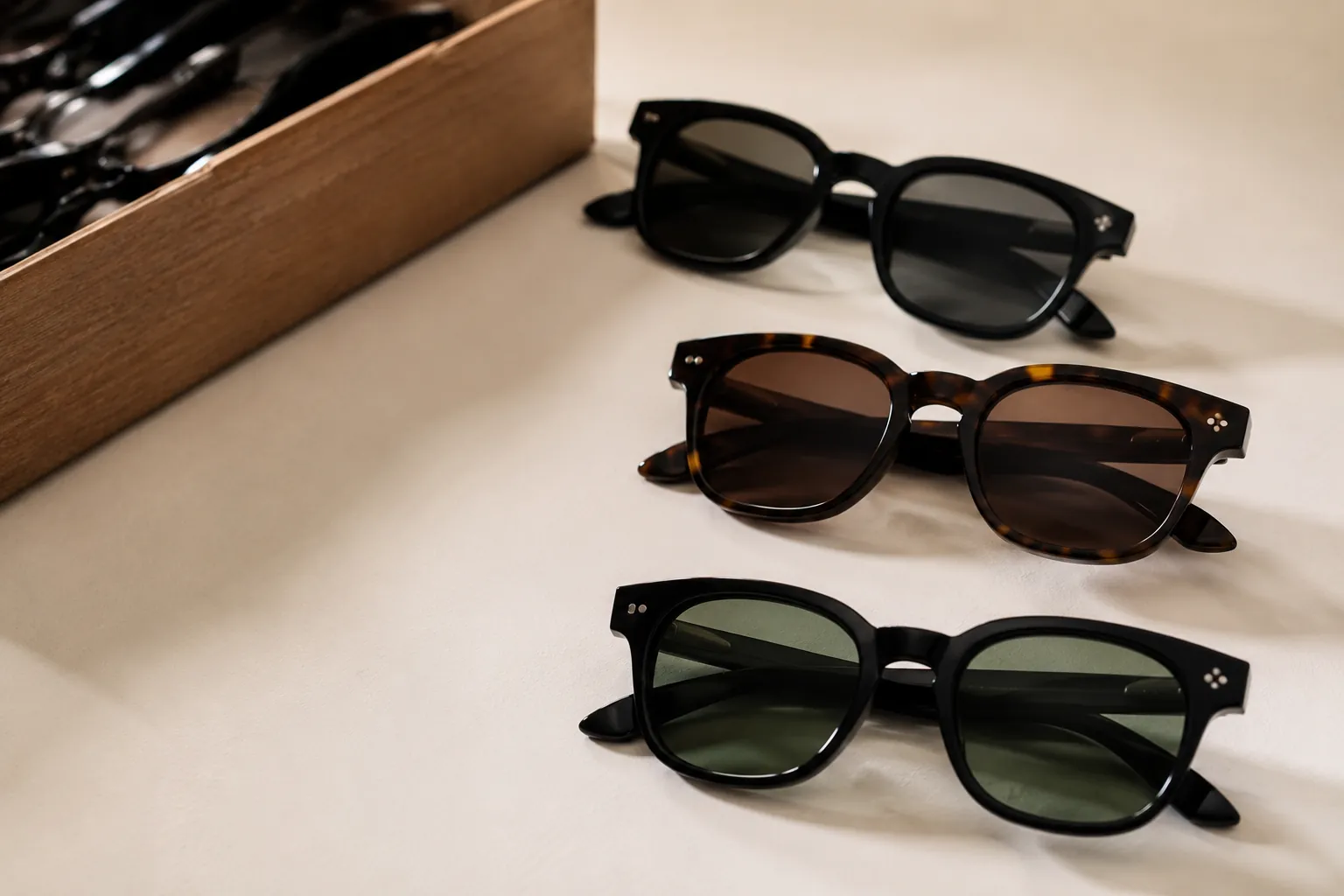
This guide is for eyewear buyers building retail assortments, promo programs, or private-label sun collections. Smoke, brown, green, and G15 behave differently once VLT, substrate, polarization, mirror, and frame finish are fixed. Pick the wrong tint and the shelf story gets muddy, approvals slow down, and sample-to-bulk disputes follow. Pick the right one and the sales story is clearer and the factory target is tighter. Use this guide to choose lens color by channel, end market, and production limits before the PO is issued.
Start at the Shelf, Not the Lens Lab
Buyers often leave lens color until after frame shape, logo placement, and packaging. That is backwards. Tint is first a merchandising call, then an optical spec. Start with the job the SKU must do: broad-volume sun, an outdoor use-case range, or a style capsule. In mixed-market programs, many teams lead with smoke as the core offer and use brown or G15 as the second story. It is easier to explain, replenish, and photograph.
Channel changes how the tint is judged. On a peg wall or value retail fixture, shoppers decide fast, and smoke is usually the easiest story to read. At a premium optical counter, resort store, or travel capsule, brown or G15 can justify a more specific choice. Online, buyers and consumers judge tint from thumbnails and on-model shots. In store, they judge it against lighting, skin tone, and frame finish. A lens that looks rich outdoors can look warmer or flatter under 3000K to 3500K retail lighting. If the benefit is not obvious or easy for staff to explain, the tint is harder to move in that channel.
Why Smoke Wins First Orders
Smoke, or neutral grey, is usually the safest high-volume lens. It cuts brightness with less visible color shift than brown or green, works across the widest range of frame colors, and needs the least explanation at shelf. It pairs cleanly with black, crystal, tortoise, gunmetal, navy, and bright injection colors. If one lens has to cover several frames without starting a visual fight, smoke is usually the lowest-risk choice.
It is also easier to approve. Most buyers can spot neutral versus too warm or too green faster than they can decide whether a brown or green cast is correct. Repeatability still depends on supplier process control and a retained approval standard, but smoke usually leaves less room for replenishment disputes. It also takes common flash mirrors without changing the core merchandising story.
For general-purpose sun, smoke is often built in category 3. Lighter fashion briefs may land in category 2. Do not order smoke by name alone. Put the full construction on the PO, for example smoke grey, target 15% +/- 2% VLT, polycarbonate, non-polarized, hard coat, silver flash mirror.
- Use smoke as the default for a new private-label sun program with several frame colors.
- Use smoke when the main selling point is frame shape, logo treatment, or price position rather than a lens claim.
- Use smoke when one lens story has to work across mass retail, promo, and broad ecommerce.
Brown Works When the Use Case Is Clear
Brown works best when the reason is obvious. Compared with smoke, brown and amber-based lenses often increase perceived contrast in mixed or variable light and complement tortoise, honey, olive, champagne, and gold frames. That makes brown a strong option for driving assortments, resort product, golf or hiking stories, and warmer lifestyle ranges. Without that context, a basic black frame with a brown lens can read dated next to the same frame with smoke.
Brown also needs tighter approval control. Brown is not one exact color. Recipes run from neutral brown to obvious amber. The same named tint can look warmer or cooler depending on substrate, thickness, and coatings. Polarized builds can also measure differently from non-polarized versions because the full lens stack changes transmission. If brown carries the use-case story, approve it assembled in the final frame and final substrate, not as a loose swatch or a sample made in another material. For gradients, define top density and fade position in writing along with the target VLT.
Green and G15 Need Exact Specs
Green and G15 are related, but they are not interchangeable buying terms. In trade use, G15 usually means a dark grey-green lens around 15% VLT, with a balanced look and clear heritage ties to aviators and other classic metal shapes. Plain green is much looser. It can mean a visible fashion green or a darker commercial grey-green. If the PO says only G15 or dark green, the supplier still has to guess at hue, VLT, and cast.
Construction makes that guess easier to see. Thin metal rims, semi-rimless styles, and drilled shapes expose the lens edge, so side-view cast shows fast. Full-rim acetate hides more edge, but warm or cool frame colors still change how the same lens reads. Green-family lenses also show left-right mismatch quickly in daylight. Specify target VLT, material, polarization, cast direction, and whether mirror or backside AR is included. Ask the supplier to check tint against the retained master before assembly and again at final inspection.
Map Each Tint to Channel and Price Point
Most assortments work better with one core tint and one secondary tint than with equal depth across four lens stories. Lower price points usually need the easiest color story to approve and replenish. More specific tints make sense only if the channel can carry the extra explanation. The table below is a practical shortlist. VLT entries reflect common buying patterns, not a substitute for testing.
| Lens color | Typical VLT target | Best channels | Strong frame pairings | Main watch-out |
|---|---|---|---|---|
| Smoke | Usually specified within category 3; lighter fashion builds may be category 2 | Mass retail, promo, broad ecommerce, first private-label runs | Black, crystal, tortoise, gunmetal, bright injection colors | Can feel generic if the frame story is weak |
| Brown | Usually specified within category 2 or category 3 depending on the use case | Resort, outdoor, driving-oriented assortments, warm lifestyle collections | Tortoise, honey, olive, gold, champagne | Hue can drift warm; simple shapes can look dated |
| Green | No standard default; define the actual target VLT and tolerance | Fashion capsules, selective optical, curated ecommerce drops | Brushed metal, clear acetate, cleaner retro shapes | Green is not standardized; mismatch shows quickly |
| G15 | Often targeted around 15% VLT in trade usage, but the name alone is not a spec | Aviators, heritage metals, mid-tier and premium fashion retail | Gold metal, silver metal, black metal, classic acetates | The name is used loosely; define cast, substrate, and tolerance |
For mixed climates and mixed store types, smoke is still the easiest tint to spread across accounts. Brown works better when the retailer can explain the use case. Green and G15 belong in deliberate SKUs with tighter specs, not as default fillers.
Compliance Starts With Final VLT
Color names do not determine compliance. Final visible light transmission of the finished lens build does, along with the other performance requirements in the target-market standard. Mirror, polarization, substrate, lens thickness, and backside coating can all change the measured result. For EU-bound sunglasses, request EN ISO 12312-1 test reports for the finished configuration and confirm the shipped product is backed by matching EU conformity documentation. For the US, request ANSI Z80.3 test data. For Australia and New Zealand, request AS/NZS 1067 test data.
For general-purpose sun under EN ISO 12312-1, category 2 is roughly 18% to 43% VLT and category 3 is roughly 8% to 18% VLT. Category 4 is darker again and is not suitable for driving. The rule is simple: write the target VLT and tolerance on the tech pack, then test the exact build that will be sold. If the mirrored version ships, the mirrored version needs to be the one covered by the test evidence.
REACH, FDA registration, ISO 9001, and BSCI matter, but they do not replace product-specific sunglass test reports. REACH covers chemical compliance. FDA registration is not model-specific optical testing. ISO 9001 and BSCI describe systems or audit status, not whether a given lens build meets the applicable sunglass standard.
Approve Color Like a Buyer
Most color disputes start with vague approvals. Dark green lens is a preference, not a control standard. Serious buyers lock the full build, the viewing conditions, and the retained master.
- Approve the exact finished build. A loose flat sample can look cleaner and lighter than the assembled lens because it hides edge color, wrap, and frame contrast.
- Record the full lens stack: material, base curve, thickness if relevant, polarization yes or no, hard coat, mirror color, backside AR, and any hydrophobic layer.
- View the sample in daylight or a D65 booth and under the store lighting it will face. Brown often looks warmer indoors. Green-family lenses can flatten or shift in poor photography.
- Keep a signed retained master and link it to the PO, sample date, and full lens spec. Ask the supplier how in-process tint checks and final inspections are controlled against that master.
- Check left-right match and gradient consistency on pre-production and bulk inspections. For gradients, define top density and fade position rather than approving
close enough.
Factory capability matters. Ask who controls tinting, where VLT is measured, and at what stage visual shade checks happen. The right process catches drift before final packing, not after the cartons are sealed.
Plan SKUs Around MOQ, Decoration, and Margin
Lens color can simplify a line or split it into small, hard-to-control parts. MOQ depends on whether the frame uses an existing mold, a stock lens library, standard packaging, and one decoration method. Every extra tint adds another approval path, another lens inventory line, and more room for shade variation between sample and replenishment. Small programs are usually easier to control with one lens story. Add a second tint only when it has a clear channel role and a clear margin case.
The cost stack follows the same logic. Smoke on a stock non-polarized build is usually the lowest-friction option. Gradients, custom mirrors, polarized builds, laser engraving, metal logo trims, and mixed-carton labeling all add quoting variables and approval time. Ask suppliers to quote stock tint versus custom tint, non-polarized versus polarized, and one-tint versus two-tint assortments as separate options so the margin trade-off is visible before sampling. Lead times also move with factory capacity, season, and approval path, so confirm sample timing and bulk timing in writing before you commit to launch.
Practical rule: if the sales team cannot explain in one sentence why the lens is brown, green, or G15, smoke is usually the safer buy.
That is not timid buying. It is range control.
Have a custom sunglasses project in mind?
Send us your styles, target market and quantities and we will return a detailed quote with MOQ, lead time and a sample plan.
Get a QuoteWhy source this from Wenzhou with LumiShades
Wenzhou in Zhejiang Province is widely regarded as China’s eyewear manufacturing capital, producing a large share of the world’s sunglasses. That concentration matters to buyers: a deep local supply chain for acetate sheet, hinges, lens blanks, plating and packaging means shorter component lead times, easier color and material matching, and a workforce with decades of eyewear-specific skill. LumiShades has manufactured in this ecosystem since 2009, and our vertical integration — in-house injection molding, acetate cutting, CNC milling, lens tinting, decoration and quality control — means no part of your order is quietly subcontracted to a workshop you cannot audit.
For international buyers, that vertical control translates into accountability. When a single factory owns every step, defects are traced and fixed at source rather than bounced between vendors, and your specifications survive intact from first sample to bulk. We back this with 15+ years of experience, shipments to 60+ countries, more than 5 million pairs produced per year and a 98.5% on-time delivery rate. Our certifications — CE EN ISO 12312-1, FDA registration, ANSI Z80.3, AS/NZS 1067, REACH, ISO 9001 and BSCI audit — mean the compliance documentation your market requires already exists. Explore our manufacturing capabilities and quality control process to see how this works in practice.
Frequently asked questions
Is G15 just a marketing name for green? No. In buying language, G15 usually refers to a dark grey-green lens around 15% VLT, but suppliers do not use the label in exactly the same way. Treat G15 as shorthand, not a full spec. On the PO, state the target VLT and tolerance, substrate, polarization, mirror or backside coatings, and whether the cast should stay neutral grey-green or read greener. Approve an assembled sample before bulk.
What is the safest lens color for a first private-label order? Smoke is usually the safest start because it works across the widest range of frame colors and needs the least shelf explanation. For a broad general-sun program, first define the target market standard, target VLT range, substrate, and coatings, then review the assembled sample in daylight and store lighting before sign-off. That gives you a repeatable baseline before you add more specific tint stories.
Can I order a custom lens color on a low-MOQ program? Sometimes, especially if the frame uses an existing mold and the supplier already has a workable stock lens library, but low-volume programs leave less room for tint control. Before sampling, ask the supplier to confirm minimums by frame, substrate, polarization, and coating. Approve the exact assembled sample, define acceptable shade tolerance in writing, and clarify whether future replenishment lots must match a retained master.
Do mirror coatings change compliance or just appearance? Both. Mirror changes appearance and can shift final VLT enough to affect how the finished build is classified or labeled in the target market. Ask for test evidence on the exact mirrored construction that will ship, not just on the non-mirrored base lens. If mirror is optional in the assortment, treat mirrored and non-mirrored versions as separate compliance checks.
How should lens color be written on the PO? Write the lens as a full construction, not as a color name alone. Include the color designation, target VLT and tolerance, material, base curve, polarization yes or no, mirror color, backside AR or other coatings, approved sample reference and date, and the target standard such as EN ISO 12312-1, ANSI Z80.3, or AS/NZS 1067. A workable format is: <code>smoke grey, target 15% +/- 2% VLT, polycarbonate, base 6, non-polarized, hard coat, silver flash mirror, approved sample reference/date, EN ISO 12312-1</code>.
Ready to start?
Explore our shield & oversized sunglasses or request a quote — our sales team replies within 12 hours.
Request a Quote