
Lens Thickness, Edge Profile, and Weight in Sunglasses
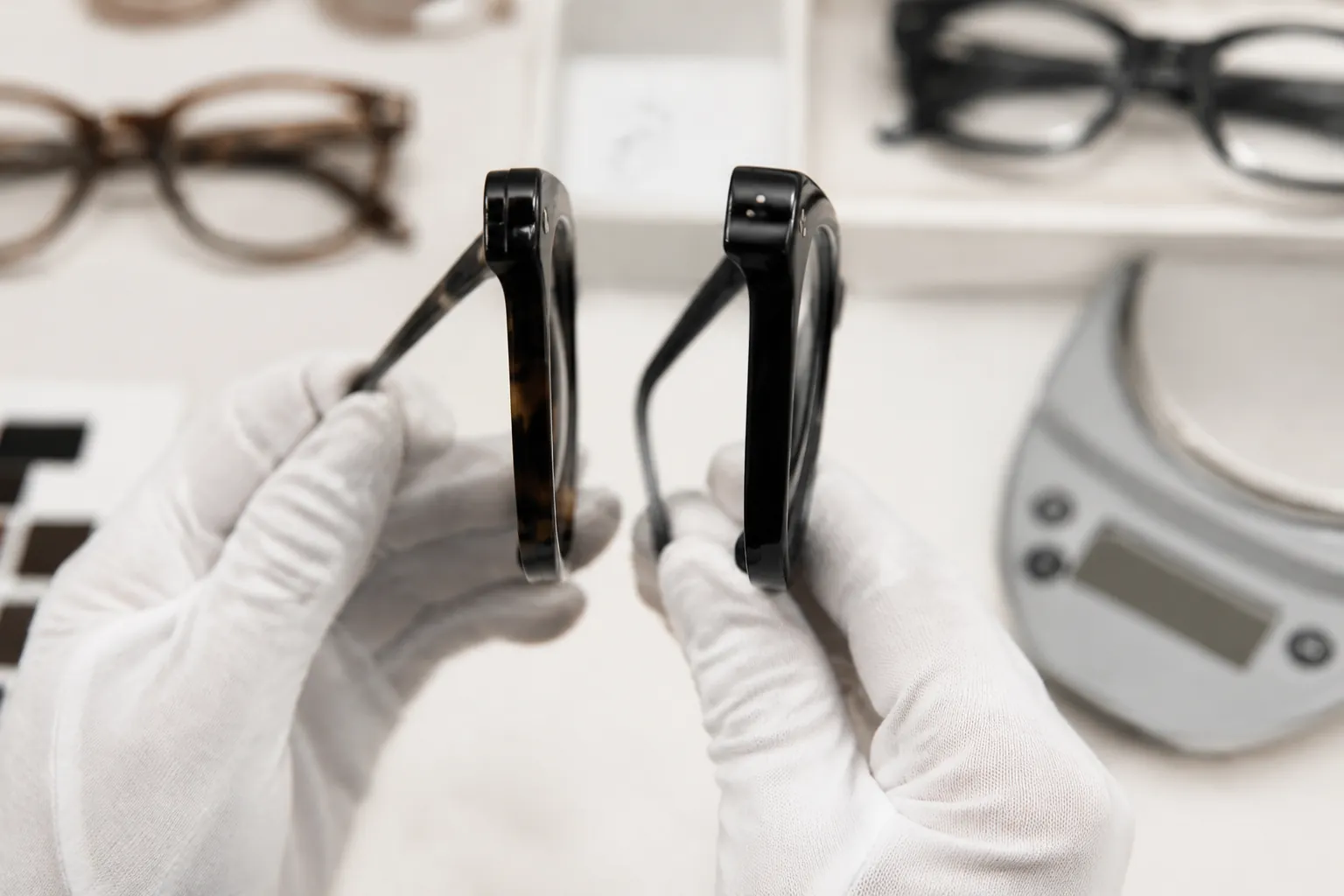
This guide is for brand owners, importers, and sourcing teams buying custom sunglasses in volume. It focuses on three lens specifications that are often left too vague during development: thickness, edge profile, and finished lens weight. These details affect comfort, lens retention, assembly consistency, and perceived quality, especially on oversized, deep-eye, and wrapped frames. Leave them open, and an approval sample may pass while bulk production shows heavier front balance, edge stress, or inconsistent fit. Define them early, and you improve wearability and repeatability without changing the frame design.
Why these specs matter more in hand than on CAD
Many buyers lock frame shape, color, logo placement, and packaging first. Lens construction then gets reduced to a few broad notes: PC, TAC polarized, nylon, smoke category 3, mirror, or similar. That is not enough for production control.
On the finished product, lens thickness, edge profile, and lens weight affect three things fast: face balance, groove fit, and rim appearance at inspection. These points matter even more on large eye sizes, flat-top fashion fronts, thick acetate looks, and wrapped sport styles, where the lens perimeter takes more stress during edging and insertion.
CAD will not tell you the full result. Final fit depends on lens material, base curve, eye size, depth, edging geometry, and the real groove in the frame. A lens that works in one style may insert poorly or sit unevenly in another, even with the same nominal material and tint.
This is not a minor technical issue. It affects remake risk, assembly efficiency, and consistency between approved sample and bulk output. Suppliers with in-house molding or frame processing, CNC capability, lens edging, tinting, decoration, and QC usually solve fit problems faster because frame groove, lens bevel, and assembly method can be checked together instead of across several subcontractors.
Thickness is not one number
Buyers often ask for a "1.1 mm lens" or "1.8 mm lens" as if one number controls the result. It does not. In production, at least four thickness-related points matter.
- Center thickness: relevant to rigidity, impact behavior, and the visual impression of substance in plano sun lenses.
- Edge thickness: critical on larger and more wrapped shapes because edge build usually increases as lens size and curve increase.
- Thickness at the bevel zone: this is the area that actually engages with the eyewire groove or channel.
- Effective rigidity after finishing: a lens may meet the nominal blank specification but still feel too flexible after edging, beveling, and polishing.
Commercial ranges vary by material and style. Polycarbonate sun lenses are widely used because they are light and impact resistant, but hard-coat quality matters because polycarbonate is not naturally very scratch resistant. TAC polarized lenses are common in mid-price sunglasses because they combine polarization with competitive cost, but the laminated structure needs careful finishing to avoid visible edge lines, haze, or separation. Nylon lenses are often chosen for performance and wrapped styles because they can suit higher-curve geometry better, though cost and process control demands are usually higher.
Material choice changes the logic of the spec. A standard full-rim fashion frame and a high-wrap sport frame should not share the same lens build by default just because they use the same material. Ask suppliers to quote and sample by material plus shape family. Then compare fit, appearance, weight, and cost before approval.
Edge profile decides whether the lens fits or fights the frame
Edge profile is the geometry cut around the lens perimeter so it locks into the frame correctly. It includes bevel angle, bevel position, edge width, and any local adjustment around the nasal, top-corner, or temporal areas. Buyers rarely define it in detail. That is a mistake.
For full-rim plastic sunglasses, the bevel has to match the finished groove width, groove depth, and front curve. Actual fit depends not only on design intent but also on groove variation after molding or machining, polishing, CNC finishing, and the front curve itself. If the bevel is too sharp, insertion force may rise and the frame can show stress whitening. If the bevel is too shallow or misplaced, retention may weaken and the lens may sit proud, sink too deep, or rock in the rim.
Wrapped styles are less forgiving. Edge conditions are not uniform around the perimeter. The top corner, nasal area, and temporal zone may each need slightly different treatment because local curve and insertion angle change. In some cases, a highly curved front plus the wrong lens material creates a fit problem from the start.
A realistic development sequence should look like this:
- Measure the finished frame groove after molding, tumbling, polishing, or CNC finishing.
- Cut the lens blank oversize enough to allow controlled edging.
- Set bevel position and edge angle by style instead of using a generic default file.
- Trial-fit the lens and inspect retention, stress marks, gap, and flushness.
- Revise the edge geometry if needed, then retain the approved sample as the bulk reference.
For large or wrapped styles, expect at least one fit revision during sample development. Build that into the timeline. Do not assume edging will sort itself out during bulk assembly.
Weight adds up fast on large and wrapped styles
A heavy frame with heavy lenses usually shows problems at the bridge first. Product photos will not show that. A quick office try-on may not either. Lens weight rises with lens area, thickness, and edge build, so large and wrapped sunglasses can become front-loaded faster than expected.
As a sourcing rule, ask for finished pair weight, not just lens material. Two frames can both use TAC or PC lenses and still end up with very different total weight once eye size, depth, base curve, and edge profile are factored in. On some fashion styles, extra weight may support a deliberate premium feel. On sport, youth, or all-day wear styles, excess front weight is more likely to create fit complaints.
| Lens setup | Typical center thickness | Typical use | Weight effect | Buyer trade-off |
|---|---|---|---|---|
| PC, moderate build | Style-dependent | Sport, youth, promo | Low to medium | Light and impact-resistant; hard-coat quality is critical |
| TAC polarized, standard fashion build | Style-dependent | Mid-price fashion sun | Medium | Good value and polarization; edge finishing must control lamination visibility |
| Nylon, wrapped profile | Style-dependent | Performance wrap | Low to medium | Often better suited to higher curve geometry; higher material cost |
| Thick fashion lens for visual substance | Style-dependent | Oversized premium look | Medium to high | Stronger shelf presence but greater risk of nose-heavy balance |
When reviewing samples, compare total pair weight with fit and balance. Weight alone is not enough. Where that weight sits matters too.
Perceived quality often shows at the lens edge
Consumers notice the front view first, but much of their quality judgment comes from the rim and side view. That is where poor lens construction shows up.
Common edge defects include visible lamination lines on polarized lenses, polishing haze, micro-chipping from insertion damage, stress whitening around the eyewire, and uneven seating where one section sits proud while another sinks too deep. These defects stand out more on gradients, lighter tints, transparent frames, glossy black fronts, and thicker fashion rims.
A clean edge can make a moderate-cost sunglass look refined. A rough edge can make a good frame design look cheap. Simple as that. Sample approval should include side-angle review under consistent lighting, not just front-facing photography.
Decoration can make the contrast worse. Pad print logos, hot foil, laser engraving, metal logo plates, and visible temple cores all pull attention toward detail quality. If the frame finish is sharp but the lens edge is rough or uneven, the mismatch is obvious. Review lens QC alongside decoration QC, not after it.
Practical approval standards should be written in plain visual terms: no visible edge chips within the agreed inspection standard, no stress whitening around the eyewire, no obvious lamination exposure beyond the approved sample, even seating around the frame, and no polishing haze visible under the agreed light condition. The key is to define the inspection method and retain a signed sample so the factory and buyer judge against the same benchmark.
How these specs affect compliance and test results
Thickness and edge shape are not only comfort and appearance issues. They also affect whether the finished sunglasses remain suitable for the target market requirements.
Buyers often request alignment with CE EN ISO 12312-1, ANSI Z80.3, AS/NZS 1067, REACH, and FDA registration where applicable. Factory management and social compliance credentials such as ISO 9001 and BSCI may also matter during supplier qualification. The main point is straightforward: compliance applies to the finished product configuration, not just a raw material claim.
A lens blank may be suitable in principle, but the finished result can change after edging, coating, tinting, mounting, and mass production. A lens that is too thin for the frame design may deform more easily during assembly. Poor beveling can weaken retention. Wrapped constructions can behave differently once mounted than they do as uncut blanks. Tint and mirror processes also need batch consistency so the approved lens category and appearance stay stable during bulk output.
Ask how the supplier controls these points in production: incoming material checks, thickness verification, tint verification, sample retention, assembly inspection, and final QC records. Certificates help only if they tie back to actual process control.
What to put on your RFQ and sample approval sheet
If lens construction is left open, the supplier will usually quote toward the target cost first. That is normal. It is the buyer's job to define the technical range clearly enough that sample approval does not turn into a bulk dispute later.
- Material: PC, TAC polarized, nylon, or another agreed option.
- Center thickness target: state the nominal requirement and the allowed tolerance.
- Critical edge requirement: especially for large or wrapped styles where edge build affects fit and weight.
- Base curve or front curve: do not assume it is clear from artwork alone.
- Edge profile: standard bevel, modified bevel, flat edge, or a style-specific note.
- Finished pair weight range: define a tolerance for the assembled product, not only for the lens blank.
- Visual standard: no edge chips, no stress whitening, no obvious lamination exposure, even seating.
- Compliance target: state required markets and standards before sampling.
Also write the commercial logic into the project. If you expect to scale from a low trial quantity to a larger bulk order, ask whether the same lens construction will be maintained at the next quantity break or whether the supplier plans to change material, coating, or finishing method. That question often prevents re-approval work later.
Bulk lead time is more predictable when the sample file is complete. Vague approvals cause production pauses, especially when lens tinting, edging, decoration, and final fitting must be coordinated in sequence.
Factory checkpoints that prevent bulk surprises
Buyers do not need to run the line step by step, but they should know where failures usually start. Most repeat problems tied to wearability and edge appearance begin at four control points.
- Lens blank selection: if initial thickness, curve, or batch consistency is wrong, later correction is limited.
- Edging setup: drift in bevel position or angle can create retention and appearance variation across the run.
- Assembly force: if fit is marginal, operators may stress the frame, chip the lens, or create whitening around the eyewire.
- Final QC: if inspection checks only color and logo placement, fit and edge defects can pass through.
A capable factory should record weight checks, fit checks, and visual edge inspections by style. For acetate and CNC-finished fronts, groove consistency matters because hand finishing can subtly change the channel. For injection-molded frames, shrink variation can also influence fit if process control is loose. In-house production usually shortens response time because groove dimensions, lens edge geometry, or assembly method can be adjusted without waiting on outside suppliers.
If your style is large, wrapped, or meant to feel premium in hand, treat lens thickness, edge profile, and weight as approval specs. Not background details. They help determine whether the sunglasses look good only in photos or stay wearable and repeatable in bulk production.
Have a custom sunglasses project in mind?
Send us your styles, target market and quantities and we will return a detailed quote with MOQ, lead time and a sample plan.
Get a QuoteWhy source this from Wenzhou with LumiShades
Wenzhou in Zhejiang Province is widely regarded as China’s eyewear manufacturing capital, producing a large share of the world’s sunglasses. That concentration matters to buyers: a deep local supply chain for acetate sheet, hinges, lens blanks, plating and packaging means shorter component lead times, easier color and material matching, and a workforce with decades of eyewear-specific skill. LumiShades has manufactured in this ecosystem since 2009, and our vertical integration — in-house injection molding, acetate cutting, CNC milling, lens tinting, decoration and quality control — means no part of your order is quietly subcontracted to a workshop you cannot audit.
For international buyers, that vertical control translates into accountability. When a single factory owns every step, defects are traced and fixed at source rather than bounced between vendors, and your specifications survive intact from first sample to bulk. We back this with 15+ years of experience, shipments to 60+ countries, more than 5 million pairs produced per year and a 98.5% on-time delivery rate. Our certifications — CE EN ISO 12312-1, FDA registration, ANSI Z80.3, AS/NZS 1067, REACH, ISO 9001 and BSCI audit — mean the compliance documentation your market requires already exists. Explore our manufacturing capabilities and quality control process to see how this works in practice.
Frequently asked questions
What lens detail do buyers most often fail to specify on oversized sunglasses? The biggest gap is usually the finished edge condition: edge thickness after edging, bevel position, and final pair weight. Many RFQs specify only lens material and tint. For oversized or wrapped styles, ask the supplier to confirm 1) nominal center thickness, 2) expected edge build on the final shape, 3) bevel type and position, and 4) finished pair weight of the approved sample. Put those points on the sample approval sheet so the bulk run is matched to a measurable reference.
Can I use the same lens construction from a small frame on a 60 mm wrapped style? Not without a style-specific review. A larger eye size and stronger curve can change rigidity, edge thickness, bevel requirements, retention, and total front weight. Ask for a dedicated sample using the exact frame geometry, then check three things before approval: clean seating in the groove, acceptable pair weight and balance, and no stress marks after assembly. If the supplier cannot confirm those points on the actual shape, do not assume the smaller-frame lens construction will scale.
How should I write lens requirements on an RFQ? List the lens material, nominal center thickness with tolerance, base curve, lens category or tint requirement, any mirror or coating requirement, edge-profile note, critical edge requirement for wrapped or oversized shapes, finished pair weight target with tolerance, visual defect standard, and target compliance markets. Attach a marked drawing or sample photo if the style has unusual edge requirements. Also require the factory to keep the approved sample as the bulk reference for fit and appearance.
Does a thicker lens always mean better quality? No. More thickness can improve visual substance and, in some cases, rigidity, but it also adds weight and may make balance worse on large frames. Quality depends on the full system: material choice, frame geometry, base curve, edge profile, finishing quality, and how the lens performs once mounted. Judge thickness together with fit, edge appearance, and finished pair weight rather than treating thickness alone as a premium indicator.
At what order stage should I lock these specs? Lock them during sample approval, before the bulk purchase order is released. At minimum, the signed sample should confirm lens material, nominal thickness, edge profile, tint or lens category, visual edge standard, and finished pair weight. Ask the supplier to record these values on the approval sheet and to use that retained sample for in-line and final QC during bulk production. If these points are still open after PO release, delays and rework become much more likely.
Ready to start?
Explore our sport wrap sunglasses or request a quote — our sales team replies within 12 hours.
Request a Quote