
Keep Lens Color Consistent on Sunglass Reorders
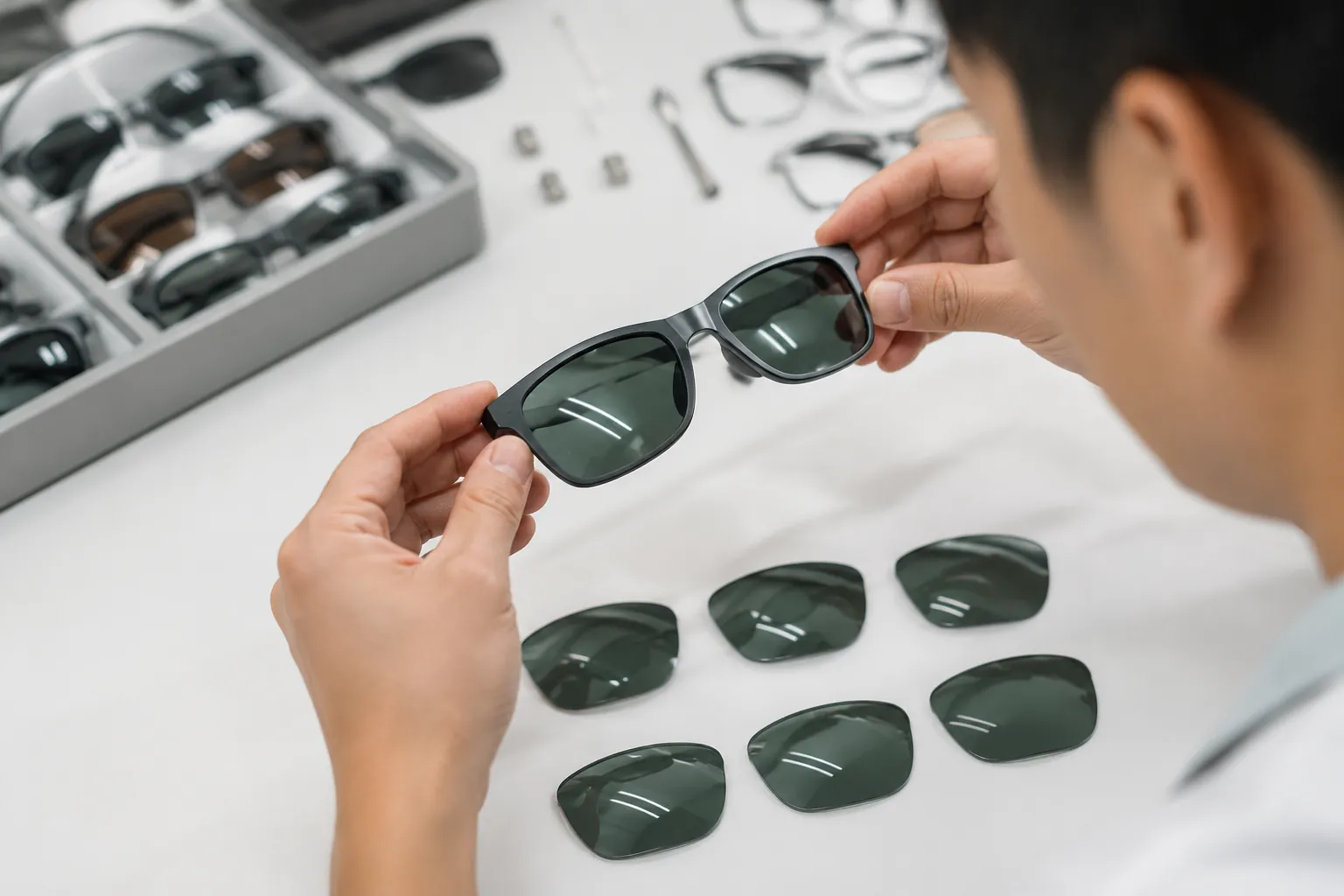
This guide is for brand owners, importers, and retail buyers who need repeat sunglass orders to match the first approved shipment as closely as practical. Lens color drift is a common reorder problem, especially when production is split across different dates, materials, or process lots. Do not rely on memory, photos, or color names. Use a controlled approval system built on a physical master standard, fixed lens specifications, written tolerances, and checks at the production stages where color can shift.
Why lens color shifts between purchase orders
Buyers often treat lens color as a simple cosmetic choice. In production, it is not. Final appearance comes from material, geometry, tinting, coatings, and viewing conditions working together. That is why two lenses with the same color name can still look different.
Common variables include lens material, base lens color, center thickness, dye concentration, process time, temperature, mirror or flash coating, hard coating, and polarization construction. Polycarbonate, TAC, nylon, acrylic, and other materials absorb and transmit light differently. Thickness matters too. A thicker lens can look darker than a thinner lens made to the same nominal tint target.
Frame design also changes perception. A wrapped frame, a thicker rim, or a darker front can make the same lens read differently to the eye. Lighting matters just as much. A lens checked in office light may not look the same in daylight or under a D65 source. So repeatability depends on an agreed reference and viewing method. Not memory. Not phone photos.
Also keep cosmetic consistency separate from legal compliance. A lens may look close to a previous batch and still need confirmation against the required market standard, such as CE EN ISO 12312-1, ANSI Z80.3, or AS/NZS 1067, depending on the destination market and product classification.
Start with a master standard, not a photo
If you want consistent reorders, create a master standard from the first approved sample or first approved production lot. The best standard is a physical lens pair or complete sunglass sample kept by both buyer and supplier. Photos can help communication, but they should never be the approval authority. Camera settings, screens, and ambient light all distort color.
A practical master standard file should include:
- Physical approved sample: one retained lens pair or one complete sunglass sample labeled with style code, date, and PO number.
- Lens specification sheet: material, construction, base curve, center thickness, substrate color, tint type, and all coatings.
- Viewing condition: the agreed light source and comparison method, such as daylight, D65 simulation, or another specified condition.
- Compliance target: the applicable requirement for the market, such as CE EN ISO 12312-1, ANSI Z80.3, or AS/NZS 1067.
- Tolerance note: a written statement of what level of visual variation is acceptable and how comparison will be judged.
The purchase order should state that bulk color must match the signed master standard under the agreed viewing condition. Do not write only "match approved photo" or "same as last time." If the item is a repeat program, require the supplier to retain a production sample from each lot for traceability.
During development, use sampling to define the actual lens build. Terms like smoke, tea, olive, green, or blue mirror are not real specifications by themselves. They describe direction, not a controlled target.
Lock the lens build before approval
Many reorder disputes come from specification drift, not weak process control. A buyer approves one lens build, then later changes material, thickness, polarization construction, or coating to hit a cost or lead-time target. Even if the supplier uses the same color name, the result can shift.
Your purchase specification should lock the following points before bulk starts:
| Control point | Why it affects color | What buyer should state |
|---|---|---|
| Lens material | Polycarbonate, TAC, nylon, and acrylic absorb and transmit light differently | State exact material and do not allow substitution without written approval |
| Center thickness | Thicker lenses can read darker at the same nominal tint setting | Specify nominal thickness and acceptable tolerance |
| Tint type | Solid, gradient, polarized, mirrored, and flash-coated builds produce different visual results | Write the full lens build sequence, not only the color name |
| Base lens color | Grey, brown, green, or clear substrate changes the final appearance | Identify the substrate color before tinting or coating |
| Coatings | Hard coat, AR, mirror, and top coats can shift the apparent tone | List all coatings and their order in the process |
For example, a smoke polarized TAC lens with silver mirror is not the same as a smoke polycarbonate lens with a flash coating. They may look similar at one angle and clearly different at another. If cost engineering is needed, do it before final approval and create a new approved standard for the revised construction.
This gets more critical when the lens sits close to a transmission threshold for a target category. A small structural change can affect both appearance and compliance.
Use staged approvals before mass production
A staged approval flow cuts reorder risk. It gives both buyer and supplier clear checkpoints before full production starts.
- Lab dip or lens trial: prepare initial color options on the correct material family and substrate so the buyer can choose the target direction.
- Pre-production sample: build the lens in the final construction, with the approved frame, coatings, and decoration, for formal sign-off.
- Golden sample retention: keep one approved sample with the buyer and one with the supplier for reorder matching.
Whenever possible, approve color in the finished sunglass, not as a loose lens. Frame wrap, eye size, rim thickness, and frame color all affect perceived color. If the product is sold into more than one market, define whether the same approved lens must satisfy multiple compliance targets or whether separate market versions are required.
If the lens design sits near a legal transmission boundary, document that clearly. For sunglasses sold as sun-protective eyewear, the supplier should confirm the standard requested by the buyer, such as CE EN ISO 12312-1, ANSI Z80.3, or AS/NZS 1067. If the product is only a light cosmetic tint rather than sun eyewear, state that clearly in the product specification and market documents.
The rule is simple: do not jump from a general color discussion to mass production. Sign off the actual construction that will ship.
Check color where drift actually happens
Do not judge color only at final packing. By then, any mismatch is expensive to sort or remake. Good control means checking the stages where drift is introduced.
- Incoming material check: verify substrate material, thickness, and base color against the approved specification.
- First-off tint check: compare the first dyed or coated pieces to the golden sample under the agreed light source.
- In-process patrol: recheck at defined intervals, especially for gradients, mirrors, and other visually sensitive finishes.
- Post-coating check: confirm appearance again after mirror, hard coat, AR, or top-coat application.
- Final QC by lot: compare packed-goods samples against the retained standard and record the lot identity.
Lot segregation matters. Ask how the supplier identifies production date, lens batch, and coating lot, and whether mixed lots are packed together. Without lot traceability, it is hard to find the cause of a warmer or cooler batch later.
For reorder programs, compare the new run not only to the original golden sample but also to the most recent accepted retained lot sample. If those references already differ, stop and resolve it before the next bulk run starts. That prevents gradual drift over time.
How order size, timing, and changes affect consistency
Lens color can be controlled on both small and large orders, but the control method has to fit the program. Small runs leave less room for adjustment and may be produced alongside other short lots. That makes strict pre-production approval more important. Larger repeat programs are usually easier to standardize because materials, setup, and retained references can be managed more systematically.
For a small launch order, ask for a signed pre-production sample and make sure the factory understands that the retained sample will govern future reorders. If the SKU becomes a carryover item, treat the first accepted order as the baseline for all later production.
Short version: if a style is expected to reorder, the first approved production should become the permanent standard.
Timing matters too. If a reorder is placed months later, confirm that the supplier still has the retained standard, the same lens construction, and the same compliance target on file. If the buyer changes frame color, logo finish, coating type, or lens build after approval, review the lens again in the finished product. Surrounding colors and finishes can change perception.
Treat the item as a controlled SKU. Not a loosely repeated idea.
What to put in your PO and QC checklist
Most reorder disputes start with weak paperwork. A clear PO and QC sheet remove guesswork and make it easier to judge whether bulk goods match the approved standard.
Your checklist should include:
- SKU reference: exact style code, color code, and approved sample date or reference number.
- Lens build: material, thickness, substrate color, tint type, polarization status, mirror or flash coating, hard coat, AR if used, and any top coat.
- Visual approval condition: light source, viewing angle, and comparison method.
- Compliance request: applicable requirement such as CE EN ISO 12312-1, ANSI Z80.3, AS/NZS 1067, REACH, or FDA registration relevance depending on the market and product type.
- Retention rule: supplier must keep the approved sample and retain lot samples for future comparison.
- Rejection rule: define whether mismatch is judged against the golden sample, within a pair, within a lot, or carton to carton.
For supplier qualification, it is reasonable to ask who approves first-off production, how lot coding is recorded, whether lens tinting is managed in-house or outsourced, and how retained samples are stored. If a factory claims a management system or social compliance program, ask for current evidence. Common credentials buyers may verify in this sector include ISO 9001 and BSCI. Product compliance requirements such as CE EN ISO 12312-1, ANSI Z80.3, AS/NZS 1067, REACH, and FDA registration should be confirmed based on the product and destination market.
These standards and certifications do not guarantee cosmetic color matching by themselves. They support process control and market compliance. You still need a physical master standard and a clear acceptance method.
If a reorder still arrives off-color, find the cause fast
If a reorder looks wrong, start with evidence. Pull the buyer-retained sample, the supplier golden sample, and a sample from the last accepted production lot. Compare all three under the same agreed light source and viewing method. Then review the production records for the current shipment.
Typical root causes include:
- the approved sample aged, yellowed, or was stored poorly
- material or substrate color was changed without formal approval
- center thickness drifted outside the intended range
- the tint or coating lot produced a visible shift
- approval relied on photos rather than a physical standard
- different production lots were mixed in packing
Ask the supplier for lot-level records covering substrate, process date, coating or tint batch, first-off approval, and final QC notes. If the item is commercially important, request corrected trial pieces against the retained standard before authorizing a full rerun.
For long-term programs, keep a simple archive of approved and accepted retained samples by season, lot, and PO. That makes future comparisons faster and helps separate real process drift from normal ageing of old reference samples.
Have a custom sunglasses project in mind?
Send us your styles, target market and quantities and we will return a detailed quote with MOQ, lead time and a sample plan.
Get a QuoteWhy source this from Wenzhou with LumiShades
Wenzhou in Zhejiang Province is widely regarded as China’s eyewear manufacturing capital, producing a large share of the world’s sunglasses. That concentration matters to buyers: a deep local supply chain for acetate sheet, hinges, lens blanks, plating and packaging means shorter component lead times, easier color and material matching, and a workforce with decades of eyewear-specific skill. LumiShades has manufactured in this ecosystem since 2009, and our vertical integration — in-house injection molding, acetate cutting, CNC milling, lens tinting, decoration and quality control — means no part of your order is quietly subcontracted to a workshop you cannot audit.
For international buyers, that vertical control translates into accountability. When a single factory owns every step, defects are traced and fixed at source rather than bounced between vendors, and your specifications survive intact from first sample to bulk. We back this with 15+ years of experience, shipments to 60+ countries, more than 5 million pairs produced per year and a 98.5% on-time delivery rate. Our certifications — CE EN ISO 12312-1, FDA registration, ANSI Z80.3, AS/NZS 1067, REACH, ISO 9001 and BSCI audit — mean the compliance documentation your market requires already exists. Explore our manufacturing capabilities and quality control process to see how this works in practice.
Frequently asked questions
Can I approve lens color from a Pantone code? Not reliably. Pantone can help describe the intended direction, but sunglass lens appearance depends on material, thickness, substrate color, tint method, and coatings. For production approval, ask for a physical lens or finished sunglass sample, label it with the style and date, and state in the PO that future bulk must match that retained sample under the agreed viewing condition.
What is the biggest reason repeat orders do not match the first batch? The most common cause is specification drift. The approved sample may have been made in one material, thickness, or coating sequence, while the reorder is produced with a different construction. To prevent this, lock the exact lens build in the PO, prohibit substitutions without written approval, and require a pre-production sample whenever any structural detail changes.
Is a small MOQ enough for stable color? It can be, but the approval process has to be tighter. Small runs leave less room to adjust and may involve short production windows or mixed scheduling with other colors. For a small order, require a signed pre-production sample, confirm lot traceability, and keep the retained sample for future matching. If the SKU becomes a repeat item, use the first accepted lot as the permanent master standard.
Should I approve loose lenses or finished sunglasses? Approve finished sunglasses whenever possible. Final lens appearance is affected by frame wrap, eye size, rim thickness, and surrounding frame color. If you must review loose lenses first, treat that only as an interim step and still require final approval on a complete assembled sample before bulk production starts.
Do compliance standards guarantee color consistency? No. Standards such as CE EN ISO 12312-1, ANSI Z80.3, and AS/NZS 1067 address performance and safety requirements, while REACH and FDA registration may be relevant for regulatory or market-access purposes. They do not define cosmetic repeatability between production lots. To control color consistency, you still need a physical master sample, fixed lens specifications, defined viewing conditions, retained lot samples, and lot-level QC records.
Ready to start?
Explore our aviator sunglasses or request a quote — our sales team replies within 12 hours.
Request a Quote