
Reduce Sunglasses Sample Costs Without Missing Key Checks
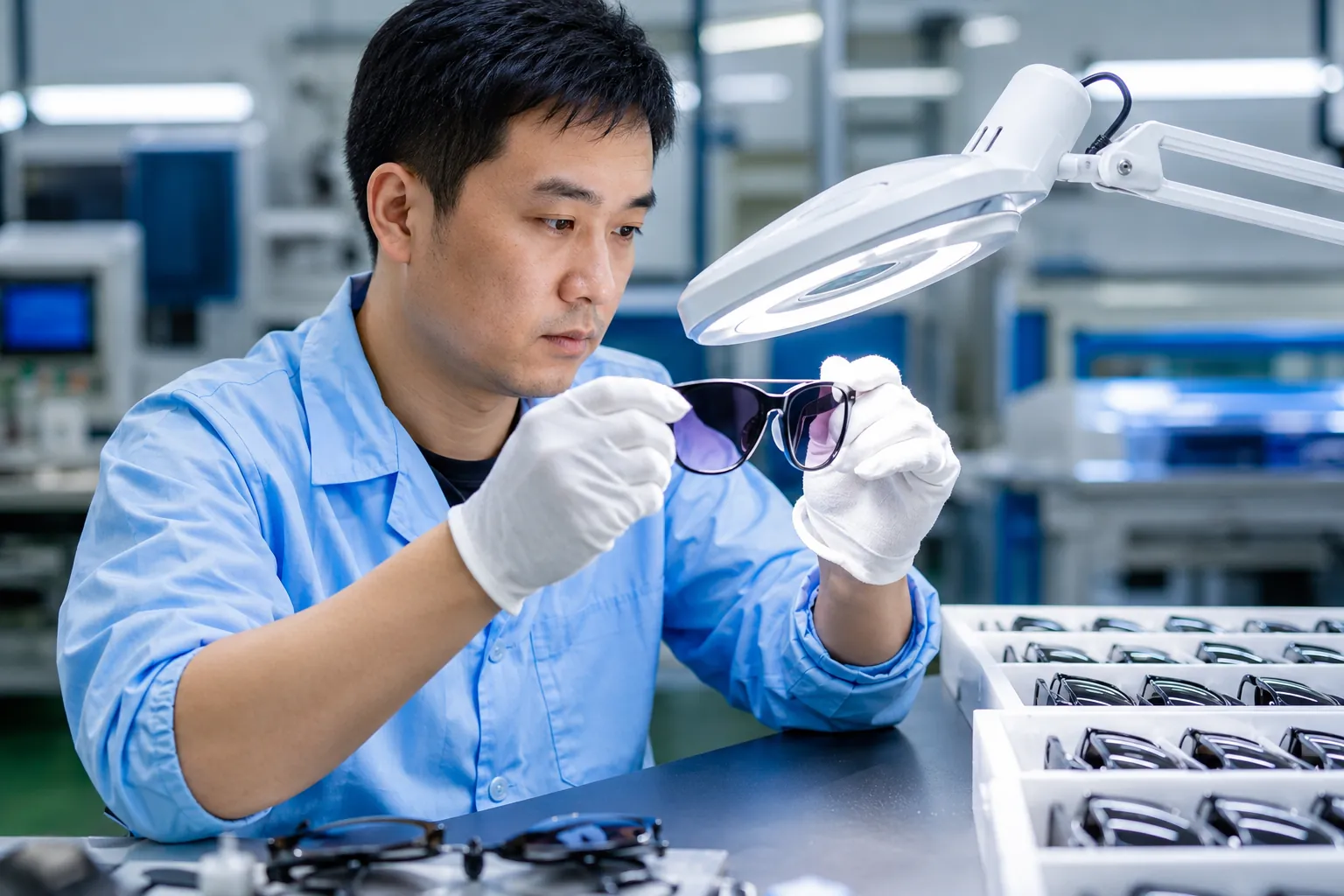
This guide is for brand owners, importers, distributors, and retailers buying custom sunglasses in volume. The goal is simple: spend less on samples without skipping the checks that protect the bulk order. Use the right sample at the right stage. Confirm the dimensions and construction details that affect fit and appearance. Avoid paid revisions that repeat the same decision. A gated sample plan keeps costs under control while still covering fit, finish, branding, compliance alignment, and production readiness.
Start with a sample plan, not a sample pile
Many buyers waste money by customizing too much too early. They ask for multiple colorways, final lens tints, engraved logos, metal logo plates, microfiber pouches, barcoded boxes, and retail inserts before the frame shape is even approved. That creates duplicate work. If frame dimensions or fit change later, decoration and packaging may need to be redone too.
A better method is to split sampling into stages. Each stage should answer one operational question. Stage 1 confirms frame shape, wearing fit, and core dimensions. Stage 2 checks materials, hinge feel, lens appearance, and cosmetic finish. Stage 3 covers branding and packing details. Stage 4 confirms that the approved sample can be repeated in production using the factory's normal process controls, not only by manual bench adjustment.
For custom sunglasses, the cheapest useful sample is rarely the prettiest one. It is the one that removes one risk at a time. If a supplier manages molding or frame machining, lens sourcing or tint selection, decoration, and QC with clear internal control, miscommunication drops and rework usually drops with it. Sample cost is not just the fee on the invoice. It also includes approval delays, internal review time, and the risk of locking in the wrong detail too early.
- Approve shape, dimensions, and fit first.
- Approve materials, lens appearance, hinge feel, and surface finish next.
- Approve logos, print position, and packaging after the frame specification is frozen.
- Approve one final pre-production sample only when the purchase order details are fixed.
That sequence helps prevent paying twice for the same decision. It also shows whether the supplier understands production discipline or is only good at making attractive prototypes.
Use the right sample type for the job
Not every sample should be a retail-ready custom piece. Buyers often pay for decoration and packaging on a design that is still changing. Usually, that is unnecessary. The right sample type depends on what you need to validate and how close the project is to tooling or bulk production.
| Sample type | What it validates | When to use it | Typical lead time | Cost logic |
|---|---|---|---|---|
| Stock sample | Basic shape, size, hinge action, and general build quality | Early supplier screening | Supplier dependent; often available quickly if in stock | Lowest-cost way to compare baseline quality across factories |
| Counter sample | Supplier ability to interpret your target look, proportions, and geometry | When you already have a reference frame | Supplier dependent | Higher than stock, but often cheaper than opening custom tooling too early |
| Logo sample | Pad print, laser engraving, hot stamp, or metal logo plate placement and finish | After frame structure is approved | Supplier dependent | Best used after the model is stable so decoration setup is not repeated |
| Pre-production sample | Final materials, color, lens, branding, packaging, and repeatability against the approved specification | Right before mass production | Supplier dependent | Most complete sample; keep to one controlled final approval round |
If you are developing an injection-molded style, ask whether the factory can adapt an existing mold platform or provide a development sample before quoting a fully new tool. That can help you confirm front curve, overall width, and wearing balance before committing to full tooling. For acetate or CNC-shaped styles, a machined development sample can verify geometry before final polishing and decoration.
Ask directly which processes are simulated and which are final. A machined sample may show the correct eye size and bridge shape, but not the final polish. A temporary color treatment may show shade direction, but not production consistency. Keep the purpose clear. Do not order retail-ready samples to answer engineering questions.
Validate the dimensions that affect sell-through
Sampling should focus on the dimensions customers notice the moment they wear the product. Small cosmetic changes matter less than poor fit. Ask the supplier to record the core measurements on the sample approval sheet and confirm them again before bulk production starts.
- Lens width, bridge width, and temple length
- Overall frame width and front curve
- Lens base and visible wrap angle
- Weight per pair and left-right balance
- Temple opening and closing tension
- Nose contact, temple pressure, and face stability
Fit failures show up fast. Frames can sit crooked, pinch at the temple, slide on the nose, or feel unbalanced because the left and right temples do not match. On molded frames, that may trace back to molding control and post-assembly alignment. On acetate frames, it may come from cutting, polishing, wire-core insertion, and heat adjustment. On styles with metal logo plates, added hardware can also affect weight distribution if installation is inconsistent.
Buyers do not need unrealistic tolerances. They do need measurable production targets and a clear checking method. The approval record should identify which dimensions are critical to function or appearance, how they are measured, and what variation is acceptable for the order. Hinge alignment, lens seating, and left-right symmetry should be checked physically, not only by photo.
A useful sample report includes dimensional readings, weight, hinge feel, and notes on any manual adjustment used to make the sample presentable. That last part matters. If the factory relied on heavy heat bending, hand grinding, or another one-off correction to make one sample look right, ask whether the same result is realistic in bulk production. A good sample should reflect a repeatable process, not heroic bench work.
Spend money on checks that prevent expensive failures
Some sample costs are worth paying. Others can wait. Separate the two.
Worth paying for early:
- Lens category and tint confirmation for appearance and intended light transmission range
- Branding position proof for pad print, laser engraving, hot stamp, or metal logo plates
- Hinge function check, screw fit, and opening feel
- Material confirmation for frame, lens, nose pads, coatings, and skin-contact parts
- Compliance document review for the target market before mass production
Usually safe to delay:
- Final retail box printing and insert localization
- Full accessory sets such as pouches, cloths, and hang tags
- Multiple duplicate colorways before one color is approved
- Premium finishing upgrades on a frame shape still under review
Compliance is not the place to cut corners. If the target market is the EU, ask how the sample and final construction align with CE requirements and EN ISO 12312-1 for sunglasses. For the US, ask about ANSI Z80.3 and whether the supplier can provide relevant FDA registration information where it applies to the business and product route. For Australia and New Zealand, ask about AS/NZS 1067 alignment. REACH matters for restricted substances in applicable materials, coatings, inks, adhesives, and plated parts. ISO 9001 and BSCI are different. They relate to management systems and social compliance, not sunglasses performance.
Ask the factory which documents already exist, which tests have been completed on similar constructions, and which tests still need to be run on your final specification. A reliable supplier should explain that gap clearly. That clarity cuts waste because buyers stop ordering extra samples to compensate for vague claims or missing paperwork.
Cut branding sample waste with one approval sheet
Logo sampling gets expensive when approvals are based on general appearance instead of written specification. Then the next sample comes back with the logo shifted, too heavy, too light, or slightly off-tone, and another paid round begins.
Use one branding approval sheet for every decorated area. It should state the logo method, exact placement, size, orientation, finish color, artwork version, and the visual standard to be accepted. For sunglasses, define whether the logo is centered on the temple, aligned to the temple core, measured from the hinge, or referenced from the temple tip. Different reference points can produce different results on curved or tapered temples.
| Decoration method | Best use | Main risk | Approval focus |
|---|---|---|---|
| Pad printing | Simple logos on plastic temples or lens corners | Ink thickness, abrasion, and position shift on curved surfaces | Color match, edge sharpness, rub resistance, and placement |
| Laser engraving | Permanent marks on metal or coated surfaces | Weak contrast or inconsistent marking | Depth, clarity, and visibility under normal lighting |
| Metal logo plate | Premium branding on acetate or injected temples | Plate color mismatch, weak adhesion, or uneven cavity depth | Flush fit, adhesion, color tone, and left-right consistency |
Even if decoration is managed internally by the supplier, insist on a marked-up drawing or approved photo before ordering another physical logo sample. Keep the order tight: digital artwork and position markup first, one physical logo sample on the approved frame structure second, and one final pre-production sample with all confirmed details third. That prevents repeated physical rounds to fix a placement issue that should have been defined in writing.
Tie sample spending to MOQ and price-break decisions
Sampling cost should be judged against the production plan, not in isolation. A buyer ordering a small trial run should not sample the same way as a buyer planning a long-term program across multiple colorways. The sample plan should scale with the order value and the risk of error.
If a factory offers low-MOQ development or price breaks at higher volumes, the logic changes at each tier. A small market test may justify only one stock or counter sample and one final branded sample. A first branded production run usually justifies a fit sample, one logo sample, and one pre-production sample. At higher volumes, it is worth adding a formal approval sheet covering dimensions, branding, lens, and packing because one preventable bulk issue can cost more than the entire sample budget.
| Order scenario | Recommended sample approach | Main cost control | Main risk to watch |
|---|---|---|---|
| 50 pairs, market test | 1 stock or counter sample, 1 final logo sample | Skip duplicate colorways and full packaging | Over-customizing a small trial order |
| 300 pairs, first branded run | 1 fit sample, 1 logo sample, 1 pre-production sample | Freeze frame before decoration setup | Branding errors repeated across the lot |
| 1000 pairs, repeatable program | Structured approval with dimensions, branding, lens, and packing sign-off | Consolidate revisions into one controlled round | Variation between approved sample and mass production |
| 5000+ pairs, multi-color rollout | Approve one master color first, then use color chips or limited physical variants | Avoid full physical sample sets for every SKU | Shade variation across frames and lenses |
Factories often quote separate timelines for sample development and bulk production, but those timelines only mean something when the specification is frozen. If buyers keep changing lens tint, logo size, temple finish, or insert text after sign-off, the schedule will move. Increase the sample budget only when the order value, repeatability, or retailer exposure justifies the added control.
Ask production-readiness questions before final approval
A good-looking sample is not enough. The final sample should show that the supplier can repeat the result during normal production, not just make one corrected piece at the bench. This is where many sourcing teams get caught. The sample is adjusted by hand. The bulk lot is made under standard line conditions.
Before final approval, ask the factory to explain how the sample translates into production. The answer should cover the actual process route: molding or acetate cutting, CNC or manual shaping where relevant, polishing, lens sourcing or tint specification, decoration, assembly, adjustment, final inspection, and packing. If key operations are handled internally, ask where the remaining risk points still are.
- Will frame color be controlled by raw material selection, masterbatch, lamination, or surface coating?
- Will lens tint be specified by sourced lens standard, coating, gradient effect, or mirror finish?
- At what stage is logo adhesion or print abrasion checked?
- How is hinge function checked during QC?
- What packing method prevents lens rub, temple marks, and transit distortion?
Also ask what remains manual. Manual polishing can soften edges slightly. Manual heat adjustment can improve fit on one sample but create variation in bulk if the work instruction is not controlled. Adhesive-set metal logo plates may depend on cure control. Mirror coatings may need careful handling to reduce marking risk. Acetate lamination can show visible variation at cut edges. These are normal manufacturing realities, but buyers need them stated before sign-off.
Treat the final sample as a production control document. The approval should reference the sample code, frame color, lens specification, artwork version, packaging notes, and any agreed cosmetic or functional standard. That turns a sample from a display piece into a usable benchmark for production and inspection.
A lean sampling workflow buyers can reuse
Buyers managing multiple SKUs need a repeatable system. Keep it gated. Each sample round should have a pass-or-fail purpose, and no stage should be asked to answer the wrong question.
- Supplier screening: request one stock or comparable sample to judge baseline build quality, hinge feel, finishing, and communication quality.
- Design check: approve shape, fit, dimensions, material direction, and weight before adding final decoration.
- Branding check: approve one physical logo sample using a written branding sheet with position references.
- Compliance review: confirm document alignment for CE and EN ISO 12312-1, ANSI Z80.3, AS/NZS 1067, REACH, and FDA registration details where relevant to the market and supply route.
- Pre-production approval: approve the exact sellable specification with lens, frame, branding, and packing notes.
- Bulk release: issue a signed approval referencing the sample code, color, lens, and artwork version.
This workflow keeps sample spending tied to decision points instead of guesswork. It also makes supplier comparison fairer. One factory may quote cheaper samples but need more rounds to correct fit, branding, and finish. Another may charge more at the start but save time and rework because the approval path is clearer. Serious buyers compare total validation cost, not just the fee for one sample.
The lowest sample fee is not the lowest validation cost. The better program is the one that reaches a stable bulk specification with the fewest paid revisions.
Have a custom sunglasses project in mind?
Send us your styles, target market and quantities and we will return a detailed quote with MOQ, lead time and a sample plan.
Get a QuoteWhy source this from Wenzhou with LumiShades
Wenzhou in Zhejiang Province is widely regarded as China’s eyewear manufacturing capital, producing a large share of the world’s sunglasses. That concentration matters to buyers: a deep local supply chain for acetate sheet, hinges, lens blanks, plating and packaging means shorter component lead times, easier color and material matching, and a workforce with decades of eyewear-specific skill. LumiShades has manufactured in this ecosystem since 2009, and our vertical integration — in-house injection molding, acetate cutting, CNC milling, lens tinting, decoration and quality control — means no part of your order is quietly subcontracted to a workshop you cannot audit.
For international buyers, that vertical control translates into accountability. When a single factory owns every step, defects are traced and fixed at source rather than bounced between vendors, and your specifications survive intact from first sample to bulk. We back this with 15+ years of experience, shipments to 60+ countries, more than 5 million pairs produced per year and a 98.5% on-time delivery rate. Our certifications — CE EN ISO 12312-1, FDA registration, ANSI Z80.3, AS/NZS 1067, REACH, ISO 9001 and BSCI audit — mean the compliance documentation your market requires already exists. Explore our manufacturing capabilities and quality control process to see how this works in practice.
Frequently asked questions
How many sample rounds are usually enough for a new custom sunglasses style? For most programs, two to three rounds are enough: one fit or structure sample, one branding sample, and one pre-production sample. If you are going beyond that, stop and check whether the approval sequence is wrong. Freeze one decision at a time. First confirm shape and fit, then branding, then the full sellable version. Ask the supplier to list exactly what changed between rounds so you do not pay again for the same issue.
Should I ask for full packaging during the first sample round? Usually no. In the first round, focus on frame shape, fit, lens appearance, material direction, and basic finish. Request full packaging only after the product specification is stable. If packaging matters for a retailer review, ask for a flat artwork proof, dieline, or digital mockup first, then approve one physical packed sample later. That keeps printed materials and insert text from being revised twice.
How can I compare two suppliers if their sample prices are different? Compare total validation cost, not just the first sample fee. Ask each supplier four things in writing: what each sample round includes, whether tooling or logo setup is charged separately, how revisions are handled, and which processes are controlled internally versus outsourced. Then compare how many rounds each supplier expects before bulk approval. A lower first sample price can still cost more if the supplier needs repeated corrections or cannot provide clear compliance and production information.
What compliance points should I confirm during sampling for export markets? Start with the destination market and confirm what applies to the final product. For Europe, ask about CE and EN ISO 12312-1. For the US, ask about ANSI Z80.3 and request clarification on FDA registration where relevant to the supplier and import route. For Australia and New Zealand, ask about AS/NZS 1067. Also ask for REACH information for applicable materials, coatings, inks, adhesives, and finishes. If a supplier mentions ISO 9001 or BSCI, treat those as factory-system credentials, not proof that the sunglasses themselves meet performance requirements.
Is it worth paying for a pre-production sample if I already approved a logo sample? Yes. A logo sample confirms decoration placement and appearance. A pre-production sample confirms the final combination of frame, lens, branding, finish, and packaging against the exact order specification. Before approving it, match the sample to a written approval sheet that lists the sample code, color, lens specification, artwork version, and packing notes. That final cross-check helps you hold the bulk order to the same standard.
Ready to start?
Explore our square sunglasses or request a quote — our sales team replies within 12 hours.
Request a Quote