
Plan a Sunglasses Line Around Factory Capability
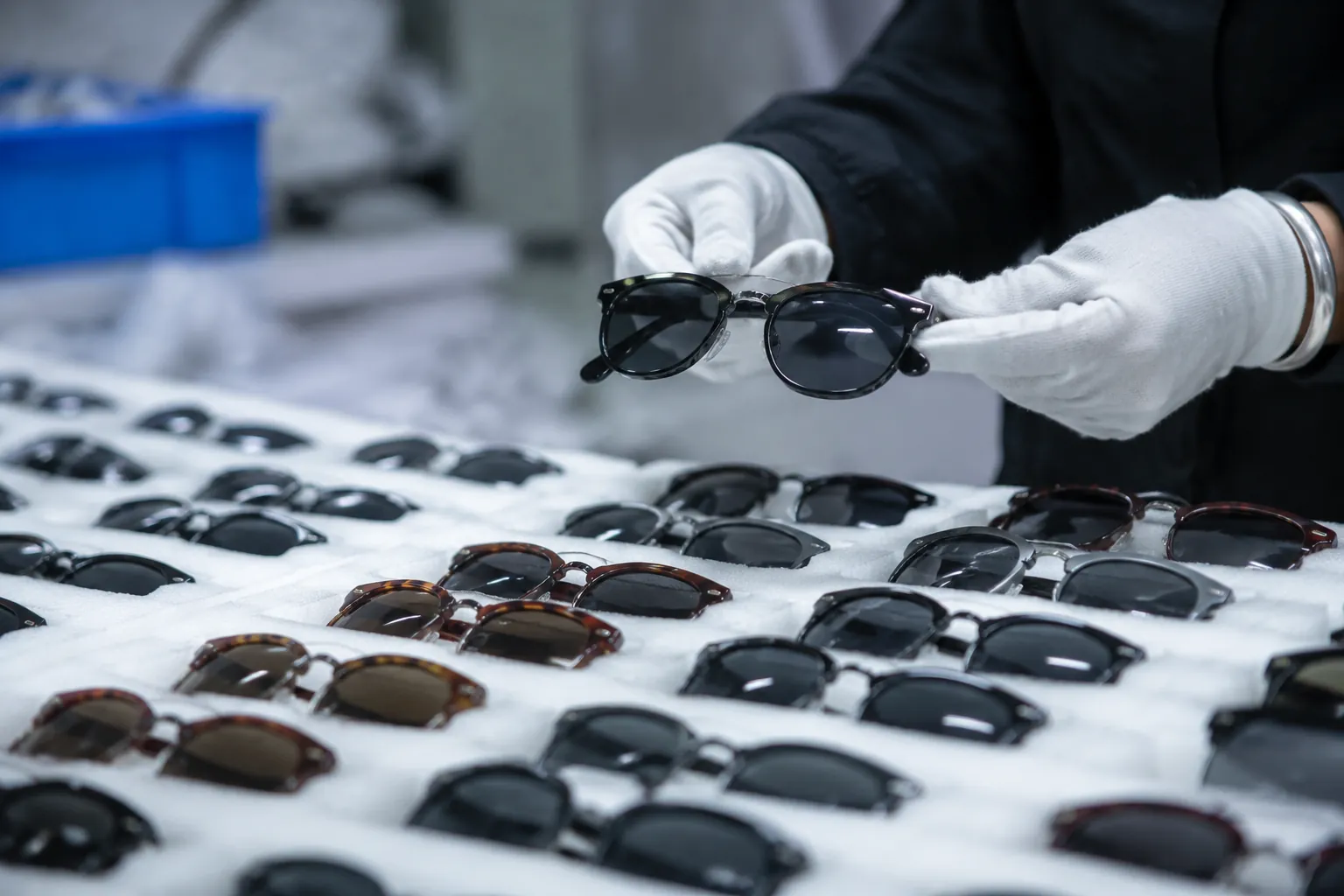
This guide is for brand owners, importers, distributors, and retailers planning a custom sunglasses line with a Chinese OEM or ODM factory. The central idea is simple: design to what the factory can repeat at scale, not to what looks good in a mockup. Doing that reduces rejects, protects margin, and avoids late-stage tooling changes that cost time and money. Use the factory's actual capabilities, confirmed documents, and sample results to shape the line before you commit to bulk.
Start With the Sales Target, Not the Sketch
Before you pick a frame shape, define the commercial job the line has to do. Is it a traffic-driving entry program, a brand-building retail collection, or a low-risk replenishment line for wholesale? Each answer changes the factory brief. A volume SKU that needs to land at roughly a low single-digit factory cost cannot be designed like a premium fashion capsule. Likewise, a collection meant to support a higher retail ticket can justify more finishing time, better lens treatment, and a more complex bill of materials.
Good buyers start with a target matrix: expected sell-through window, target landed cost, preferred margin, and acceptable reorder cadence. If the first order is only a market test, a small MOQ per design may be workable. If you already know the program will repeat, push the factory toward a cleaner production plan at 300, 1,000, and 5,000+ pairs so setup time and scrap can be absorbed more efficiently. That is where price usually improves. The factory is not becoming more generous; it is spreading mold setup, line changeover, and QC labor across more units.
On sunglass programs, the fastest way to lose money is to ask for too many variables at once. Ten colorways, three lens tints, two logo methods, and premium packaging may sound commercially flexible. In production, it creates more approvals, more inventory fragmentation, and more chances for a borderline spec to miss target. A better launch plan is usually one frame family, two or three colors, one logo method, and one packaging standard. That gives you enough market signal to judge demand without forcing the factory into a high-mix, low-repeat pattern it will struggle to hold.
Think like the factory planner: every added option increases resin handling, polishing sequences, printing setups, and stock keeping. If the line must stay profitable, the spec has to be simple enough to repeat.
Match Style To the Production Process
Not every sunglasses style behaves the same in production. Injection molding, acetate cutting, and CNC milling have very different cost structures, cycle times, and defect modes. If you treat them as interchangeable, your quotations will be unreliable and your lead times will drift.
| Style / Process | Best For | Main Risk | Typical Buyer Use |
|---|---|---|---|
| Injection molded frame | High-volume fashion, sport-inspired shapes, cost-sensitive programs | Gate marks, sink, warp, color mismatch, thin-wall stress | Core line, promo programs, wide distribution |
| Acetate cut and polished frame | Premium look, thicker temples, stronger color depth, higher perceived value | Edge finishing, polishing labor, shrink control, hinge alignment after heat cycling | Retail programs, brand-led collections |
| CNC milled frame or detail parts | Sharp geometry, premium detailing, mixed-material builds, smaller runs | Tool-path marks, slower cycle time, higher scrap on complex cuts | Higher-spec fashion or design-driven lines |
| Mixed-material build | Style differentiation with metal, acetate, and injected components | Assembly tolerance stack-up, glue failure, plating wear, part mismatch | Fashion-forward or higher-margin private label |
Ask the factory one blunt question: which operation creates the most manual labor per pair? That is usually where cost, variation, and rework will live. If the answer is polishing or hand assembly, the style is probably too ambitious for your intended price point. If the answer is a simple mold cycle with minimal secondary processing, you are closer to a scalable spec.
For buyer planning, process choice also affects tolerance strategy. A clean injected frame may run with tighter dimensional variation than a heavily polished acetate model, but only if the mold is stable and shrink behavior is understood. A practical eyewear factory should be able to discuss key checks such as temple length symmetry, front-width consistency, and lens groove uniformity, not just show renderings.
If the supplier says it can handle multiple processes, ask which steps are actually in-house and which are outsourced. That distinction matters because it affects lead time, accountability, and how quickly sample feedback can be turned into a corrected bulk order.
Build Around Materials That Survive Production
Material choice is not just a style decision. It determines how stable the frame is during molding, cutting, polishing, hinge insertion, transport, and final wear. A beautiful sample that is brittle, unstable, or too sensitive to heat becomes a service problem later.
- Injection materials: Best for repeatability, consistent wall thickness, and short cycle times. Good programs usually keep wall sections uniform and avoid abrupt thickness jumps that can create sink or warp. They are strongest when the factory needs predictable output and lower labor input.
- Acetate: Better color depth and a more premium hand feel, but it requires tighter control during cutting, tumbling, polishing, and hinge installation. Slight temperature swings can affect fit, and poor finishing shows immediately at the temple tips and front edge.
- Metal parts: Useful for temples, hinges, logo plaques, and reinforcement. More sensitive to plating finish, alignment, corrosion control, and tolerance drift during assembly. If plating is inconsistent, the line can fail on appearance even when the frame structure is fine.
- Lenses: Base material, tint density, and coating choice affect visual quality and compliance. Buyers should check distortion, scratch resistance, UV performance, and how the lens sits in the groove under heat and handling.
In mixed-material sunglasses, the frame is not always the hardest part. The assembly often is. A metal logo plate can look elegant in artwork, but if its adhesive or fixing method cannot survive warehouse heat, repeated handling, or carton pressure, it becomes a failure point. Laser engraving is simpler and more durable when the surface allows it. Pad printing is lower cost and faster to set up, but ink wear, solvent resistance, and abrasion should be checked before approval. Metal badges feel premium, but they add a separate part number, a separate supplier risk, and one more inspection step.
For export orders, ask for material declarations and lot traceability for the approved sample and bulk run. If you are selling into the EU, REACH-related substance control may matter. If you are supporting U.S. and other international markets, ask how the factory tracks the exact resin, coating, and lens lot used for the approved sample. Documentation should match the SKU you are buying, not a general capability statement.
For sunglasses specifically, the most useful material questions are practical ones: Does the injected frame recover shape after heat exposure? Does acetate edge polish stay smooth after hinge stress? Does the lens tint remain uniform from lot to lot? Does the metal part show plating wear after packaging abrasion? Those are the issues that decide whether a line stays healthy after the first shipment.
Use Decoration Methods the Line Can Hold
Decoration can destroy margin if it is treated like a late-stage aesthetic choice. A logo that looks effortless on a mockup can be slow, fragile, or inconsistent at scale. The right question is not whether the branding looks premium. The question is whether the factory can apply it repeatably without adding too much touch labor or reject risk.
- Laser engraving: Best for permanent branding on metal or selected coated surfaces. It creates a crisp mark, requires little consumable inventory, and scales well once the laser path is dialed in. The limits are surface finish, curvature, and placement. If the target area is too small or too glossy, contrast can be weak.
- Pad printing: Best for simple logos, icons, and color marks. It is fast to set up and affordable for short-to-mid runs, but adhesion and wear must be validated. Curvature, ink thickness, and drying time all matter. A pad print that looks clean on day one may abrade quickly if packing or handling is rough.
- Metal logo plates: Best for premium cues and strong shelf presence. They add visual value, but they also add component sourcing, attachment review, and more QC points. Adhesive-backed plates are simpler, while riveted or mechanically fixed plates are stronger but more complex.
- Lens or temple engraving: Useful for subtle branding, but it requires careful control of location and depth so the mark does not interfere with optical or structural integrity.
A useful production rule is to limit decoration layers. If a frame has gradient coloring, dual-color printing, a metal badge, and custom lens marking, the line starts to carry multiple failure opportunities at once. That may be acceptable in a design studio. It is not always acceptable on a factory floor where every extra touch increases handling and rework.
If the program needs a short bulk lead time, keep the first order conservative. Prove the decoration method on run one, then add complexity on a reorder only after the factory has shown stable yield. This is especially important when branding must align precisely across the front, temple, and lens. A half-millimeter shift may be invisible in a render and obvious on a finished sunglass.
Buyers should also request the factory's practical decoration limits: minimum line thickness for engraving, color registration tolerance for pad printing, adhesive cure time for logo plates, and whether decoration happens before or after lens insertion. Those details determine whether the line is truly scalable.
Know the Compliance Stack Before You Approve Artwork
Compliance is not a paperwork box. It affects frame material, lens type, labeling, packaging, and sometimes the markets you can enter at all. If you skip this step, you may end up with inventory that looks ready but cannot be sold legally or efficiently.
Only rely on certifications and registrations that are relevant to the exact product and market. Ask for SKU-specific evidence, not brochure language. A certificate attached to one style does not automatically cover another style if the lens color, tint density, coating, frame material, or decoration changes after approval.
| Standard / Registration | What It Tells the Buyer | Why It Matters |
|---|---|---|
| CE EN ISO 12312-1 | Relevant for sunglass safety requirements in applicable markets | Lens and frame safety, labeling, and category control |
| FDA registration | Factory registration status relevant for U.S. trade | Useful for U.S. import programs, but not a product test by itself |
| ANSI Z80.3 | U.S. sunglass safety standard reference | Important for impact resistance and optical requirements |
| AS/NZS 1067 | Standard used for Australia and New Zealand sunglasses compliance | Needed if those markets are in scope |
| REACH | Restricted substances framework | Material and coating control for EU-facing supply chains |
Before approval, ask what the factory can provide with each shipment: test reports, declarations, batch references, and the exact SKU version covered. A certification held on one style does not automatically carry over if you change lens color, tint density, coating, logo method, or temple material after approval. The approved spec should be frozen and traceable.
It also helps to align artwork with compliance early. Darker lenses may need different testing attention than fashion tints. A printed logo on the lens can introduce a new inspection point. A mirror coating may require different handling than a standard tint. If you plan to sell into multiple regions, it is easier to design one compliant base and create regional packaging or labeling variants than to redesign the sunglass itself for every market.
Do not treat compliance as a yes-or-no question from the sales team. It is a document-and-spec matching exercise. If the factory cannot explain which certificate, test report, or declaration matches the exact SKU you are approving, the order is not ready.
Price, MOQ, and Lead Time Need One Spec Sheet
Buyers often negotiate price, MOQ, and lead time as if they were separate items. They are not. They are one system. Change one variable and the others move. If you want the factory to quote accurately, you need a spec sheet that removes ambiguity about materials, finishes, lens type, decoration, packaging, and expected quantity.
The useful buying pattern is straightforward: lower MOQ usually means a higher unit price because setup and changeover are spread across fewer units. Larger orders usually price better because the factory can run longer, waste less time on setup, and absorb QC and handling more efficiently. That is why you should ask for the same style at several quantity levels before deciding on the launch volume.
- Low-MOQ order: Best for testing demand and fit. Expect higher unit cost, fewer customization options, and less room for production inefficiency.
- Mid-volume order: Usually the best balance of price and flexibility. This is where many private-label programs should sit.
- High-volume order: Lowest unit cost, but only if SKU complexity stays controlled and replenishment is planned ahead.
The factory's quote will also shift based on whether your design asks for thick acetate polishing, plated metal parts, special lens colors, custom tooling, or premium packaging. A buyer who asks for a low price on a difficult spec is setting up a conflict later. A better approach is to decide which elements are non-negotiable and which can be standardized. That gives the factory room to optimize the order instead of defending itself with change orders after sampling.
A practical pricing conversation looks like this: "What is your best price for 1,000 pairs with one frame color, one lens tint, one logo method, and standard packaging?" Then compare that against the same model at 300 pairs and 5,000 pairs. You will see where the cost curve really bends. That tells you whether the line is meant to be a test, a steady seller, or a scalable hero SKU.
Lead time should be discussed the same way. A clear design with stable components can move faster than a design that needs new tooling, new decoration setup, or multiple approval rounds. If the supplier gives a lead time, ask what assumptions it depends on and what would cause it to change.
Run the Development Process Like a Factory Audit
Sampling is not decoration approval. It is the first production test. Treat it that way, and you will catch most problems before they become expensive.
- Send a tight brief: frame type, target market, lens category, color count, decoration method, target retail price, packaging, and expected order size.
- Confirm which operations are in-house and which are outsourced, including molding, cutting, tinting, polishing, printing, plating, and final packing.
- Ask for sample checks on fit, hinge action, surface finish, lens tint, logo placement, and carton presentation.
- Review measurable details such as temple symmetry, front width, lens seating depth, hinge alignment, and print registration before approving bulk.
- Freeze the approved sample, then use it as the reference for pre-shipment inspection and any later reorder.
With a factory that controls more than one process step, the feedback loop is shorter. If the temple angle is off or a decoration location interferes with assembly, the same factory can often correct it faster than a fragmented chain of subcontractors. That is useful, but it does not remove the need for buyer-side control.
As a buyer, you should be looking for tolerance behavior, not just appearance. A good sample should show stable hinge feel, even lens seating, consistent temple closing, and clean decoration alignment. If possible, ask the factory what their typical inspection checkpoints are for critical dimensions. In eyewear, small drift matters. A 0.5 mm change in front width or a slight temple mismatch can affect comfort, packaging fit, and repeatability. The prettier the design, the more painful those small errors become.
Good development also includes realism about tooling. If the line needs new molds, ask how long they need for tool creation, first article review, and any correction cycle. If the design uses standard components, ask which parts can be borrowed from existing libraries. A factory that explains those tradeoffs clearly is usually easier to work with than one that only says "yes."
Keep a written approval trail. The sample, artwork, measurements, and compliance documents should all match the same version. That record becomes the reference point if there is a dispute later.
What Good Planning Looks Like on a Real Order
A practical first order for an overseas buyer often looks ordinary on paper. That is a good sign. One frame family, one or two lens colors, one logo method, one packaging spec. Enough variety to sell, not enough to confuse the factory or inflate inventory risk.
For example, a retailer launching a private-label acetate frame might start with two colors, one lens tint, pad printing on the temple, and a moderate initial order per color once the sample is approved. A distributor targeting a lower-price offer might choose injected frames with laser engraving, standard pouch packaging, and a smaller color set, then scale toward a larger reorder after sell-through is proven. Both are valid. The key is that the product architecture matches the factory's process instead of fighting it.
On the first order, buyers should also decide what not to customize. If custom packaging delays launch, use a standard carton and upgrade later. If a special lens color adds risk, start with a safer tint and test the market. If a metal badge adds too much assembly time, switch to engraving for run one. Small concessions at launch often produce better margin than over-designed inventory that sits.
Rule of thumb: if a feature does not improve sell-through, compliance, or repeatability, leave it out of the first run.
That rule saves money and makes reorders easier. The factory can repeat a stable bill of materials instead of rebuilding the job every time. In sunglasses sourcing, that repeatability is the difference between a product line and a one-off experiment.
The best planning documents are specific enough that the factory can quote them without guessing. If the supplier can read the sheet and tell you the likely problem points before sampling starts, you are probably working with a capable partner. If they cannot, the design is probably too vague.
How to Evaluate a Supplier Before You Commit
Once the line is defined, the supplier conversation should focus on proof, not promises. Ask for a factory profile, current certifications, sample capability, and a clear explanation of which production steps are in-house. That gives you a realistic view of where the order will actually be made and controlled.
For sunglasses, the most useful checks are simple: Does the factory show traceable compliance documents for the exact SKU? Can it explain its process route from material to finished pair? Can it identify the likely production risks before you approve bulk? Can it repeat the sample without drifting in fit, finish, or decoration?
When those answers are clear, your sourcing risk drops. When they are vague, the first order becomes a gamble. The strongest suppliers are usually the ones that can explain their limits as well as their strengths. That is a sign they understand production, not just sales.
Use that standard to compare factories. A supplier with ISO 9001 and BSCI can still vary in process control, decoration consistency, and documentation quality. A supplier with the right compliance names is not automatically the right supplier for your design. The real test is whether the factory can make your exact spec repeatedly, with the documents to prove it.
If the answer is yes, you have a usable sourcing base. If the answer is no, revise the design until it matches the factory's capability or keep searching.
Have a custom sunglasses project in mind?
Send us your styles, target market and quantities and we will return a detailed quote with MOQ, lead time and a sample plan.
Get a QuoteWhy source this from Wenzhou with LumiShades
Wenzhou in Zhejiang Province is widely regarded as China’s eyewear manufacturing capital, producing a large share of the world’s sunglasses. That concentration matters to buyers: a deep local supply chain for acetate sheet, hinges, lens blanks, plating and packaging means shorter component lead times, easier color and material matching, and a workforce with decades of eyewear-specific skill. LumiShades has manufactured in this ecosystem since 2009, and our vertical integration — in-house injection molding, acetate cutting, CNC milling, lens tinting, decoration and quality control — means no part of your order is quietly subcontracted to a workshop you cannot audit.
For international buyers, that vertical control translates into accountability. When a single factory owns every step, defects are traced and fixed at source rather than bounced between vendors, and your specifications survive intact from first sample to bulk. We back this with 15+ years of experience, shipments to 60+ countries, more than 5 million pairs produced per year and a 98.5% on-time delivery rate. Our certifications — CE EN ISO 12312-1, FDA registration, ANSI Z80.3, AS/NZS 1067, REACH, ISO 9001 and BSCI audit — mean the compliance documentation your market requires already exists. Explore our manufacturing capabilities and quality control process to see how this works in practice.
Frequently asked questions
What is the safest way to start a new sunglasses line with an OEM factory? Start with one frame family, limited colors, one decoration method, and one target market. Approve a sample, freeze the exact spec, and only then place bulk. The safest first order is the one the factory can repeat without redesigning the process.
How do MOQ and unit price usually move together? Lower MOQ usually means a higher unit price because setup and changeover are spread across fewer units. To get a meaningful quote, ask the factory for the same product at several quantities, such as a low test quantity, a mid-volume run, and a larger production run.
How long should I plan for samples and bulk production? Ask the factory for lead time based on your exact spec, not a generic promise. The quote should state what is included, such as tooling, sampling, decoration setup, and packing, and should name the assumptions that could change the timeline.
Which decoration method is easiest to control at volume? Laser engraving is usually the most stable for permanent branding. Pad printing is flexible and cost-effective, but it needs validation for adhesion and wear. Metal logo plates look premium but add parts, assembly steps, and inspection points, so they need more control.
What compliance documents should I ask for before placing an order? Ask for SKU-specific test reports, declarations, and batch references tied to the exact style you are approving. The certifications and registrations you should evaluate are CE EN ISO 12312-1, ANSI Z80.3, AS/NZS 1067, REACH, FDA registration where relevant, plus ISO 9001 and BSCI for supplier qualification.
Why does in-house production matter to a buyer? It shortens feedback loops and reduces handoff risk. If molding, cutting, tinting, decoration, and QC are under one roof, the factory can correct problems faster and keep responsibility clearer than a fragmented supply chain.
Ready to start?
Explore our round sunglasses or request a quote — our sales team replies within 12 hours.
Request a Quote