
How to Audit Sunglasses Factory Lead Times
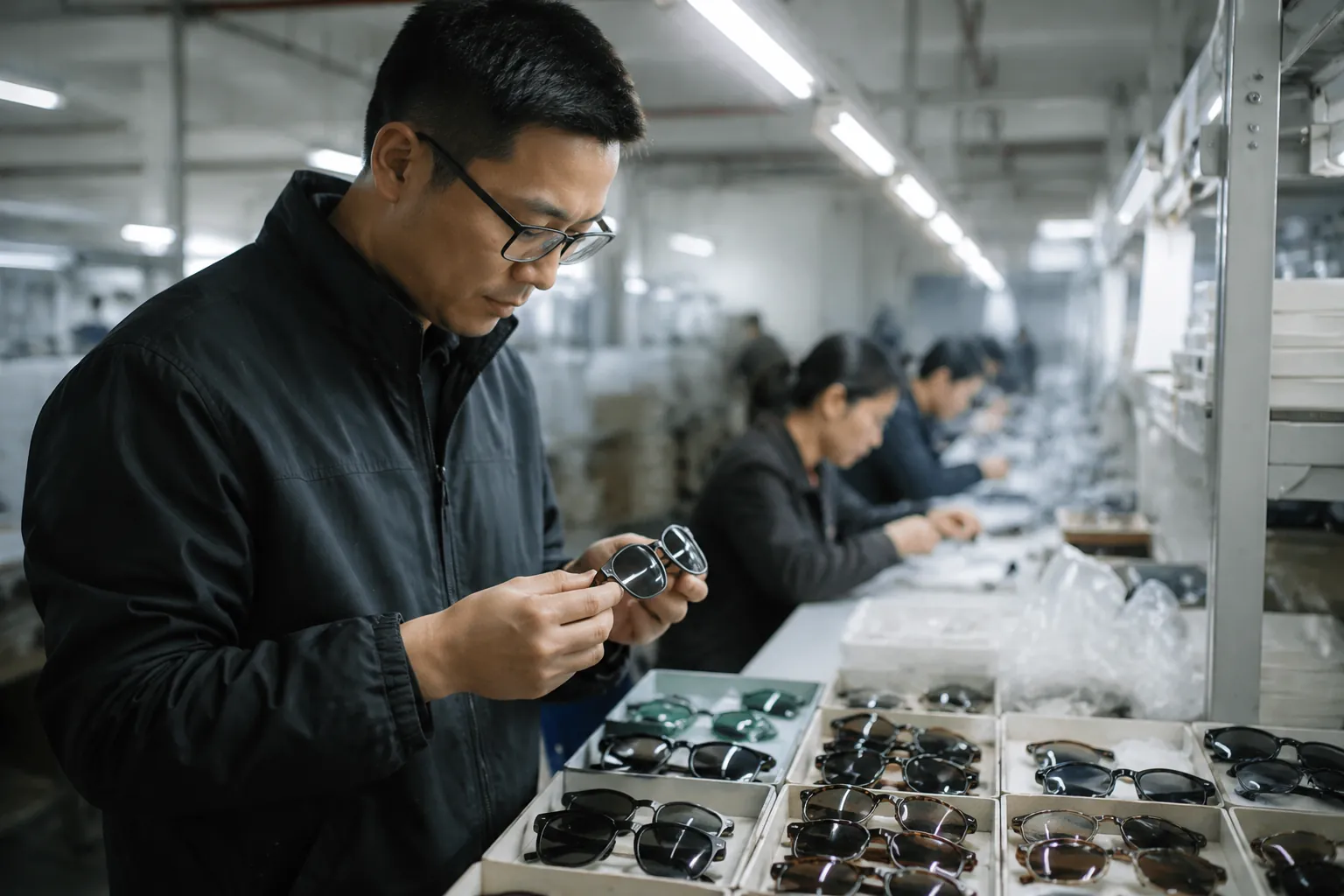
If you buy custom sunglasses for a brand, import business, retail chain, or distribution program, lead time is not just a number on a quote. It depends on whether the factory can repeat the same process under real load, with your materials, your decoration method, and your approval flow. This guide shows you how to check that before you scale past a first order.
Start with the real question
Do not ask a factory for a "fast lead time" and stop there. Ask how it protects the timeline at each step: material intake, cutting or molding, lens preparation, decoration, assembly, QC, packing, and export handoff. A credible supplier should be able to explain where time is spent, which steps happen in-house, and which steps depend on outside vendors or approvals.
Lead-time reliability usually breaks in three places. First is material shortage: frame resin, acetate sheets, hinges, screws, lenses, cases, or cartons are not available when needed. Second is changeover delay: the line loses time moving from one color, lens tint, or logo method to another. Third is QC rework: the batch is produced, but defects force sorting, retouching, or reassembly. If the supplier cannot explain how it manages those risks, treat the schedule as tentative.
Separate quoted time from controllable time. A factory may quote 28 days, but part of that may be waiting for artwork approval, material arrival, or outsourced finishing. You need to know which days are actually under the factory's control and which depend on you or a third party.
For any supplier, ask for the process flow in order. A serious answer should cover design confirmation, material sourcing, first-off sample, fit check, finish approval, bulk scheduling, in-process QC, final inspection, packing, carton labeling, and shipment booking. If the answer is vague, the lead time is probably vague too.
Read the process, not the pitch
Factories that control more steps can usually control time better. If a sunglasses factory handles injection molding, acetate cutting, CNC milling, lens tinting, decoration, and QC in-house, it has fewer handoffs to coordinate. Every outside handoff adds risk, especially when a batch depends on frame blanks, lens work, logo application, or inspection slots at another facility.
Ask for the exact sequence on your style. A clear answer should identify the steps from sample confirmation to bulk release. If the supplier cannot describe the sequence in practical terms, it is harder to trust its timing estimate.
Process detail matters differently by material. Acetate frames require controlled cutting, tumbling, and polishing so edges stay smooth and the frame does not pick up avoidable stress or finish defects. Injection frames depend on tooling stability and cycle consistency; if the mold or process drifts, the batch can show flash, sink marks, or trim issues that slow output. Metal or mixed-material styles add assembly risk because hinges, pads, temple tips, and decorative parts must all fit correctly.
Ask where tolerances are held. Temple alignment, hinge symmetry, and lens seating are common problem points. A practical shop should explain how it checks those points and what it does when a frame falls outside spec. If it cannot describe the tolerance or the rework step, it is not managing lead time tightly enough.
Make sample lead time boring
Sample lead time is the first reliability test. A supplier that cannot consistently hit its sample window will usually struggle more on bulk orders, because the same planning gaps show up later. Sample work should be tied to a clear spec sheet: frame material, finish, lens color, tint level, logo method, hinge type, packaging, and compliance target. The more exact the spec, the less time the factory spends guessing.
Use this checklist before you approve a sample run:
- Confirm the exact frame material and finish, such as acetate polish, matte TR90, or glossy injected resin.
- Confirm lens tint, category, UV requirement, and whether the lens is CR-39, TAC, or polycarbonate.
- Confirm logo method: laser engraving, pad printing, hot stamping, metal logo plate, or embossing.
- Confirm whether the sample is production-equivalent or hand-finished with extra manual steps.
- Confirm the fit target, including bridge width, temple angle, and any preferred size tolerance.
- Confirm what counts as approval: photos, physical sample, or both.
- Confirm which changes reset the clock and which can be absorbed without a new build.
The last point matters more than most buyers expect. A "small change" after sample approval can add time quickly. A new logo position, different lens tint, tighter fit spec, or different case style may require new setup, new artwork, or a fresh inspection run.
When a supplier states sample lead time, ask whether it includes artwork confirmation, material prep, and courier transit. Some factories quote only shop-floor time. Others quote the full cycle. Those are not the same number. You need to know which one is being used before you plan a launch date.
Use a lead-time table
Ask the supplier to map timing by order size and process complexity. If it cannot do this on one page, it may not be managing capacity tightly enough. A useful answer separates sample build time, normal bulk time, and the extra time caused by mixed styles or add-on packaging.
| Order stage | Typical timing | What can slow it down | Buyer check |
|---|---|---|---|
| Sample build | 7-10 days, if the spec is clear and materials are available | New tooling, logo changes, lens spec changes, special packaging | Approve a full spec sheet before production starts |
| Small bulk run | 25-35 days, depending on complexity and capacity | Material delays, decoration queues, final QC rework, carton printing | Ask for a line-by-line schedule with dates |
| 300 pairs | Often the first price step where unit cost improves | Setup time may still dominate if the order has multiple variants | Keep the order to one frame family and one packaging spec |
| 1000 pairs | Usually a better balance between unit cost and line efficiency | Too many lens colors or logo methods can slow the batch | Freeze artwork, labels, and case color early |
| 5000+ pairs | Can produce the lowest unit cost when the order is operationally simple | Capacity conflicts, mixed styles, staggered material arrival | Separate core style from optional add-ons |
Volume pricing and lead time are linked, but not in a simple way. Bigger orders can improve unit cost, but they can also slow output if the order includes too many lens colors, frame colors, or packaging variants. Scale helps only when the order stays operationally simple.
Ask for a production window, not just a ship date. A practical schedule should show when materials arrive, when the first-off sample is approved, when bulk begins, when QC starts, and when packing is complete. If the factory can only provide a shipment estimate, you do not yet have enough control.
Audit capacity, not the machine list
Many suppliers list equipment. Fewer can explain actual throughput. For sunglasses, you care about whether the line can absorb your style mix without constant changeovers. One injection line may run quickly, but if it is also feeding several low-volume styles, your order may wait behind another job. The same is true for decoration stations, where screen printing, laser marking, or hot stamping can become a bottleneck.
Ask these direct questions:
- How many active styles are produced at the same time?
- How much of the frame work is done in-house versus outsourced?
- What is the factory's standard QC hold point?
- How many days of raw-material buffer are kept for common colors and lens types?
- What happens if a first-off sample fails fit, polish, or finish?
- How many units per day can the line actually complete on a similar style?
Good factories answer in process terms. Weak factories answer with adjectives. You need line balance, buffer stock, and rework rules, not slogans.
The buffer question is especially important. If a factory keeps very little inventory for standard colors, common lenses, or cartons, a routine supply delay can stop production. A stronger plant will have safety stock for common inputs and a defined replenishment rule. That is a meaningful sign of reliability.
Also ask whether changeovers are planned or ad hoc. A supplier that batches by color, logo method, and packaging can usually protect timing better than one that starts and stops many styles throughout the week. The more disciplined the batch plan, the more believable the lead time.
Check compliance early
Compliance delays are a common hidden cause of missed ship dates. For overseas buyers, the relevant documents are not decorative. Use only certifications and regulatory references that match the market you sell into and the product category you are importing.
Keep the list focused on the standards you can verify: CE EN ISO 12312-1, ANSI Z80.3, AS/NZS 1067, REACH, FDA registration, ISO 9001, and BSCI. Ask the supplier to show which one applies to your destination market and which one applies to the factory itself.
Do not treat every document as the same kind of proof. Product standards such as CE EN ISO 12312-1, ANSI Z80.3, and AS/NZS 1067 relate to sunglass performance or testing requirements in specific markets. REACH relates to chemical compliance. FDA registration is not a quality certificate; it is a U.S. regulatory registration point. ISO 9001 is a quality management system standard. BSCI is an audit and social compliance framework.
Compliance also affects timing through test samples, document revisions, and artwork checks. If your logo is too close to a required marking, or if the lens specification changes after documentation is prepared, the factory may need to reissue labels or remake samples. That can push the order back even if the frame line is on time.
Ask for the document set before production: test reports where applicable, declarations of conformity where applicable, material declarations for lenses or coatings, and carton markings. If the supplier cannot align those documents with the order before production, it may finish the goods and still miss the ship date.
Pressure-test QC and rework
On-time delivery is not just production speed. It is defect control. A factory that produces quickly but reworks a large share of the batch is not reliable. Ask where QC happens: incoming material check, in-process check, final inspection, and packing audit. You want to know at which point defects are caught and who has authority to stop the line.
For sunglasses, common time sinks include lens tint inconsistency, hinge misalignment, surface scratches, logo print rejection, and cosmetic mismatch between left and right temples. Ask whether the factory tracks these defects by type and whether each type has a defined corrective action. A shop that records only "pass" or "fail" is weaker than one that logs the actual defect and the rework path.
Ask for the final inspection method. If the supplier cannot explain how it handles sampling, sample retention, rework segregation, and packing release, it is not ready for volume. It may still be a usable vendor, but it is not yet a low-risk scale partner.
Also ask how rework is isolated. A reliable factory keeps failed goods out of the main flow so they do not contaminate the next batch or delay packing. If rework is mixed back into the line without control, lead times tend to slip order by order until the issue becomes obvious.
Decide if the supplier can scale
Reliability changes with complexity. A single black acetate style with one logo method is easier to schedule than six colors, three lens tints, two packaging formats, and a mixed drop model. Keep your first scale order simple.
Use this decision rule:
| Order pattern | Risk level | Why | Best move |
|---|---|---|---|
| One style, one color, one logo method | Lower | Minimal changeover and easier QC | Use this as the pilot volume run |
| Several colors, same frame | Medium | More sorting, labeling, and inventory handling | Freeze packaging and label specs early |
| Multiple styles with different materials | Higher | More process switching, more QC risk, more setup loss | Split into separate purchase orders if timing matters |
| Mixed frame, mixed lens, mixed packaging | Highest | Every variable multiplies the chance of delay | Reserve this only after the supplier proves schedule control |
A practical supplier should be able to explain where the savings come from as quantities rise. Typically the savings come from material purchasing efficiency, fewer line resets, lower packaging waste, and better labor utilization. If the answer is only "more quantity, better price," the factory is not thinking like a production planner.
Before you scale, get three things in writing: the approved spec sheet, the confirmed production window, and the shipment handoff date. That is the minimum control set. If your supplier will not commit to those three items, the order is still in the quote stage, not the execution stage.
Use a short audit script
Keep the audit tight. You are not trying to become a factory inspector. You are trying to find schedule risk before it becomes your problem. A short, specific script will tell you more than a long sales call.
- What is the exact sample lead time for my style, including artwork and courier handoff?
- What is the exact bulk lead time at my target quantity, and what is the production window?
- Which steps are fully in-house, and which steps are outsourced?
- Which certifications or standards apply to my target market, and can you map them to this SKU?
- What is the MOQ per design, and what price step changes at 300, 1000, and 5000+ pairs?
- What happens if I change a logo, lens tint, hinge type, or packaging after approval?
- How do you handle QC failure, rework, and shipment release?
If the supplier answers clearly, with numbers and process detail, you are probably dealing with a real production team. If the answers are broad and cheerful, keep the order small until they prove discipline.
One last buyer check: ask for photos or a short video of the line doing a similar order. You are not looking for marketing polish. You are looking for evidence of active work, organized material flow, and a factory that can move from sample to bulk without improvisation.
Have a custom sunglasses project in mind?
Send us your styles, target market and quantities and we will return a detailed quote with MOQ, lead time and a sample plan.
Get a QuoteWhy source this from Wenzhou with LumiShades
Wenzhou in Zhejiang Province is widely regarded as China’s eyewear manufacturing capital, producing a large share of the world’s sunglasses. That concentration matters to buyers: a deep local supply chain for acetate sheet, hinges, lens blanks, plating and packaging means shorter component lead times, easier color and material matching, and a workforce with decades of eyewear-specific skill. LumiShades has manufactured in this ecosystem since 2009, and our vertical integration — in-house injection molding, acetate cutting, CNC milling, lens tinting, decoration and quality control — means no part of your order is quietly subcontracted to a workshop you cannot audit.
For international buyers, that vertical control translates into accountability. When a single factory owns every step, defects are traced and fixed at source rather than bounced between vendors, and your specifications survive intact from first sample to bulk. We back this with 15+ years of experience, shipments to 60+ countries, more than 5 million pairs produced per year and a 98.5% on-time delivery rate. Our certifications — CE EN ISO 12312-1, FDA registration, ANSI Z80.3, AS/NZS 1067, REACH, ISO 9001 and BSCI audit — mean the compliance documentation your market requires already exists. Explore our manufacturing capabilities and quality control process to see how this works in practice.
Frequently asked questions
How do I know if a 7-10 day sample promise is real? Ask for the exact sample steps, who owns each step, and whether the sample uses the same material, logo method, and lens specification as bulk production. A credible answer should include a written spec sheet, a start date, what is included in the clock, and the approval rule before the sample is released.
What is the first sign a supplier may miss bulk lead time? They cannot explain where time is spent in scheduling, QC, or packing, or they avoid giving a line-by-line production window. Another warning sign is heavy dependence on outsourced decoration or finishing without a clear backup plan.
Should I focus on MOQ or lead time first? Lead time first. MOQ matters only if the factory can repeat the same timing at your target volume and maintain the same QC standard when the order gets larger. A low MOQ does not reduce schedule risk by itself.
Which certifications matter most for export sunglasses? Use only the standards that match the market and can be verified: CE EN ISO 12312-1, ANSI Z80.3, AS/NZS 1067, REACH, FDA registration, ISO 9001, and BSCI. Ask the supplier to show which one applies to the destination market and which one applies to the factory itself.
What order structure is safest for a first scale run? One style, one color, one logo method, and fixed packaging. That keeps changeovers low, makes QC easier to control, and gives you a cleaner read on whether the supplier can ship on time. Once that runs cleanly, add complexity one variable at a time.
Ready to start?
Explore our cat-eye sunglasses or request a quote — our sales team replies within 12 hours.
Request a Quote