
Temple Branding Without MOQ Pain
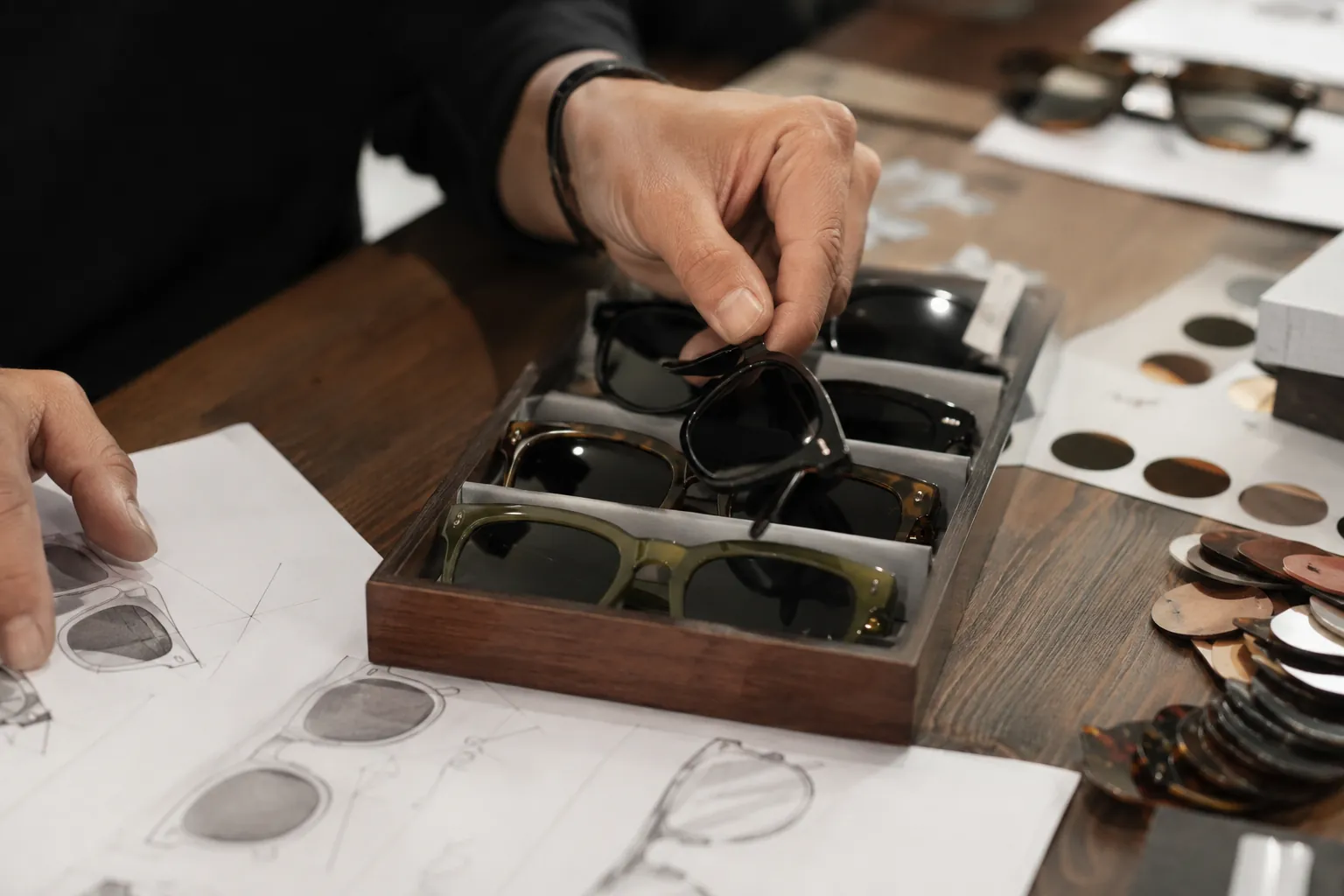
This guide is for brand owners, importers, and retail buyers developing custom sunglasses that need to look distinctly theirs without turning into a tooling or MOQ problem. Temple details are often where cost and defects stack up: extra parts, hand assembly, unstable finishes, and reorders that no longer match the first run. The goal is simple. Choose branding features that are distinctive, manufacturable, and repeatable across sampling, bulk production, and reorders.
Start with the right question: what still has to match on reorders?
Most temple-detail mistakes start early. A buyer asks for something unique, but not for something that will still look right on the first prototype, the first bulk run, and the next reorder. Those are not the same manufacturing problem.
A strong temple signature should do three things. First, it must be visible enough to matter in normal wear, not just in a close-up product shot. Second, it must tolerate ordinary production variation in placement, polishing, color, and material appearance without losing its identity. Third, it should not rely on a process or extra part that makes the order uneconomical at the volume you actually plan to buy.
In sunglasses, temple identity usually comes from four places: silhouette, surface treatment, applied branding, or construction. Silhouette includes taper, flare, facet, thickness steps, bevels, or temple-tip geometry. Surface treatment includes CNC grooves, brushed zones, texture, ribbing, or masked paint areas. Applied branding includes pad print, hot foil, laser engraving, or a metal logo plate. Construction includes laminated inserts, exposed wire-core windows on acetate, or mixed-material temple assemblies.
At lower volumes, it is usually safer to build the signature into the shape or surface. Those details are often easier to control than added hardware. At higher and more stable volumes, applied parts such as metal plates or custom inserts can make sense because setup cost and process validation are spread across more units.
Blunt rule: if brand recognition depends on a tiny glued part on the temple, expect more complexity in MOQ, assembly, and reorder consistency.
Pick the detail by MOQ, not by rendering
Temple details behave very differently in setup cost, minimums, labor, and defect risk. Compare them before approving drawings, not after the quote lands.
| Temple detail option | Typical setup burden | Best order range | Main production risk | Reorder stability |
|---|---|---|---|---|
| Pad-printed logo on temple | Low; artwork, plate, color reference | Low to mid volume | Print wear, color shift, registration drift | Good if artwork position, ink, and topcoat are standardized |
| Laser engraving on acetate or molded temple | Low to medium; program and fixture | Low to mid volume | Low contrast on some dark, glossy, or translucent finishes | Very good if substrate and machine settings stay consistent |
| CNC groove or milled signature line | Medium; CNC time and polish control | Mid volume and reorder programs | Depth variation, over-polishing, reduced wall thickness near hinge | Good if depth and finishing standards are documented |
| Metal logo plate inset into temple | Medium to high; metal part development, pocket fit, assembly fixture | Mid to high volume | Plate loss, misalignment, adhesive inconsistency, plating mismatch | Fair to good if the same vendor, finish, and assembly method are maintained |
| Fully custom temple mold or extrusion geometry | High; dedicated tooling and validation | Higher-volume or long-life styles | Tool cost exposure if the style does not reorder | Excellent once tool and process are validated |
The usual hierarchy is simple: print and laser are easiest to trial; CNC surface features come next; inserted hardware follows; fully custom temple tooling should generally be reserved for styles you expect to reorder or extend across multiple SKUs.
A metal plate may look like a small styling choice. It is not. It can add separate component sourcing, incoming QC, hand gluing or pressing, cure time, and cosmetic inspection on every pair. That is why the decision has to follow program economics, not just appearance.
Three low-drama branding routes that usually work
If the brief is recognizability without MOQ pain, three routes usually beat more decorative options.
- Signature milling or groove pattern. On acetate temples, CNC milling can create a repeating line, stepped recess, angled bevel, or notch pattern with clear definition. Usable depth depends on temple design, material, and finishing process, so confirm it on an engineering drawing and sample rather than guessing from artwork. Key control points are residual wall thickness, edge consistency after polishing, and symmetry between left and right temples.
- Laser engraving, with or without color fill. Laser is stable and works well for logos, coordinates, icons, and line motifs. On some black acetate, plain laser reads as a subtle gray. On clear, translucent, or highly polished surfaces, contrast may be weaker. Filled engraving improves visibility but adds another process step and another cosmetic variable. If color fill is used, specify the fill color, edge cleanliness standard, and cleanup method.
- Temple shape signature. A temple with a distinct facet, flare, step, or tip geometry can become part of the brand language without relying on separate hardware. It is visible at a glance and usually easier to repeat over time than a tiny applied component. On injection styles, shape signatures are often more scalable than very fine decorative surface details because they are built into the molded geometry.
What usually causes trouble? Thin metal appliques, long inlays, crystal settings, and multi-piece assemblies that require manual positioning on every temple. They can look good on a sample. They create variation in bulk.
Failure modes that turn a good idea into a sourcing problem
Temple details fail in predictable ways. Most of them can be screened during pre-production review.
- Plate misalignment: one plate sits high, low, or off-center relative to the other. Common causes are loose pocket tolerance, weak fixturing, or inconsistent adhesive application.
- Temple cracking at recesses: a deep inset near the hinge leaves too little wall thickness. Acetate can chip or weaken after aggressive milling; injection parts may stress-whiten or warp if the section becomes too thin.
- Print wear: pad print placed near the ear bend or high-contact try-on areas can rub off early. A protective topcoat can help, but wear performance still needs to be checked on the actual substrate and finish.
- Color mismatch on reorders: plated metal tone, foil color, paint fill, or ink shade can shift when supplier, batch, or process settings change.
- Left-right inconsistency: mirrored grooves, dual-color masking, or inserted plates can drift if fixtures are not fixed and first-off inspection is weak.
The fix is usually straightforward, but it has to be written early. Ask for a control drawing that shows exact logo position from fixed reference points, recess depth, minimum wall thickness, and cosmetic acceptance limits. A milled recess should have a target dimension and tolerance, not just a visual note. A metal plate should have a defined flushness and gap standard. If the acceptance rule is not documented, inspectors and suppliers will interpret the same sample differently.
Also check compliance impact. The branding itself is usually not the legal issue. Structural integrity, labeling area, and overall frame behavior are. Any major temple construction change should be reviewed against the product standard required for your market, such as CE EN ISO 12312-1, ANSI Z80.3, or AS/NZS 1067, before bulk approval.
Write the spec like a factory person
A temple concept becomes manufacturable only when the spec is concrete. Too many art files show the look but not the dimensions.
Your temple-detail spec sheet should include:
- Reference points: measure position from fixed datum points such as hinge pin center, temple top edge, or end face, not from a visual mockup.
- Depth and width: for grooves, recesses, and engraving; state target and tolerance.
- Material: cellulose acetate, TR90, PC, nylon, stainless steel, or mixed construction; edge sharpness, polish response, and adhesion differ by substrate.
- Surface finish: glossy, matte, brushed, blasted, or mixed; laser contrast and print adhesion change with finish.
- Cosmetic standard: acceptable gap, alignment shift, color deviation, edge feel, and left-right variation.
- Assembly method: if using a plate, note whether it is glued, pressed, pinned, or mechanically retained.
Material behavior matters. Acetate takes crisp CNC features and polished bevels well, but over-polishing can soften fine lines. Injection plastics are efficient at repeat volume, but undercuts, ultra-sharp grooves, or tiny raised logos can increase mold complexity and cost. A decorative line that looks minor on-screen may require side action, EDM work, or a secondary machining pass in production.
For regulated markets, keep branding separate from mandatory markings and documentation. REACH, FDA registration where applicable, product test records, and internal traceability should stay clear. Seasonal decorative changes should not interfere with model identification, compliance records, or quality documentation such as ISO 9001 systems if your supplier claims them.
A cost and lead-time breakdown buyers can use
Here is the sourcing logic many buyers miss: a temple detail can look cheap in unit terms but become expensive in total program cost if it slows sampling, raises rejection risk, or forces an MOQ higher than the style justifies.
| Order size | Most practical temple detail | Typical sample/production logic | Cost implication |
|---|---|---|---|
| Low-volume trial order | Print, laser, or adaptation of an existing temple shape | Usually avoids new hardware development and keeps sampling simpler | Lowest development risk; best for concept testing |
| Small to mid-volume order | Simple CNC groove or a small standardized plate | Manageable extra labor if fixture and finish standards are proven | Moderate cost increase can be justified by stronger visual identity |
| Mid to higher-volume reorder program | Custom pocket, plate shape, or stronger geometry cue | Dedicated setup becomes easier to justify when repeat demand is established | Setup cost is spread across more units and reorders |
| Large-volume or long-run program | Dedicated mold changes or custom metal branding system | Full tooling logic is justified only when the style or platform is stable | Best long-term efficiency if the product has proven continuity |
Lead time follows the same pattern. Decoration, milling, and moderate shape changes can often stay within a normal sample cycle. Add new hardware development, outside plating approval, or adhesive validation, and the sample cycle usually stretches. Bulk production is easier to control when the temple detail does not create a bottleneck in incoming parts, decoration, or final assembly.
Useful rule of thumb: if your temple branding adds a separate incoming component, ask what happens if that component arrives late, off-color, or out of tolerance. The answer usually shows the real schedule risk.
Build a signature that survives reorders
Reorder risk is where many low-MOQ designs become expensive later. The first run may look fine, but the second run uses a different plating batch, paint batch, or operator setup. Now the signature detail no longer matches earlier stock.
To reduce that risk, lock down the following after sample approval:
- Golden sample retention. Keep one approved left-right pair with signed cosmetic notes and finish callouts.
- Position drawing. Store exact print, engraving, or plate coordinates and orientation using fixed datum points.
- Material and finish code. Record acetate code, metal finish, plating tone, ink reference, and fill-color reference where applicable.
- Process route. For example: CNC before polishing, then laser, then final cleaning. Sequence changes the final look.
- QC checkpoints. Define first-off approval, in-process checks, and final cosmetic criteria.
This matters because temple branding is sensitive to small shifts. A minor change in plate position, groove definition, polishing sequence, or finish tone can be visible to the buyer and inconsistent at retail. The best signature detail is usually not the most complicated one. It is the one a customer recognizes quickly, a factory can inspect against clear standards, and a buyer can reorder with confidence.
A simple decision framework for the next brief
If you need a fast sourcing decision, use this framework.
- Testing a new shape with low commitment? Choose laser, pad print, or simple milling. Keep the first order focused on learning, not on hardware development.
- Need stronger brand recognition but still moderate risk? Build a temple silhouette cue plus one secondary detail such as a milled groove. That usually gives more identity without adding many failure points.
- Need jewelry-like branding for an established seller? Use a metal plate only after proving the style can reorder and after agreeing on flushness, adhesion, finish, and inspection standards.
- Need long-term brand language across many SKUs? Invest in a repeatable temple geometry standard and apply it across acetate and injection families wherever the engineering allows.
When reviewing supplier proposals, ask one direct question: which temple feature here creates the highest defect risk in bulk, and how would you simplify it without losing recognition? A supplier that answers clearly is usually thinking beyond the prototype and paying attention to reorder economics, quality control, and manufacturability.
Have a custom sunglasses project in mind?
Send us your styles, target market and quantities and we will return a detailed quote with MOQ, lead time and a sample plan.
Get a QuoteWhy source this from Wenzhou with LumiShades
Wenzhou in Zhejiang Province is widely regarded as China’s eyewear manufacturing capital, producing a large share of the world’s sunglasses. That concentration matters to buyers: a deep local supply chain for acetate sheet, hinges, lens blanks, plating and packaging means shorter component lead times, easier color and material matching, and a workforce with decades of eyewear-specific skill. LumiShades has manufactured in this ecosystem since 2009, and our vertical integration — in-house injection molding, acetate cutting, CNC milling, lens tinting, decoration and quality control — means no part of your order is quietly subcontracted to a workshop you cannot audit.
For international buyers, that vertical control translates into accountability. When a single factory owns every step, defects are traced and fixed at source rather than bounced between vendors, and your specifications survive intact from first sample to bulk. We back this with 15+ years of experience, shipments to 60+ countries, more than 5 million pairs produced per year and a 98.5% on-time delivery rate. Our certifications — CE EN ISO 12312-1, FDA registration, ANSI Z80.3, AS/NZS 1067, REACH, ISO 9001 and BSCI audit — mean the compliance documentation your market requires already exists. Explore our manufacturing capabilities and quality control process to see how this works in practice.
Frequently asked questions
What temple branding option is safest for a first order of 50 to 100 pairs? Laser engraving, pad printing, or a simple CNC groove are usually the safest starting points because they avoid separate hardware and reduce manual assembly variables. Ask the supplier for three things before approval: a marked-up position drawing from fixed reference points, a photo or physical sample on the actual material and finish, and written confirmation of how the detail will be inspected in bulk. That gives you a practical basis for comparison before you commit.
At what volume does a custom metal logo plate start to make sense? There is no universal threshold, because it depends on part size, finish, attachment method, and whether the plate uses a standard component or a new custom part. In practice, a metal plate makes more sense once the style has proven reorder potential and the added sourcing, assembly, and QC cost can be justified. Before approving it, ask for the metal-part drawing, the attachment method, the cosmetic standard for flushness and alignment, and confirmation of whether the same finish can be maintained on reorders.
Can temple details affect compliance testing? Yes. Decorative changes can affect wall thickness, hinge-area strength, assembly stability, or labeling space, which may influence performance under the market standard that applies to your product. For sunglasses, ask the supplier whether the final construction being shipped has been reviewed against CE EN ISO 12312-1, ANSI Z80.3, or AS/NZS 1067 as relevant to your destination market. If the temple construction changes after testing, confirm whether retesting or technical review is required before bulk release.
What should I ask for on a temple detail spec sheet? Ask for position from fixed datum points, target dimensions and tolerances, material, finish, assembly method, and cosmetic acceptance criteria. If a plate is used, request the pocket drawing and flushness standard. If milling or engraving is used, request the target depth and how it will be checked after polishing. Also ask the supplier to identify which dimension is critical to appearance, because that is usually the dimension most likely to cause reorder mismatch.
How do I reduce mismatch risk on reorders? Approve and retain a golden sample, lock the process sequence, record material and finish codes, and keep the same inspection criteria on every repeat order. In addition, ask the supplier to save the approved artwork, machine settings where relevant, and photos of left-right accepted appearance. For plated or painted details, confirm whether the same vendor and color reference will be used again. Reorder consistency improves when visual acceptance is tied to written records, not only memory or sample-room discussion.
Ready to start?
Explore our shield & oversized sunglasses or request a quote — our sales team replies within 12 hours.
Request a Quote