
Sunglasses Packaging Specs by Retail Channel
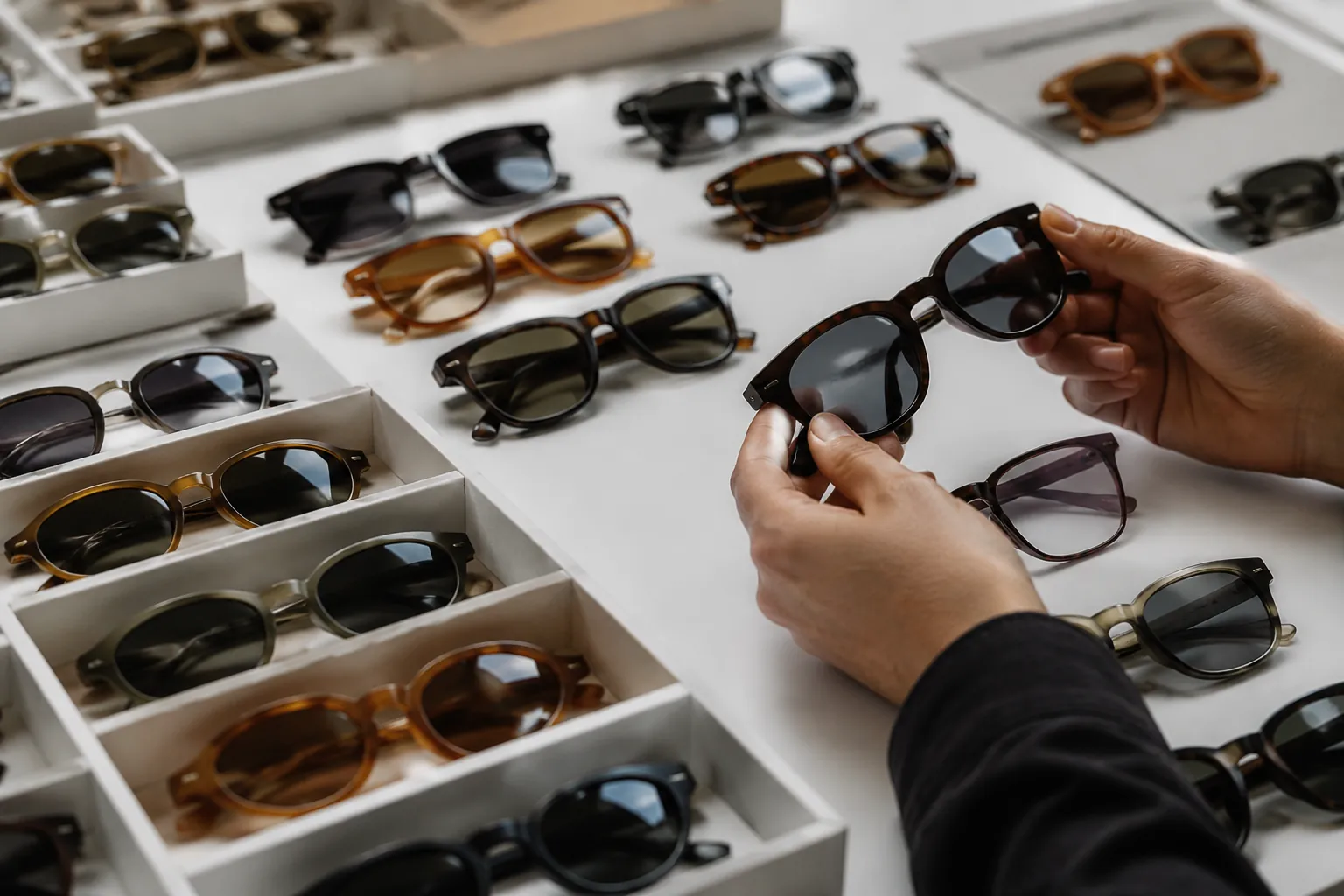
This guide is for buyers developing custom sunglasses for club stores, chain retail, e-commerce, or distributor programs. Start with the sales channel. Not the box style. A pack that works in one channel can fail in another. The right specification depends on how the product will be scanned, handled, shipped, displayed, and relabeled. This article lays out a practical way to choose format, material level, print area, barcode placement, protection method, and approval timing before you commit to samples or bulk production.
Start with the sales channel, not the pack style
Many packaging mistakes start with looks. That is the wrong starting point.
A rigid drawer box may look premium in a render, but it can be inefficient for e-commerce, awkward for club-store handling, or too expensive for an entry-price chain program.
For sunglasses, the pack usually has to do four jobs at once: protect frame shape and lenses, present the product clearly, carry required markings, and move efficiently through packing, shipping, and store handling. The priority changes by channel.
| Channel | Main packaging priority | Typical risk | Best starting format |
|---|---|---|---|
| Club stores | Visibility, barcode space, tamper resistance | High handling volume, pallet movement, member self-service | Blister card, window box, multi-pack tray |
| Chain retail | Shelf fit, compliance labeling, peg or shelf compatibility | Planogram mismatch, missing item data, scuffed packs | Hangtag + pouch, folding carton, peggable card |
| E-commerce | Drop protection, compact pack size, efficient pick-pack | Lens scratching, crushed temples, replacement cost | Micro-corrugated mailer, hard case in carton, pouch plus shipper insert |
| Distributor bulk packs | Low unit cost, carton efficiency, relabel flexibility | Mixed SKU confusion, weak inner protection | OPP bag + barcode label + master carton dividers |
Even if one supplier handles both the sunglasses and the retail pack, the packaging route needs to be set early. Decoration, hangtags, labels, cartons, inserts, and master-carton markings all depend on approved artwork and clear pack-out instructions. Delay those decisions and sampling or bulk can stall even if the eyewear is ready.
What each channel really needs on-pack
Retail-ready packaging is not a graphics exercise. It is a functional specification.
Club-store and chain buyers often care more about scan reliability, shelf fit, and legal text placement than about unboxing. So the pack must be dimensionally consistent and operationally usable.
Exact dimensional tolerances vary by retailer, material, and structure, so buyers should confirm them during packaging approval instead of relying on a generic factory standard. This matters for folding cartons, blister cards, peggable backers, and any format that must fit a display fixture or planogram.
- Club stores: prioritize a clear front-facing panel, readable branding from a distance, enough barcode space, and a structure that will not collapse under repeated handling. If the item will be palletized, ask how the retail pack performs inside the shipping carton during stacking and movement.
- Chains: confirm peg-hole position or shelf footprint, outer dimensions by SKU, and space for importer information, country of origin, model code, lens category, and care text if required by the program. If several colorways share one display row, keep pack dimensions and hang position consistent.
- E-commerce: reduce empty space, limit loose components, and use a structure that keeps temples from shifting in transit. The goal is stable protection, not oversized presentation.
For regulated markets, product and packaging claims must match the actual documentation. Buyers often review standards and records such as CE EN ISO 12312-1, ANSI Z80.3, AS/NZS 1067, REACH, and FDA registration depending on destination market and importer requirements. Factory-management credentials such as ISO 9001 and social-audit frameworks such as BSCI may matter during supplier qualification, but they are not product-performance claims and should not be presented that way on consumer packaging.
Leave physical space for required information from the start. This is basic, but it gets missed. A strong front panel will not save you if the barcode crosses a fold, the origin marking is unreadable, or compliance text has been reduced to a size the customer rejects. Barcode size and quiet-zone rules should follow the barcode type and retailer guidance, and scan testing should be done on a folded physical sample, not approved on screen alone.
Match the protective structure to frame and lens behavior
Not all sunglasses need the same packaging strength. Lightweight injection-molded frames may tolerate simpler formats than thicker acetate styles, frames with exposed metal trim, or mirrored lenses that show marks fast.
Build the protective structure around product behavior in transit and store handling. A heavier frame may need a pouch plus insert. A basic promotional style may be fine on a peggable card with protective lens film, depending on retailer expectations and transit conditions.
Material choice matters, but buyers should not assume one thickness or board name guarantees performance. Polybags offer limited crush protection. EVA pouches help reduce abrasion. Corrugated or micro-corrugated cartons can improve resistance to compression and movement. Rigid boxes can still allow scuffing if the fit between the product and insert is loose.
- Check lens surface sensitivity. Mirrored, flash, gradient, and dark lenses may show scratches or rub marks more clearly than basic tints.
- Check temple tension and closed position. If the pressure points are wrong inside the pack, lenses or frame surfaces can rub during transit.
- Check exposed decoration. Temple print, foil details, and metal logo elements can scuff against rough inner materials.
- Choose the first protection layer: pouch, bag, tissue wrap, lens film, or formed insert.
- Test a packed sample through handling and transit simulation before bulk approval.
Decoration method also affects packaging suitability. Some finishes tolerate friction better than others, and some lens stickers remove more cleanly than others. Any sticker, tissue, pouch, or insert that touches the lens or frame should be tested on the actual production material, not assumed safe because it worked on a prior style.
The real question is simple: does the approved pack keep lenses, hinges, and decoration intact through the actual route to sale?
Barcode, labeling, and compliance space: small errors, real delays
Retail packaging delays often come from basic data-placement mistakes, not from the box structure itself. Common problems include barcodes placed over folds, missing origin statements, inconsistent SKU coding, or legal text hidden under a hangtab fold.
Plan packaging panels around mandatory information first. Reserve clear space for barcode, importer or distributor details, SKU or model number, color code, quantity if sold as a multi-pack, and any approved compliance references. Keep critical data away from glue seams, die-cut edges, and high-distortion areas.
For chain retail, use one controlled layout with fixed data zones across all SKUs whenever possible. That cuts artwork variation and lowers the risk of shipping one colorway with another colorway's code or label placement. For e-commerce, preserve a separate external label area if the retail pack will also serve as the shipper or sit inside a branded mailer.
If sunglasses are packed in assortments, identify both inner packs and master cartons clearly. A practical carton code structure usually includes SKU, color, lens type, and quantity. The exact format should match the buyer's receiving system.
Practical check: print a full-size physical mockup, apply the intended barcode, fold the pack, and scan it in the position in which it will actually be received or sold. Also confirm that the printed barcode remains readable after varnish, lamination, or any other finishing process used in production.
Where compliance statements are involved, confirm that the wording has been approved by the importer or legal team. Product standards such as CE EN ISO 12312-1, ANSI Z80.3, or AS/NZS 1067 should only be referenced when supported by appropriate testing and documentation. REACH-related statements should also match actual material compliance records. FDA registration, where relevant to the U.S. market, should be handled as a documentation matter, not as a broad performance claim.
Cost and MOQ: where packaging starts to pay off
Cost packaging with the sunglasses from the start. Do not add it later as a styling layer.
The best option depends on order size, SKU count, print complexity, assembly steps, and damage-risk tolerance. At lower volumes, label-based systems are often easier to justify because they reduce print setup and assembly complexity. At higher volumes, custom printed cartons or more structured retail packs may make more sense because fixed setup costs are spread across more units.
There is no universal breakpoint. It varies by supplier, material market, print method, and pack design. Ask for itemized quotes.
| Packaging option | Best MOQ range | Unit cost effect | Lead-time effect | Notes |
|---|---|---|---|---|
| Polybag or pouch + barcode label | Low MOQ to mid-volume | Lowest added cost | Minimal | Suitable for bulk distribution or simple e-commerce prep |
| Printed hangtag + pouch | Low to mid-volume | Low to moderate | Short | Useful where branding is needed without a full box |
| Folding carton | Mid-volume to high-volume | Moderate | Adds print and assembly time | Provides more space for branding and required information |
| Blister card or window pack | Usually mid-volume upward | Moderate to high | Higher due to tooling or assembly steps | Common for self-service retail and visibility-focused programs |
Buyers should request a line-by-line quotation covering at least the sunglasses, inner protection, retail pack, carton packing, labeling, and any sample or tooling charges. That is the only reliable way to compare a simple pouch system against a carton, blister, or window structure.
Also compare packaging cost against likely claims exposure. If a more protective pack reduces breakage, scratches, relabeling errors, or retailer chargebacks, the higher packaging cost may be justified even if the pack looks expensive on paper.
Lead times: what moves fast and what slows down
Packaging lead time usually depends on three things: whether materials are stock, custom printed, or newly tooled.
A plain pouch with a stock color and label can move much faster than a custom blister, revised dieline, or molded insert. Exact timing varies by factory capacity, print-supplier schedule, approval speed, and shipping method, so all quoted lead times should be treated as project-specific. The sequence matters more than the estimate: artwork approval, proofing, material preparation, print, pack-out instruction, and final assembly.
- Fastest route: existing frame shape, standard pouch, stock carton size, one-color label.
- Medium route: custom temple decoration, printed hangtag, folding carton with an approved die line.
- Slowest route: new frame tooling plus premium carton structure, insert development, and multiple rounds of compliance-copy review.
A common buyer mistake is approving the sunglasses sample while leaving packaging for later. That often creates avoidable delay. Print suppliers need final artwork, color references, barcode numbers, carton-count details, and a clear pack-out sequence. If the product must be packed with a pouch, leaflet, lens tissue, and carton insert, that order needs to be documented before bulk packing begins.
Good production control means writing the packaging method into the production order and confirming one physical approved sample. Without that, assembly teams may improvise. Then problems show up: reversed hangtags, missing inserts, wrong labels, or mixed-language packaging in one shipment.
A simple approval framework for channel-ready packs
Use a short approval framework before sign-off. It keeps sourcing, design, compliance, and logistics aligned. It also catches functional issues early.
Physical review matters. Folding, fit, and scan performance cannot be judged well in a flat PDF.
- Confirm channel: club store, chain retail, e-commerce, or distributor bulk.
- Set protection level: pouch only, pouch plus carton, case plus carton, or shipper-ready mailer.
- Map data zones: barcode, importer details, origin, model, compliance references, assortment data.
- Check display mechanics: peg hole, shelf footprint, front-facing panel size, or mailer dimensions.
- Review assembly labor: count the packing steps per unit and assess the effect on throughput.
- Test transit: packed sample handling, drop review, and carton-compression review as appropriate to the route.
- Lock carton pack-out: units per inner, units per master, and SKU sorting method.
Testing should match the actual sales route and risk profile. E-commerce packs should be checked for courier handling and internal product movement. Retail display packs should be checked for hanging stability, shelf fit, and barcode readability after normal store handling. Skip the generic test ritual. Use a repeatable pack check tied to how the product will actually move.
If one supplier manages product production, decoration, and final packing, buyers should still verify that packaging approval includes final artwork, insert fit, barcode placement, and pack sequence as controlled items. The best packaging is not the most elaborate concept image. It is the pack that protects, scans, ships, and sells with minimal rework.
Have a custom sunglasses project in mind?
Send us your styles, target market and quantities and we will return a detailed quote with MOQ, lead time and a sample plan.
Get a QuoteWhy source this from Wenzhou with LumiShades
Wenzhou in Zhejiang Province is widely regarded as China’s eyewear manufacturing capital, producing a large share of the world’s sunglasses. That concentration matters to buyers: a deep local supply chain for acetate sheet, hinges, lens blanks, plating and packaging means shorter component lead times, easier color and material matching, and a workforce with decades of eyewear-specific skill. LumiShades has manufactured in this ecosystem since 2009, and our vertical integration — in-house injection molding, acetate cutting, CNC milling, lens tinting, decoration and quality control — means no part of your order is quietly subcontracted to a workshop you cannot audit.
For international buyers, that vertical control translates into accountability. When a single factory owns every step, defects are traced and fixed at source rather than bounced between vendors, and your specifications survive intact from first sample to bulk. We back this with 15+ years of experience, shipments to 60+ countries, more than 5 million pairs produced per year and a 98.5% on-time delivery rate. Our certifications — CE EN ISO 12312-1, FDA registration, ANSI Z80.3, AS/NZS 1067, REACH, ISO 9001 and BSCI audit — mean the compliance documentation your market requires already exists. Explore our manufacturing capabilities and quality control process to see how this works in practice.
Frequently asked questions
What packaging format is usually safest for e-commerce sunglasses? For most e-commerce programs, the safest starting point is a soft first layer around the sunglasses, such as a pouch or protective bag, placed inside a compact carton or micro-corrugated mailer that limits movement. If the frame is heavy, acetate-based, or has mirrored lenses, ask the supplier to test an insert, tissue barrier, or hard case option on the actual style. Before approval, review three points on a packed sample: lens contact points, temple movement inside the pack, and product condition after handling and drop simulation.
Can I use the same packaging for club stores and online sales? Sometimes, but only if the structure meets both display and shipping needs. Club-store packs usually need stronger front-facing presentation, larger barcode and information areas, and better resistance to repeated shelf handling. E-commerce packs usually need tighter dimensions and better protection against courier movement. If you want one pack for both channels, ask the supplier to confirm shelf readability, barcode placement, and transit protection on the same physical sample. If either side is weak, split the specification by channel.
At what order size does a custom printed carton usually make sense? There is no fixed threshold. It depends on carton size, SKU count, print colors, finishing, and how many units share the same die line. In practice, custom cartons become easier to justify when setup costs can be spread across enough units and when the buyer needs more branding or compliance space than a label-based system can provide. Compare at least three options side by side: label-only, hangtag plus pouch, and printed carton. Ask for an itemized quote that separates print setup, unit material cost, assembly labor, and any tooling or proofing fees.
What compliance references are commonly relevant on sunglasses packaging? Common references buyers review include CE EN ISO 12312-1, ANSI Z80.3, AS/NZS 1067, REACH, and FDA registration, depending on the market and importer requirements. ISO 9001 and BSCI may also matter during supplier qualification, but they are not substitutes for product test documentation. The rule is simple: print only claims supported by current documentation for the exact product and market. Before approving artwork, have the importer or legal reviewer confirm the wording, placement, and whether the statement belongs on the product, the packaging, the carton, or shipment documents instead.
How early should packaging be approved if bulk lead time is tight? Approve packaging as early as possible, ideally with the product sample or immediately after it. If artwork, barcode data, compliance wording, or carton structure stays open after product approval, packaging can become the real schedule bottleneck. A practical process is to lock five items before bulk starts: final dieline, barcode data, legal text, pack-out sequence, and master-carton marking format. Also request one final physical packed sample or pre-production mockup so critical packaging details are not approved from artwork files alone.
Ready to start?
Explore our sport wrap sunglasses or request a quote — our sales team replies within 12 hours.
Request a Quote