
Custom Sunglasses Logo Placement on a Budget
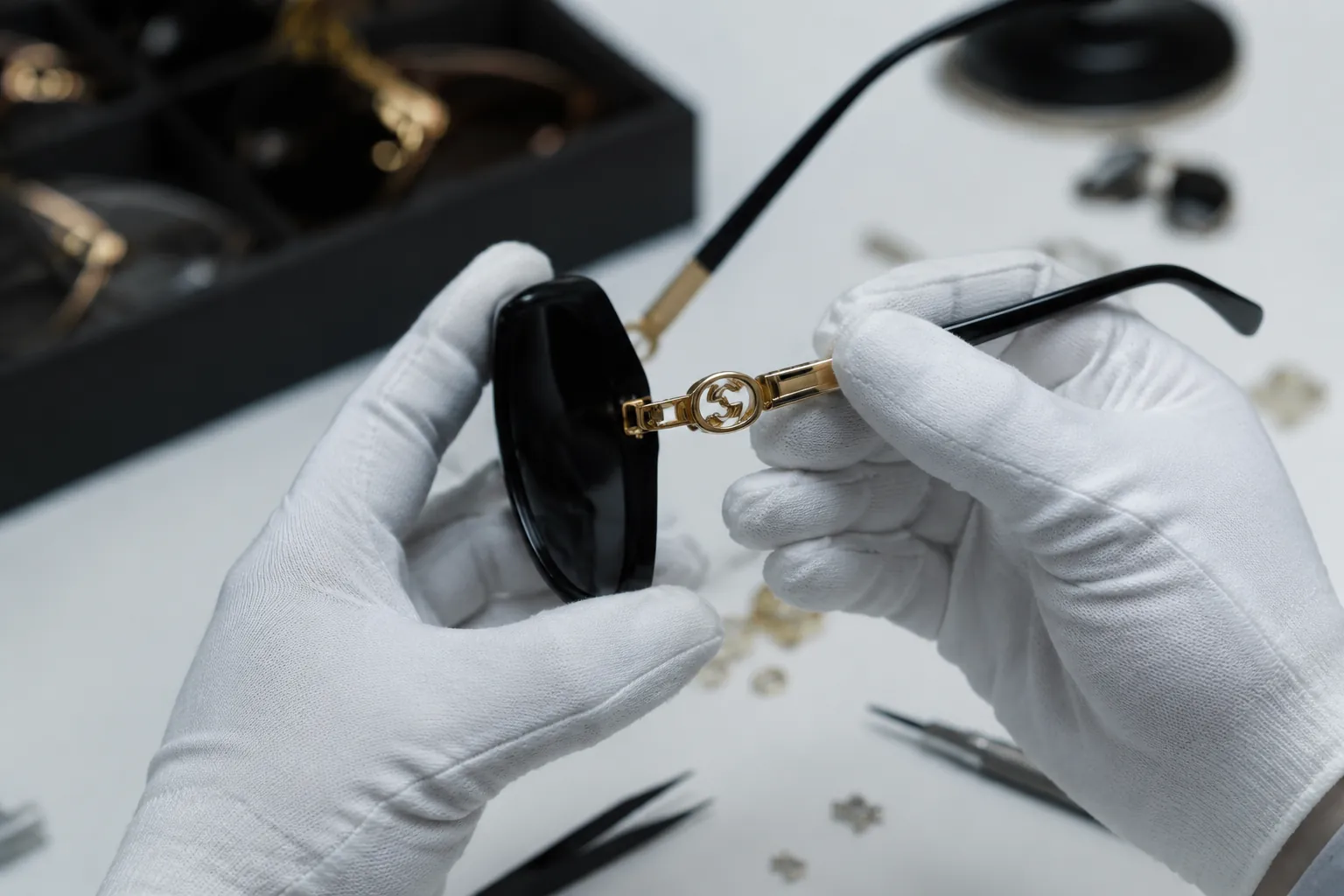
This guide is for brand owners, importers, distributors, and retailers buying custom sunglasses in volume. Logo placement is not just a design choice. On sunglasses, the position and decoration method affect unit cost, setup cost, sample work, wear resistance, space for required markings, and the risk of production problems. The goal is simple: match branding to the sales channel, target price, order quantity, and reorder plan. A low-MOQ promo run needs different logic than a private-label retail style or a repeat OEM program. The best option is the one the factory can make consistently without hurting how the product will be sold.
Start with the buying decision, not the artwork
Many branding mistakes start before final artwork reaches the factory. A logo may look good on a render and still be a poor production choice if the temple is curved, textured, too small, or already needed for inner-temple information. Start with the commercial brief. Then work back to artwork.
A better sequence is straightforward: define the program type, confirm frame construction and material, identify required product information, then choose the logo position and process that fit those limits.
- Promotional orders: usually favor low setup cost, strong visibility, and simple execution. That often points to 1-color or 2-color pad print on the outer temple.
- Entry private-label orders: often need a cleaner retail look without adding new components. A restrained outer-temple mark, plus inner-temple brand or model text, is often the most practical balance.
- Mid-tier OEM retail: perceived value matters more. Buyers may compare small laser marks, cleaner print placement, or metal logo elements if the frame design supports them.
- Repeat programs: if the same style will be reordered, molded logo details or standardized metal parts may make sense because the development cost can be spread across future runs.
MOQ changes the math fast. On small pilot orders, fixed setup cost weighs more heavily on each pair, so simple decoration is easier to justify. On larger runs, buyers have more room to improve finish quality or perceived value without changing the total build too much.
Three questions usually narrow the choice quickly: how visible should the logo be in use, what role will the product play at retail or in promotion, and is the project optimizing for speed or finish quality? Answer those first. The right placement usually follows.
Head-to-head: logo placements by cost, visibility, durability, and value
Costs below are comparative, not quoted prices. Actual cost depends on order quantity, frame material, logo size, color count, surface condition, and whether new components or tooling changes are needed. Use the table to compare production logic. Do not treat it as a substitute for a factory quote.
| Placement | Common method | Visibility | Durability | Typical MOQ logic | Lead-time impact | Best fit |
|---|---|---|---|---|---|---|
| Outer temple | Pad print, laser engraving | High while worn | Print: medium; engraving: high | Often workable at low MOQ | Low; usually no extra tooling | Promo, retail, OEM |
| Inner temple | Pad print, laser engraving | Low in wear; high in-hand | Medium to high | Often workable at low MOQ | Low | Compliance text, model info, subtle branding |
| Lens corner | Laser mark, print | Medium | Medium | Usually easier on stable repeat runs | Medium; must align with lens process | Sport, fashion, short logos |
| Temple tip | Pad print, molded detail | Low to medium | Medium to high | More practical when quantity supports extra setup | Low to medium | Subtle retail branding |
| Metal insert on temple | Custom badge or logo plate | High | High if fitted and bonded correctly | Usually better when volume can absorb development cost | Medium; extra component development | Private label, premium retail |
| Molded into frame | Tooling detail in mold or acetate part | Medium | Very high | Best for repeat orders and long runs | High on first order | Stable OEM programs |
If budget is tight, outer-temple pad print usually gives the strongest visibility with the least development work. If the goal is a less promotional, more brand-led look, smaller and cleaner often works better than larger and louder. Bigger is not always better. On retail programs, restraint can read as more premium.
What each placement means in production
Outer temple is the default for a reason. It is visible while worn and usually offers enough area for a brand mark. It works best on a reasonably flat, stable surface. Curvature, ribbing, rubber inserts, bevels, or placement too close to the hinge can all increase the risk of uneven print, poor registration, or inconsistent appearance.
Inner temple is less visible but highly useful. It often carries brand name, model code, material information, size, country-of-origin marking, or importer-required text. For understated retail programs, it helps keep the outside clean while still making the product feel complete in hand.
Lens branding needs care. A small corner mark can work on some sport and fashion styles, but oversized lens logos often reduce customer acceptance because they are obvious in use and interrupt the clean look of the lens. Lens branding also has to fit the lens material and finishing sequence. No shortcuts here.
Temple tip branding is usually a secondary detail, not the main brand location. It can work if the product is shown folded in packaging or if the brand wants a subtle signature point. By itself, it rarely does enough for a visibility-led program.
Metal logo plates can raise perceived value without requiring a fully custom frame. They also add more production variables: recess fit, edge alignment, plating consistency, adhesive choice, and long-term attachment security.
Molded logos make the logo part of the component. That improves durability and can improve consistency on repeat orders. They make the most sense when the artwork and frame platform will stay in use long enough to justify the development cost.
Decoration method matters as much as placement
Two logos in the same position can perform very differently depending on the process. Buyers should compare more than appearance. Check abrasion resistance, contrast on the chosen material, compatibility with curved surfaces, and how much manual control the process needs.
- Pad printing: usually the lowest-cost option for simple logos and low-MOQ projects. It is common on promotional sunglasses because setup is relatively simple and artwork changes are easier to manage than new components. Its weak point is wear resistance. Print quality depends heavily on surface preparation, ink system, curing, and end use.
- Laser engraving: usually gives a sharper, quieter result. It can work well on acetate, painted surfaces, and some metal parts, but contrast depends on the base material and finish. On translucent, patterned, or very dark materials, the logo may show less than expected. Always review a physical sample.
- Metal logo plates: better suited to projects where the logo acts as a design feature, not just an identifier. They require component development, finish approval, and added assembly control. Sometimes they are worth it. Sometimes a clean print or engraving is the better call.
- Molded detail: the logo is built into the part, so there is no print rub-off. This can be one of the strongest options for repeatability on stable, long-run programs, provided the logo and style are unlikely to change soon.
Process control matters. A capable supplier should be able to explain how logo position is referenced, how appearance is approved before bulk production, and how decoration defects are checked at final inspection. If decoration is outsourced, ask who controls artwork interpretation, color approval, and defect standards.
Budget logic by volume: where the money actually goes
The lowest decoration upcharge is not always the lowest total-cost choice. Buyers also need to account for development time, reject risk, product positioning, and whether the style will reorder.
At low volume, fixed setup cost is a larger share of landed cost, so simple print or straightforward engraving is often the rational path. As quantity rises, buyers can compare more refined branding options because setup cost is spread across more units and repeatability becomes easier to control.
Use this as practical sourcing logic:
- Trial or approval run: stay with simple print or basic engraving unless the sample is specifically for approval before a larger production commitment.
- Small to mid-volume program: compare visible, low-cost branding against more restrained execution that better supports retail positioning.
- Large repeat program: evaluate metal plates, standardized inserts, or tooling-based logo details if the same style is expected to reorder.
- Long-run platform styles: custom components and molded branding can become more efficient when development cost is spread over multiple production cycles.
Ask the right question. Not "What is the cheapest logo option?" Ask instead: "Which branding method supports the selling price and product role without adding unnecessary production risk?" A decoration method that looks cheap on paper can get expensive fast if it scratches easily, fails inspection, or weakens shelf appeal.
Compliance, material limits, and QC points to check early
Branding must not interfere with function, required markings, or the documents needed for the destination market. Good mockups often ignore those limits. Production cannot.
For regulated markets, buyers should verify the documents that apply to the target market and the exact product being purchased. Depending on the market and program, this may include CE EN ISO 12312-1 for Europe, ANSI Z80.3 for the United States market standard commonly referenced for non-prescription sunglasses, and AS/NZS 1067 for Australia and New Zealand. Chemical and supply-chain requests may also include REACH, while importer due diligence may extend to FDA registration where relevant to the supplier or product category, plus quality or social compliance records such as ISO 9001 and BSCI. Ask for documents that match the actual model, lens category, and construction being ordered, not just a general supplier file.
- Large lens logos may not prevent a product from meeting a standard, but they can still trigger customer complaints about distraction or appearance.
- Inner-temple branding must leave room for essential product and importer information where required.
- Metal logo parts should be checked for attachment security after normal handling and heat exposure relevant to transport and storage.
- Print adhesion depends on material, pretreatment, ink, and curing. If adhesion matters, ask the supplier to define the internal test method used for approval.
Material choice also changes branding behavior. Injection-molded frames are often efficient for print and molded logo details because part consistency is relatively high. Acetate can look more premium and can engrave well, but color and pattern variation can change logo contrast. CNC-milled acetate parts can accept inserts cleanly, but recess fit and polishing consistency still need review on actual samples.
Define QC before mass production starts. Request the reference point for logo position, the approved appearance standard, the inspection method, and the acceptance criteria for defects such as skew, edge lift, poor fill, or attachment issues.
A practical sourcing path for OEM and promo orders
If the goal is to reduce surprises, control the project step by step. Do not jump straight from artwork to production.
- Define the sales channel. Promotional giveaway, distributor program, chain retail, or private-label collection. This determines how much branding complexity is commercially justified.
- Choose one primary and one secondary location. For example, outer temple for visibility and inner temple for brand, model, or origin information.
- Match the method to the volume. Print is usually the simplest route for low MOQ or fast execution; engraving, metal plates, or molded details need stronger justification.
- Approve artwork with dimensions. Ask for logo length, height, and placement referenced from a fixed point such as the hinge or temple end, not just a centered render.
- Review a pre-production sample. Check straightness, edge quality, contrast, surface compatibility, and overall balance on the real frame color and material.
- Lock QC points before bulk. Confirm what defects count as rejectable, how decoration is inspected, and who approves any deviation before shipment.
- Plan for reorders early. Ask which plates, screens, badges, molds, or artwork files can be reused so future orders do not repeat unnecessary setup cost.
There is no single best budget placement. There is only the right fit for the job. For promotional orders, that is often outer-temple print. For retail private label, it is often smaller, cleaner branding with better execution. For repeat OEM business, it may be a component or molded detail that gets more efficient over time.
Have a custom sunglasses project in mind?
Send us your styles, target market and quantities and we will return a detailed quote with MOQ, lead time and a sample plan.
Get a QuoteWhy source this from Wenzhou with LumiShades
Wenzhou in Zhejiang Province is widely regarded as China’s eyewear manufacturing capital, producing a large share of the world’s sunglasses. That concentration matters to buyers: a deep local supply chain for acetate sheet, hinges, lens blanks, plating and packaging means shorter component lead times, easier color and material matching, and a workforce with decades of eyewear-specific skill. LumiShades has manufactured in this ecosystem since 2009, and our vertical integration — in-house injection molding, acetate cutting, CNC milling, lens tinting, decoration and quality control — means no part of your order is quietly subcontracted to a workshop you cannot audit.
For international buyers, that vertical control translates into accountability. When a single factory owns every step, defects are traced and fixed at source rather than bounced between vendors, and your specifications survive intact from first sample to bulk. We back this with 15+ years of experience, shipments to 60+ countries, more than 5 million pairs produced per year and a 98.5% on-time delivery rate. Our certifications — CE EN ISO 12312-1, FDA registration, ANSI Z80.3, AS/NZS 1067, REACH, ISO 9001 and BSCI audit — mean the compliance documentation your market requires already exists. Explore our manufacturing capabilities and quality control process to see how this works in practice.
Frequently asked questions
What logo placement is best for a low-MOQ test order? In most cases, start with outer-temple pad printing if logo visibility matters, or inner-temple print if you mainly need brand and product identification. Both options usually avoid new component development and keep approval simpler. Before placing the order, ask the supplier to confirm the printable area on the exact frame and to show a photo or sample on the real material and color.
Does a metal logo plate always look more premium than printing? No. A metal plate can improve perceived value, but only if the size, finish, fit, and attachment are well controlled. Review a sample from the same frame construction, not just a generic reference. Check that the edges sit cleanly, the plating is consistent, and the part does not loosen or lift after normal handling. If those points are not controlled, a small print or laser mark can look better in the finished product.
Can I put my logo on the lens for all markets? A small lens logo is possible on many projects, but check three things before approving it: first, that it does not interfere with the look and use of the lens; second, that it remains clear after the actual lens finishing sequence; and third, that the finished product still aligns with the documentation and market requirements for the destination country. Keep the mark small, place it away from the main field of view, and ask for a physical sample on the final lens color and coating combination.
How much lead time does custom branding add? There is no fixed number. Lead time depends on the method, the supplier's workflow, and whether new parts must be developed. Simple pad print or straightforward engraving usually adds less time than custom metal plates or new molded logo details. Ask the supplier for a clear breakdown: artwork approval time, sample time, component development time if needed, and bulk production time after sample approval. Get those stages confirmed in writing before purchase order release.
What certifications or documents should I ask to see for custom sunglasses? Ask for documents that match your destination market and the exact sunglasses model you are buying. Common requests include CE EN ISO 12312-1 for Europe, ANSI Z80.3 for the U.S. market, and AS/NZS 1067 for Australia and New Zealand. Depending on your compliance program, you may also request REACH information, FDA registration details where relevant, and factory-level records such as ISO 9001 or BSCI. The key point is simple: make sure the document applies to the actual product construction and supplier entity involved in your order, not a different style or a general company file.
Ready to start?
Explore our wayfarer sunglasses or request a quote — our sales team replies within 12 hours.
Request a Quote