
Keep Sunglasses and Packaging on One Production Plan
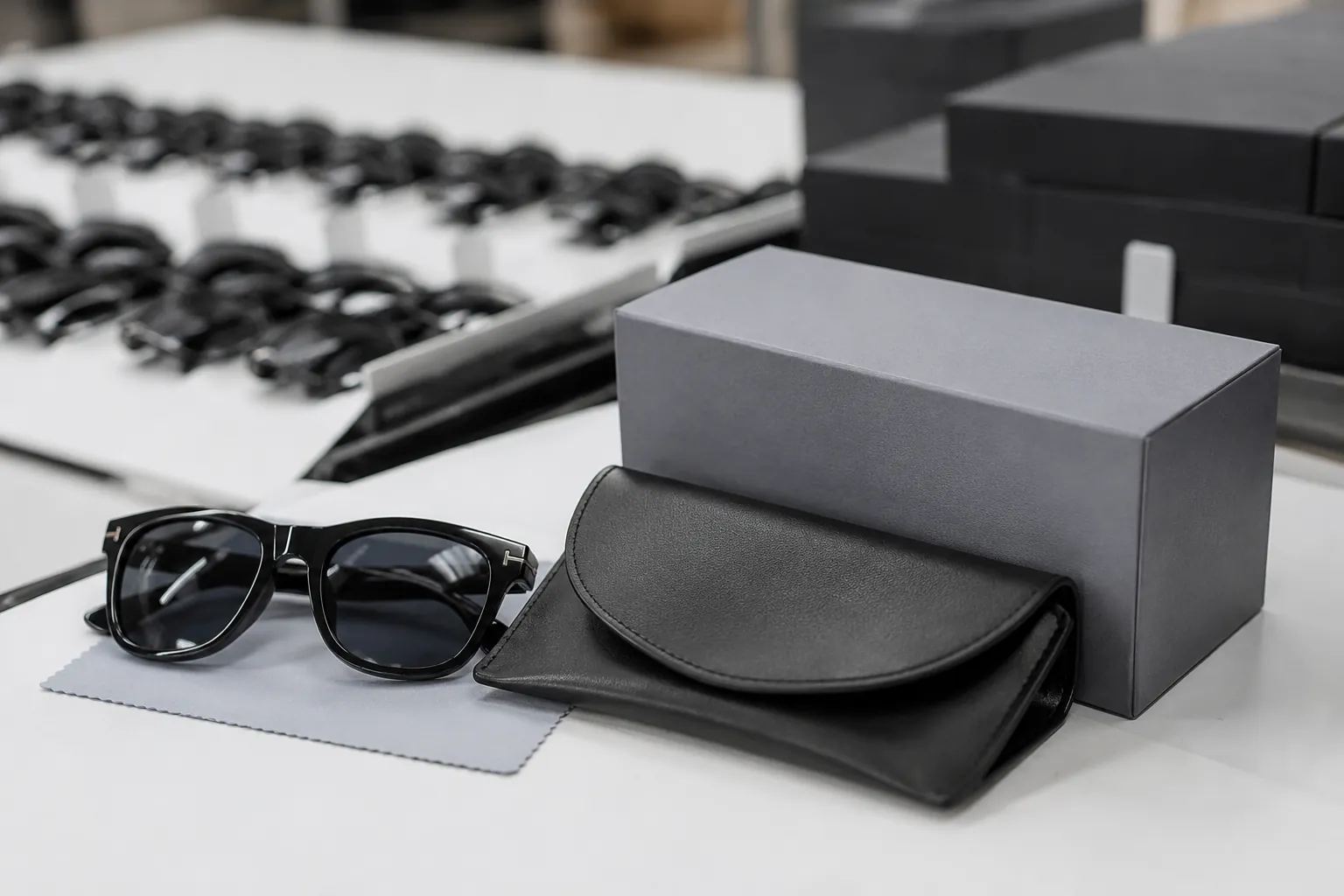
This guide is for brand owners, importers, distributors, and retailers buying custom sunglasses in volume. The failure pattern is common: the sunglasses are ready, but the pouch is late, the box does not fit the folded frame, the barcode changes after print approval, or the carton spec was never confirmed. Then finished goods sit and the ship date moves. The fix is not complicated. Manage sunglasses, accessories, labels, inserts, inner packs, and master cartons as one production program. One approval path. One artwork freeze date. One assembly window. Lock fit, artwork, required text, and inspection points early, and the order is far less likely to stall at the end.
Build One Critical Path for the Full Pack-Out
Many delays start with split ownership. The eyewear team is chasing frame color, lens category, logo placement, and sample approval. Packaging is still debating pouch dimensions, cloth artwork, barcode content, insert text, or carton marks. The sunglasses may be finished first. That does not matter if one required accessory is still missing or unapproved.
For private label sunglasses, treat the retail unit as one SKU made of linked components: frame, lenses, hinges and hardware, pouch or case, cleaning cloth, hangtag, barcode label, leaflet if required, inner box, and master carton. Build the schedule around the last approval that can affect final packing, not the component that happens to finish first.
Lead times rarely match. Eyewear sampling, frame production, decoration, and inspection move on one timeline. Printed boxes, sewn pouches, EVA cases, labels, and cartons move on another. Plan both from day one. A folding box may need a final die-line before artwork release. A pouch or case needs a real fit check with the final folded frame. A barcode label needs confirmation of size, placement, and scan performance on the actual surface.
One rule helps: if branded cases, cloths, labels, and cartons only start after final frame approval, the pack-out schedule is already tight. Then a small delay in artwork, fit approval, or PO release can push assembly past the target packing date because labor, incoming accessories, carton supply, and inspection slots all have to line up.
Lock a Signed Pack-Out Spec Before Bulk Production
Before bulk production starts, issue one pack-out specification approved by both buyer and factory. Use a controlled production document, not a loose email chain. It tells packaging suppliers what to make, the packing line what to assemble, and inspectors what to check.
- Style code, frame color code, lens color, and lens category
- Folded frame dimensions and target packed orientation
- Unit pack method: polybag, microfiber pouch, PU pouch, EVA hard case, display box
- Accessory list with quantity per pair and agreed spare allowance
- Logo method on each item: pad print, screen print, laser engraving, metal plate, deboss, foil stamp
- Artwork references with Pantone numbers, outlined fonts, and barcode data
- Label size, placement, scan direction, and adhesive type
- Inner pack quantity, master carton quantity, gross weight limit, and carton specification
- Country of origin marking and required market text
This is where vague language causes trouble. "Black pouch with silver logo" is not a production instruction. The factory needs material, thickness, finished dimensions, opening width, logo width in millimeters, print position tolerance, color standard, and face direction. A pouch can look fine on a drawing and still drag on the hinge end, catch the temple tip, or press against the frame front once the actual sunglasses are inserted. Small fit errors turn into lens rub, pressure marks, and packing-line delays.
Labels and barcodes fail the same way. A buyer may approve label size in principle, then find that the real application area is curved, textured, or too small. Scan performance drops. If the label is resized late, inner box art, carton marks, and system data may all need revision. Close that work before print POs are released.
Freeze required text early too. Product standards, destination-market requirements, and packaging statements are related, but they are not the same thing. CE EN ISO 12312-1, ANSI Z80.3, and AS/NZS 1067 are product standards used for sunglasses in relevant markets. REACH covers restricted substances in materials. FDA registration, where relevant to the supplier or importer, is a regulatory document issue, not automatic packaging copy. ISO 9001 and BSCI are factory or system credentials, not consumer performance claims.
Approve Packaging in the Right Order
Buyers often approve packaging in the wrong sequence. They sign off the artwork PDF first, then find that the case is too shallow for the folded frame, the cloth is too small to wrap the lenses, or the box insert presses on the hinge area. A better sequence is simple: fit first, graphics second, packed performance third.
- Approve the sunglasses sample: final dimensions, temple shape, lens curve, hinge type, logo method, and color.
- Approve packaging structure: pouch size, case cavity, box die-line, insert dimensions, and folded orientation.
- Approve artwork only after the structure is fixed.
- Approve one fully packed sample assembled exactly as the order will ship.
- Verify carton packing, barcode scan, and basic handling checks before mass pack-out.
There is a practical reason for that order. Thick acetate fronts, pronounced end pieces, exposed temple tips, high-wrap lenses, or rubber temple components can all change packed volume and contact points. A drawing will not show everything. A closed frame can sit very differently inside a pouch or case once the real temples are folded.
Ask for physical measurements of the packed unit, not just approval photos. Useful checkpoints include folded width, folded height, packed thickness, insertion force, and whether any part of the temple or hinge touches the inside lens surface. For mirrored or coated lenses, repeated contact during transit can leave visible abrasion.
Check decoration performance at sample stage as well. Pad print results vary by substrate and surface treatment. A metal plate on a pouch may look premium, but it can also create a hard contact point if the frame presses against it during packing. Catch those problems before bulk accessories are released.
Know Which Packaging Items Drive Lead Time and Cost
Not every accessory controls the ship date. Some do. Buyers need to identify the packaging items most likely to become bottlenecks. Lead time, MOQ, and cost behavior vary by material, structure, and decoration method.
| Item | Typical MOQ | Usual Lead Time | Main Risk | Buyer Note |
|---|---|---|---|---|
| Microfiber cloth with printed logo | Supplier-dependent; often higher than sunglass MOQ | Supplier-dependent | Wrong Pantone, lint, color bleed after humidity exposure | Confirm cloth weight, edge finish, logo position tolerance, and color standard before bulk print |
| PU pouch or soft case | Supplier-dependent | Supplier-dependent | Fit mismatch, peeling logo, glue odor | Approve with the final folded frame, not a size estimate or artwork alone |
| EVA hard case | Supplier-dependent | Supplier-dependent | Cavity size error, zipper failure, shell deformation | Do not approve from photos only; check internal length, depth, closure pressure, and fit with the packed sunglasses |
| Printed folding box | Supplier-dependent | Supplier-dependent | Barcode error, weak board, crushed corners | Freeze die-line, artwork, and carton specification early; confirm board grade with the box supplier |
| Metal logo plate decoration | Supplier-dependent | Supplier-dependent | Color mismatch, plating inconsistency, adhesion failure | Check finish approval against a physical sample and verify attachment method before bulk use |
MOQ logic matters. A sunglass order may work at a relatively low quantity, but that does not mean every custom packaging component follows the same economics. Printing plates, die-cutting setup, pouch stitching, zipper sourcing, and metal trim production often carry their own minimums. Ask for those limits at quotation stage. Do not assume packaging can scale down to the sunglass quantity without extra cost or compromise.
The same goes for cost. A microfiber pouch and a custom EVA case may protect the same product, but they behave very differently in price, lead time, and approval complexity. For launch orders, many buyers protect the schedule by simplifying the accessory pack and customizing only the items that matter most for retail presentation or channel requirements.
Build the Timeline Around the Assembly Window
The real completion date is the day all approved components are available for final assembly and inspection. Not the day the frames are finished. If sunglasses are done but labels, pouches, or cartons are not, the order is still incomplete. That is the date that matters for ex-factory planning, freight booking, and customer delivery commitments.
A practical schedule for a new style often looks like this:
- Confirm quotation, MOQ, Incoterm, destination market, compliance scope, and packaging concept
- Develop sunglasses sample and packaging mock-up in parallel
- Approve frame sample, packaging fit sample, die-line, and final artwork
- Release bulk materials and packaging purchase orders; freeze UPC or EAN data and carton marks
- Run frame production, lens processing, logo decoration, and accessory production
- Perform incoming QC on accessories, line packing trial, barcode check, and carton verification
- Complete final packing, inspection, and shipment release
This only works if approvals are real approvals. "Looks fine, may revise later" is not a production decision. Once cartons, labels, or cloths enter bulk print, late changes usually lead to reprint cost, relabeling work, or hand rework at packing stage. Any of those can delay release.
Ask the supplier to state one date clearly in the production schedule or proforma invoice: the latest artwork freeze date that does not move the ex-factory date. That single deadline helps buyers control internal marketing, sales, and compliance reviews before the packing schedule is affected.
Use Simple Tests That Match Real Transit Failures
Buyers do not need testing theater to catch most packaging problems. They need practical checks that match how sunglasses are packed, stacked, moved, and stored. The goal is clear: catch lens scratching, box damage, logo failure, odor complaints, and assortment errors before shipment.
At minimum, require these checks on the approved packed unit:
- Fit test: the frame enters and exits the pouch or case without scraping the lens edge, temple logo, or hinge area
- Rub test: logos on cloth, pouch, case, and temple withstand repeated rubbing without obvious loss or color transfer
- Odor check: PU, EVA, glue areas, and printed parts should not have a strong residual solvent smell at packing
- Drop check: packed unit and master carton are checked from a practical handling height agreed with the supplier to review shifting, burst points, and corner crush
- Compression review: carton specification and stacking strength are suitable for the shipping method and palletization plan
- Barcode scan check: labels scan correctly after application to the actual surface
Material behavior matters. Dark microfiber can transfer color if dye fixation is poor. A rushed print process on plastic or coated parts can fail in rubbing. A glossy frame can haze if it moves repeatedly against a hard interior surface during transit. A low-grade zipper pull or metal trim can damage a lining or leave marks inside the case. These are routine production risks.
If the order is split across color ratios or customer assortments, inspect carton-level accuracy too. One wrong ratio inside a sealed master carton is expensive to fix after arrival because the labor shifts from the factory packing line to the destination warehouse or retail channel.
Match Compliance Documents to the Product and Packaging
Compliance delays usually come from weak document control. Buyers request the wrong documents, request them too late, or print factory credentials on retail packaging as if they were product claims.
For sunglasses, keep the document set limited to what actually applies. CE EN ISO 12312-1, ANSI Z80.3, and AS/NZS 1067 are product standards relevant to sunglasses in their respective markets. REACH is commonly used for restricted substances in materials. FDA registration, where applicable, should be verified based on the product category and import arrangement. ISO 9001 and BSCI relate to factory systems and social compliance, not sunglass performance and not automatic retail packaging text.
The clean way to manage this is a three-column document control list:
- What applies to the product itself
- What applies to the factory or management system
- What text or marks, if any, must appear on the packaging
That separation prevents a common mistake: copying internal compliance references onto a hangtag, box, or leaflet without checking whether they belong there. Keep the document set tied to the approved style, lens category, and destination market. Do not print compliance marks or statements on packaging until the supplier confirms the exact wording for that product and market.
Run a Final Pre-Pack Review Before Bulk Assembly
Right before mass packing starts, run one hard gate review. No open artwork points. No unconfirmed barcode data. No unresolved accessory fit issue. This is where disciplined buyers avoid expensive rework.
- Final sunglasses sample matches approved color, lens, logo, dimensions, and folded size.
- Case, pouch, cloth, tags, labels, inserts, and cartons are approved physically and visually.
- Barcode, country marking, and required compliance text are frozen and checked against purchase order data.
- Accessory quantities match sunglass order quantity, plus any agreed spare rate.
- Master carton dimensions and gross weight fit the freight plan and handling limits.
- Incoming QC on all accessories is complete before line packing starts.
- One production packed sample has been reviewed using actual bulk materials, not only pre-production samples.
- The inspection plan covers both product quality and pack-out accuracy.
Do this before the packing line is committed to full output. Once bulk assembly starts, every unresolved issue becomes slower and more expensive to fix. A shipment leaves complete, correctly packed, and correctly labeled, or it does not.
Serious buyers treat packaging as part of product quality, landed cost, and schedule control from the quotation stage. That is how sunglasses, accessories, labels, and cartons are ready on the same day instead of turning into separate problems at the end of production.
Have a custom sunglasses project in mind?
Send us your styles, target market and quantities and we will return a detailed quote with MOQ, lead time and a sample plan.
Get a QuoteWhy source this from Wenzhou with LumiShades
Wenzhou in Zhejiang Province is widely regarded as China’s eyewear manufacturing capital, producing a large share of the world’s sunglasses. That concentration matters to buyers: a deep local supply chain for acetate sheet, hinges, lens blanks, plating and packaging means shorter component lead times, easier color and material matching, and a workforce with decades of eyewear-specific skill. LumiShades has manufactured in this ecosystem since 2009, and our vertical integration — in-house injection molding, acetate cutting, CNC milling, lens tinting, decoration and quality control — means no part of your order is quietly subcontracted to a workshop you cannot audit.
For international buyers, that vertical control translates into accountability. When a single factory owns every step, defects are traced and fixed at source rather than bounced between vendors, and your specifications survive intact from first sample to bulk. We back this with 15+ years of experience, shipments to 60+ countries, more than 5 million pairs produced per year and a 98.5% on-time delivery rate. Our certifications — CE EN ISO 12312-1, FDA registration, ANSI Z80.3, AS/NZS 1067, REACH, ISO 9001 and BSCI audit — mean the compliance documentation your market requires already exists. Explore our manufacturing capabilities and quality control process to see how this works in practice.
Frequently asked questions
When should I start packaging development for a new sunglasses order? Start packaging development when the sunglasses sample program starts. At that point, confirm the intended pack method, request supplier MOQs and lead times for each packaging component, and begin structure work for the pouch, case, box, label, and carton. Before bulk production, you should have approved folded-frame fit, die-line, barcode data, required text, and one packed sample. Waiting until final frame approval usually compresses the packing schedule and increases delay risk.
Can I use the 50-pair MOQ for fully custom packaging too? Do not assume that you can. Sunglasses and packaging usually have different MOQs because packaging suppliers have separate setup costs for printing, stitching, die-cutting, trimming, and tooling. Ask for MOQ and lead time by item: cloth, pouch, EVA case, box, label, insert, and carton. If your sunglass quantity is below the practical MOQ for custom packaging, use a simpler pack plan such as a stock pouch or case color with custom logo, hangtag, and carton marks.
What causes the most common shipment delay on private label eyewear orders? The usual cause is late artwork freeze or late fit approval for accessories. The sunglasses may already be produced, but the order still cannot move into final pack-out because the pouch does not fit, the barcode changed after print, the carton marks are unconfirmed, or the labels are missing. Prevent that with one internal deadline for artwork freeze, one approval point for packed fit, and one final pre-pack review before bulk assembly starts.
What packing tests should I insist on before shipment? Require checks that match actual handling and transit: fit test, logo rub test, odor check, barcode scan check, drop check on the packed unit and master carton, and a review of carton strength against the shipping plan. Also inspect one fully packed production sample made from actual bulk materials. If the order includes mixed colors or assortments, add a carton-level count check so each master carton matches the required ratio before sealing.
How do I avoid printing the wrong compliance information on the packaging? Build a document control list before artwork release. Split it into three groups: product standards, factory or system documents, and packaging text or marks. Then confirm the destination market for each style and lens category. Only print wording that the supplier has confirmed for that exact product and market. Do not place ISO 9001 or BSCI on consumer packaging as if they were product performance claims, and do not assume that a test report or registration document automatically belongs on retail artwork.
Ready to start?
Explore our aviator sunglasses or request a quote — our sales team replies within 12 hours.
Request a Quote