
Cut Sunglasses Landed Cost Without Cheapening the Product
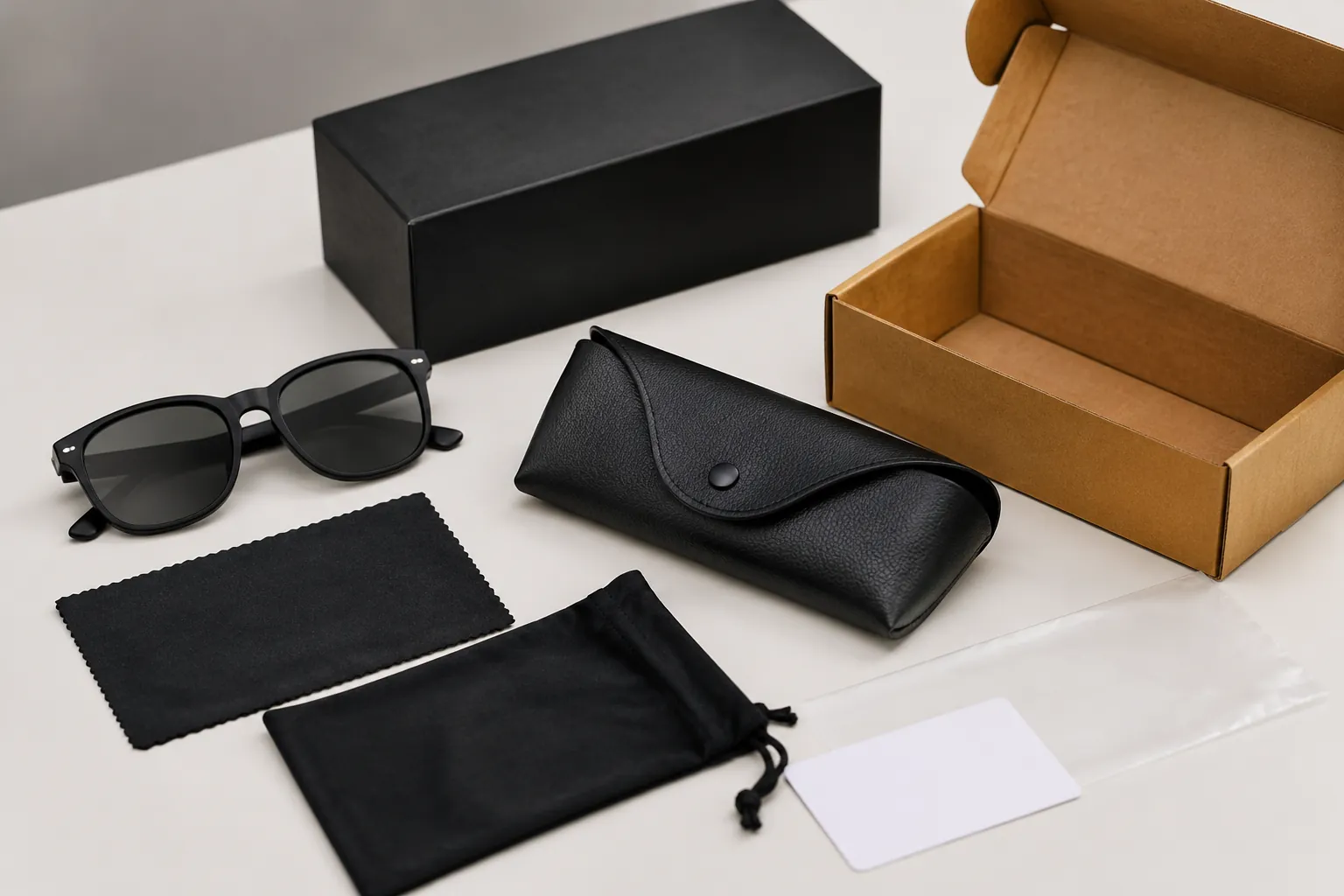
This guide is for overseas brands, importers, distributors, and retailers buying custom sunglasses in bulk. It shows where landed cost is usually won or lost: frame material, lens specification, logo decoration, packaging cube, carton planning, SKU split, compliance, and freight mode. The aim is simple. Lower the cost per sellable pair without making the product feel weaker, look cheaper, fail testing, or arrive late.
Start With Landed Cost, Not Factory Unit Price
A low ex-factory price can still become an expensive pair after packaging, inland trucking, export handling, ocean or air freight, duty, customs brokerage, warehouse receiving, relabeling, and local delivery. Serious buyers compare options by landed cost per sellable pair. FOB or EXW price is only one part of the number.
For custom sunglasses, the main cost levers are visible before production starts: frame material, mold status, lens material, lens coating, decoration method, packaging size, carton quantity, SKU split, testing requirements, labeling requirements, and shipping mode. Check them during development and sampling. Do not wait until cartons are packed.
A useful landed-cost review includes the quoted unit price, inspection standard, packaging cost, packed carton CBM, gross weight, freight quote, duty rate, customs and destination handling cost, and expected sellable quantity after inspection. A pair that looks cheaper at the factory can lose fast if it ships in bulky packaging, needs rework, or moves by air because approvals came late.
| Cost lever | Where buyers lose money | Better buying decision |
|---|---|---|
| Frame choice | Using acetate or metal on a low-price promotional style that cannot support the finishing cost | Use PC or TR90 injection for volume styles where color, fit, durability, and repeatability matter most |
| Lens spec | Adding polarization, mirror, gradient, and custom tint without a clear retail reason | Choose the lens upgrade that supports the selling channel and required market standard |
| Packaging | Approving rigid cases before checking carton CBM and chargeable weight | Compare pouch, soft case, folded box, and rigid case by packed carton data before approval |
| Carton plan | Low pairs per master carton, random mixed SKUs, and late barcode or carton-mark changes | Lock inner pack, carton size, gross weight, pair count, and carton marks before bulk packing |
| Order quantity | Too many colors at MOQ and too few pairs per color for efficient packing or pricing | Concentrate volume into fewer SKUs where possible and ask for price breaks by quantity tier |
Frame Material: Save on the Right Styles
Frame material affects tooling, cycle time, rejection risk, weight, packing density, repairability, and perceived value. The lowest quoted frame is not always the lowest landed cost. If it breaks in transit, feels weak in-store, or creates returns, the saving was not real.
Start with two questions. What does this SKU need to survive? What retail position must it support?
PC injection is often the cost-control choice for event, beach, promotional, and fast-turn fashion programs. It molds efficiently, accepts solid and transparent colors well, and suits simple styles that need repeatable color and shape. But PC is relatively stiff. If temple thickness, hinge choice, polishing, or fit is under-specified, the finished pair can feel cheap.
TR90 usually costs more than basic PC, but it offers better flexibility and comfort. It can be better value for sport, kids, youth, travel, or active-lifestyle styles where breakage and wearer comfort matter. Acetate gives richer color depth and a heavier retail feel, but it requires sheet cutting, CNC milling, tumbling, polishing, hinge insertion, and more handwork. Patterned acetate can also add visual-sorting work if the buyer expects the left and right sides to look balanced.
Metal frames can look slim and premium, but they depend on controlled plating, soldering, screw quality, nose pad assembly, and alignment. If the target retail price cannot support those controls, cost often disappears from the wrong places: weak hinges, thin plating, uneven solder joints, or loose nose pads.
- Use PC for promotional and price-sensitive retail programs where the design is simple and high color consistency matters.
- Use TR90 where flexibility, wearer comfort, and lower breakage risk justify a moderate cost increase.
- Use acetate for brand programs that can pay for thicker material, polishing, richer color, and slower production.
- Use metal only when the target retail price supports plating control, hinge strength, solder inspection, and alignment checks.
Lens Selection: Specify Performance, Not Just Appearance
Lenses affect cost, compliance, defect risk, and shipment timing. Buyers usually recognize visible options such as smoke, brown, green, gradient, mirror, polarized, and photochromic. Fewer connect those choices to UV performance, lens category, optical requirements, coating durability, axis control for polarized lenses, and left-right color matching.
For many general fashion sunglasses, a compliant UV400 lens with a stable tint is enough if it meets the required market standard. State the destination market and product type clearly. Common references include CE EN ISO 12312-1 for sunglasses sold in the EU, ANSI Z80.3 for non-prescription sunglasses in the US, AS/NZS 1067 for Australia and New Zealand, and REACH for restricted substances where applicable. FDA registration may be relevant to US import documentation, but registration does not replace product testing against the applicable standard.
Polarized lenses add cost and inspection work because the polarizing film direction must be controlled during cutting and assembly. If the axis is wrong or inconsistent, the lens may look fine on a table and perform poorly in use. Mirror coating adds shelf impact, but it is more scratch-sensitive during handling, cleaning, and packing. Gradient tinting requires close left-right matching. A small vertical mismatch can be obvious once the frame is worn.
Use one clear lens upgrade when it supports the selling proposition. Polarized smoke can make sense for driving, fishing, resort retail, and outdoor programs. A mirror gradient polarized lens on a very low-cost frame usually creates an unbalanced spec. The lens becomes expensive and inspection-heavy while the frame still positions the product as budget.
Decoration: Match the Method to the Surface
Logo decoration is a small line item that can create large visible defects. The wrong method can chip, smear, sit crooked, wear off, or force rework. Choose decoration after checking the temple curve, surface texture, artwork size, frame color, contrast requirement, and expected wear.
Pad printing is usually economical for simple logos on PC or TR90 temples. It works best on a flat or mildly curved area. It also needs controlled ink mixing, fixture position, drying time, and rub testing. Very small text, thin lines, and multi-color artwork raise risk because the print can fill in, misregister, or shift between passes.
Laser engraving is clean and durable on many materials, but contrast depends on frame color and finish. A laser mark on matte black may look refined. The same mark on glossy black may be too subtle for retail display. Metal logo plates can increase perceived value, but they add parts, placement labor, adhesive or mechanical fixing, and inspection time. On curved temples, the plate must follow the surface without lifting at the edges.
- Keep logo size realistic. Fine text below practical print tolerance may blur or disappear.
- Confirm logo position on a physical pre-production sample, not only on a flat artwork proof.
- For multi-color logos, approve registration tolerance before bulk printing.
- For metal plates, confirm how the plate is fixed and whether it passes tape, rub, and heat checks.
Decoration should support the product. It should not become the most fragile part of the sunglasses.
Packaging Cube Can Kill the Saving
Packaging controls freight volume. This matters most for air, courier, and small LCL shipments, where chargeable weight may be based on dimensional weight rather than actual weight. A rigid case may look strong in a sample room and still damage the landed cost.
Before approving packaging, ask for packed dimensions at three levels: unit pack, inner carton if used, and master carton. Also ask for pairs per master carton, net weight, gross weight, and carton CBM. Without those numbers, freight quotes are guesses.
For sunglasses, damage commonly comes from lens scratching, temple pressure, loose movement inside the pack, and crushed master cartons. Bulky packaging is not always better protection. A microfiber pouch, lens film, correctly sized polybag, inner divider, and stronger export carton may protect better than a loose pair inside an oversized rigid box.
| Packaging type | Cost and cube profile | Best use | Risk to control |
|---|---|---|---|
| Microfiber pouch | Lowest weight and low cube | Promo, online, travel, and value retail | Lens scratching if pouch fabric or packing pressure is poor |
| Soft zipper case | Moderate cost and moderate cube | Mid-range retail and branded programs | Shape deformation if cartons are underfilled or stacked badly |
| Rigid case | High presentation value but high freight cube | Higher retail price points and gift sets | Dimensional weight, case denting, and excess air in cartons |
| Display box | Useful for shelf and rack programs | Retailers needing barcode-ready merchandising | Crushing, wasted carton space, and mixed-SKU receiving errors |
Carton Planning: Lock It Before Bulk Packing
Carton planning is not clerical work. It affects freight quotes, warehouse receiving, customs documents, claim handling, and damage rate. Lock it before bulk packing begins, especially when the order includes multiple colors, lens types, packaging options, barcode labels, or customer-specific carton marks.
Ask for a carton plan showing SKU, color, lens type, packaging type, pairs per inner carton, pairs per master carton, carton size, gross weight, net weight, total carton count, and total CBM. For a mixed order, poor planning creates predictable costs: too many carton types, underfilled cartons because SKU splits came late, and gross weights or carton dimensions that do not suit the forwarder's handling or rating rules.
If the order includes many colors at low quantities, carton utilization will usually be worse than a concentrated order with fewer colors. That is packing math. A carton holding one SKU is easier to label, count, inspect, and receive. Several colors in small quantities may require mixed packing, more labels, more checking, and more warehouse handling.
For private label buyers, barcode labels and carton marks need early approval. Incorrect carton marks can delay customs clearance and warehouse receiving. For distributors, mixed cartons can help local delivery, but they should be planned by destination, customer account, or store allocation. Random mixing may save time at origin and create extra work at the destination warehouse.
MOQ, Price Breaks, and Freight Need One Quote
MOQ only means something when it is quoted with the specification, packing method, and freight mode. A low MOQ can be useful for buyer presentations, color testing, influencer seeding, or a small first run. It is not a scale-cost benchmark.
Unit price, carton efficiency, inspection cost per pair, and freight cost usually improve as order quantity rises and the SKU mix becomes more concentrated. Ask the supplier to quote meaningful quantity tiers using the same frame material, lens type, decoration, packaging, labeling, inspection requirement, and carton plan. Otherwise the comparison is weak.
Sampling and bulk timelines should be confirmed in writing for the exact project. Build the calendar from sample approval, not from the first inquiry. Add time for artwork confirmation, lens and packaging approval, compliance testing if required, inland logistics, export handling, freight transit, customs clearance, and local delivery. Late sample approval often turns into expensive freight. The bill lands later, but the cause is earlier.
| Order situation | Likely freight choice | Cost effect | Risk to watch |
|---|---|---|---|
| Small test run | Courier or air | High landed cost per pair but fast feedback | Do not use it as the benchmark for scale pricing |
| Launch order | Air, sea-air, or LCL ocean depending on deadline and cube | Balanced cost and timing if packaging volume is controlled | Late artwork or packaging approval can force expensive air freight |
| Replenishment order | LCL or FCL ocean where timing allows | Better unit price and freight efficiency | Forecast error, too many slow colors, and delayed carton data |
| Seasonal program | Ocean freight with a fixed production and approval calendar | Best opportunity to lower unit and freight cost together | Compliance, labeling, inspection, and carton plan must be locked early |
Run a Cost-Down Review Before Sample Approval
The best time to reduce landed cost is before the approved sample is signed off. After approval, every change gets slower. Tooling, lens stock, packaging, barcode labels, carton marks, and production fixtures may already be in motion.
Run a short cost-down review with the supplier before sign-off. Ask which changes would reduce cost without changing the retail promise. The answer may be simple: reduce a two-color temple logo to one color, use a standard smoke or brown lens instead of a custom tint, switch from a rigid case to a pouch, reduce colorways from eight to four, or move more volume into the strongest SKU.
Do not remove QC or compliance checks to save money. That is false economy. Sunglasses must meet the rules of the market where they are sold, and eyewear defects are visible to consumers immediately. Relevant compliance references may include CE EN ISO 12312-1, ANSI Z80.3, AS/NZS 1067, REACH, FDA registration requirements, ISO 9001, and BSCI, depending on the destination market, product type, factory qualification request, and buyer policy. The purchase order should state destination market, lens category, labeling needs, inspection standard, packaging requirements, and any required test reports or factory documents.
- Confirm target landed cost per pair, not only FOB or EXW price.
- Freeze frame material, lens spec, decoration, packaging, barcode rules, and carton plan before bulk production.
- Request packed carton CBM, gross weight, total carton count, and packing method before booking freight.
- Concentrate order volume into fewer SKUs where possible.
- Keep compliance testing, incoming material checks, hinge inspection, lens inspection, and final AQL checks in the budget.
Have a custom sunglasses project in mind?
Send us your styles, target market and quantities and we will return a detailed quote with MOQ, lead time and a sample plan.
Get a QuoteWhy source this from Wenzhou with LumiShades
Wenzhou in Zhejiang Province is widely regarded as China’s eyewear manufacturing capital, producing a large share of the world’s sunglasses. That concentration matters to buyers: a deep local supply chain for acetate sheet, hinges, lens blanks, plating and packaging means shorter component lead times, easier color and material matching, and a workforce with decades of eyewear-specific skill. LumiShades has manufactured in this ecosystem since 2009, and our vertical integration — in-house injection molding, acetate cutting, CNC milling, lens tinting, decoration and quality control — means no part of your order is quietly subcontracted to a workshop you cannot audit.
For international buyers, that vertical control translates into accountability. When a single factory owns every step, defects are traced and fixed at source rather than bounced between vendors, and your specifications survive intact from first sample to bulk. We back this with 15+ years of experience, shipments to 60+ countries, more than 5 million pairs produced per year and a 98.5% on-time delivery rate. Our certifications — CE EN ISO 12312-1, FDA registration, ANSI Z80.3, AS/NZS 1067, REACH, ISO 9001 and BSCI audit — mean the compliance documentation your market requires already exists. Explore our manufacturing capabilities and quality control process to see how this works in practice.
Frequently asked questions
Can I reduce cost by starting at a low MOQ? A low MOQ is useful for testing a design, checking colors, preparing buyer presentations, or launching a small first run. It usually does not show the best landed cost because setup work, inspection, carton space, and freight are spread across fewer pairs. Ask for quotes at the test quantity and at larger quantity tiers using the same specification, packaging, and freight assumptions so you can see the real cost curve.
Which frame material is usually lowest cost for custom sunglasses? PC injection is often the lowest-cost practical choice for simple volume styles. TR90 usually costs more but improves flexibility and comfort. Acetate and metal suit higher retail price points because they require more finishing, assembly control, and inspection. Choose the material based on the retail promise, expected wear, and return risk, not only the lowest line-item price.
Is a polarized lens worth the extra cost? Polarized lenses are worth considering when the selling channel can explain and price the benefit, such as driving, fishing, resort, sport, and outdoor use. They add cost and require axis control during production. For basic fashion programs, a compliant UV400 lens with a stable tint may give better cost control. Confirm the required destination-market standard before approving the lens.
What packaging information should I ask for before booking freight? Ask for unit pack dimensions, inner carton details if used, master carton dimensions, pairs per carton, gross weight, net weight, total carton count, and total CBM. Also confirm whether cartons are single-SKU or mixed-SKU and whether barcode labels or customer carton marks are required. Give this data to the forwarder before comparing air, courier, LCL, or FCL options.
Which compliance standards should be stated on the purchase order? State the destination market and required standard clearly. Common references include CE EN ISO 12312-1 for sunglasses sold in the EU, ANSI Z80.3 for non-prescription sunglasses in the US, AS/NZS 1067 for Australia and New Zealand, and REACH where restricted substances apply. FDA registration may be relevant for US import paperwork, but it does not replace product testing. If the buyer requires ISO 9001 or BSCI factory documentation, request current documents before placing the order.
How do I avoid paying for air freight at the last minute? Build the calendar backward from the required delivery date. Include time for sample approval, artwork approval, lens and packaging confirmation, testing if required, bulk production, final inspection, inland transport, export handling, international transit, customs clearance, and local delivery. Lock packaging and carton data early so the forwarder can quote accurately. Late sample, artwork, barcode, or carton-mark approvals are common reasons buyers lose the option of slower, cheaper freight.
Ready to start?
Explore our rimless sunglasses or request a quote — our sales team replies within 12 hours.
Request a Quote