
Sunglasses Freight: Courier, Air, Sea, or Rail?
This guide is for overseas buyers shipping custom sunglasses from China into retail, distributor, promotional, and private-label channels. It explains how to choose courier, air freight, sea freight, or rail using the variables that actually move cost and timing: order size, carton dimensions, packaging volume, inspection schedule, compliance documents, customs readiness, required arrival date, and landed cost. Freight should not be a last-minute rescue plan. It should match how the sunglasses are produced, packed, tested, documented, and received.
Start With Cartons, Not Pair Count
Freight planning for sunglasses starts with carton data. Pair count is not enough.
Freight companies price shipments by gross weight, chargeable weight, cubic volume, route, service level, and handling method. Sunglasses are often light for their size, so packaging can drive the freight bill more than the product itself.
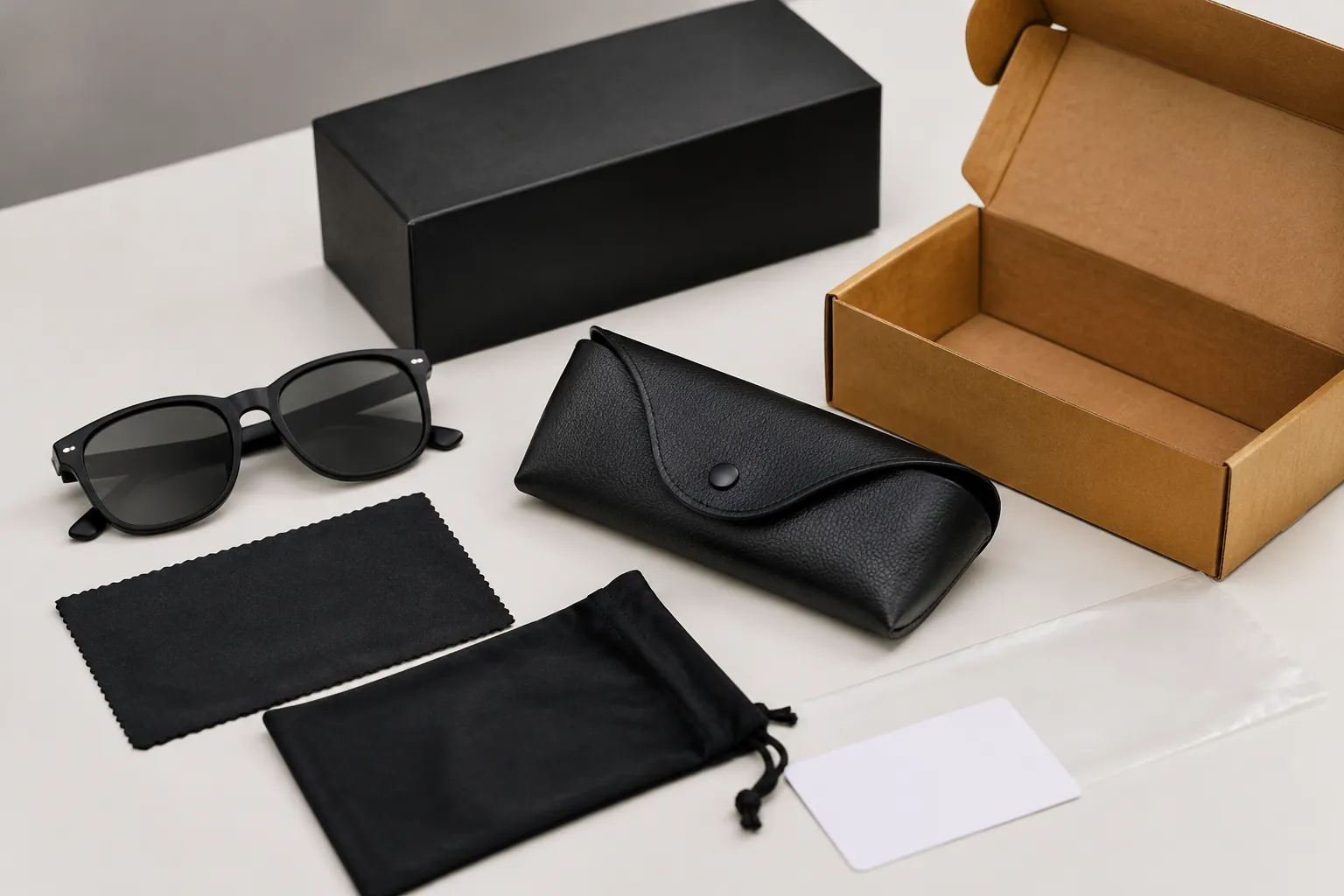
A basic promotional sunglass in a polybag may pack tightly. A retail sunglass with a microfiber pouch, rigid case, printed box, booklet, barcode label, and protective sleeve may not. The same pair count can turn into a very different carton count once frame shape, lens protection, accessories, and retail packaging are confirmed.
For courier and air freight, chargeable weight is usually based on actual gross weight or volumetric weight, whichever is higher. Volumetric weight is commonly calculated from carton length x width x height divided by a carrier-specific divisor. That divisor is not universal. Confirm it with the courier, airline, or freight forwarder before approving a quote.
Carton data should be confirmed after the final product and packaging specification are approved. Early estimates help with budgeting, but they are not booking data. A small change in retail box height, case thickness, or inner packing method can add real cubic volume across the shipment.
- Order quantity: small test orders, launch orders, and repeat replenishment orders should be evaluated differently because freight cost per pair changes as carton volume grows.
- Carton data: pairs per carton, carton dimensions, gross weight, net weight, and total carton count.
- Packaging detail: polybag, microfiber pouch, EVA case, paper box, hangtag, booklet, barcode, retail display pack, master carton, or pallet request.
- Product behavior: acetate frames, coated lenses, mirrored lenses, and polarized lenses may need more surface protection than low-cost injection frames.
- Warehouse rules: carton marks, SKU labels, pallet limits, appointment delivery, routing guide requirements, and retailer receiving instructions.
Many freight errors happen before pickup. The shipment is booked from estimated pairs instead of confirmed carton dimensions. Then the quote changes.
Compare Freight Modes by Cost and Deadline
There is no single best freight method for sunglasses. The right choice depends on the required arrival date, carton volume, gross margin, customs readiness, inventory risk, and how much stock the buyer can carry.
Courier and air are useful for samples, first launches, and urgent top-ups. Sea freight usually protects margin once the shipment becomes carton-heavy. Rail can work on selected China-Europe routes when the buyer needs a middle option between air cost and ocean transit time.
| Freight mode | Typical sunglasses fit | Usual timing logic | Main cost risk | Best use |
|---|---|---|---|---|
| Courier | Samples, photo samples, very small batches, urgent replacements | Fastest door-to-door option in many lanes, subject to customs clearance | High cost per pair and dimensional weight on boxes or hard cases | Development samples, approval samples, trade-show sets, urgent small shipments |
| Air freight | Launch-critical stock, moderate quantities, split shipments | Useful when the receiving date cannot support sea freight | Bulky packaging, airport handling charges, local delivery fees, and split-shipment admin | Launch coverage, seasonal deadlines, partial urgent stock |
| Sea LCL | Orders that do not justify a full container | Best when there is enough lead time for consolidation, sailing, clearance, and destination handling | CFS charges, multiple handling points, and destination fees | Margin-focused orders with moderate carton volume |
| Sea FCL | Large repeat orders, distributor programs, stable replenishment SKUs | Best planned from reorder points and sales forecasts | Inventory cash tied up during production and transit | Large programs with predictable demand and enough volume to use a container efficiently |
| Rail | Selected China-Europe shipments | Can be considered when air is too expensive and sea is too slow for the required date | Terminal handling, final-mile complexity, route disruption, and schedule variability | European replenishment where the lane, terminal plan, and delivery rules are clear |
Use the table as a first filter. Then test the choice against confirmed carton volume and destination charges. A premium acetate order in rigid boxes does not ship like a promotional injection-molded sunglass in polybags.
Courier: Samples and Small Urgent Batches
Courier is usually the simplest freight mode. It is also the easiest one to overuse.
Use courier for design samples, pre-production samples, photo samples, small replacement shipments, and very small test orders where speed and door-to-door visibility matter more than unit freight cost.
Courier becomes expensive when packaging is bulky. A small test order in polybags may be reasonable. The same quantity with EVA cases, rigid gift boxes, or retail display packaging can produce much higher volumetric weight. Before approving courier for anything beyond samples or urgent small batches, compare the courier quote against air freight and check the landed cost per pair.
Sample freight still needs import discipline. If the sample uses acetate, the approved color should be traceable to the selected material batch or supplier reference. If the sample uses tinted, polarized, mirrored, gradient, or photochromic lenses, confirm lens category, visible light transmission requirements, and destination-market testing needs before mass production. Freight cannot fix a product that fails retail approval or compliance review.
Courier paperwork must be accurate. The invoice should state product description, quantity, unit value, total value, country of origin, consignee details, and HS code guidance from the broker or forwarder. For regulated markets, keep the applicable files ready: CE EN ISO 12312-1, ANSI Z80.3, AS/NZS 1067, REACH, FDA registration where relevant, ISO 9001, and BSCI if requested by the buyer, retailer, or platform.
Air Freight: Use It for Launch-Critical Stock
Air freight is useful when the required arrival date matters more than the lowest freight cost. It should be planned, not used as a routine repair for late decisions.
For custom sunglasses, air can make sense for urgent launch quantities, best-selling colors, retailer deadlines, or high-margin programs where missing the shelf date costs more than the added freight. Be strict. Air freight should serve a clear business need.
A proper air shipment should start after final QC, packing list confirmation, invoice review, and label verification. Before cartons are sealed, check frame alignment, hinge movement, temple opening, lens fit, surface scratches, logo position, lens tint consistency, and packaging accuracy. Acceptable tolerance should be written into the purchase order, approved sample record, or inspection standard before production begins.
Decoration affects timing and risk. Pad printing can work well for simple logos. Laser engraving may suit selected metal parts, temples, or coated surfaces if tested on the final material. Metal logo plates add assembly steps. Hot stamping on cases or boxes requires separate artwork approval and material compatibility checks. Change decoration after pre-production approval, and you may lose the calendar time that made sea freight possible.
Before approving air freight, compare landed cost per pair against product margin and the retail deadline. Include pickup, export handling, air freight, airline or terminal charges, customs clearance, duty, broker fees, local delivery, and warehouse handling where applicable. Split shipping is often the better answer: send the minimum launch-critical stock by air, then move the balance by sea or rail.
Sea Freight: Protect Margin With Planning
Sea freight is the main option for margin-focused sunglasses programs. It is slower than courier or air, but it usually lowers freight cost per pair once carton volume grows.
It matters most for retailers, distributors, and brands ordering repeat SKUs, multiple colors, multiple lens treatments, or retail packaging formats. These programs need a calendar, not a scramble.
Buyers should account for sample approval, material confirmation, production, decoration, lens treatment, packaging production, inspection, carton packing, export handling, vessel schedule, sailing time, destination clearance, port or CFS handling, trucking, and warehouse receiving. Put each step on the calendar before treating the purchase order as launch-ready.
LCL works when the order does not justify a full container. The drawback is handling. Cargo moves through consolidation warehouses, and destination charges can be material if they are not quoted upfront. FCL gives better control and can reduce unit handling cost when shipment volume supports it. For repeat programs, FCL should be tied to reorder points, sales forecasts, and warehouse capacity rather than emergency purchasing.
Sea freight also gives buyers time to improve packaging efficiency. Standardizing retail box size, reducing unused space inside cases, improving inner carton layout, and confirming pallet requirements can reduce freight without weakening product protection. Do not over-compress sunglasses to save cubic volume. Hinges, temples, coated lenses, mirrored lenses, and polarized lenses need protection from vibration, rubbing, and stacking pressure during long transit.
Rail: A Middle Option for Some Europe Programs
Rail is not universal. It can work for selected China-Europe shipments when air is too expensive and sea freight cannot meet the required arrival date.
The buyer still needs a forwarder with a stable lane, a realistic terminal plan, clear customs responsibilities, and final-mile delivery pricing. Without those details, rail can become complicated quickly.
For sunglasses, rail is most useful when the shipment is too large for comfortable air freight but too time-sensitive for normal sea freight. Examples include European replenishment, seasonal stock that missed the ideal ocean booking window, or a launch where air freight for the full order would damage margin.
The weakness is complexity. Rail is not as simple as courier. It does not offer the same routing flexibility as ocean freight. Terminal handling, customs clearance, final-mile trucking, warehouse appointment rules, pallet requirements, and labeling rules need to be checked before booking.
Use rail only after confirming three points: estimated door-to-door transit time, landed cost per pair compared with air and sea, and delay risk against the required warehouse receiving date. A rail shipment that misses the selling window can be worse than air freight. It consumes time and still fails the business need.
Match Compliance, Labels, and Packing Documents
Freight planning is not only about moving cartons. Sunglasses are regulated consumer products in major markets, and customs authorities, brokers, retailers, and online platforms may ask for supporting documents.
The shipment should match the compliance file: product type, lens category, labeling, destination market, and applicable test standard. Do not let the paperwork tell one story while the cartons tell another.
For Europe, buyers commonly need CE EN ISO 12312-1 documentation for sunglasses. For the United States, ANSI Z80.3 is the key performance standard for non-prescription sunglasses, and FDA registration may be relevant for eyewear-related import handling. For Australia and New Zealand, AS/NZS 1067 applies. REACH may apply to restricted substances in frame materials, coatings, nose pads, inks, and packaging components. ISO 9001 and BSCI may be requested as factory-level quality management and social compliance references.
The product description should be specific and consistent across documents. If the shipment includes polarized sunglasses, acetate frames, TR90 temples, metal parts, mirror-coated lenses, or mixed SKUs, the commercial invoice and packing list should not reduce everything to vague wording such as plastic eyewear. The broker or importer of record should confirm HS classification and duty treatment for the destination market.
Carton marks should match SKU, color, quantity, PO number, country of origin, and destination requirements. Barcode labels, warning text, retail labels, and country-of-origin marking should be checked before mass packing. If a retailer or marketplace requires specific label placement or carton routing labels, those rules belong in the packing instruction before production is complete.
Buyer rule: final artwork, lens category, country-of-origin marking, warning text, retail barcode, carton mark, and packing list should be approved before cartons are sealed. Relabeling after packing wastes time and can push a planned sea shipment into air freight.
Use a Decision Path Before Booking
Choose freight with a decision path, not habit. The right answer changes by order quantity, carton volume, packaging, season, cash flow, destination charges, and inventory risk.
- Work backward from warehouse arrival. Use the required receiving date, not only the marketing launch date, and add time for retail DC processing, allocation, or marketplace check-in.
- Confirm production timing. Separate sample approval, material ordering, mass production, decoration, lens processing, packaging production, inspection, and packing into visible calendar steps.
- Lock product and decoration. Confirm material, lens type, logo method, logo position, color tolerance, retail artwork, and packaging specification before mass production.
- Request carton data. Get carton size, pairs per carton, net weight, gross weight, carton count, and pallet information before booking freight.
- Compare landed cost per pair. Include freight, destination charges, duty, broker fees, local trucking, storage, warehouse handling, and any known platform or retailer receiving charges.
- Split urgent and non-urgent stock. Ship only the required launch or replenishment quantity by courier or air, then move the balance by sea or rail when timing allows.
- Check document readiness. Match the commercial invoice, packing list, compliance documents, labels, carton marks, consignee details, and broker instructions before pickup.
For many buyers, the best plan is mixed. Samples may go by courier. A launch order may go partly by air. A repeat order should usually be planned early enough for sea freight unless the selling window requires a faster option.
Cash flow matters as much as transit time. Air freight brings inventory to market faster, but the freight bill arrives quickly. Sea freight usually protects gross margin, but inventory stays tied up longer in transit. Compare both scenarios before placing the purchase order, not after the goods are packed.
Have a custom sunglasses project in mind?
Send us your styles, target market and quantities and we will return a detailed quote with MOQ, lead time and a sample plan.
Get a QuoteWhy source this from Wenzhou with LumiShades
Wenzhou in Zhejiang Province is widely regarded as China’s eyewear manufacturing capital, producing a large share of the world’s sunglasses. That concentration matters to buyers: a deep local supply chain for acetate sheet, hinges, lens blanks, plating and packaging means shorter component lead times, easier color and material matching, and a workforce with decades of eyewear-specific skill. LumiShades has manufactured in this ecosystem since 2009, and our vertical integration — in-house injection molding, acetate cutting, CNC milling, lens tinting, decoration and quality control — means no part of your order is quietly subcontracted to a workshop you cannot audit.
For international buyers, that vertical control translates into accountability. When a single factory owns every step, defects are traced and fixed at source rather than bounced between vendors, and your specifications survive intact from first sample to bulk. We back this with 15+ years of experience, shipments to 60+ countries, more than 5 million pairs produced per year and a 98.5% on-time delivery rate. Our certifications — CE EN ISO 12312-1, FDA registration, ANSI Z80.3, AS/NZS 1067, REACH, ISO 9001 and BSCI audit — mean the compliance documentation your market requires already exists. Explore our manufacturing capabilities and quality control process to see how this works in practice.
Frequently asked questions
How many pairs of sunglasses should ship by courier? Use courier for samples, approval samples, photo samples, urgent replacements, and very small test orders where speed matters more than freight cost. Before using courier for a few hundred pairs or any order with hard cases, printed boxes, or display packaging, ask for carton dimensions and compare the courier chargeable weight against an air freight quote.
Should I ship my first custom sunglasses order by air or sea? Base the choice on the required warehouse receiving date and confirmed carton volume. If the order is small, urgent, or tied to a fixed launch date, courier or air may be justified. If there is enough time for production, inspection, sailing, customs clearance, and warehouse receiving, sea freight usually protects margin better. Compare landed cost per pair, not only the freight quote.
Can I split one sunglasses order between air and sea? Yes. Split shipping is often practical when only part of the order is needed for launch or replenishment. Ship the urgent SKUs or best-selling colors by air, then send the balance by sea or rail. Use separate carton marks, packing lists, commercial invoices, and broker instructions for each shipment so customs and warehouse receiving stay clean.
What documents should be ready before sunglasses leave China? Prepare the commercial invoice, packing list, product description, carton marks, country-of-origin details, consignee information, and broker instructions. Depending on the destination and buyer requirements, keep the applicable compliance files ready, including CE EN ISO 12312-1, ANSI Z80.3, AS/NZS 1067, REACH, FDA registration where relevant, ISO 9001, and BSCI.
Do hard cases change the best freight method? Often, yes. Hard cases and rigid retail boxes increase carton volume, which can raise courier and air freight chargeable weight even when the actual gross weight is low. Confirm packed carton dimensions before booking. If the selling date allows, larger hard-case programs should usually be evaluated for sea freight or split shipment.
When should I ask the factory for freight carton details? Ask for estimated carton data during quoting, then request confirmed carton data after product and packaging specifications are approved. Before booking freight, you need pairs per carton, carton dimensions, gross weight, net weight, total carton count, pallet information if applicable, and any retailer labeling or warehouse delivery requirements.
Ready to start?
Explore our cat-eye sunglasses or request a quote — our sales team replies within 12 hours.
Request a Quote