
How to Avoid Delays in Sunglasses Packaging
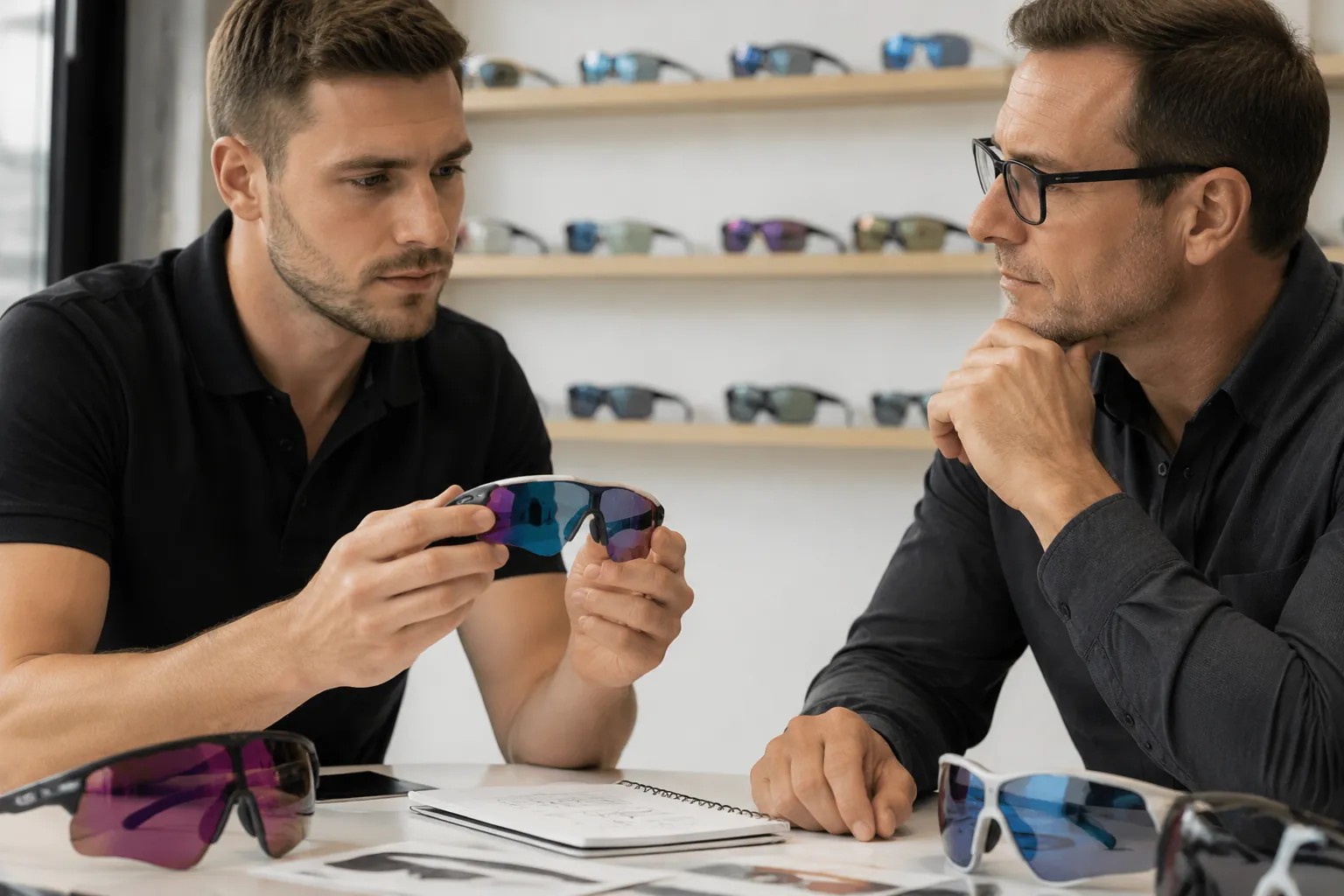
If you buy custom sunglasses in volume, packaging can push back your ship date. Boxes, pouches, labels, and inserts often run on a different timeline from frames and lenses, and one late artwork approval can hold an entire order. The fix is not to rush. It is to treat packaging as its own workstream, with its own samples, tolerances, and freeze date. This article shows overseas buyers how to keep packaging from blocking bulk production by using a process that fits how OEM eyewear suppliers actually schedule private label orders.
Start with the rule that prevents most delays
Packaging should not sit on the same critical path as frame production. That sounds basic, but delays often happen because buyers approve product samples first and leave box artwork, barcode data, and legal copy until the end. By then, the factory may have already locked the bulk schedule.
The fix is to split the order into two tracks. Track one covers the product: frame material, lens type, surface decoration, quality checks, and the final packing method. Track two covers packaging: outer box, pouch, insert, barcode label, carton marks, and any retail sticker. Approve Track two early, and the supplier can reserve paper stock, confirm the dieline, and prepare print production before bulk assembly starts.
In a factory with in-house steps such as molding, cutting, milling, tinting, decoration, and final inspection, product work can move quickly once the spec is frozen. Packaging has to match that pace. If a printed box needs its own production time and the insert needs separate cutting or tooling, packaging can become the bottleneck even when the sunglasses are ready.
Rule of thumb: freeze packaging structure before sample sign-off, and freeze artwork before bulk production begins. Wait until the sunglasses are finished, and packaging becomes the delay.
Buyers should also decide whether packaging is part of the factory order or sourced separately. A separate vendor adds another schedule, another approval loop, and another chance for rework. Keep responsibility clear. That alone cuts surprises at packing.
Break packaging into four parts, not one vague request
"Custom packaging" is too broad to manage well. In practice, sunglasses packaging usually has four separate parts, and each one has its own lead time, cost, and risk.
- Outer retail box: folding carton, rigid box, sleeve box, or window box. A standard folding carton with CMYK printing and no special finish is usually quicker than a rigid box with foil, embossing, or hand assembly.
- Pouch or case: microfiber, EVA, PU, felt, or drawstring bag. Material choice affects protection, unit cost, and whether the surface can scratch or shed lint.
- Insert: paper tray, molded pulp tray, foam, EVA cut insert, or blister. This must match the actual frame geometry and lens shape.
- Labels and marks: barcode, SKU, country of origin, care copy, carton marks, and retail sticker. These are small items. If they are wrong, they can stop warehouse intake or create customs problems.
Lock the insert size first. It has to fit the real frame. Then choose the pouch or case based on coating sensitivity and scratch risk. After that, design the box artwork around those physical limits. Many delays happen in the opposite order: marketing approves a box mockup before anyone checks whether the frame actually sits in the tray without pressure on the temples or lenses.
Material behavior matters. Soft-touch coatings and rubberized temple tips can scuff if they rub against rough paperboard. High-gloss acetate can pick up marks from uncoated insert stock. Metal frames with adjustable nose pads can deform if the insert presses on the bridge. Oversized fashion frames need even more clearance. A small fit problem can create pressure on the lens edge or temple springback during transit.
Define packaging with measurable inputs: box dimensions to the nearest millimeter, a realistic insert tolerance, and a packing method workers can repeat without force. That keeps the line moving.
Use a packaging decision table before you approve artwork
Different packaging structures affect schedule in different ways. Use this as a working guide during quoting and sample review.
| Packaging option | Typical use | Lead-time impact | Cost impact | Main risk |
|---|---|---|---|---|
| Plain pouch + sticker | Promo sets, entry price programs, fast replenishment | Lowest; often 3-7 days if material is on hand | Lowest | Weak shelf presentation and lower perceived value |
| Printed folding box | Mid-range retail and e-commerce | Moderate; usually 7-12 days depending on print queue and finishing | Low to medium | Artwork errors, color shift, barcode mismatch |
| Rigid box + insert | Gift sets, premium retail, influencer kits | Highest; often 12-20 days and more hand packing | Highest | Longer assembly time, higher freight volume, more damage risk if packed loosely |
| Retail box + microfiber pouch | Common private label SKU | Moderate if standardized early | Medium | Two-component coordination if pouch and box are sourced separately |
This table is not only about price. It shows where the schedule can break. Rigid boxes are fine, but if you keep changing foil color, embossing depth, or paper choice, you may lose more time than the sunglasses take to produce. For low MOQ work, simple packaging often makes more sense. A basic pouch, one-color sticker, or standard folding carton can protect margin and reduce rework. Once the style is proven, more elaborate box structures make more sense at higher quantities, where setup cost can be spread over more units.
Freight matters too. A rigid box takes up more space than a flat-fold carton. That can raise transport cost even if the unit price looks acceptable. On small orders, freight and rework often cost more than the packaging itself.
Stage packaging approval earlier than the frame sample
The fastest programs are the ones where packaging artwork is approved before bulk frame production starts. That means buyers need a complete file set, not a mood board. A usable file set includes logo artwork in vector format, Pantone references if color accuracy matters, final box dimensions, copy text, barcode data, and country-specific marks.
For eyewear, compliance details must be handled early. If you are selling into the EU, packaging and product documentation should support CE expectations under EN ISO 12312-1, and packaging materials and inks must be assessed against REACH where applicable. For the US, sunglasses programs may need alignment with ANSI Z80.3 depending on how the product is marketed and classified, and imported shipments should be handled with the correct FDA registration and import documentation where required. Australia and New Zealand buyers may need AS/NZS 1067. Confirm these items before print release, not at packing time.
A workable sequence is:
- Confirm product spec: frame material, lens type, coating, size, and decoration method.
- Lock packaging structure: box style, pouch material, insert type, and closure method.
- Approve legal text, barcode content, and carton marks.
- Approve the dieline and artwork.
- Release packaging to print while tooling or sample work is still moving.
- Match final carton labels to the same SKU and color codes used in production.
Real factories move faster when the buyer respects their internal gates. If the supplier has ISO 9001 and BSCI systems in place, use them to organize approvals and checks rather than trying to improvise changes at the end. Packaging can be checked together with lens inspection and surface inspection if the work is planned correctly.
One detail many buyers miss: confirm the dieline against the converted board thickness, not just a flat PDF mockup. A box that looks right on screen can be too tight once the board is folded and glued.
Control the insert, or you will pay for scratches and returns
The insert does more than hold the sunglasses in place. It controls crush resistance, surface protection, and packing speed. A weak insert design can lead to scratched lenses, bent temples, loose movement inside the box, and slow packing because workers have to fight the tray to seat each pair.
Match the insert to the frame construction and decoration method:
- Acetate frames: use a tray with enough temple clearance. Acetate can hold stress if compressed too tightly, especially around the hinge.
- Injection frames: they are often lighter, but some designs have thin bridge sections. Support the bridge and avoid point pressure.
- Metal frames: protect nose pads, adjustable pads, and temple tips from hard edges or rough paperboard.
- Oversized fashion frames: need deeper cavities or a wider pouch to avoid lens-edge pressure and temple springback.
Decoration method affects packaging as well. Pad printing and screen printing can chip if the insert rubs against raised logo areas. Laser engraving is usually more durable, but the surrounding finish can still show scuffing. Metal logo plates, foil stamping, and embossed panels need extra clearance. If the insert presses directly on a logo plate or raised decoration, that is a packaging spec failure, not a random defect.
For bulk orders, ask for a packing trial using 10 to 20 finished pairs. Check whether the frames can be packed without forcing the hinges or lenses, then inspect the units after unpacking for marks, deformation, or loose fit. If workers must stop to re-seat frames, the insert is too tight. If the sunglasses shift when the carton is shaken, the insert is too loose.
A good insert should let a trained packer finish a pair quickly and consistently once the line is stable. If packing takes too long or varies by worker, the structure is probably too delicate for bulk use.
Match packaging quantity to your MOQ and volume breaks
Packaging economics change fast with volume. At 50 pairs per design, most of the work is hand-finished and setup cost per unit is high. At 300 pairs, the same packaging can become more efficient if the dieline and print layout are already frozen. At 1000 and 5000+ pairs, unit cost matters more than setup friction, and the packing line should be planned as a repeatable operation.
| Order level | Packaging strategy | What to avoid | Expected result |
|---|---|---|---|
| 50 pairs/design | Standard pouch, simple label, generic or lightly branded box | Complex multi-part rigid packaging and multiple finishes | Faster approval, fewer delays, lower setup waste |
| 300 pairs | Printed box with fixed insert and barcode system | Frequent artwork changes after sample approval | Better unit cost with manageable setup time |
| 1000 pairs | Dedicated packaging spec by SKU family | Mixing box styles within one shipment | Cleaner packing, easier warehouse handling, fewer picking errors |
| 5000+ pairs | Optimized pack plan, carton loading plan, reserved print inventory | Short-print emergency reorders and last-minute finish changes | Lowest unit cost and stable replenishment |
Typical packaging cost logic is simple: a basic pouch and sticker may be a small add-on, while a fully custom rigid box with insert, foil, and special paper can become a much larger share of landed cost on low-MOQ orders. If your program is under 300 pairs, saving on packaging often matters because setup cost is spread across very few units.
Standardization helps the factory too. If three colorways can use one insert spec and one carton size, the line can move faster and warehouse picking becomes simpler. The buyer's job is to reduce variation unless that variation clearly earns its keep.
Build a packaging QC gate before cartons are sealed
Packaging mistakes are expensive because they multiply. One wrong barcode can affect an entire batch. One incorrect lens warning can force a reprint. One loose insert can create a scratch complaint from retail or e-commerce customers and increase returns.
Use a packaging QC checklist before master cartons are closed:
- Retail box dimensions match the approved dieline within the agreed tolerance.
- Logo placement and color match the approved sample within tolerance.
- Barcode scans correctly and matches the SKU.
- Country of origin, care copy, and compliance text are correct.
- Insert holds the frame without pressure on the lens, hinge, or coating.
- Pouch material is clean, lint-free, and sized to the actual product.
- Master carton count, carton marks, and packing list all match.
If your supplier has ISO 9001 and BSCI systems in place, use them properly. Ask for a pre-pack sample approval, then a first-article check on the first carton run, then a random packed-unit audit. That sequence is usually enough when the specifications are clear.
Do not skip carton testing. A box that looks fine on a desk can fail when stacked, compressed, or shipped through humid routes. Paperboard can soften in high humidity, printed varnish can scuff, and adhesive seams can open if the carton is overfilled. Packaging has to survive transport conditions, not just the showroom.
If you are using a retail display shipper, check the outer carton compression as well. Leave enough buffer so the retail box is not forced against the shipper walls. That reduces corner crush and keeps the presentation intact when the goods arrive.
A practical buyer workflow that keeps product moving
If you want a repeatable system, use this sequence for every new sunglasses program.
- Choose the sunglasses model and confirm the final frame spec.
- Decide whether packaging is standard, semi-custom, or fully custom.
- Approve a packaging sample in parallel with the product sample.
- Lock legal text, barcode data, and carton marks before bulk production starts.
- Reserve simple packaging for small MOQ runs and reserve premium packaging for proven sellers.
- Ask the supplier to run a packing trial before full packing.
- Keep one packaging revision window only. After that, freeze it.
This workflow works because it respects factory reality. Product work and packaging work can run together, but only if the buyer gives clear inputs early. Wait until the frames are done, and packaging becomes the blocker. Freeze packaging too early without checking fit, and you create rework. The middle path is the safest.
For overseas B2B buyers working with an OEM eyewear supplier, the goal is not fancy packaging. It is packaging that does not slow production, does not create compliance errors, and does not force last-minute hand packing. The best packaging is often the one that disappears into production because it was planned properly.
Practical rule: approve the packaging structure before sample sign-off, freeze the artwork before bulk, and keep the insert simple enough for workers to pack fast, consistently, and without surface damage.
Follow that rule, and packaging stops being the reason a shipment misses its booking window.
Have a custom sunglasses project in mind?
Send us your styles, target market and quantities and we will return a detailed quote with MOQ, lead time and a sample plan.
Get a QuoteWhy source this from Wenzhou with LumiShades
Wenzhou in Zhejiang Province is widely regarded as China’s eyewear manufacturing capital, producing a large share of the world’s sunglasses. That concentration matters to buyers: a deep local supply chain for acetate sheet, hinges, lens blanks, plating and packaging means shorter component lead times, easier color and material matching, and a workforce with decades of eyewear-specific skill. LumiShades has manufactured in this ecosystem since 2009, and our vertical integration — in-house injection molding, acetate cutting, CNC milling, lens tinting, decoration and quality control — means no part of your order is quietly subcontracted to a workshop you cannot audit.
For international buyers, that vertical control translates into accountability. When a single factory owns every step, defects are traced and fixed at source rather than bounced between vendors, and your specifications survive intact from first sample to bulk. We back this with 15+ years of experience, shipments to 60+ countries, more than 5 million pairs produced per year and a 98.5% on-time delivery rate. Our certifications — CE EN ISO 12312-1, FDA registration, ANSI Z80.3, AS/NZS 1067, REACH, ISO 9001 and BSCI audit — mean the compliance documentation your market requires already exists. Explore our manufacturing capabilities and quality control process to see how this works in practice.
Frequently asked questions
What packaging items should I approve first for custom sunglasses? Approve the insert and box structure first, then the artwork, then the labels. The insert controls fit, scratch risk, and packing speed. If the structure is wrong, artwork changes will not solve the problem. Ask the supplier for a sample box, a sample insert, and a packing trial before you release bulk.
How do I keep packaging from delaying bulk production? Run packaging and product in parallel. Freeze box dimensions, pouch material, barcode data, and legal copy before bulk starts. Do not wait until frames are finished. Put a packaging freeze date into the sample schedule and treat it as a release gate, not an afterthought.
Can I use one packaging spec across multiple sunglasses styles? Yes, if the frame dimensions are close and the insert fits every SKU safely. This is one of the best ways to cut cost and simplify packing. Before you standardize, test the insert on each style to confirm there is no pressure on hinges, lenses, or raised logo details.
What compliance details belong on packaging for export orders? That depends on the destination market, but buyers should confirm the country of origin, SKU and barcode data, care instructions, and any required market-specific markings before print release. For sunglasses, buyers often need to review CE EN ISO 12312-1 for the EU, ANSI Z80.3 for the US, AS/NZS 1067 for Australia and New Zealand, REACH where applicable, and FDA registration or import documentation where required. Confirm the exact wording with your supplier or compliance advisor before printing.
What is a sensible packaging choice for a 50-pair MOQ order? Use a simple pouch, standard insert, or basic box with minimal finishing. Complex rigid packaging usually adds cost and delay that do not fit a 50-pair run. At that quantity, the safest approach is to keep the pack structure simple, reduce setup time, and avoid artwork or tooling changes after approval.
Ready to start?
Explore our wayfarer sunglasses or request a quote — our sales team replies within 12 hours.
Request a Quote