
Custom Sunglasses Logo Debossing, Embossing & In-Mold Branding
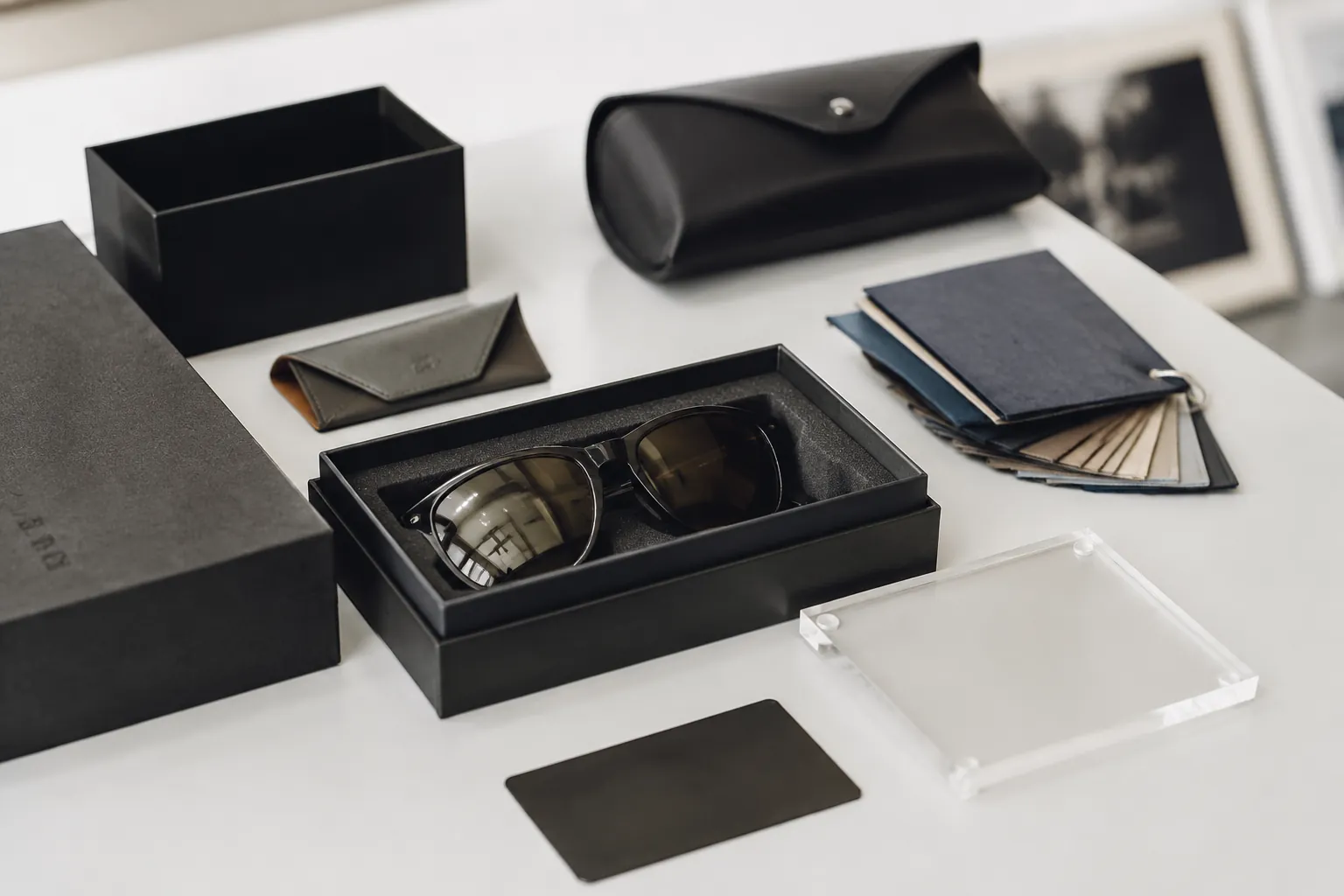
If you source custom sunglasses for a brand, retail chain, promotion, or private-label program, logo decoration is a production decision first and a design decision second. The branding method changes tooling cost, unit price, MOQ, sample time, and how the frame holds up after handling, cleaning, packing, and shelf display. Debossing, embossing, and in-mold branding can all work. But only if they match the frame material, wall thickness, finish, and order volume. This guide focuses on the checks buyers need before artwork approval so the logo survives production, not just a render.
Start with the frame material, not the logo artwork
Most branding failures on sunglasses start with the wrong material-method match. Buyers often begin with the logo file and placement idea. Production should start with the frame substrate: acetate, injection-molded plastic, TR90 or nylon-based material, or metal. Each behaves differently under pressure, heat, finishing, and wear.
Rule of thumb: the harder and more stable the surface, the better the edge definition. The more flexible the material, the more conservative you need to be with line width, relief height, and draft angle.
- Acetate: suitable for debossing, embossing, CNC engraving, and laser marking. It machines cleanly, but very fine relief can soften during polishing.
- Injection plastic: suitable for in-mold branding and some molded relief details. Results depend on cavity design, gate location, flow behavior, and shrinkage.
- TR90 / nylon-based frames: workable for molded branding, but fine raised details can lose sharpness because the material flexes and may round slightly during release and finishing.
- Metal frames: usually better suited to laser engraving, stamping, or a separate metal logo plate than molded relief.
A logo that looks fine in Illustrator can still fail on a real frame if the strokes are too fine. Thin lines disappear. Or they look inconsistent after molding, trimming, polishing, and packing. As a practical production guideline, keep line widths no finer than about 0.25 mm unless the factory has confirmed that the process can hold the detail on the chosen material.
Placement matters too. If the logo sits too close to a hinge, edge break, or strong curve, the mark can distort visually or vary from pair to pair. Leave room. Not much, but enough. Keep the detail away from screw bosses, hinge points, and temple ends so finishing does not crush the mark.
Debossing: the most forgiving tactile logo method
Debossing places the logo below the surface. For many B2B programs, it is the safest durable decoration method because the brand mark is tactile, looks clean, and is better protected from abrasion than a raised logo or surface print.
Where debossing works best: inside temples, outer temples, temple tips, acetate front corners, model codes, size marks, and understated branding for mid-premium or corporate programs.
How it is made: on acetate, the logo is typically CNC-cut or mechanically engraved before final polishing. On injection parts, the recessed detail can be formed directly into the mold cavity if the geometry allows it. On larger runs, molded-in debossing is usually more consistent than post-cutting on curved injected parts.
Typical practical specs:
- Depth: about 0.15 mm to 0.40 mm
- Minimum line width: about 0.25 mm for readable results
- Preferred internal corners: rounded rather than sharp to reduce chipping or stress marks
- Distance from edge: ideally at least 1.5 mm on narrow temples, more if the area is heavily curved
Debossing is more tolerant of handling and rubbing because the surrounding surface protects the mark. It also hides small polish variation better than embossing. The main risk is over-detailing. If the recess is too deep or the logo contains tiny counters and narrow gaps, polishing compound, dust, or skin oils can collect in the mark and make it look dirty if cleaning is poor.
For buyers comparing options by cost, debossing usually has the lowest setup burden among durable non-print methods. It may still require tooling adjustment or engraving work, but it is generally simpler than full mold-based branding. That is why it is often the first choice for lower-MOQ custom sunglasses and early sampling.
Embossing: stronger shelf visibility, tighter geometry limits
Embossing creates a raised logo above the surface. It reads quickly at retail and gives a more assertive branded look. But it is less forgiving in production than debossing.
Raised details take more abuse during tumbling, sanding, edge finishing, and final hand polishing. They also reveal mold and finishing defects more easily, especially on glossy black, crystal, and mirror-polished acetate. If the logo geometry is wrong, the result can look soft, uneven, or cheap. There is no hiding it.
Embossing usually works best when:
- The temple has enough thickness to support the relief without distortion.
- The wordmark is simple, with open shapes and moderate stroke widths.
- The frame finish is matte, satin, or controlled-gloss rather than highly reflective.
Practical geometry guidelines:
- Raised height: usually about 0.15 mm to 0.30 mm
- Draft angle: typically about 3-5 degrees to help clean release from mold tooling
- Minimum top width for raised strokes: about 0.30 mm, wider if the material is flexible
- Avoid long unsupported thin lines that can visually collapse after finishing
Embossing is a poor fit for ultra-light temples, thin-wall injected frames, and detailed crest-style logos with tiny internal cuts. If a frame wall is too thin, the relief can telegraph through the opposite side or create sink around the logo area. That distortion is hard to hide once the part is polished.
Review embossed samples under strong direct light, not only in hand. A sample that looks acceptable under office lighting may show every ripple under store lighting. So embossing needs stricter sample review than debossing. Simple fact.
In-mold branding: best long-run durability on injection frames
In-mold branding means the logo geometry is formed in the injection mold itself, so the mark becomes part of the frame rather than a decoration added afterward. For injection plastic and many nylon-based programs, this is usually the cleanest and most durable branding method.
Why buyers use it: there is no printed layer to scratch off, no separate adhesive badge to detach, and no extra decoration step that can drift in placement from pair to pair. Once the tool is correct, consistency is generally better across long runs.
What in-mold branding requires:
- Artwork locked early in development
- Tool insert design or cavity modification
- Approval of draft, relief depth, and polish level in the logo area
- Review of gate location and flow path to reduce sink, knit lines, or flow marks near the brand area
Typical mold-built logo depth or height falls in a similar broad range to debossing or embossing, but the tolerance window is tighter because material shrinkage and fill behavior matter more. If the logo sits where flow fronts meet, the detail can lose edge definition or show a slight gloss difference compared with the surrounding frame.
For MOQ logic, in-mold branding is harder to justify at very small quantities than on repeat orders. A print change or laser mark can be revised more cheaply than a mold insert change. As a practical rule, consider in-mold branding when the SKU is stable, the volume is repeatable, and the logo location is unlikely to change after first approval.
Use the term carefully. In-mold branding is mainly for injection frames. It is not the normal answer for acetate, where CNC cutting, engraving, laser marking, or other secondary decoration methods are more realistic.
Side-by-side comparison: material fit, tooling burden, and durability
The table below reflects normal factory-floor logic rather than idealized design theory. Actual results still depend on artwork, finish, and frame geometry, but this is a reliable starting point for buyers comparing methods.
| Method | Best frame material | Typical relief spec | Tooling impact | Durability | Best use case |
|---|---|---|---|---|---|
| Debossing | Acetate, some rigid injected plastics | About 0.15-0.40 mm recessed depth | Low to moderate | High | Inside temple logos, size/model marks, subtle outer-temple branding |
| Embossing | Thick acetate, rigid injection frames | About 0.15-0.30 mm raised height | Moderate | Medium to high | Visible retail branding, bold wordmarks on thicker temples |
| In-mold branding | Injection plastic, some nylon-based frames | Built into mold; geometry depends on shrink and draft | High upfront | Very high | Repeat SKUs, long-run private label programs |
| Laser engraving | Acetate, metal, coated components | Surface mark, minimal depth | Low | Medium to high | Fast samples, inside temple information, low-MOQ customization |
Decision shortcut:
- Need the safest durable option at lower MOQ? Choose debossing.
- Need stronger visual impact on shelf? Consider embossing, but simplify the logo.
- Need maximum durability on injected frames over repeat orders? Use in-mold branding.
- Need speed for sample approval or small information marks? Use laser engraving.
Do not force one logo method across a mixed collection. A branding method that works on a thick acetate sun frame can fail on a slim TR90 sport style.
Artwork rules and sample tolerances that prevent rejections
Many logo problems are not manufacturing defects. They start with artwork that was never adapted for relief branding. A flat vector file is only the starting point. The logo needs to be engineered for size, depth, radius, and process capability.
Good production artwork practice includes:
- Provide vector files with closed paths and no overlapping stray points.
- Specify final logo size in millimeters on the actual frame location.
- Simplify tiny internal gaps, serifs, and counters that may fill during molding or polishing.
- Keep line widths consistent where possible.
- Mark the logo position from fixed references such as hinge center, temple edge, or temple tip.
Buyers should also set realistic tolerances. On a production run, slight position variation is normal, especially on curved temples or hand-finished acetate. A practical visual tolerance for placement may be around ±0.30 mm to ±0.50 mm depending on the part and process. Chasing zero variation is not realistic. It usually leads to unnecessary sample rounds.
Approval should never rely on a flat proof only. A physical sample is needed to verify three things: readability at real size, surface behavior after polishing, and appearance under the final frame color and gloss level. Matte black can hide softness. Crystal or high-gloss tortoise can expose inconsistency.
Hybrid branding setups are possible. For example, a buyer may use debossing on the outer temple and laser size marking inside the temple, or pair a recessed logo with a small metal plate at the tip. That can work. But too many branding elements on one frame can reduce perceived quality instead of increasing it.
Cost, MOQ, and lead time: how the economics really change
Branding method affects both setup cost and unit economics. On smaller orders, the least expensive method on paper is not always the lowest total cost once revisions and delays are included. On higher volumes, more permanent tooling-based branding becomes easier to justify.
MOQ and timing are supplier-specific, but the commercial logic is consistent: simple decoration methods suit low-volume programs, while mold-based branding is more appropriate when the style will be repeated. Ask the factory for a quotation that separates tooling, sampling, and bulk unit price. Otherwise the numbers are hard to compare.
| Order volume | Recommended branding route | Setup burden | Lead-time effect | Commercial logic |
|---|---|---|---|---|
| 50 pairs/design | Debossing or laser engraving | Low | Fastest sample-to-bulk path | Best for testing a style or serving small private-label runs |
| 300 pairs/design | Debossing or simple embossing | Moderate | Manageable with one sample round if artwork is clean | Balanced option for boutique chains and seasonal drops |
| 1,000+ pairs/design | Embossing or in-mold branding | Higher upfront | More tool review on the first run | Better unit economics over repeat volume |
| 5,000+ pairs/design | In-mold branding preferred on injected frames | High upfront, lower long-run decoration risk | Most efficient after tool approval | Best for stable SKUs and distribution programs |
As a practical lead-time benchmark, samples often take about 7-10 days and bulk production commonly takes about 25-35 days after sample approval and order confirmation. That depends on product complexity, factory load, and whether tooling changes are needed. If the branding method requires mold insert work or cavity revision, allow extra time for the first sample round.
Ask whether the quote includes tooling, sample revisions, and any logo-area modifications. Do not ask only, "What is the decoration price?" Ask what the choice does to total landed program cost and timing. That is the real question.
QC and compliance: branding still has to pass the product file
A good-looking logo is irrelevant if the frame fails performance, safety, or receiving inspection. Decoration must stay within the compliance and functional limits of the eyewear program.
Relevant checks commonly requested for sunglasses programs include:
- CE marking with compliance to EN ISO 12312-1 for EU sunglasses programs where applicable
- ANSI Z80.3 for U.S. sunglass performance reference where required by the buyer or market
- AS/NZS 1067 for Australia and New Zealand where applicable
- REACH compliance for restricted substances where applicable
- FDA registration and related U.S. regulatory documentation where applicable to the supply chain
- ISO 9001 and BSCI as supplier-system and social-compliance references when requested by the buyer
At QC stage, inspect the logo area for:
- Sharp edges that can irritate skin or catch cloth during cleaning
- Sink, flash, or witness lines around molded branding
- Softened detail after polishing
- Residue trapped in debossed areas
- Temple folding interference caused by raised marks
- Case-fit problems if the embossed logo adds too much height
Check function as well as appearance. An embossed outer-temple logo that looks excellent on a loose sample may still rub against the opposite lens in folded position during transit. A deep inner-temple deboss may collect residue and fail visual inspection after handling. An in-mold logo placed too near a gate may show a gloss halo or flow mark that is invisible in photos but obvious in person.
Simple pre-bulk approval checklist:
- Confirm frame material and finish.
- Confirm logo method and exact location in millimeters.
- Approve a physical sample for depth, visibility, and hand feel.
- Test hinge movement, temple closure, and case fit.
- Review the relevant compliance documents before bulk release.
The most reliable branding programs are usually the least dramatic ones: correct material match, simplified artwork, realistic tolerances, and a sample approved under real inspection conditions.
Have a custom sunglasses project in mind?
Send us your styles, target market and quantities and we will return a detailed quote with MOQ, lead time and a sample plan.
Get a QuoteWhy source this from Wenzhou with LumiShades
Wenzhou in Zhejiang Province is widely regarded as China’s eyewear manufacturing capital, producing a large share of the world’s sunglasses. That concentration matters to buyers: a deep local supply chain for acetate sheet, hinges, lens blanks, plating and packaging means shorter component lead times, easier color and material matching, and a workforce with decades of eyewear-specific skill. LumiShades has manufactured in this ecosystem since 2009, and our vertical integration — in-house injection molding, acetate cutting, CNC milling, lens tinting, decoration and quality control — means no part of your order is quietly subcontracted to a workshop you cannot audit.
For international buyers, that vertical control translates into accountability. When a single factory owns every step, defects are traced and fixed at source rather than bounced between vendors, and your specifications survive intact from first sample to bulk. We back this with 15+ years of experience, shipments to 60+ countries, more than 5 million pairs produced per year and a 98.5% on-time delivery rate. Our certifications — CE EN ISO 12312-1, FDA registration, ANSI Z80.3, AS/NZS 1067, REACH, ISO 9001 and BSCI audit — mean the compliance documentation your market requires already exists. Explore our manufacturing capabilities and quality control process to see how this works in practice.
Frequently asked questions
Which logo method is best for acetate frames? Debossing is usually the safest choice for acetate because it holds detail well, looks clean, and wears better than surface print. Embossing can also work on thicker acetate temples, but the artwork must be simplified and the polishing process controlled so the raised edges do not soften. If you want a fast visual proof, laser engraving is useful for sampling, but for a durable retail logo, debossing is usually the first option to test.
Can in-mold branding be used on all sunglasses? No. In-mold branding is mainly for injection-molded plastic or some nylon-based frames because the logo is created in the mold. It is not the normal process for acetate. If you have an acetate style, ask the factory for debossing, embossing, CNC engraving, or laser marking instead of trying to force a mold-based solution onto the wrong material.
How small can a debossed logo be and still read well? A practical starting point is to keep fine lines at about 0.25 mm or thicker and use a deboss depth of roughly 0.15-0.40 mm. Tiny text, hairline strokes, and very tight internal gaps are risky because they can fill in or round off during cutting, molding, or polishing. Before bulk, always approve a physical sample at final size on the actual frame finish, not only a digital proof.
Does logo branding change lead time? Yes. Simple debossing or laser marking usually has the shortest path because it needs less tooling work. In-mold branding and some embossing projects can add time if a mold insert or cavity change is required. A typical estimate is 7-10 days for samples and 25-35 days for bulk after approval, but the exact schedule depends on the product and whether the logo area needs tooling revision. Ask the supplier to separate sample time from tool modification time in writing.
What should I send the factory to get an accurate quote? Send vector artwork, target frame material, preferred branding method, exact logo position in millimeters, estimated order quantity, and the target market. Also tell the factory whether you need CE marking with EN ISO 12312-1, ANSI Z80.3, AS/NZS 1067, REACH-related compliance, FDA registration-related documentation, ISO 9001, or BSCI-related supplier documentation. If possible, include a reference image showing the logo size on the temple so the factory can quote tooling, sampling, and bulk cost separately.
Ready to start?
Explore our aviator sunglasses or request a quote — our sales team replies within 12 hours.
Request a Quote