
Logo Plates vs Laser vs Print for Sunglasses
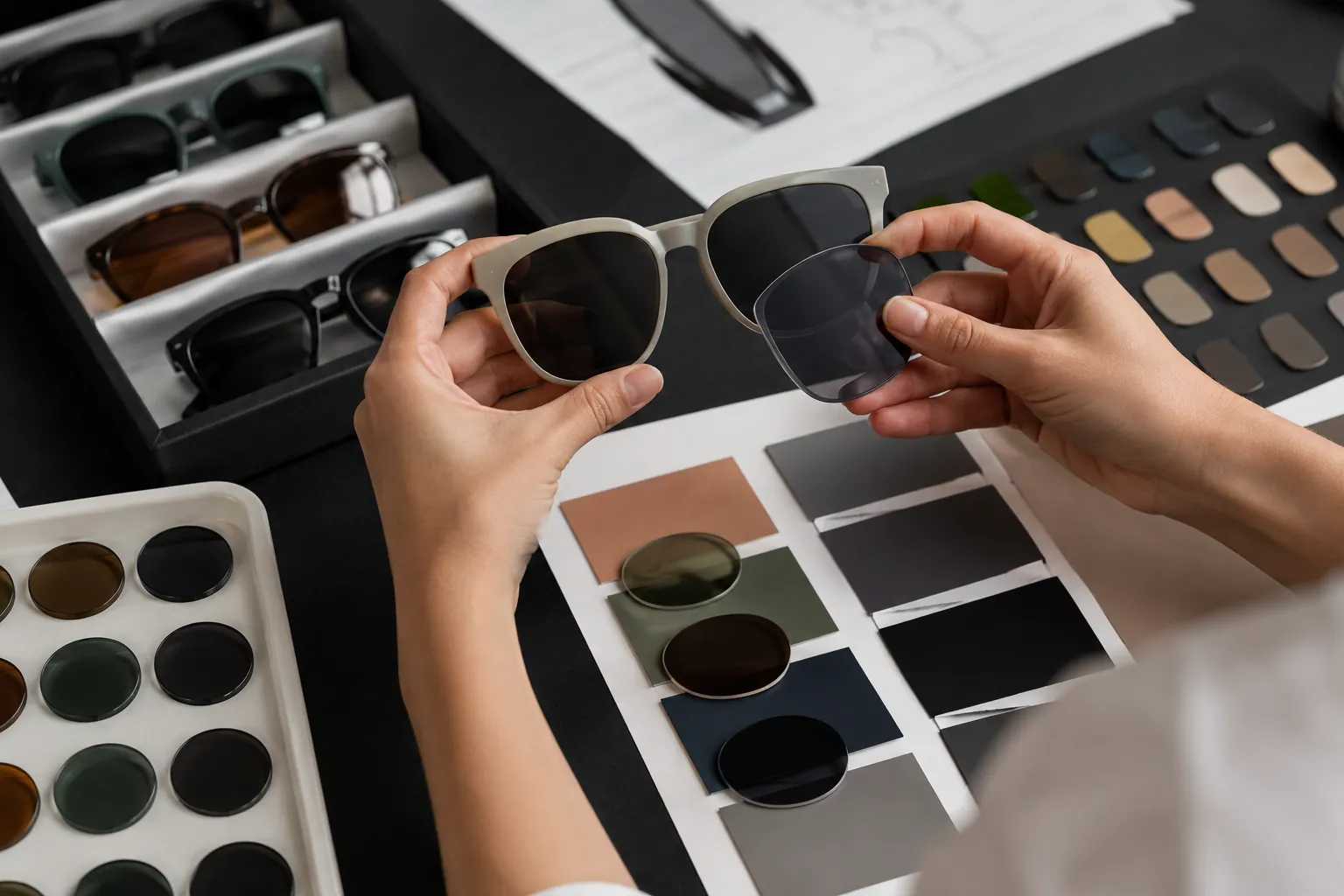
If you buy sunglasses for retail, private label, promotions, or distributor programs, decoration choice is not cosmetic. It affects shelf impact, logo durability, unit cost, and lead time. This guide compares logo plates, laser engraving, and pad printing from a buyer's point of view, based on common eyewear manufacturing constraints in Wenzhou and similar production hubs. It shows where each method fits best when you need a metal logo plate, a clean laser mark, or a low-cost printed logo.
Start with the retail job, not the decoration method
Most buyers start with the logo method. That is backwards. Start with the retail job: is this a low-cost promotional frame, a mid-priced private label pair, or a higher-value product where branding has to look built into the design?
On shelf, the logo does two jobs. It must be readable at arm's length. It must also support the price point. A metal plate on a matte acetate frame sends one signal. A small pad print on a temple sends another. A laser mark on brushed metal sends a third.
The artwork may be the same. The perception is not.
Production limits matter too. Frame material, temple geometry, and order structure decide what is realistic. Injection-molded frames often suit pad printing because the surface is consistent. Acetate can work well with laser engraving, logo plates, and pad printing, but the finish changes the result. Metal and mixed-material frames usually open the door to laser and plates. Soft-touch, rubberized, or heavily textured coatings can reduce contrast and make adhesion less predictable.
Use this rule: if the logo needs to look premium in a retail box or on an open shelf, do not start with the cheapest marking method. Start with the method that fits the material, survives handling, and still reads clean after packaging, shipping, and store display.
Buyer rule: choose the decoration method based on material, wear, and shelf impact—not only decoration cost.
How the three methods differ in the factory
These are not interchangeable processes. They create different surfaces, different lead-time needs, and different defect risks. The right choice depends on how the part is made and how the decoration is applied.
| Method | How it is applied | Best on | Typical strengths | Main weakness |
|---|---|---|---|---|
| Metal logo plate | Die-cut, stamped, etched, or CNC-cut plate fixed with adhesive, pins, or embedded mounting | Acetate, premium plastic, some metal temples | Strong shelf impact, tactile, premium look | Higher part cost, more assembly steps, lift risk if adhesion is poor |
| Laser engraving | Laser removes or discolors the surface layer directly | Acetate, metal, coated parts, some wood-look finishes | Clean, precise, durable, no ink to rub off | Limited color; contrast depends on base material and laser settings |
| Pad printing | Silicone pad transfers ink onto the part, then cures | Injection-molded plastic, temples, curved areas | Lowest-cost logo, supports color branding | Ink wear, adhesion risk, weaker premium feel |
In practice, a metal plate usually adds more visible value than printed branding, especially on acetate frames with a polished temple surface. Laser engraving is the most direct durability choice because it marks the part itself rather than adding a separate layer. Pad printing is the workhorse for volume programs, especially when the brand needs a color logo or the target cost is tight.
The defect modes are different too. Print can fail because of ink viscosity, pad hardness, transfer pressure, curing time, or surface contamination. Laser can fail because of focus, depth, beam speed, or an unsuitable base color or coating. Plates can fail because of alignment, adhesive contamination, insufficient bond area, or inconsistent plate thickness. A buyer should ask what the factory inspects, not just what it can produce.
Small logos need tighter placement control than large ones. Fine text needs more room than a simple mark or icon. Before approval, confirm that the factory can keep the logo centered, legible, and consistent across the full order.
Shelf impact: what buyers and shoppers actually notice
Retail is unforgiving. Most shoppers do not inspect a logo under ideal light. They see the frame from about arm's length, then pick it up for only a few seconds. That is enough time for branding to support the product or disappear.
Logo plates create the strongest tactile and visual cue. A small metal plate on the temple can make a mid-priced frame feel more finished. This works well on acetate because the material already has depth and polish. A plate on a matte frame can look deliberate if the size is right. Too large, and it becomes a badge. Too small, and it looks accidental.
Laser engraving is more restrained. On dark acetate it can read as technical and understated. On brushed metal it can look sharp and premium if the finish creates enough contrast. On glossy black material, the mark may be subtle. Material choice and test samples matter. A shallow laser mark may be decorative only; the visible result depends on the base material and settings.
Pad printing works best when the brand needs color. A red logo on a white temple or a black logo on a translucent frame can look strong if the print is crisp. But in premium retail, print usually looks flatter than a plate. It is visible. It simply does less work for perceived value.
Ask one blunt question: will the customer notice the logo before they notice the frame shape? If yes, plates or a clean laser mark usually outperform plain print. If the frame is the star and branding should stay quiet, laser is often the best fit.
Durability and wear: what survives handling, cleaning, and returns
Decoration is not finished when it passes initial inspection. It has to survive try-on cycles, wiping, packaging abrasion, humidity, and transport. Sunglasses get handled more than most accessories, especially in open retail fixtures and distributor channels.
Laser engraving is usually the most durable of the three under normal use because there is no ink layer to peel. On acetate, the contrast comes from the surface change itself. On metal, the mark can remain readable after repeated cleaning with cloths or alcohol wipes if the base finish is compatible. For buyers who want a long-lasting mark on a core line, laser is often the safest choice.
Logo plates are durable if the attachment method is correct. A mechanically fixed plate or properly bonded plate can last well. The real risk is edge lift, adhesive failure, or finish wear on the plate surface. A low-grade plated finish can scratch quickly in pouch-to-box friction, and a weak adhesive bond can fail when the frame is exposed to heat in transit.
Pad printing is the least durable under friction unless the ink system, curing, and surface preparation are controlled tightly. It can still be acceptable for many B2B programs. But if the product will be sold in stores where customers try on multiple pairs, expect wear on high-contact zones. That includes temple logos and inside-temple markings, where repeated rubbing from hands, packaging, and cleaning cloths can soften the edges of the print.
The real question is not whether the method can work once. It is whether it can survive the expected retail life. A logo that looks perfect in pre-production but fades after two weeks of display is a costing mistake, not a decoration choice.
MOQ fit, pricing logic, and lead-time impact
Decoration cost changes with volume, and so does setup time. If your order is only 50 pairs per design, the wrong logo method can distort landed cost more than the frame itself. The best method at 5,000 pairs is not always the best method at 50.
| Method | Best MOQ fit | Relative cost at low volume | Relative cost at 300 / 1,000 / 5,000+ | Typical lead-time impact |
|---|---|---|---|---|
| Logo plate | Best from 300+; possible at 50 if the design is stable | High | Improves as volume rises because setup and plate prep spread out | Usually adds several days for plate making and approval |
| Laser engraving | Good at 50 and up | Medium | Stays relatively stable; less artwork complexity | Often adds little time once the machine file is ready |
| Pad printing | Best at 50+ and most efficient at 300+ | Low | Usually the lowest-cost option at scale | May add time for screens, ink tests, and curing validation |
At a 50-pair MOQ, pad print is often the most cost-efficient if you need to keep cost down. Laser becomes attractive if the frame material supports it and you want a mark that will not rub off. Logo plates make the most sense when you are building perceived value and can spread the added part and labor cost across more units.
As a working rule, expect plate decoration to cost more in both material and labor because it adds a physical component and another assembly step. Laser tends to sit in the middle because the machine time is efficient but the result depends on material compatibility. Pad print is usually the least expensive, especially when the logo is one color and the artwork is simple.
Lead time follows the same pattern. Once a laser file is approved, production can be relatively fast. Pad print may require a screen or cliché, ink matching, and drying or curing checks. Plates require die-making or plate machining, finish confirmation, and a bonding step that may need extra inspection. For launch planning, that difference can matter as much as the unit cost.
Material and geometry constraints that can make or break the result
Good decoration starts with the part geometry. Bad geometry forces compromise, and compromise shows up on shelf.
- Flat or gently curved temples: best for pad printing and metal plates.
- Thick acetate temple arms: good for laser engraving and plates.
- Very narrow temples: limit plate size and print area; artwork often needs to be simplified.
- Glossy black acetate: laser contrast may be subtle; test before approval.
- Translucent or bright frames: pad print often reads better than laser.
- Rubberized or soft-touch coatings: print adhesion can be less predictable and may need extra surface preparation.
There are also practical process limits. A logo plate needs enough surface area and thickness to hold alignment. On very narrow temples, the plate can look crowded or be vulnerable to edge lift. Pad printing needs a stable, clean contact area and a logo large enough to transfer without breaking into disconnected elements. Laser needs a material that reacts predictably; some colors and coatings create weak contrast, which means the mark may be technically there but visually underwhelming.
Artwork matters just as much as method. Fine type, tiny outlines, and stacked details increase reject risk. If the logo has lines thinner than the process can hold, legibility will suffer before brand recognition does. A good rule: if the logo looks fuzzy in a 1:1 factory proof, it will look worse on a packed shelf. Simplicity is not a compromise; in eyewear decoration, it is often the difference between clean and messy.
A practical selection guide for private label and promo programs
Use this as a working filter.
- Choose logo plates if the order is private label, the frame is acetate or premium plastic, and the brand needs stronger shelf impact. This is the best choice when you want a more finished, retail-ready feel.
- Choose laser engraving if durability matters, the design is minimal, or you want a restrained mark that will not wear like ink. This is often the best all-around option for core retail lines.
- Choose pad printing if the budget is tight, the logo needs color, or the program is high-volume and fast-moving. This is the default choice for many promotional eyewear orders.
For promotional eyewear, pad printing usually wins because the economics are straightforward. For private label, laser is often the safest all-around choice. For higher perceived value, logo plates usually carry the most visual weight, especially on acetate frames with enough temple width to hold the design.
If you are unsure, sample all three on the actual frame material. Do not judge from a digital mockup. A logo that looks sharp on screen can disappear on a curved glossy temple, and a plate that looks elegant in artwork can look oversized in hand. The best approval is a physical sample under the same lighting that the customer will see in store.
What to lock before production starts
Before you approve a logo method, lock these items in writing:
- Exact logo size in millimeters
- Placement location on left and right temple, or front if applicable
- Color reference, if print or plated finish is involved
- Surface finish of the frame: gloss, matte, translucent, rubberized, or metal
- Attachment method for plates
- Inspection standard for alignment, smudging, edge lift, contrast, and allowable variation
Good suppliers should also confirm their process controls in plain language. If the decoration includes a plate, ask how the bond is verified. If it is pad print, ask what curing method is used and whether rub testing is part of the inspection. If it is laser, ask which colorways were tested and what level of contrast is acceptable for approval.
Decoration does not replace product compliance. Sunglasses still need to meet the relevant requirements for the destination market, such as CE EN ISO 12312-1, ANSI Z80.3, AS/NZS 1067, REACH, or FDA registration where applicable. A premium logo does not fix a failed lens or frame spec. It only makes the mistake more visible.
If you want better retail value without blowing up your cost structure, the usual path is simple: use plates on hero SKUs, laser on the durable core line, and pad print on the volume or promo line. That is the clearest way to match decoration to margin, channel, and shelf expectation.
For supplier qualification, it also helps to check whether the factory can document quality systems such as ISO 9001 or BSCI where applicable. Those do not replace product testing, but they can help buyers assess process discipline and social compliance.
Have a custom sunglasses project in mind?
Send us your styles, target market and quantities and we will return a detailed quote with MOQ, lead time and a sample plan.
Get a QuoteWhy source this from Wenzhou with LumiShades
Wenzhou in Zhejiang Province is widely regarded as China’s eyewear manufacturing capital, producing a large share of the world’s sunglasses. That concentration matters to buyers: a deep local supply chain for acetate sheet, hinges, lens blanks, plating and packaging means shorter component lead times, easier color and material matching, and a workforce with decades of eyewear-specific skill. LumiShades has manufactured in this ecosystem since 2009, and our vertical integration — in-house injection molding, acetate cutting, CNC milling, lens tinting, decoration and quality control — means no part of your order is quietly subcontracted to a workshop you cannot audit.
For international buyers, that vertical control translates into accountability. When a single factory owns every step, defects are traced and fixed at source rather than bounced between vendors, and your specifications survive intact from first sample to bulk. We back this with 15+ years of experience, shipments to 60+ countries, more than 5 million pairs produced per year and a 98.5% on-time delivery rate. Our certifications — CE EN ISO 12312-1, FDA registration, ANSI Z80.3, AS/NZS 1067, REACH, ISO 9001 and BSCI audit — mean the compliance documentation your market requires already exists. Explore our manufacturing capabilities and quality control process to see how this works in practice.
Frequently asked questions
Which decoration method looks most premium on retail shelves? Usually a metal logo plate, especially on acetate frames. It creates more visual and tactile impact than print. Laser can also look premium, but it is subtler and depends more on material contrast. If shelf impact is the main goal, request physical samples of all options on the actual frame material before approval.
Which method is most durable for daily wear? Laser engraving is usually the most durable because there is no ink layer to rub off. Plates can also be durable if the attachment is done correctly and the finish is specified well. Pad printing is usually the least durable under friction, so it is better suited to lower-wear or cost-sensitive programs.
What is the best method for a 50-pair MOQ order? Pad printing is often the most cost-efficient at 50 pairs. Laser is a strong option if you want better durability and the frame material supports it. Plates can work at 50 pairs, but the added part and labor cost are harder to absorb at low volume. If the design is new, ask for a sample on the actual frame before you commit to the full order.
How should I choose between laser and print? Choose laser if you want a permanent mark, minimal branding, or a cleaner premium look. Choose pad printing if you need a color logo, a lower unit cost, or a simple promotional design. Before deciding, confirm the frame material, surface finish, and whether the logo must remain readable after repeated handling or cleaning.
Can LumiShades do all three methods in-house? According to the provided brief, LumiShades lists decoration in-house, including laser engraving, pad printing, and metal logo plates, alongside injection molding, acetate cutting, CNC milling, lens tinting, and QC. You should still confirm the exact process route for your specific style and colorway before placing an order.
Do I need separate compliance testing for the logo method? The decoration itself is not the same as product compliance. The sunglasses still need to meet the relevant requirements for the target market, such as CE EN ISO 12312-1, ANSI Z80.3, AS/NZS 1067, REACH, or FDA registration where applicable. Ask the supplier for the test reports or compliance documents that match the specific model, lens type, and destination market.
Ready to start?
Explore our rimless sunglasses or request a quote — our sales team replies within 12 hours.
Request a Quote