
How to Choose Sunglass Lens Thickness
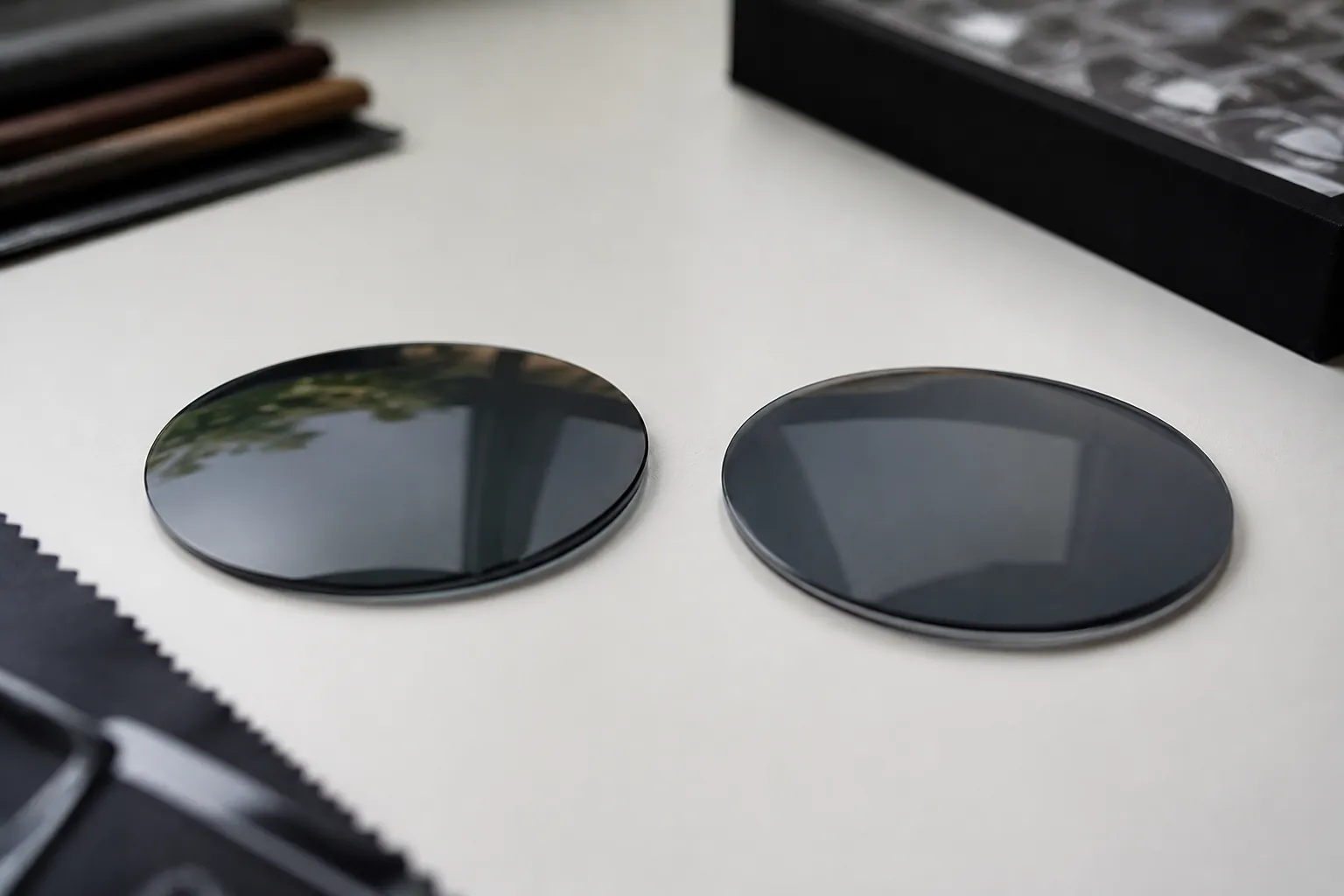
This guide is for brand owners, importers, distributors, and retailers sourcing custom sunglasses in volume. Lens thickness looks minor on a spec sheet. It is not. It affects perceived quality, weight, lens retention, breakage risk, tint appearance, production yield, and landed cost. In bulk programs, the wrong choice usually shows up later: cracked lenses, pop-out in transit, nose-heavy fit, or avoidable cost on price-sensitive SKUs. Start with the sales channel and frame geometry. Then match thickness to material, curvature, and compliance needs.
Start with channel and frame construction, not the lens catalog
A common sourcing mistake is choosing lens thickness after the frame is already approved. By then, the factory is trying to force the lens into a fixed eye wire, base curve, groove design, and visual target. That is where avoidable risk starts.
For OEM sunglass projects, confirm thickness only after four basics are clear: sales channel, retail target, frame size, and expected use conditions. A small promo frame for short-term event use does not need the same build logic as an oversized fashion style or a wrap sport frame for active wear.
- Fashion retail: edge appearance, tint consistency, and hand feel usually matter most. On medium to oversized fronts, buyers may want a fuller visible edge, especially with transparent injection frames or thicker acetate fronts.
- Promo / giveaway: target piece price usually drives the choice. The lens still needs stable assembly, acceptable cosmetic consistency, and enough rigidity to survive packing and export transit.
- Sport / active: impact behavior, retention, and low front weight usually matter more than a thick-looking edge. Here, material selection often matters more than adding a little thickness.
Thickness also has to match the frame build. Full-rim plastic fronts, acetate CNC-cut fronts, shield constructions, and wrapped sport geometries all place different demands on the lens edge. If the edge and groove do not match, problems follow: hard insertion, edge stress, weak retention, or cosmetic defects.
Good factories check thickness against the actual frame construction route. They do not treat it as a stand-alone catalog option. First it is a fit and process decision. Then it is a styling decision.
What lens thickness changes in production
Thickness changes more than side profile. In real production, it affects five things buyers should check: appearance, handling durability, weight, process stability, and tint or coating presentation.
1) Visual profile: On a large square, shield, or butterfly frame, a thin lens can look too light against a heavy front. A thicker lens can look more intentional at retail. On small frames, the same increase may add cost and weight with little visible gain.
2) Handling and transit durability: More thickness usually improves rigidity. But material still has a bigger effect on impact behavior and crack resistance. A properly specified polycarbonate lens may perform better in assembly and handling than a thicker low-cost brittle alternative.
3) Weight and fit: Added thickness increases front-end mass. On sport frames and fashion styles with limited nose support, that can worsen slipping if the frame balance is not adjusted too.
4) Process yield: Deep curves, sharp corners, oversized eye shapes, and shield lenses are more sensitive to warpage, edge stress, and insertion difficulty. Too thin, and the lens may deform during edging or assembly. Too thick, and insertion stress and rejection rates can rise.
5) Tint and coating consistency: Thickness can change how the lens reads at the edge, especially with dark solid tints, gradients, and mirror coatings. If the approved sample and bulk production do not match in thickness, the final look may not match either.
Practical rule: lens thickness is not just a styling spec. It affects retention, process control, and claim risk after shipment.
Planning ranges by program type and material
The exact number depends on material, lens size, base curve, and retention design. Buyers still need a planning range. Use the table below as a starting point for common custom sunglass programs, then validate against the actual frame and target market.
| Program type | Typical material | Common finished thickness | Typical use case | Main advantage | Main failure risk if mis-specified |
|---|---|---|---|---|---|
| Low-cost promo | Acrylic or entry PC | 1.0-1.2 mm | Event giveaways, low-price campaigns, simple retail packs | Lower material cost and light weight | Large shapes can flex, crack in packing, or feel underbuilt |
| Mass fashion retail | PC, TAC, CR-39 depending on design | 1.2-1.5 mm | Mid-range private label, chain retail, online fashion | Better side profile and more stable perceived quality | Extra weight and cost on smaller frames |
| Sport / active | PC preferred | 1.1-1.4 mm | Wrap styles, outdoor use, youth active | Good impact behavior with controlled weight | Wrong material choice creates more risk than thickness alone |
| Premium oversized fashion | PC or nylon-based lens | 1.5-1.8 mm | Large shields, oversized acetate, statement retail styles | Stronger edge presence and heavier premium feel | Nose-heavy fit, more visible tint variation, higher scrap cost |
These are not compliance guarantees. Final finished eyewear should be tested and documented for the destination market where relevant, such as CE EN ISO 12312-1, ANSI Z80.3, or AS/NZS 1067. Chemical compliance requirements such as REACH should also be confirmed where applicable.
Material behavior: what thickness can and cannot fix
Many buyers try to solve every durability concern by increasing thickness. That works only to a point. Material still controls impact behavior, brittleness, scratch resistance, optical quality, and how the lens behaves during edging and insertion.
Polycarbonate (PC): often the practical choice for sport, youth, and active programs. It is widely used where impact resistance, low weight, and wrapped geometry matter. In many OEM builds, PC can deliver reliable performance without an excessively thick section.
Acrylic: common in lower-cost promo programs because it is economical. It can work on smaller, simple frames, but it is less forgiving in demanding wrap shapes or higher-abuse use cases. On large frames, the cost saving may be erased by breakage, assembly difficulty, or claims.
CR-39 or similar optical-grade lens options: often chosen where visual clarity matters in fashion programs. They can be suitable, but the design still needs to be checked against intended use, edge design, and the required test route.
TAC polarized constructions: useful when polarization is part of the retail offer. But laminated constructions behave differently from single-material sun lenses. Thickness alone will not fix poor edge finishing, weak lamination quality, or bad frame fit.
Before bulk approval, ask the factory to confirm these points in writing:
- nominal lens thickness and acceptable tolerance
- base curve and finished eye size
- groove compatibility and insertion method
- tint method, mirror or hard-coat sequence, and cosmetic standard
- finished weight target per pair
- test route for the destination market
If these details stay vague at sample stage, thickness-related problems usually appear later as inconsistent bulk quality.
Where wrong thickness shows up after shipment
Bad thickness choices often pass desk review. Then they fail later in assembly, packing, transit, or first retail handling.
- Lens pop-out during shipping: often seen on oversized shapes where the lens edge does not match the groove closely enough. Compression in packing and movement in export transit can dislodge the lens.
- Visible flex and weak hand feel: common on low-cost promo styles pushed too thin for the frame size. Buyers notice this fast when checking the edge profile or lightly flexing the front.
- Stress whitening or edge cracking: often caused by forcing an over-thick or brittle lens into a frame with inconsistent groove dimensions or difficult assembly conditions.
- Nose-heavy fit and slipping: common when a brand wants a thick-lens premium look but does not rebalance frame design, nose support, or temple fit.
- Sample-to-bulk color difference: if the approved sample uses one thickness and bulk production uses another, tint or edge appearance may read differently in finished goods.
Good sampling prevents most of this. If the frame is large, highly curved, transparent, or shield-based, ask for two thickness options side by side. That comparison inside the actual frame is usually more useful than a stand-alone lens spec sheet.
Also watch decoration timing. Once logo plates, pad printing, hot stamping, laser engraving, or custom temple details are approved, changing the lens specification can trigger more sampling, rebalancing, or part replacement.
How thickness affects MOQ, price, and lead time
Thickness is not always the biggest cost driver, but it is one of the easiest places to over-specify. A thicker lens can mean more raw material, harder finishing on some shapes, and more rejection if frame-to-lens fit is not controlled well.
Use simple quoting logic by order size:
- At 50 pairs per design: development efficiency may matter more than material optimization. For very small orders, a custom lens build is worth it only if the margin or brand position supports it.
- At 300 pairs: standard thickness choices start to matter commercially. Staying inside a factory's proven construction range can reduce rework and simplify QC.
- At 1,000-5,000+ pairs: small per-pair differences become meaningful. At this scale, thickness, yield, and coating consistency can change total program cost in a visible way.
Lead-time impact is usually moderate on standard programs. Special builds can slow approval. Extra review is more likely when the build includes:
- oversized shields
- heavier lens sections above 1.5 mm
- mirror coatings with strict cosmetic standards
- dark gradients matched to an approved standard
- tight weight targets on sport frames
If launch timing is fixed, the safer commercial route is to use a thickness already validated on a similar frame family. Buyers should also ask whether the supplier works under systems such as ISO 9001 or social compliance audits such as BSCI, and whether any FDA registration requirement is relevant for the planned market route or product classification. Those points do not replace product testing. They do help show supplier readiness and documentation discipline.
A buyer workflow that cuts claims and rework
The best buyers use a short approval sequence and ask the factory direct technical questions before mass production. Keep it simple.
- Define the channel and target price. State whether the program is promo, mass fashion, premium fashion, or active sport, and give the expected retail or landed target.
- Confirm frame geometry. Eye size, front thickness, base curve, groove design, and retention style should be settled before final lens approval.
- Choose material first. For active use, PC is often the starting point. For low-cost promo, test whether acrylic still gives acceptable performance for the real frame size and packing method.
- Review two thicknesses on risky shapes. This matters most on large squares, wraps, shields, and transparent frames where edge appearance is visible.
- Request exact sample data. Ask for nominal thickness, tolerance, finished pair weight, lens category or transmittance result where relevant, and side-profile photos of the finished sample.
- Test the packed unit. A style can survive sample handling and still fail in export packing if the inner pack, bag pressure, or carton stacking method is weak.
- Lock the golden sample. Record material, thickness, tint, coating, logo method, packaging, and approved market test route before bulk starts.
For compliance, thickness is never a substitute for testing. The final finished sunglass should be checked against the standard and market route required by the buyer, such as CE EN ISO 12312-1, ANSI Z80.3, or AS/NZS 1067 where applicable, along with REACH for chemical restrictions when required.
Best buying rule: choose the thinnest lens that still meets the real channel, frame size, retention needs, and transit conditions without looking underbuilt.
That is the whole idea. Many failed programs come from using sport logic on fashion frames or promo cost logic on oversized retail styles. Get the channel right. Sample early. Then thickness becomes a controlled sourcing choice instead of a late-stage quality problem.
Have a custom sunglasses project in mind?
Send us your styles, target market and quantities and we will return a detailed quote with MOQ, lead time and a sample plan.
Get a QuoteWhy source this from Wenzhou with LumiShades
Wenzhou in Zhejiang Province is widely regarded as China’s eyewear manufacturing capital, producing a large share of the world’s sunglasses. That concentration matters to buyers: a deep local supply chain for acetate sheet, hinges, lens blanks, plating and packaging means shorter component lead times, easier color and material matching, and a workforce with decades of eyewear-specific skill. LumiShades has manufactured in this ecosystem since 2009, and our vertical integration — in-house injection molding, acetate cutting, CNC milling, lens tinting, decoration and quality control — means no part of your order is quietly subcontracted to a workshop you cannot audit.
For international buyers, that vertical control translates into accountability. When a single factory owns every step, defects are traced and fixed at source rather than bounced between vendors, and your specifications survive intact from first sample to bulk. We back this with 15+ years of experience, shipments to 60+ countries, more than 5 million pairs produced per year and a 98.5% on-time delivery rate. Our certifications — CE EN ISO 12312-1, FDA registration, ANSI Z80.3, AS/NZS 1067, REACH, ISO 9001 and BSCI audit — mean the compliance documentation your market requires already exists. Explore our manufacturing capabilities and quality control process to see how this works in practice.
Frequently asked questions
Is a thicker sunglass lens always more durable? No. Thickness can improve rigidity, but durability depends heavily on material, frame fit, edge design, and intended use. A properly specified polycarbonate lens, for example, may handle assembly stress and impact better than a thicker acrylic lens. Ask the factory to confirm the material, nominal thickness, edge design, and intended compliance route before approval. If the product is for active or youth use, review a sample in the final frame rather than judging the lens alone.
What lens thickness is usually safest for a low-cost promo order? For many simple promo styles, 1.0-1.2 mm is a reasonable starting range. It often works for small to medium frames with basic geometry and controlled packing. But if the style is oversized, highly curved, transparent, or meant for tighter retail presentation, ask the factory to compare at least two thickness options in the actual frame. Also confirm whether the lens is acrylic or entry-level PC, because the material can change the risk more than a small thickness difference.
Can I standardize one lens thickness across a whole collection? You can, but it is often inefficient. Small round frames, oversized squares, shields, and wrap sport styles place different demands on retention, weight, and edge appearance. One thickness may simplify purchasing while creating avoidable fit, appearance, or yield problems on several SKUs. A better approach is to standardize by frame family, such as one thickness for small promo frames, one for medium fashion frames, and one for shields or wraps. Ask the supplier to map thickness by eye size, base curve, and material before finalizing the line.
Does thicker lens construction increase lead time? Usually not by itself on standard builds, but it can add approval time when combined with difficult shapes or demanding finishes. Oversized shields, mirror coatings, dark gradients, and tightly controlled weight targets are more likely to require another sample round or closer quality review. To avoid delay, confirm early whether the requested thickness is already proven on a similar frame construction and ask the factory to state any extra sampling or QC steps in advance.
What should I ask the factory to confirm before approving thickness? Ask for a written specification covering: exact lens material, nominal thickness and tolerance, eye size, base curve, frame groove compatibility, insertion method, finished pair weight, tint or mirror process, cosmetic acceptance standard, packing method, and the required compliance path for your market. Where relevant, confirm testing against CE EN ISO 12312-1, ANSI Z80.3, or AS/NZS 1067, and ask about REACH compliance for restricted substances. On the supplier side, it is also reasonable to ask whether the factory operates under ISO 9001, has BSCI audit status, or holds any applicable FDA registration. Then lock those details against the approved golden sample before bulk production starts.
Ready to start?
Explore our square sunglasses or request a quote — our sales team replies within 12 hours.
Request a Quote