
OEM vs ODM Sunglasses: Speed, Margin, and Control
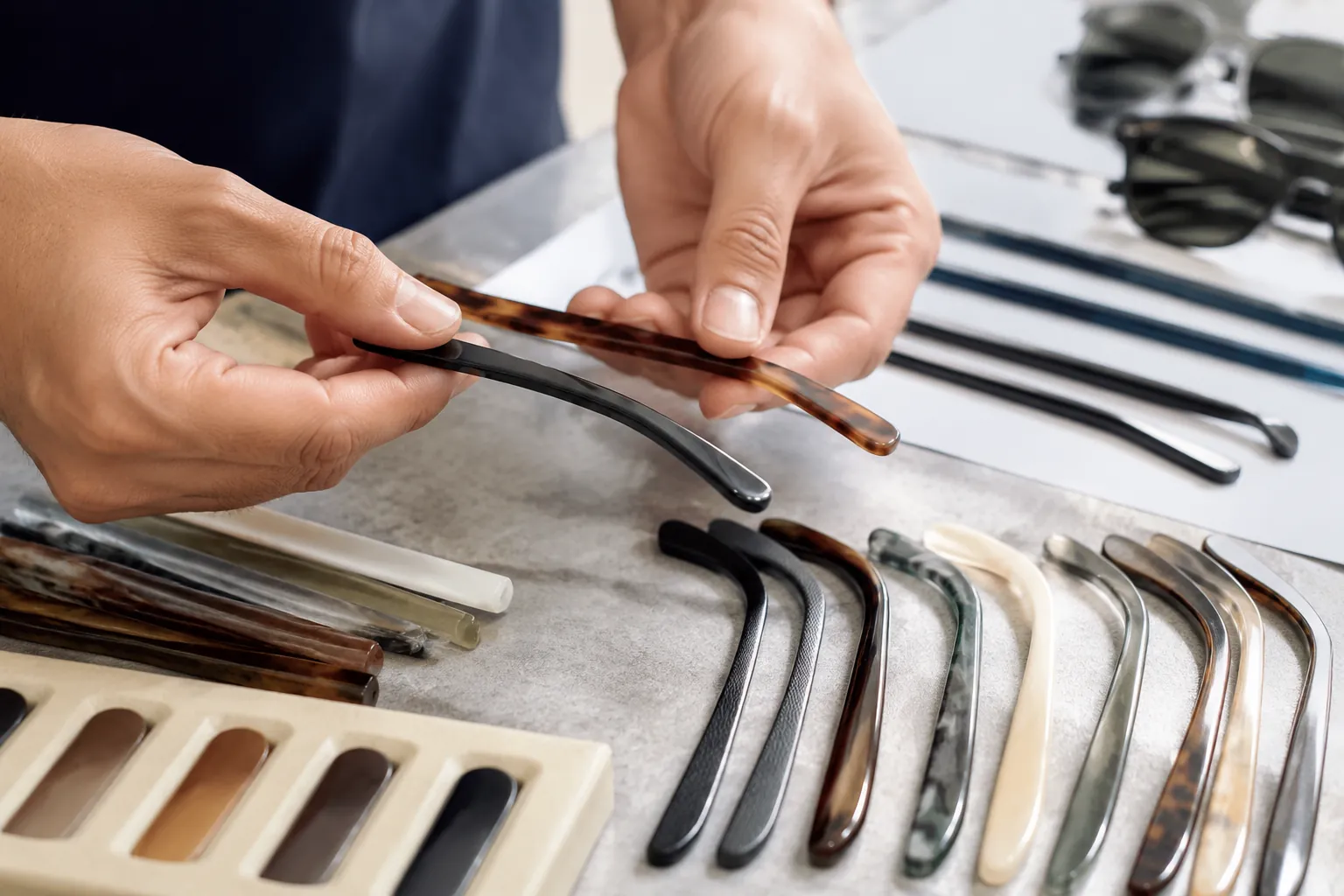
This guide is for brand owners, importers, distributors, and retailers buying sunglasses in volume. The choice is not simply custom versus ready-made. It is a trade-off between product control, development cost, and launch speed. That choice affects tooling, sample rounds, MOQ, compliance work, and whether future production matches the approved sample. Decide early. You cut avoidable cost, protect margin, and make reorders easier to manage.
Start With the Commercial Decision, Not the Sketch
Many buyers start with a reference photo and ask whether the factory can copy the shape. Wrong first question. Start here instead: what must be unique, and what can stay standard?
ODM means you begin with an existing factory model. The mold or production setup already exists. Hinge position, lens groove, and basic structure have usually been run before. That lets the supplier move faster into frame color, lens tint, logo application, and packaging. OEM means the core product specification is built for your program. That may involve a new front curve, custom temple geometry, different bridge fit, special metal ornament, new acetate lamination, or a lens shape that needs a new cutting program or mold.
For most B2B buyers, the decision comes down to four variables:
- Launch speed: ODM is usually faster because it avoids new mold development and structural validation. OEM takes longer because drawings, prototypes, corrections, and pre-production approval come first.
- Upfront cost: ODM often avoids mold charges. OEM may add tooling, CAD work, prototype correction, and extra sample rounds before bulk approval.
- Differentiation: OEM gives more control over eye size, bridge width, temple length, wrap angle, decoration structure, and material selection.
- Reorder control: OEM can reduce direct style overlap and improve long-term spec ownership, but only if the tech pack, tolerances, and approved sample set are documented properly.
A simple sourcing rule helps. If most of the product already exists and you mainly need branding, color, and packaging changes, ODM is usually the better business choice. If the shape itself is part of the brand asset or fit requirement, OEM is easier to justify. This matters even more on smaller orders, where development cost is harder to absorb.
Use This Framework to Choose OEM or ODM
| Buying situation | Better fit | Typical timing | Why | Trade-off |
|---|---|---|---|---|
| You need a seasonal launch fast | ODM | Shorter sample and production cycle | Existing molds remove the slowest development step | Less shape exclusivity |
| You are testing a new price point or channel | ODM | Lower setup, faster approval | Lower cash risk on trial quantities | Base structure may be shared with other buyers |
| You need a signature fit or silhouette | OEM | Longer development before bulk | Custom geometry, trim, dimensions, and material stack | Higher tooling and engineering cost |
| You expect repeat orders over multiple seasons | OEM | Slower first order, more controlled repeats | Better long-term control over spec continuity and overlap risk | More work up front |
| You only need logo, lens tint, frame color, and packaging | ODM | Fastest path | No clear business reason to pay for new tooling | Architecture stays standard |
| You need unusual wrap angle, lens size, or youth fit | OEM | Extra fit validation required | Technical changes often require new tooling or revised CNC programs | More approval rounds |
The cost logic is similar. ODM usually wins on first-order simplicity because there is little or no mold charge and the sample cycle is shorter. OEM can become the better margin decision later if the style repeats often enough to absorb tooling and if the custom shape supports stronger pricing power or channel protection.
MOQ is not one fixed number. It depends on frame material, lens type, decoration method, packaging complexity, and whether the supplier is using open-line stock components or making parts specifically for your order. Ask for MOQ by SKU, by color, and by packaging configuration. Do not rely on one factory-wide figure.
Where the Time Goes in an ODM Launch
Buyers choose ODM for one main reason: speed. More specifically, it removes the slowest and most failure-prone part of development: validating a new core structure.
- Model selection: The buyer reviews existing shapes, materials, dimensions, and hinge structures. Check eye size, bridge width, temple length, front width, and whether the frame is injection plastic, acetate, metal, or combination construction.
- Customization brief: The factory confirms frame color, lens color, logo method, finish, barcode labels, pouch, box, and carton mark details.
- Sampling: Samples are prepared using the chosen base model and the requested customization scope.
- Approval: The buyer checks branding position, lens appearance, weight, fit balance, surface finish, labeling, and packaging execution.
- Bulk production: Production starts after sample approval, artwork confirmation, packaging confirmation, and commercial sign-off.
Because the mold or production platform already exists, the factory is less likely to be solving first-time structural issues during your order. Think poor lens seating, visible sink, hinge pull-out, or temple imbalance. That matters in injection styles, where wall thickness, draft angle, and cooling behavior affect consistency. It matters in acetate too, where a proven front shape can reduce unnecessary hand correction during polishing and assembly.
ODM works especially well for buyers who only need controlled customization:
- Decoration: Pad print, laser marking on suitable surfaces, or metal logo application depending on the base construction.
- Lens options: Smoke, brown, green, mirrored, gradient, polarized TAC, or PC depending on the performance target and price point.
- Surface finish: Gloss, matte, transparent colors, demi effects, or soft-touch coatings where suitable.
- Packaging: Polybag, microfiber pouch, foldable case, gift box, barcode sticker, and export carton marking.
Compliance handling can also be simpler on a stable ODM platform because fewer structural variables are changing. That does not remove the need to confirm the exact finished specification. It does reduce the chance that a design change creates an avoidable test failure later.
What OEM Buys You Beyond a New Shape
OEM matters when the product itself is the differentiator, not just the branding. The value is not only visual uniqueness. It is control over fit, material behavior, trim execution, and repeatability.
In injection styles, small geometry decisions change both appearance and production stability. Front thickness, temple wall thickness, draft angle, bridge reinforcement, and lens groove depth all affect molding performance and assembly yield. If a temple wall is too thin, it may warp. If the groove design is too shallow, lens insertion becomes inconsistent. If hinge placement is off, the frame may not sit square after assembly.
In acetate programs, the details change but the discipline does not. CNC path accuracy affects lens opening consistency. Lamination quality affects edge appearance. Polishing allowance determines whether sharp lines stay crisp or become rounded. Hinge slot precision affects alignment and opening feel. A rendering can look clean and still become expensive in bulk if the machining path is inefficient or the front thickness creates unnecessary scrap.
Fit is another strong reason to choose OEM. Small dimensional changes in bridge width, eye size, temple length, or frame angle can decide whether a style works for youth retail, sports use, travel retail, or a fashion customer. Buyers often miss this. A standard open-line frame may look close to the target concept while failing on actual wearability or target demographics.
OEM usually makes sense when one or more of these conditions apply:
- The shape is a brand asset: You want to reduce direct open-line overlap.
- The fit must be controlled: Youth sizing, wrap fit, or a narrow-bridge target requires custom geometry.
- The style will repeat: Repeat volume can recover tooling and development cost across later orders.
- The trim matters: Custom metal parts, embedded logos, or unusual temple construction cannot be handled well through basic ODM modification.
The trade-off is time and process discipline. OEM often requires CAD confirmation, prototype review, correction, pre-production sample approval, and only then bulk release. The first launch is slower. If the product is commercially strong, later reorders are often easier to control because the specification was defined more precisely at the start.
Cost, MOQ, and Margin: Model the Full Program, Not One PO
Buyers make bad sourcing decisions when they compare OEM and ODM only on ex-works unit price. Use a wider view. Compare total development cost across the first launch and the likely reorder cycle.
For a small test order, ODM is usually the safer financial choice because the market has not yet proved the concept. Extra spend on mold work, repeated prototypes, and engineering review can erode margin before demand is validated.
Once the style shows repeat potential, the logic changes. A custom program may be easier to justify if it supports a better retail price, cleaner replenishment, reduced overlap, or a more reliable fit for the target customer. The right answer depends on order frequency, SKU life, packaging requirements, and how much of the product cost sits in the frame, lens, decoration, and pack-out.
Serious buyers should ask for a costed breakdown, even if the supplier does not share a fully open worksheet. At minimum, separate these components:
- Frame cost: Material, molding or machining, assembly, and finishing.
- Lens cost: TAC, PC, polarization, mirror, gradient, coating, and thickness effects.
- Branding cost: Pad print, laser, hot foil where applicable, metal badge, or embedded decoration.
- Packaging cost: Pouch, box, insert card, barcode, and carton specification.
- One-time charges: Mold, logo tooling, sampling, or development fee.
Decoration choice also affects both cost and reject risk. Pad printing is economical, but durability depends on the ink system, surface preparation, and curing process. Laser marking is durable, but only reads well on suitable materials and colors. Metal logo plates feel premium, but they add assembly steps and alignment risk. Mirror lenses and special coatings may improve shelf appeal in the right channel, but they also raise approval complexity and may require tighter scratch and appearance inspection.
Compliance, Materials, and Tolerances Can Force the Route
Compliance is not a final paperwork task. It is part of product definition. Lens category, frame material, decoration chemistry, and labeling all affect whether an ODM platform still works or whether OEM is needed.
If you sell across multiple markets, confirm the finished product against the relevant requirements. Do not assume one document covers every variation. Common standards and credentials discussed in sunglass sourcing include CE EN ISO 12312-1, ANSI Z80.3, AS/NZS 1067, REACH, FDA registration where applicable, ISO 9001, and BSCI. The point is simple: changes to the finished specification can matter.
For example, changing only logo placement on an existing ODM frame is usually lower risk than changing lens material, visible light transmission category, coating type, base curve, frame resin, or soft-touch coating. The same applies if you change adhesives, inks, or decorative parts that affect regulated materials lists or labeling requirements.
Ask technical questions early. Get the answers in writing:
- Lens material: Is the lens TAC, PC, or another specified material?
- UV performance: What is the finished-lens UV result and what test record supports it?
- Tint category: Does the selected tint and transmission range fit the target market and intended use?
- Surface chemistry: Are inks, coatings, and adhesives appropriate for destination-market requirements?
- Tolerance control: What dimensional variation is accepted on eye size, bridge, temple length, weight, and lens thickness?
Even for ODM, ask how the factory controls key dimensions and appearance standards. A capable supplier should be able to define fit-critical tolerances, color acceptance standards, and what counts as acceptable difference between the approved sample and bulk. Many reorder problems are not major failures. They are small drifts that build into retailer complaints.
How to Keep Reorders Under Control
The first order gets the attention. Reorders reveal whether the sourcing program is actually stable.
With ODM, the main mistake is assuming the model will never change. A factory may update a hinge supplier, resin lot, temple core, mold insert, or lens source. Any one change may be manageable. Not if it happens without a documented approval standard. Keep a signed approval file that includes dimensions, target weight range, lens specification, visible lens appearance, finish reference, logo location, packaging details, labeling details, and carton standard. Also confirm whether the frame is a standard open-line style or whether any exclusivity applies.
With OEM, the risk is different. Buyers often assume that a custom mold guarantees consistency. It does not. If the tech pack is weak, the supplier may still interpret details differently from run to run. A proper OEM control file should include dimensional drawing, tolerance bands, hinge specification, material callout, lens insertion method, artwork placement, approved colors, packaging details, and golden samples retained by both buyer and factory.
| Control point | ODM priority | OEM priority | Why it matters |
|---|---|---|---|
| Dimensions and weight | Confirm sample-to-bulk match | Define tolerance bands in tech pack | Small fit drift creates retailer complaints |
| Materials | Track resin and lens source changes | Lock exact material callouts | Material substitution affects feel, color, and compliance |
| Branding and finish | Approve position and surface look | Approve artwork method and construction detail | Premium perception depends on consistency |
| Lead time planning | Confirm standard production window | Confirm mold availability and repeat scheduling | Peak-season capacity affects replenishment reliability |
Operational capacity matters too. On-time delivery performance, annual output, and peak-season allocation affect reorder reliability as much as product design. Ask how repeat colors, acetate patterns, or polarized lens materials are booked, and whether raw material reservation is required before the next season. Without strong documentation, a reorder turns into a new project.
A Practical Path for New Brands, Importers, Distributors, and Chains
Different buyer types should not enter the process the same way. A new brand testing demand should not carry the same development burden as a chain retailer planning a core line.
| Buyer type | Best starting route | Why | Next step if the style works |
|---|---|---|---|
| New brand | ODM | Lower cash exposure and faster market test | Move the best seller into an OEM variant later |
| Importer | ODM or light OEM | Needs assortment breadth and replenishment speed | Reserve high-volume shapes with exclusive details |
| Distributor | ODM | Broad line coverage matters more than unique molds | Use OEM only for proven account-specific winners |
| Retail chain | ODM for seasonal, OEM for core | Fast campaigns need speed while core programs need continuity | Split sourcing strategy by category and volume |
A staged sourcing path works well for many overseas buyers. Start with an ODM frame. Customize lens tint, branding, and packaging. Then measure sell-through, return rate, complaint pattern, and reorder speed. If the style proves itself, convert the next generation into OEM by improving the fit, refining the trim, adjusting the shape, or upgrading the material package. This approach protects cash on the first launch while creating a clear path to stronger margin and better control later.
The common mistake is choosing OEM too early for a concept that has not earned the investment, or staying with ODM too long once a high-volume product deserves stronger protection. Good sourcing is not ideological. It is commercial, technical, and documented.
Have a custom sunglasses project in mind?
Send us your styles, target market and quantities and we will return a detailed quote with MOQ, lead time and a sample plan.
Get a QuoteWhy source this from Wenzhou with LumiShades
Wenzhou in Zhejiang Province is widely regarded as China’s eyewear manufacturing capital, producing a large share of the world’s sunglasses. That concentration matters to buyers: a deep local supply chain for acetate sheet, hinges, lens blanks, plating and packaging means shorter component lead times, easier color and material matching, and a workforce with decades of eyewear-specific skill. LumiShades has manufactured in this ecosystem since 2009, and our vertical integration — in-house injection molding, acetate cutting, CNC milling, lens tinting, decoration and quality control — means no part of your order is quietly subcontracted to a workshop you cannot audit.
For international buyers, that vertical control translates into accountability. When a single factory owns every step, defects are traced and fixed at source rather than bounced between vendors, and your specifications survive intact from first sample to bulk. We back this with 15+ years of experience, shipments to 60+ countries, more than 5 million pairs produced per year and a 98.5% on-time delivery rate. Our certifications — CE EN ISO 12312-1, FDA registration, ANSI Z80.3, AS/NZS 1067, REACH, ISO 9001 and BSCI audit — mean the compliance documentation your market requires already exists. Explore our manufacturing capabilities and quality control process to see how this works in practice.
Frequently asked questions
What is the fastest route if I need a private-label sunglass launch in under six weeks? ODM is usually the most realistic route because it starts from an existing factory model rather than a new product structure. To judge whether the timeline is credible, ask the supplier for four dated milestones in writing: sample completion, sample approval deadline, bulk production window, and shipping handover date. Also confirm that logo artwork, packaging files, lens specification, and deposit timing will not delay release. If any of those items are still open, the schedule can slip even on an ODM program.
At what order size does OEM usually start to make financial sense? There is no universal volume threshold. It depends on tooling cost, material choice, expected reorder frequency, and whether the custom shape supports a higher selling price or better channel protection. A practical approach is to compare two scenarios: first, the total landed cost of using ODM now; second, the total cost of OEM across the initial order plus the next likely reorder. Ask the supplier to separate one-time development charges from recurring unit cost so you can see how quickly the custom program pays back.
Can I still customize a lot with ODM sunglasses? Yes, but the customization is usually commercial rather than structural. You can often change frame color, lens tint, finish, logo method, packaging, labels, and some trim details while keeping the original mold and main frame architecture. Before approving an ODM model, ask the factory to confirm exactly which items are fixed and which can be changed without creating new tooling, new compliance work, or a different MOQ.
How do I protect reorder consistency on an ODM model? Keep a control file, not just an approved sample. At minimum, retain the approved sample, a dimension sheet, lens material and tint details, branding position, finish reference, packaging spec, labeling spec, and carton requirements. Ask the factory to confirm whether the style is open-line or reserved, and require written notice before any change to hinge source, resin, lens supplier, coating, or decoration process. If possible, agree on a pre-shipment check against the golden sample for repeat orders.
Do certifications automatically transfer if I change lens or frame specifications? No. A meaningful change to lens material, visible light transmission category, geometry, coating, frame resin, surface treatment, or decoration chemistry can affect whether prior test results or documentation still apply. Treat compliance review as a finished-product question, not a generic factory claim. For the markets you serve, ask the supplier which records support the exact final specification and whether additional testing or document updates are needed for standards such as CE EN ISO 12312-1, ANSI Z80.3, AS/NZS 1067, REACH, or FDA registration where applicable.
Ready to start?
Explore our wayfarer sunglasses or request a quote — our sales team replies within 12 hours.
Request a Quote