
Custom Sunglasses Packaging That Protects Margin
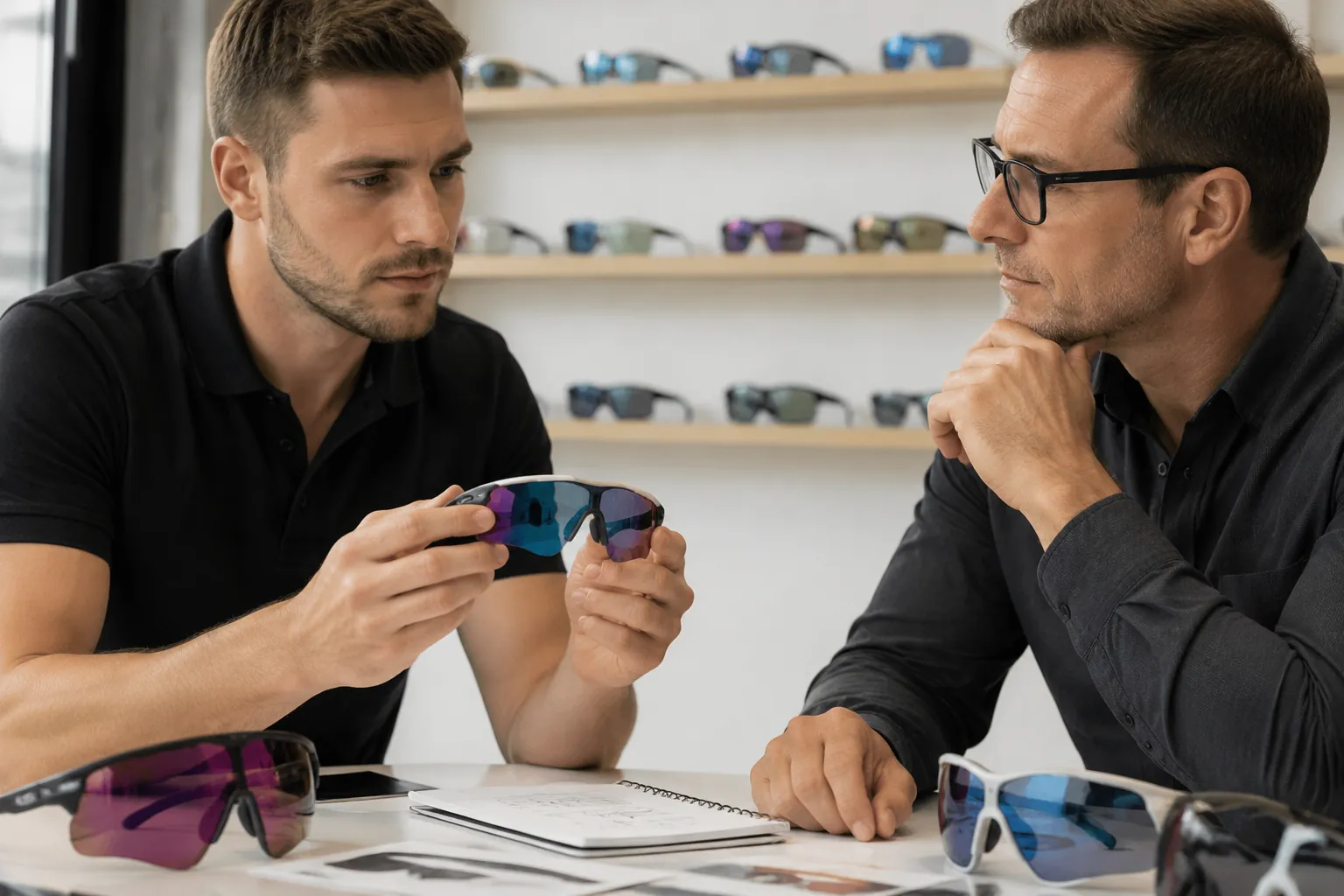
This guide is for brand owners, importers, distributors, and retailers buying custom sunglasses in volume. The goal is simple: build packaging that protects the product, supports the brand, and does not quietly eat margin. Packaging is one of the easiest places to overspend because small upgrades stack up fast. A disciplined packaging system keeps cost, lead time, freight, and presentation under control.
Start With a Packaging Budget, Not a Mood Board
Most buyers make the same mistake first. They choose the case by appearance, then try to force the unit cost to work later. That usually ends with margin erosion or a rushed downgrade after sampling. Start the other way around. Set your target landed packaging cost per pair before artwork starts.
For mid-volume custom sunglasses, a practical packaging budget usually falls into three bands:
- Entry commercial program: microfiber pouch plus branded outer carton or polybag label, built to keep packaging spend lean.
- Core retail program: folding paper box plus pouch, or pouch plus EVA case, where shelf presentation matters but freight efficiency still matters too.
- Gift or premium program: rigid box, molded case, cleaning cloth, insert card, and more decoration steps. It looks better. It also costs more, takes more room, and adds handling time.
Use a simple rule: if the retail value does not support the packaging, cut it back. A $2.10 high-volume frame does not need a heavy rigid gift box unless the brand has already proved that presentation lifts sell-through enough to pay for it. For many importers and distributors, the right answer is a two-layer system: a protective inner pack for transit and a modest branded presentation pack for the customer.
LumiShades can make the sunglasses and control decoration in-house, including laser engraving, pad printing, and metal logo plates. That matters because packaging should match the product decoration level. A basic printed temple logo paired with an expensive magnetic box looks off. Buyers notice that. After the invoice is paid.
Choose the Pack by Sales Channel
The right packaging for e-commerce is often the wrong packaging for wholesale retail. Both may be wrong for promotional distribution. The sales channel should drive the structure.
| Packaging Format | Best Use | Typical Cost Effect | Lead-Time Effect | Main Trade-Off |
|---|---|---|---|---|
| Microfiber pouch | Promotional orders, lean private label, replacement stock | Lowest packaging cost | Fastest to approve and produce | Weak crush protection unless paired with stronger master carton setup |
| EVA zipper case | E-commerce, travel, sports styles | Moderate increase per pair | Usually adds sourcing and approval steps | Bulkier carton volume and higher freight cost |
| Folding paper box | Retail shelf display, optical chains, distributors | Moderate cost, efficient for printing | Reasonable if artwork is locked early | Limited impact resistance by itself |
| Rigid gift box | Premium launches, gifting, high perceived value programs | Highest packaging cost | Often longest due to handwork and finishing | Consumes margin fast and raises carton cube |
If the order ships mostly by courier direct to consumers, focus on compression resistance and scratch prevention. If the order ships on pallets to retail stores, shelf appearance and barcode placement matter more. For promotional sunglasses handed out at events, keep it simple. The buyer is paying for logo exposure, not a collector box.
Channel also affects return risk. A thin carton that looks fine on the factory table may arrive dented after parcel handling. That does not mean you need a premium box. It means you need the right board weight and the right shipper configuration.
What Each Packaging Layer Is Actually Doing
Separate packaging into functions. Each layer has a job. Once you do that, over-specification gets easier to spot.
- Primary contact layer: usually a polybag, tissue, or microfiber pouch. Its job is to prevent lens and frame scuffing.
- Protective pack: EVA case, paper box, or inner support. Its job is shape retention and impact resistance.
- Brand layer: printed carton, sticker, belly band, insert card, or logo plate. Its job is presentation and product information.
- Transit layer: inner carton and export master carton. Its job is surviving stacking, compression, and container movement.
These jobs should not be mixed up. A nice rigid box does not automatically protect lenses if the sunglasses move inside it. A microfiber pouch looks premium enough for some brands, but it does not stop temple pressure marks in a badly packed master carton. Buyers often try to make one package do all four jobs. That is where cost goes sideways.
Frame material matters too. Injection-molded sunglasses usually tolerate handling better than polished acetate styles, which can show rub marks more easily. Acetate also tends to justify better internal protection because the finish is part of the value. If the style includes metal logo plates or sharp temple hardware, make sure the packaging prevents contact with the lens front during transit.
Print and Decoration: Spend Where the Eye Lands First
Print treatments are cheap one by one and expensive in combination. Pick one or two visible branding points and keep the rest clean.
Common packaging decoration choices include one-color logo print, two-color offset print, foil stamping, embossing, debossing, inside print, spot UV, woven labels on pouches, and molded logos on cases. Not all of these belong on the same item.
- For microfiber pouches: one-color screen print is usually enough. Keep the logo away from the fold line or drawstring area.
- For folding cartons: standard offset print handles multi-color branding well. Matte lamination hides minor scuffs better than gloss in many retail programs.
- For rigid boxes: foil and embossing can look good, but they add setup steps and reject risk if registration is off.
- For EVA cases: molded badges, woven labels, or simple heat-transfer logos are usually more practical than complex print.
Ask for decoration position drawings before approval. A logo that looks centered on flat artwork can land awkwardly once the pouch is sewn or the carton is folded. Small misalignment is common because these are separate processes from frame production. Control it with approval checkpoints. Not assumptions.
If the sunglasses themselves already carry laser engraving or pad printing, let that do some of the branding work. Packaging does not need to carry every message. Put legal and care information on an insert or carton panel, not across the hero surface.
Compliance and Label Content: Keep It Accurate
Packaging is not just decoration. It is also where buyers create compliance problems by printing claims loosely. If the sunglasses are being sold into regulated markets, product claims on packaging must match the documentation behind the order.
For LumiShades, the relevant product and system certifications buyers can reference where appropriate are CE EN ISO 12312-1, FDA registration, ANSI Z80.3, AS/NZS 1067, REACH, ISO 9001, and BSCI. Use them correctly. Do not print standards or market claims on packaging unless they apply to the product version being shipped and the importer has the file set to support it.
At minimum, review these packaging content points before mass production:
- SKU or model reference matches the production order.
- Barcode format and placement are confirmed for the retail channel.
- Country-of-origin marking is correct for the destination market.
- Lens category or warning text, if required for the market, is checked against the tested lens specification.
- Material or disposal marks are added only if accurate for the packaging components.
Keep artwork control tight. One approved PDF should be tied to one SKU revision. Mixing old inserts, old cartons, and new lens specs is how importers end up relabeling stock in the warehouse. That is wasted labor. And avoidable delay.
Lead Time and MOQ: Packaging Can Be the Bottleneck
Buyers usually focus on frame production timing and forget that packaging approvals can hold the order. LumiShades can provide samples in 7 to 10 days and bulk production in about 25 to 35 days, but that only works smoothly if packaging decisions are locked early enough. The sunglasses may be ready while the cartons are still waiting on revised artwork.
Here is the sequence that keeps the line moving:
- Approve frame and lens specification first.
- Choose packaging structure at the same time as product decoration, not after.
- Confirm packaging dimensions from the actual folded frame size.
- Approve dieline and logo position.
- Make one full packaging mockup if the order uses multiple components.
- Release bulk only after the final approved sample matches all components.
MOQ logic matters as well. LumiShades can start custom sunglasses from 50 pairs per design, but packaging economics improve at higher breaks just like product pricing does. Unit price usually gets better around 300, 1000, and 5000+ pieces because setup cost is spread wider, especially for printed cartons, custom cases, and multi-step decoration. A buyer forcing very low-volume custom packaging on top of a 50-pair frame order should expect a poor cost structure. That is normal.
Bluntly: if the volume is small, keep packaging modular. Use a standard pouch size, a shared carton format, and only change the print where the customer will actually notice it.
How to Cut Cost Without Making the Pack Look Cheap
There are smart savings, and there are false savings. Smart savings remove waste that the end customer does not value. False savings create damage, rework, or a weak first impression.
The easiest cost reductions usually come from these changes:
- Use one standard case or pouch size across several frame styles if fit is acceptable.
- Print one exterior color instead of full-color inside-and-out decoration.
- Replace rigid boxes with folding cartons for programs shipped in volume.
- Reduce unnecessary inserts and put care text on the carton.
- Optimize master carton pack quantity to improve container utilization.
What should not be cut first? Lens protection, carton strength, and fit. If temples press the lenses inside the package, you will pay for it in returns. If the master carton board is too weak, the bottom layers can crush in container stacks. If the sunglasses rattle inside a gift box, the whole pack feels badly made even if the frame itself is fine.
Ask the factory for packed-drop and compression common-sense checks, especially for e-commerce programs. You do not need a theatrical test protocol for every order, but you do need to know whether the chosen pack survives normal handling. Factories with in-house QC tend to catch these issues earlier because product packing can be checked alongside final inspection instead of being treated as an afterthought.
A Practical Packaging Brief Buyers Can Use
The fastest way to get usable quotations is to send a packaging brief that answers real production questions. Most delays come from vague requests like "premium box" or "simple pouch." Those terms mean nothing on a factory floor.
Your brief should include:
- Frame dimensions when folded and whether the style is injection, acetate, or metal-accented.
- Sales channel: retail shelf, distributor, e-commerce, or promotional giveaway.
- Target packaging cost per pair.
- Required components: pouch, case, carton, insert, barcode label, outer sticker.
- Branding method on each component.
- Destination market and any required compliance text tied to CE EN ISO 12312-1, ANSI Z80.3, AS/NZS 1067, FDA registration context, or REACH-related material expectations where relevant.
- Order quantity by color and by SKU.
- Need-by ship date, not just PO date.
With a supplier like LumiShades that handles injection molding, acetate cutting, CNC milling, lens tinting, decoration, and QC in-house, buyers can coordinate product and packaging decisions with one project flow instead of splitting them across multiple vendors. That reduces handoff risk. It does not remove the need for discipline. The buyer still needs one approved spec, one artwork file set, and one sign-off path.
Good packaging does three things at once: it protects the sunglasses, presents the brand clearly, and stays inside the cost structure that keeps the order worth doing.
Have a custom sunglasses project in mind?
Send us your styles, target market and quantities and we will return a detailed quote with MOQ, lead time and a sample plan.
Get a QuoteWhy source this from Wenzhou with LumiShades
Wenzhou in Zhejiang Province is widely regarded as China’s eyewear manufacturing capital, producing a large share of the world’s sunglasses. That concentration matters to buyers: a deep local supply chain for acetate sheet, hinges, lens blanks, plating and packaging means shorter component lead times, easier color and material matching, and a workforce with decades of eyewear-specific skill. LumiShades has manufactured in this ecosystem since 2009, and our vertical integration — in-house injection molding, acetate cutting, CNC milling, lens tinting, decoration and quality control — means no part of your order is quietly subcontracted to a workshop you cannot audit.
For international buyers, that vertical control translates into accountability. When a single factory owns every step, defects are traced and fixed at source rather than bounced between vendors, and your specifications survive intact from first sample to bulk. We back this with 15+ years of experience, shipments to 60+ countries, more than 5 million pairs produced per year and a 98.5% on-time delivery rate. Our certifications — CE EN ISO 12312-1, FDA registration, ANSI Z80.3, AS/NZS 1067, REACH, ISO 9001 and BSCI audit — mean the compliance documentation your market requires already exists. Explore our manufacturing capabilities and quality control process to see how this works in practice.
Frequently asked questions
Should I use a hard case for every custom sunglasses order? No. Hard cases make sense for e-commerce, sports styles, travel use, or higher-value acetate frames. For promotional, wholesale, or cost-sensitive programs, a microfiber pouch or folding carton is often enough if the master carton setup is solid.
What is the biggest hidden packaging cost in sunglasses orders? Carton volume. A bulky case or rigid box can raise freight cost more than the packaging unit price suggests. Always review packed dimensions and master carton quantity before approval.
Can I run custom packaging at the 50-pair MOQ level? You can, but the economics are usually weak for fully custom cases or complex printed boxes. At low volume, keep the structure standard and customize only the logo print or carton artwork.
How early should packaging artwork be approved? Before bulk frame production is too far along. In practice, approve structure and dieline as soon as the folded frame size is confirmed, then release final artwork so packaging does not become the bottleneck in a 25 to 35 day bulk window.
What compliance information should appear on the packaging? Only information supported by the actual product documents for that SKU and market. Common checks include country of origin, barcode, model reference, and any required warning or lens-category text tied to the tested specification and destination market.
Ready to start?
Explore our cat-eye sunglasses or request a quote — our sales team replies within 12 hours.
Request a Quote