
Plan Seasonal Sunglasses Color Drops
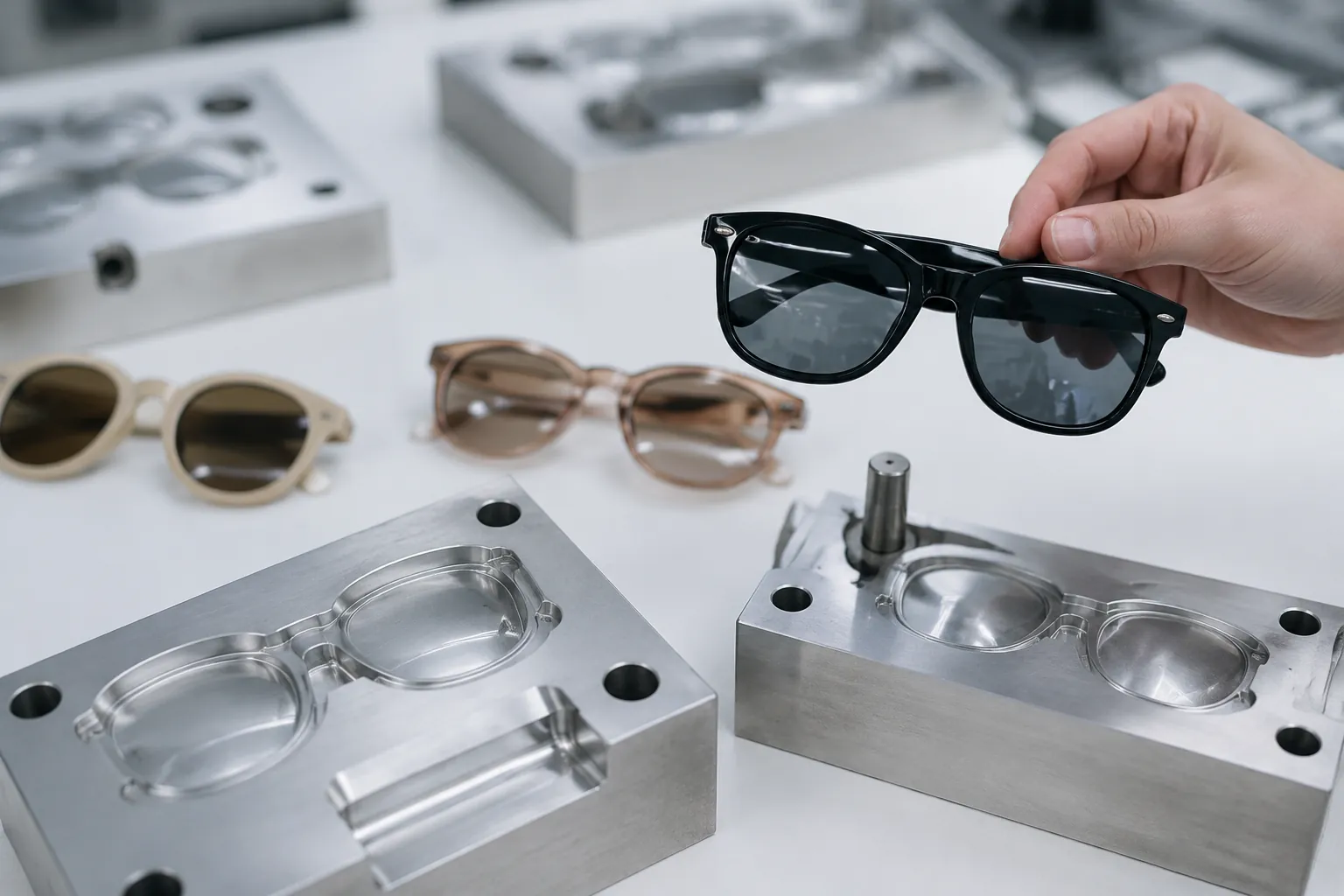
This guide is for brand owners, importers, distributors, and retailers who want seasonal sunglasses updates without paying for a new frame mold each launch. In many cases, the safer move is to keep a proven frame shape and change what customers notice first: frame color, acetate pattern, lens tint, surface finish, and branding details. Done well, seasonal color drops reduce development risk, simplify forecasting, and make reorders easier for wholesale and retail accounts.
Why color drops often beat new frame development
Most seasonal launches do not need a new frame shape. A new shape adds risk fast: fit, comfort, hinge balance, tooling, technical review, and market acceptance. A CAD can look right and still fail in wear. Bridge fit may be off. Temple pressure may be wrong. The frame may simply feel bad on face.
That is a problem if the retail window is fixed.
Color drops are usually easier to manage because they build on a frame that already works. The shape has been tested in the market or approved internally for fit and construction. The update comes from visible changes: acetate pattern, injected frame color, lens tint, mirror coating, gloss or matte finish, temple-tip contrast, or branding methods such as pad print, laser engraving, or a metal logo plate.
The logic is simple. Keep the expensive, uncertain part stable. Change the parts the customer sees first. That usually means simpler sampling, faster approvals, and cleaner forecasting than starting a new mold route every season.
There is also a quality benefit. Once frame geometry is fixed, the factory can focus on execution: color consistency, left-right lens matching, logo placement, hinge tension, and packing accuracy. Fewer moving parts. Fewer surprises.
Use a three-tier color plan, not random swatches
Strong seasonal drops are built around commercial roles, not personal taste. A common mistake is choosing several attractive colors without deciding what each one needs to do in the line. That leads to weak MOQ allocation, vague sales messaging, and slow-moving SKUs.
A better structure is a three-tier plan:
- Core carryover colors: examples include black, dark tortoise, crystal smoke, or deep olive. These support replenishment and give sales teams dependable options that can sell past one season.
- Seasonal drivers: two to four colors tied to a launch window or trend direction, such as translucent tea, milky sage, honey amber, or matte espresso.
- Attention colors: one limited-run option for preorder, key accounts, event retail, or campaign seeding. Keep volume tight on purpose.
This structure also improves MOQ planning. Instead of spreading units across too many weak colors, buyers can place most of the order into one or two reliable SKUs and use the smallest viable quantity on the higher-risk option.
Plan in production terms, not just color names or screen references. A translucent beige in acetate may look deeper after polishing because edge finishing changes visual density. The same beige in injected material may look flatter. A brown gradient lens may suit a large square frame but feel too heavy on a narrow oval. Shape, bevel width, lens size, finish, and material all change how color reads in the final product.
If a color only works under studio lighting or in a retouched render, reject it early. Products are sold in daylight, store lighting, and phone-camera photos.
Pick the right variable to change
Not every seasonal update needs a new frame color. Sometimes the lowest-risk move is to keep the frame unchanged and update only the lens or finish. That can reduce development work while still making the SKU look new.
| Change type | Best use | Typical cost impact | Lead-time impact | Main production risk |
|---|---|---|---|---|
| Injected frame color change | Fast refresh on proven shapes | Low to moderate | Low to moderate, depending on material and color availability | Lot-to-lot color drift, flow marks, or visible variation on thin sections |
| Acetate color or pattern change | Premium seasonal stories | Moderate | Moderate, depending on sheet sourcing and cutting yield | Visible pair-to-pair pattern variation |
| Lens tint or mirror change | Quick visual update with stable frame | Low to moderate | Low to moderate | Left-right lens mismatch or coating inconsistency |
| Finish change: gloss to matte | Subtle update on existing SKU | Low | Low | Scratch visibility, especially on dark matte colors |
| Decoration change: pad print, laser, metal plate | Retail exclusives and limited editions | Low to moderate | Low to moderate | Placement inconsistency if artwork and reference points are vague |
For budget-sensitive programs, the usual order of efficiency is lens change first, finish second, frame color third, and shape change last. If the goal is to test a trend with limited risk, a new mold should be the last option.
Decoration details need more control than many buyers expect. Pad print is often the cheapest option for simple logos, but placement tolerance must be defined clearly. Laser engraving is durable and clean for understated branding, but it can disappear on very dark matte surfaces unless depth and position are specified. Metal logo plates create a stronger premium signal, but they add assembly steps and require accurate slot or cavity positioning.
Keep it disciplined. Change only what supports the sales story. Too many small changes at once make root-cause analysis harder if the sample misses target or the market response is weak.
Build the assortment around MOQ and packing logic
A common buying mistake is designing the drop first and dealing with quantities later. Seasonal programs work better when SKU count is planned around actual MOQ, price breaks, and packing logic from the start.
Ask the supplier to confirm the minimum order quantity per colorway or per design, how pricing changes at higher volumes, and whether decoration, packaging, or lens upgrades affect those breaks. Small runs often have a higher unit cost because setup, material loss, and inspection time are spread across fewer pairs. That does not make small runs wrong. It means they need a clear commercial purpose.
- Low-volume runs: best for market tests, limited capsules, event retail, or account-specific programs. Keep the specification simple and avoid too many unique components.
- Mid-volume runs: usually the practical level for a serious seasonal colorway because unit economics and production efficiency improve.
- High-volume runs: best for proven colors, distributor programs, and repeat sellers with stable packaging and replenishment demand.
One shape in three colors is often safer than three shapes in one color each. It concentrates MOQ, simplifies photography, reduces warehouse fragmentation, and makes replenishment easier. It also gives the sales team a clearer story: one known fit, several distinct color positions.
Check packing at master-carton level too. If inner packs are fixed in set quantities, awkward order splits can create repacking waste, mixed-carton confusion, or extra handling cost. Before approving the assortment, ask for a simple packing breakdown by SKU so logistics and warehouse teams can confirm it works.
Match material behavior before approving samples
The same color reference can look very different across materials. Approvals should be based on actual production samples, not digital artwork alone.
Injected plastic is often the most efficient option for solid colors, translucent neutrals, and higher-volume runs. It can be consistent and cost-effective, but some pigments may show swirl, gate marks, or slight density variation depending on mold flow, wall thickness, and cooling conditions. Thin temple sections may also read lighter than the front if color distribution is not balanced well.
Acetate can give more depth and a more premium look, especially in layered or patterned colors. But it is naturally more variable. In sheet-based production, patterned fronts will not be identical from pair to pair, and cutting yield affects how much of the pattern appears on each frame. Buyers should decide early whether visible pattern variation is acceptable and define that standard with the supplier.
Lens tinting should always be checked under more than one light source. A lens can look neutral indoors and warmer in daylight. Mirror coatings also change the final impression because the base lens color affects the result. A mirror over smoke will not look the same as that mirror over brown.
Ask for sample approvals with clear checkpoints:
- Frame front and temples in final finish, not pre-polish condition
- Left and right lens color match under daylight and white LED light
- Logo placement measured from a fixed reference point
- Hinge opening feel after final assembly, not loose pre-assembly parts
- Color evaluation after protective film removal and cleaning
It also helps to define basic cosmetic tolerances before approval. For example, logo position should be tied to a measured reference point, lens shade should match visually as a pair, and finish should be reviewed both close-up and at normal retail viewing distance. This cuts down on subjective disputes later.
Freeze compliance and performance specs before bulk
Seasonal drops still need the same compliance discipline as core programs. A color change does not remove the need to control lens performance, labeling, and material documentation.
For sunglasses, buyers may need alignment with CE EN ISO 12312-1, ANSI Z80.3, and AS/NZS 1067 depending on the destination market. REACH may also apply to relevant materials and components, including coatings, inks, adhesives, and metal parts. For the US market, buyers should confirm whether FDA registration or related importer documentation is required for their program structure and product classification. Supplier quality systems such as ISO 9001 and social compliance programs such as BSCI can also matter during vendor qualification.
The timing matters. Lens category, visible light transmittance, UV protection, product marking, user information, and packaging statements should be fixed before mass production starts. If a buyer changes from a dark smoke lens to a lighter fashion gradient late in the process, performance classification or required labeling may change too. A late mirror change can also affect approved appearance and may require another check against the target market standard.
Buyers should ask the factory to link the approved sample to the exact production bill of materials: frame material, color code, lens base tint, coating type, decoration artwork, labels, and packaging version. That creates a solid reference for production and final inspection.
At minimum, confirm these points before bulk release:
- Target market and applicable standard
- Lens category and UV requirement
- Labeling language and warning text
- Chemical compliance documents for relevant materials
- Approved sample linked to bulk BOM and packing standard
Run a realistic 10-week calendar
Fast production only helps if buyer approvals move on time. For an existing frame shape, a 10-week working calendar is often a useful model, but the actual schedule should be confirmed with the supplier based on material availability, sample revisions, test needs, and shipping method.
| Week | Buyer action | Factory action | Main risk if delayed |
|---|---|---|---|
| 1 | Confirm shape, target market, quantity split, and target price | Review feasibility and recommend material options | Weak assortment planning from the start |
| 2 | Send color references, lens direction, logo files, packaging brief | Prepare development plan and sample routing | Sample round turns into guesswork |
| 3-4 | Review first samples and comments | Produce development samples | Season slips if revisions start late |
| 5 | Approve revised sample and packaging | Lock BOM, QC points, and production standard | Bulk cannot start cleanly |
| 6-9 | Approve pre-production details and release order | Bulk production, decoration, assembly, QC | Rush decisions create inconsistency |
| 10 | Approve final documents and shipment release | Pack and ship | Missed retail window |
For first-time seasonal programs, keep the structure tight:
- Use one proven shape in two core colors and one seasonal color.
- Add only one lens variation if it clearly strengthens the story.
- Use one branding method across the whole drop.
- Keep packaging unchanged except for SKU labels or color stickers where possible.
- Put the largest quantity on one hero color with the strongest forecast support.
This gives you a collection that looks intentional without becoming operationally heavy. It also produces cleaner post-launch data. Buyers can see more clearly whether demand came from the frame, the color, the lens, or the account mix.
The rule is simple: refresh what already sells, change what the customer can clearly see, and control the variables that cause delays or compliance risk.
Have a custom sunglasses project in mind?
Send us your styles, target market and quantities and we will return a detailed quote with MOQ, lead time and a sample plan.
Get a QuoteWhy source this from Wenzhou with LumiShades
Wenzhou in Zhejiang Province is widely regarded as China’s eyewear manufacturing capital, producing a large share of the world’s sunglasses. That concentration matters to buyers: a deep local supply chain for acetate sheet, hinges, lens blanks, plating and packaging means shorter component lead times, easier color and material matching, and a workforce with decades of eyewear-specific skill. LumiShades has manufactured in this ecosystem since 2009, and our vertical integration — in-house injection molding, acetate cutting, CNC milling, lens tinting, decoration and quality control — means no part of your order is quietly subcontracted to a workshop you cannot audit.
For international buyers, that vertical control translates into accountability. When a single factory owns every step, defects are traced and fixed at source rather than bounced between vendors, and your specifications survive intact from first sample to bulk. We back this with 15+ years of experience, shipments to 60+ countries, more than 5 million pairs produced per year and a 98.5% on-time delivery rate. Our certifications — CE EN ISO 12312-1, FDA registration, ANSI Z80.3, AS/NZS 1067, REACH, ISO 9001 and BSCI audit — mean the compliance documentation your market requires already exists. Explore our manufacturing capabilities and quality control process to see how this works in practice.
Frequently asked questions
How many colors should we launch on one frame for a seasonal drop? For most B2B programs, start with three colors on one proven frame: one or two dependable carryover colors and one seasonal color. That is usually broad enough for sales presentation but narrow enough to protect MOQ efficiency and replenishment. Before finalizing, ask the supplier to quote MOQ by colorway, then place most units on the color with the strongest forecast. If demand is uncertain, cut the number of colors before cutting the quantity of the hero SKU.
Is a small MOQ enough for a serious test order? Yes, if the order has a clear test objective. A small run works best for event retail, a limited-account launch, market-entry testing, or campaign seeding. To make the result useful, keep the specification simple: one frame shape, minimal component changes, standard packaging, and a defined sell-through review period. Before ordering, decide what success means, such as reorder interest from wholesale accounts, sell-through rate by a target date, or customer response to one specific color direction.
What causes the biggest color approval problems in sunglasses production? The biggest problems usually come from approving digital files instead of physical samples, assuming acetate and injected plastic will look the same, and checking lens color under only one light source. Other common issues are failing to define acceptable pattern variation in acetate, not measuring logo placement from a fixed point, and approving pre-polish samples instead of final-finish samples. A practical fix is to approve a signed sample with a written checklist covering material, finish, lens base color, coating, branding position, and packaging version.
Can we change only the lens color and keep the frame the same? Yes. In many cases, that is the lowest-risk way to refresh an existing bestseller. It can also simplify forecasting because frame fit, construction, and packaging stay stable. But buyers still need to verify performance and compliance before bulk production. Confirm the target market, lens category, visible light transmittance, UV protection, marking requirements, and whether the new lens appearance still matches the approved sample standard.
How should we handle compliance for limited seasonal runs? Handle them the same way as any other commercial order. First, confirm the destination market and the applicable standard, such as CE EN ISO 12312-1, ANSI Z80.3, or AS/NZS 1067. Second, freeze the lens specification early so labeling and performance classification do not shift late in development. Third, request supporting material documents where relevant, including REACH-related information for applicable components. For US programs, confirm whether FDA registration or importer documentation applies to your specific setup. Finally, link the approved sample to the final BOM, labels, and packaging so inspection and shipment release are based on one controlled reference.
Ready to start?
Explore our round sunglasses or request a quote — our sales team replies within 12 hours.
Request a Quote