
Make Stock Sunglasses Look Exclusive—No New Tooling
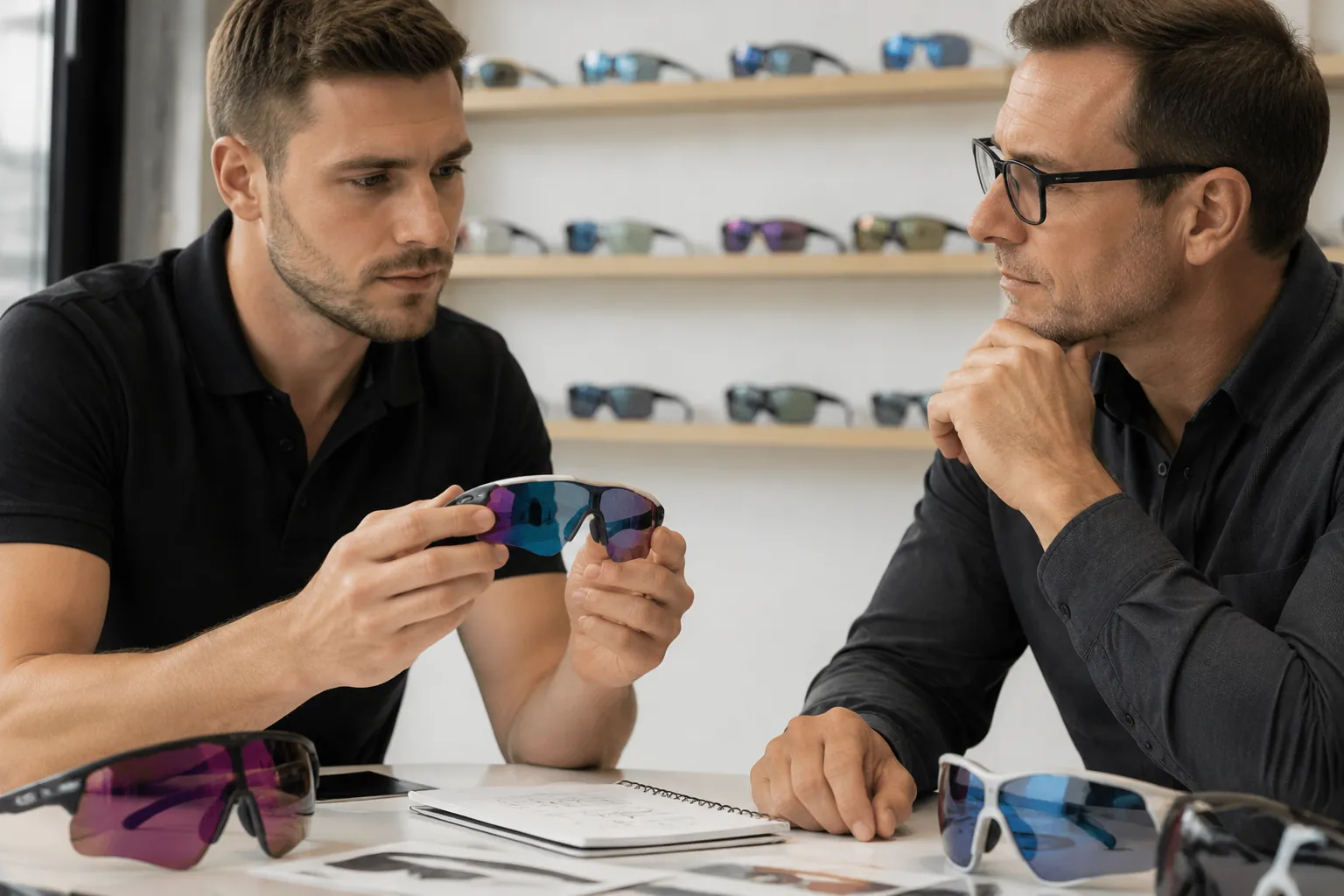
If you want private-label sunglasses to look brand-specific without paying for new molds, keep the frame shape and change what people notice first. That usually means frame color, lens tint or coating, logo treatment, hardware finish, surface texture, and packaging. The logic is straightforward: improve what the customer sees, avoid tooling changes that add cost, time, and approval risk. Done well, this gives you a differentiated SKU that still fits normal factory processes and established quality controls.
Start with the right rule: change appearance, not tooling
If the base frame already fits your market, avoid new molds unless the business case is strong. New tooling adds development work, fresh dimensional approval, and more chances for problems before launch. For many importers, distributors, and retail brands, the faster path is simpler: keep the front and temple tooling as is, then customize the visible parts customers judge first—color, lenses, trim, finish, and packaging.
That distinction matters. Tooling changes affect mold development, fit validation, and repeatability. Appearance changes usually sit inside existing production steps. A stock frame can often be differentiated without mold revision if the factory already has stable processes for frame production, lens supply, decoration, assembly, and final inspection. Fewer moving parts. Fewer communication errors.
Still, not every appearance change is low risk. Buyers should confirm what the factory does routinely and what it is trying for the first time. A practical filter is to ask three questions for every modification: does it improve shelf appeal, does the factory have proven process capability, and does it add approval or inspection risk?
Buyer rule: if the customer would call it "the same shape, different attitude," you probably do not need a new mold.
The benefit is not only lower development cost. It is tighter control. Appearance-led customization is easier to quote, easier to sample, and easier to manage against a sealed approval sample.
The fastest customization options, ranked by cost, risk, and lead time
Not all customizations behave the same in production. Some fit cleanly into normal factory flow. Others add setup, curing, plating control, or stricter cosmetic inspection. Buyers should know the difference before they build a low-MOQ program around details that look easy on paper but slow everything down.
| Customization option | Typical MOQ impact | Sample effect | Bulk lead-time effect | Main process detail / trade-off |
|---|---|---|---|---|
| Frame color change in existing material | Often limited by base frame MOQ or color batching requirement | Usually low if the material and color route are already standard | Usually minimal | Approve against a physical color standard or sealed sample; color on plastic should not be approved from digital artwork alone |
| Lens tint change or gradient / mirror finish | May depend on lens source, coating route, and whether the lens base is standard | Low to moderate | Can be minimal or moderate depending on lens treatment | Requires confirmation of visible light transmission and intended-use compliance; mirror coatings can make cosmetic defects easier to see |
| Pad print or laser logo | Usually low | Usually low once artwork and location are confirmed | Usually minimal | Artwork should be dimensioned from a fixed reference point; adhesion or contrast should be checked on the actual frame material and finish |
| Metal logo plate or special hardware tone | Often depends on separate component MOQ and plating setup | Moderate | Can add time for component preparation and matching | Needs plating consistency, secure fixing, and flush placement; mixed-metal appearance must be reviewed carefully |
| Soft-touch, rubberized, or heavy texture finish | May increase practical MOQ if the process is not standard | Moderate | Can add process time and increase inspection sensitivity | Higher risk of dust points, rub marks, uneven feel, or coating durability issues if process control is weak |
| Custom retail packaging set | Usually separate MOQ by packaging item | Often runs in parallel but needs separate approval | Frequently becomes the critical path | Printed cartons, molded cases, and foil details often move slower than the eyewear itself |
For a fast private-label launch, the safest build is usually an existing frame, a controlled frame color, a standard lens construction, one branding method, and stock or lightly customized packaging. That mix often gives the best balance between exclusivity and execution reliability.
- Fastest to approve: standard frame in a new colorway with inner temple print.
- Best visual upgrade per dollar: coordinated frame and lens color plus restrained outer temple branding.
- Most likely to delay: special coatings, metal trim, and custom packaging introduced at the same time.
Build exclusivity through frame-and-lens pairing
Many buyers pick the frame color first and the lens color later. That is usually backward. Treat the frame and lens as one visual identity. A stock shape can look generic in the wrong pairing and intentional in the right one.
Examples that often work well:
- Classic premium: black frame, smoke or green lens, matte or satin finish, restrained logo.
- Seasonal fashion: crystal gray, translucent tea, or olive frame with brown or gray gradient lens.
- Sport-casual: dense dark frame with blue, silver, or green mirror lens if the price point supports the coating.
- Resort or gift line: champagne, sand, or milky translucent frame with a lighter lens tint and upgraded pouch.
Approve color pairing from a physical sample built to the real spec. Not a rendering. Small shifts in tint density, mirror strength, or frame transparency can change the whole look. Lens effects also need technical definition, not just mood-board language. Solid tint, gradient tint, flash mirror, and full mirror do not behave the same in production or inspection.
Where compliance matters, lens color and coating are not only design decisions. Buyers should confirm that the finished sunglasses are assessed against destination-market requirements and intended use. Depending on market and channel, that may include CE EN ISO 12312-1, ANSI Z80.3, AS/NZS 1067, REACH, and FDA registration where applicable. Do not treat those references as sales copy. Ask what documents the supplier can provide for the exact product.
If mirrored lenses are the hero feature, define the inspection method before bulk starts. Ask how lenses will be checked for cosmetic defects, under what lighting, and against which approved standard. The final approval sample should match the exact lens material, coating type, and tint level planned for production.
Decoration and hardware: quick value, easy mistakes
Branding should make a stock frame look deliberate, not busy. In many low-to-mid price programs, one strong decoration is enough. That could be a pad print on the outer temple, a restrained laser mark, or a small metal logo plate. Stack too many attention-grabbing details on one frame and the product often looks cheaper, not better.
Each method has limits. Pad printing is efficient, but adhesion depends on the substrate and surface finish. Laser engraving is usually more durable because it is not an added ink layer, but visibility depends on base color and texture. Metal logo plates can raise perceived value, though they also demand tighter component control, more precise positioning, and a clean fit against the frame surface.
For placement, ask for artwork or a drawing dimensioned from a fixed hinge reference point or other stable datum. Review left and right temples together, not as separate parts. For metal details, check flushness, burr-free edges, secure attachment, and consistency of plating tone across assembled pairs.
Useful decoration checks include:
- Logo position from hinge centerline or agreed reference point
- Left-right symmetry
- Print edge sharpness and fill consistency
- Rubbing / abrasion resistance after curing where applicable
- No burrs, tilt, or lift on metal plates
- Consistent hardware tone across assembled pairs
If the style depends on visual refinement, pick one hero detail and execute it well.
If a supplier claims formal systems, ask specific questions. Is production and inspection managed under ISO 9001? Is BSCI documentation available if social compliance matters to your channel? These do not guarantee a good product. They do tell you something about process discipline.
Texture, finish, and material behavior change perceived value fast
Surface finish can change how a frame is perceived almost immediately. The same mold may look basic in glossy black and more considered in fine matte, crystal translucent, sanded effect, or patterned acetate. Often, finish creates more visible differentiation than extra trim does.
Material matters. Injection-molded plastics and acetate do not mark, polish, or age the same way. Matte finishes may hide fingerprints better but show handling marks more clearly. High gloss can look cleaner at first glance but reveal molding or polishing inconsistencies more easily. Soft-touch coatings improve first-touch feel, but they add another process layer. That means another failure point if control is weak.
For acetate, visible pattern, lamination quality, polish quality, and edge finishing usually matter more than extra decoration. If the factory handles acetate processing in-house, it may have better control over finish consistency than a supply chain spread across outside processors.
When reviewing finish options, confirm:
- Base material: injected plastic or acetate.
- Available finish routes: gloss, matte, crystal, laminated pattern, rubberized, or brushed effect already proven on that material.
- Handling standard: what level of rub mark, swirl, gate visibility, or internal mark is acceptable.
- QC points: gate marks, polishing consistency, edge smoothness, coating adhesion where applicable, and surface cleanliness.
Approve a visual standard and a handling standard. Both matter. A sample that looks clean on a desk may not survive assembly, packing, and freight in the same condition.
Packaging is often the safest exclusivity move per unit
Many buyers spend too much effort on the frame and too little on packaging. That is a mistake. Packaging is often the most efficient way to make a stock frame feel proprietary, especially when several frame shapes sit under one brand story. It also helps smaller brands create consistency without changing the eyewear itself.
A practical setup might include a stock or semi-custom case, a branded microfiber pouch or cleaning cloth, a barcode label, and an insert covering care, model identification, and origin information where required. Retail programs may add a sleeve or carton by collection. Distributor programs may prefer lighter protective packaging to reduce cube and simplify storage.
There is a catch. Packaging often becomes the bottleneck. Printed boxes, molded cases, foil stamping, and late artwork revisions can delay shipment even when the sunglasses are already approved. It happens often, especially when frame approvals get all the attention and packaging decisions are pushed to the end.
For low-MOQ programs, unit economics matter too. Elaborate boxes can push cost up fast on small runs. A common fix is to standardize one packaging platform across multiple SKUs and vary only the sleeve, sticker, barcode, or insert by model. That keeps the eyewear flexible and makes branded components easier to reorder.
Fastest packaging strategy:
- Use one case format across multiple SKUs
- Vary sleeve, sticker, or barcode by model
- Approve artwork early and lock dielines fast
- Avoid introducing custom molded cases on a rushed launch
Cost ladder and MOQ logic: know what each layer does to margin
Think in layers. The stock frame sets the base cost. Every added layer should earn its place by improving sell-through, supporting a higher retail price, or creating channel differentiation. If a customization adds cost without changing one of those outcomes, it is just complexity.
MOQ may start low for some stock-frame programs, but practical MOQ by colorway, lens treatment, logo method, and packaging component often differs. Split a small order across too many variants and approvals, forecasting, and replenishment all get harder. A tighter plan is to build one core SKU properly, then add variants only when reorder volume justifies them.
As a planning model:
- Entry differentiation: stock frame, standard lens, inner temple print, stock pouch.
- Best value tier: curated frame color, matched lens tint, outer temple branding, upgraded cloth or pouch.
- Premium-looking without new mold: special finish, upgraded lens treatment, metal logo plate, coordinated packaging set.
Ask for quotations as a matrix, not one all-in number. Request pricing by quantity break and separate frame cost from decoration, lens upgrade, and packaging cost. That makes it easier to see where margin is being spent and to build channel-specific versions from one base product. A distributor SKU may use the same frame and lens as a retail SKU but drop metal trim and use simpler pack-out.
The real goal is not the lowest unit cost. It is the most profitable SKU structure with the fewest unnecessary variables.
A buyer workflow that keeps the program fast and controllable
The quickest private-label programs usually follow a strict sequence. Most avoidable delays come from making fit, finish, lens, branding, and packaging decisions in the wrong order, then re-sampling after conflicts show up too late.
- Choose the stock frame first. Confirm dimensions, fit, material, hinge construction, and target price before discussing styling changes.
- Define the destination market per SKU. EU, US, Australia/New Zealand, or mixed-market requirements affect lens testing, labeling, and documentation.
- Select frame and lens as one pair. Approve the colorway as a complete retail identity.
- Add one branding method. Pad print, laser, or metal plate; keep the first run controlled.
- Lock packaging early. Especially if printed cartons, sleeves, or custom cases are involved.
- Approve a sealed sample. Use it as the physical standard for color, finish, decoration position, lens effect, and pack-out.
- Set QC points before bulk. Include cosmetic limits, decoration location reference, hinge function, lens inspection method, packaging checks, and carton markings.
To verify supplier readiness, ask practical questions instead of accepting broad claims. Which processes are handled in-house? Which components are outsourced? What compliance documents are available for this exact model? Is the quality system managed under ISO 9001? Is BSCI documentation available if social compliance is required? Can the supplier provide evidence of CE EN ISO 12312-1, ANSI Z80.3, AS/NZS 1067, REACH, or FDA registration where relevant?
For buyers trying to make stock sunglasses look exclusive, the answer is usually discipline, not complexity. Pick a frame that already works. Change what the customer sees first. Approve the real sample built to the real specification. Then hold bulk production to that standard.
Have a custom sunglasses project in mind?
Send us your styles, target market and quantities and we will return a detailed quote with MOQ, lead time and a sample plan.
Get a QuoteWhy source this from Wenzhou with LumiShades
Wenzhou in Zhejiang Province is widely regarded as China’s eyewear manufacturing capital, producing a large share of the world’s sunglasses. That concentration matters to buyers: a deep local supply chain for acetate sheet, hinges, lens blanks, plating and packaging means shorter component lead times, easier color and material matching, and a workforce with decades of eyewear-specific skill. LumiShades has manufactured in this ecosystem since 2009, and our vertical integration — in-house injection molding, acetate cutting, CNC milling, lens tinting, decoration and quality control — means no part of your order is quietly subcontracted to a workshop you cannot audit.
For international buyers, that vertical control translates into accountability. When a single factory owns every step, defects are traced and fixed at source rather than bounced between vendors, and your specifications survive intact from first sample to bulk. We back this with 15+ years of experience, shipments to 60+ countries, more than 5 million pairs produced per year and a 98.5% on-time delivery rate. Our certifications — CE EN ISO 12312-1, FDA registration, ANSI Z80.3, AS/NZS 1067, REACH, ISO 9001 and BSCI audit — mean the compliance documentation your market requires already exists. Explore our manufacturing capabilities and quality control process to see how this works in practice.
Frequently asked questions
Can I make a stock frame look private-label enough for my brand without changing the shape? Yes. In many cases, the highest-impact changes are frame-and-lens color pairing, surface finish, logo treatment, hardware finish, and packaging. To make that work, ask the supplier to build a physical sample to your exact specification and approve it as the production reference. If the shape already fits your customer and price point, changing visible details is usually faster and lower risk than developing new tooling.
What is the minimum order if I want different colorways on one frame? There is no universal minimum that applies to every factory or every color split. Base MOQ may be quoted by frame design, but practical MOQ by colorway can change depending on material batching, lens treatment, decoration setup, and packaging requirements. Ask the supplier for a variant breakdown in writing: minimum per frame, minimum per color, minimum per lens treatment, and any separate MOQ for packaging components. That helps prevent a small order from being fragmented into too many inefficient variants.
Will changing lens color affect compliance? Yes. Lens tint and coating can affect visible light transmission, category, labeling, and suitability for intended use. Before approving a lens change, confirm which market the SKU will be sold into and ask what product-specific documentation the supplier can provide. Relevant references may include CE EN ISO 12312-1, ANSI Z80.3, AS/NZS 1067, REACH, and FDA registration where applicable. The key is to verify compliance for the finished product specification, not assume that a previous lens or a similar model covers the new one.
Which branding method holds up best in use? Laser engraving is often durable because it is not a surface-applied ink layer, but its visibility depends on frame color and finish. Pad printing is efficient and widely used, but buyers should request adhesion and rub-resistance checks on the actual production material and finish. Metal logo plates can add perceived value, though they require stricter control of attachment, position, edge quality, and plating consistency. Approve both the appearance and the test standard for the chosen branding method before bulk production starts.
What usually delays a fast private-label sunglasses order? Packaging approvals are a common source of delay, especially when artwork, dielines, or case decisions are left until after the eyewear sample is approved. Other frequent causes are late changes to lens treatment, unclear logo placement, and adding several new decorative processes at once. To keep the program moving, lock the frame first, approve the frame-and-lens combination as one sample, dimension the branding location from a fixed reference point, and finalize packaging artwork early.
Ready to start?
Explore our sport wrap sunglasses or request a quote — our sales team replies within 12 hours.
Request a Quote