
Turn Stock Frames Into Distinct Sunglass SKUs
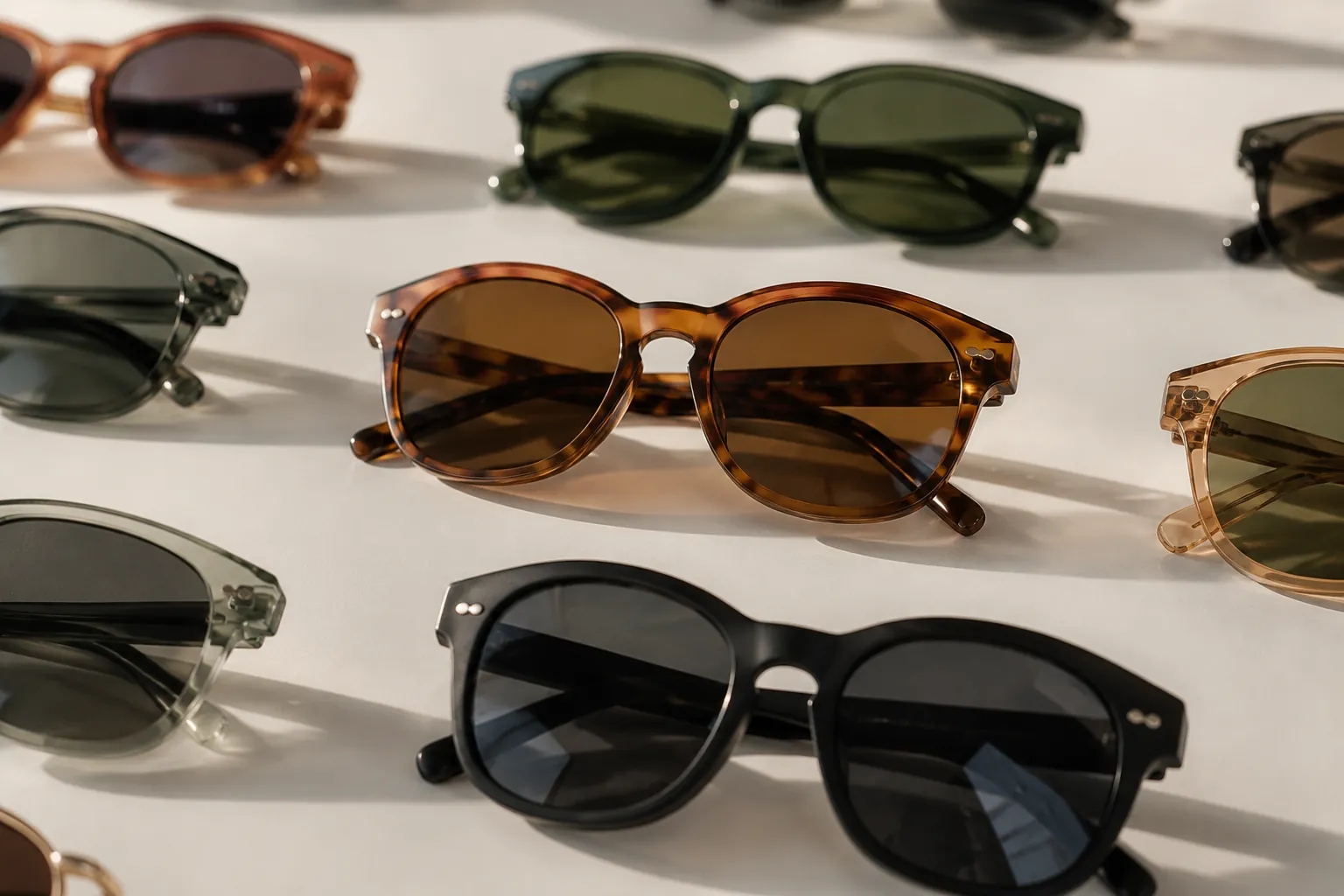
For brand owners, importers, distributors, and retailers, the fastest route to a differentiated sunglass SKU is often not a new mold. It is a proven stock frame, changed where buyers and end customers notice it first: color, lens look, hardware, logo execution, and packaging. Done well, a stock base can look exclusive without mold investment. It also lowers development risk and shortens the path from sample to bulk. The advantage is not just lower upfront cost. It is better test logic. Launch several variants in smaller quantities, see what sells, then scale the winners once market response is clear.
Start with the real question: what actually needs to be custom?
Many eyewear buyers ask for a new mold too early. Usually, they have not defined what must be unique. In practice, sell-through is often driven by visible details: front shape, frame color, lens mood, temple branding, and trim.
If a stock frame already matches the target silhouette closely enough, full tooling may add cost without adding much value. Start with the base geometry. Check lens shape, eye size, bridge fit, temple thickness, base curve, and overall style direction. If those points already fit your line plan, a stock frame can be a lower-risk platform for a distinct SKU.
Move to new mold development only when the concept depends on structural changes such as:
- A new silhouette: for example, changing from a classic square front to a wrapped sport shape.
- New hinge architecture: such as spring hinge integration, custom rivet layout, or a branded hinge form.
- Meaningful sizing changes: especially when a size revision affects lens cutting, fit balance, or temple geometry.
- Unique construction details: such as stepped laminations, sculpted temple profiles, or visible metal-core effects not present in the stock base.
If the concept depends mostly on colorway, lens pairing, logo treatment, and trim, stock frames are often enough. That matters when timing is tight. A stock-frame program removes the mold-development stage and usually cuts revision work tied to fit, lens seating, and first-round appearance approval.
Which stock frame types customize best
Some stock frames give you room to differentiate. Some do not. The best candidates have visible surface area for decoration and enough structure to carry better details without looking generic. Material matters. A lot.
| Base frame type | What customizes well | Typical limits | Best use case |
|---|---|---|---|
| Injection molded PC or TR90 | Custom solid colors, soft-touch or rubber coatings, mirror lenses, pad print logos, laser marking | Less visual depth than acetate; limited inlay options; painted finishes need adhesion control | Promotional lines, sport programs, lower opening price points |
| Acetate frame | Transparent effects, tortoise variants, laminated sheets, temple milling, inset metal plates, hand-polished finish | Higher unit cost; pattern alignment must be reviewed left/right; longer finishing time | Fashion collections, boutique retail, premium private label |
| Metal-combination frame | Plated trim, engraved logos, nose pad tuning, lens-color contrast, slim premium look | Less branding surface; plating consistency and weld quality matter | Contemporary optical-sun crossover assortments |
| Classic aviator or square stock sun | Lens pairing, temple branding, logo plate, upgraded packaging story | Can look generic if left in standard color-and-lens combinations | Fast seasonal launch at low MOQ |
Acetate usually gives more depth because the color comes from the sheet itself, not just a surface finish. Crystal, smoke, tea, olive, and tortoise effects tend to read richer at retail distance. Injection materials are often lighter and more cost-efficient, but they rely more on exact color matching, finish control, and strong lens pairing to look premium.
The four changes that do most of the visual work
If the goal is to make a stock frame look exclusive, four changes usually carry most of the result. One change is rarely enough. Three is often the minimum.
- Frame color and finish. For injection frames, custom masterbatch or painted finishes can shift the look from basic to brand-specific. Matte, semi-gloss, and rubber-touch coatings send different price signals. For acetate, the sheet choice is critical: clear crystal, smoke, tea, layered tortoise, stripe lamination, or transparent olive all read differently.
- Lens specification. Lens color changes product personality fast. Smoke and G15 read classic. Brown gradient softens a fashion line. Silver flash mirror pushes sport or festival positioning. Light fashion tints create a trend-led look. But lens choice is not only aesthetic. Visible light transmission, UV performance, and labeling still need to match destination-market requirements.
- Hardware and trim. Small metal details can change the whole impression. Think exposed rivets, hinge covers, temple tip inserts, or a stamped metal logo plate. On acetate, CNC milling to recess a logo plate or create a stepped temple profile can add value without changing the base mold.
- Brand decoration. Pad printing is usually the most efficient low-MOQ option. Laser engraving gives a quieter effect, especially on matte or coated temples. Metal logo plates cost more, but often send a stronger premium signal because they add depth, reflection, and material contrast.
Think in layers. A black frame with one white temple print still looks standard. A crystal olive acetate frame with brown gradient lenses, a gunmetal logo plate, and a custom microfibre pouch reads differently on shelf even if the base frame is stock.
Cost, MOQ, and lead time: model the trade-offs first
The obvious savings from stock frames are tooling-related. The bigger gain is development efficiency. A proven stock base usually reduces rework tied to fit, lens seating, hinge alignment, and basic construction issues that often appear in first-time mold projects.
| Project route | Upfront cost | MOQ starting point | Sample lead time | Bulk lead time | Main risk |
|---|---|---|---|---|---|
| Stock frame with logo print only | Low | Supplier dependent | Usually shorter than new mold | Supplier dependent | May still look too standard |
| Stock frame with custom color + lens + print | Low to moderate | Supplier dependent | Usually shorter than new mold | Supplier dependent | Color approval discipline required |
| Stock acetate with CNC detail + metal logo plate | Moderate | Supplier dependent | Depends on finishing complexity | Supplier dependent | Extra finishing can slow approval |
| New mold development | High | Usually higher total commitment | Longer development cycle | Longer first bulk cycle | Fit, appearance, and compliance rework |
Volume pricing often improves at higher quantities, but the breakpoints depend on material, lens spec, decoration method, and packaging. That makes stock customization useful for testing. Launch several frame families in smaller quantities. Track sales by SKU. Repeat only the winners at volumes where unit economics usually improve.
Operationally, the key approval points are color matching, lens shade consistency, logo placement, hardware finish, and packaging details. Lock those early with a signed sample or sealed approval standard. Do that, and bulk timing is usually more predictable than on a new-mold project.
The process details that make a sample look premium
Small execution details decide whether a stock customization looks credible. Buyers often focus on the front shape and miss the variables that control perceived quality. That is a mistake.
- Logo placement tolerance: even a small shift can look wrong on a narrow temple or slim metal part.
- Left-right pattern consistency: on acetate, temple grain and front color balance should be checked on hero SKUs because sheet pattern can vary.
- Hinge torque and alignment: uneven opening resistance or skewed end alignment is obvious the moment someone handles the sample.
- Lens color batch consistency: a brown gradient that runs greener, darker, or less even than the approval sample can change the whole line impression.
- Finish logic: gloss front, matte temple, bright mirror lens, and warm gold trim can clash unless the mix is deliberate.
Material-specific process choices matter too. Acetate needs careful polishing and edge finishing or it will look dull. Injection frames with painted coatings should be checked for adhesion and rub resistance, especially on temple contact areas. Metal trims and plates should be reviewed for burrs, plating consistency, and secure attachment.
Integrated production helps here. If molding, acetate cutting, CNC, lens tinting, decoration, and final QC are coordinated under one system, there are fewer handoff errors. Before bulk starts, ask for quality checkpoints covering cosmetic inspection, logo position, lens shade approval, hinge function, and carton-level packing verification.
A stock frame still needs SKU-level compliance review
A stock frame is not automatically compliant in every market. The finished SKU is what counts: frame, lens, coatings, labeling, and product claims together. Change the lens, finish, or branding details, and the compliance file may need review.
For sunglasses, buyers should confirm the applicable framework based on destination market and product positioning. Common references include CE EN ISO 12312-1, ANSI Z80.3, and AS/NZS 1067. Chemical and system requirements may also involve REACH, FDA registration, ISO 9001, or social compliance expectations such as BSCI. Useful references, yes. But not a substitute for SKU-level confirmation.
Areas that often create delays include:
- Lens category changes: switching from a standard dark lens to a lighter fashion tint can affect visible light transmission category and labeling.
- Mirror coatings: do not assume a mirrored lens matches the transmission or performance profile of an approved base lens.
- Material and finish chemistry: paints, coatings, and trims may need chemical compliance confirmation for the destination market.
- Packaging and warnings: country-specific markings, language, and user information can differ.
The practical rule is simple. Any change to lens color, gradient, mirror effect, coating, or finish chemistry should trigger a check on test records, declarations, and package labeling. Many delays start because the visual sample was approved before the paperwork was checked.
How to brief the supplier so the first sample is usable
Most sample delays come from weak briefs, not slow factories. If you want a stock frame to look exclusive, the spec must be clear enough to produce consistently and review against objective criteria.
- State the exact base frame code. Use the supplier's model reference number, not a loose description.
- Define material. Specify acetate, PC, TR90, metal, or combination construction because this affects color behavior, decoration, and cost.
- Confirm dimensions. Include eye size, bridge, temple length, and any fit sensitivity relevant to your target customer.
- Specify color precisely. Use Pantone for prints or painted parts where applicable. For acetate, provide physical swatches or approved visual references whenever possible.
- Lock the lens spec. Include color, solid or gradient, mirror yes/no, lens material, and the destination-market compliance target.
- Describe branding method and position. Outer temple, inner temple, lens mark, logo plate size, engraving depth, and print color should all be stated.
- Confirm packaging and pack-out. Include pouch, box, barcode label, master carton requirements, and any retail display or shipping requirement.
Send vector logo files. State whether the logo should read bold or subtle. If you want a metal logo plate, ask for plate finish, thickness, corner radius, and attachment method during pre-production review. Small details on paper become obvious in hand. A complete brief improves first-sample quality and cuts avoidable revision cycles.
A practical low-MOQ plan for exclusive-looking launches
If demand is still uncertain, use stock customization as a staged buying plan. Do not try to solve everything with one large order. Build range first. Test response. Scale later.
Stage 1: shortlist 2 to 3 stock frames whose geometry already fits your brand direction.
Stage 2: create 2 colorways per frame. Use one safe option and one more directional option.
Stage 3: assign one branding method per SKU first: pad print for lower cost, laser for subtle branding, or metal plate for premium positioning.
Stage 4: place a trial order based on the supplier's confirmed MOQ and treat each frame-and-lens combination as a separate SKU unless the supplier confirms shared setup conditions.
Stage 5: review sell-through by colorway, not only by frame family. Reorder winners at higher volume once demand is proven and packaging or trim upgrades are commercially justified.
That is the practical value of a supplier with low-MOQ capability. You keep capital focused on testable variants, shorten development compared with full mold creation, and put larger commitments behind proven SKUs instead of assumptions. Stock frames stop looking stock through disciplined combinations of material, lens, branding, trim, and execution. Not through one dramatic change.
Have a custom sunglasses project in mind?
Send us your styles, target market and quantities and we will return a detailed quote with MOQ, lead time and a sample plan.
Get a QuoteWhy source this from Wenzhou with LumiShades
Wenzhou in Zhejiang Province is widely regarded as China’s eyewear manufacturing capital, producing a large share of the world’s sunglasses. That concentration matters to buyers: a deep local supply chain for acetate sheet, hinges, lens blanks, plating and packaging means shorter component lead times, easier color and material matching, and a workforce with decades of eyewear-specific skill. LumiShades has manufactured in this ecosystem since 2009, and our vertical integration — in-house injection molding, acetate cutting, CNC milling, lens tinting, decoration and quality control — means no part of your order is quietly subcontracted to a workshop you cannot audit.
For international buyers, that vertical control translates into accountability. When a single factory owns every step, defects are traced and fixed at source rather than bounced between vendors, and your specifications survive intact from first sample to bulk. We back this with 15+ years of experience, shipments to 60+ countries, more than 5 million pairs produced per year and a 98.5% on-time delivery rate. Our certifications — CE EN ISO 12312-1, FDA registration, ANSI Z80.3, AS/NZS 1067, REACH, ISO 9001 and BSCI audit — mean the compliance documentation your market requires already exists. Explore our manufacturing capabilities and quality control process to see how this works in practice.
Frequently asked questions
Can I really make a stock frame look exclusive enough for my own brand? Yes, if you change multiple visible elements together and control execution closely. Start with a base frame that already matches your intended silhouette, then customize at least three of the following: frame color or acetate pattern, lens color or gradient, branding method, hardware detail, and packaging. Ask the supplier for a pre-production sample that shows the exact logo position, lens shade, and trim finish you will use as the bulk approval standard. If you only add a temple logo to a standard frame-and-lens combination, the result may still look generic.
What is the lowest MOQ if I want different colorways on the same frame? There is no standard MOQ. It depends on the supplier, material, decoration method, and whether the colorways can share setup conditions. Treat each frame color and lens combination as a separate SKU unless the supplier confirms otherwise. When asking for a quote, request three numbers in writing: MOQ per base frame, MOQ per colorway, and MOQ per logo or packaging variation. That makes supplier comparisons much clearer and reduces confusion at order stage.
Which branding method works best at low quantity: print, laser, or metal plate? Pad printing is usually the simplest and lowest-cost option when you need clear brand visibility at small volume. Laser engraving suits a quieter look and works best when the frame surface gives clean contrast. Metal logo plates usually create the strongest premium effect, but they require closer approval on size, finish, placement, and attachment method. A practical approach is to ask the supplier to show the same logo on the same frame using all three methods, then compare readability, durability, cost, and lead time before approval.
Will changing the lens color affect compliance documents? It can. A lens change may affect visible light transmission category, labeling, and the supporting test evidence for the final SKU. This matters for programs targeting CE EN ISO 12312-1, ANSI Z80.3, or AS/NZS 1067. The safest process is to tell the supplier the exact destination market, request confirmation of the intended lens category and labeling, and ask whether the new lens color, gradient, or mirror coating requires updated test records or declarations before bulk shipment.
How fast can I get samples and bulk production on a stock-frame project? Timing depends on stock status, material, decoration complexity, and packaging scope, so it should always be confirmed case by case. In general, stock-frame projects are faster than new-mold programs because the base frame already exists. Ask the supplier to split the timeline into sample preparation, sample revision if needed, bulk production, and packaging completion. Also confirm what starts the clock, such as artwork approval, color confirmation, or deposit receipt, so the schedule is clear from the start.
Ready to start?
Explore our cat-eye sunglasses or request a quote — our sales team replies within 12 hours.
Request a Quote