
Pad Printing vs Laser Engraving vs Logo Plates
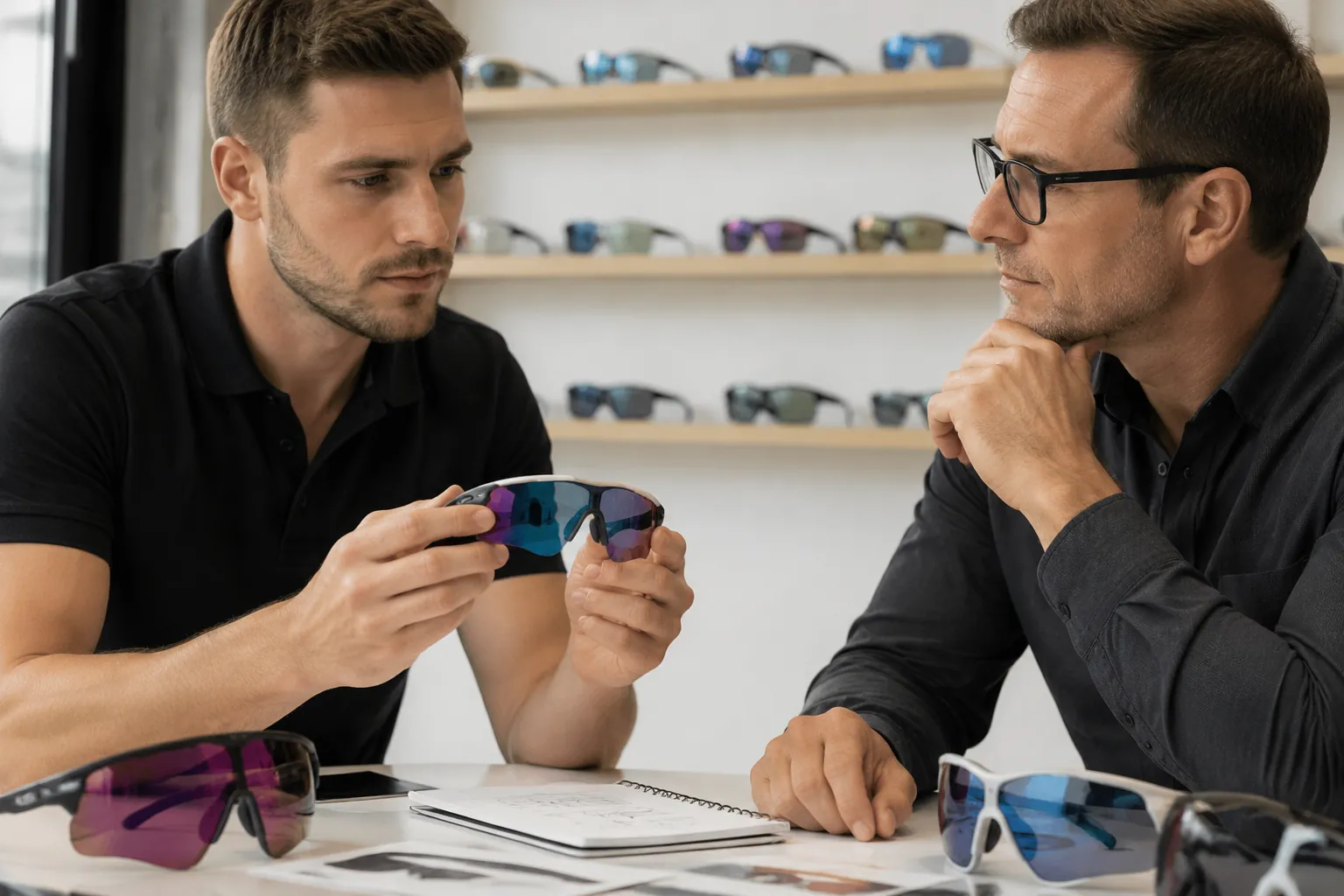
This guide is for buyers sourcing custom sunglasses in volume and choosing a logo method before sample approval or bulk production. Branding is not just a styling choice. It affects unit cost, sampling difficulty, defect risk, production speed, and how well the factory can repeat the result across the order. The right choice usually depends on order size, frame material, logo position, durability needs, and target price. Below is a factory-level comparison of pad printing, laser engraving, and metal logo plates using criteria buyers can verify during sampling and pre-production approval.
Start With The Buying Decision
Many branding problems start the same way: the buyer picks the look first and checks production fit later. That is backward. A metal logo plate may look strong on a sample, but it can be the wrong commercial choice for a small trial run if the extra part, alignment control, and assembly steps add too much cost and risk. Pad printing is flexible and usually economical, but it is not safe on every surface. If the logo sits on a sharply curved temple, a textured finish, or a weak coating, print quality and adhesion can fail fast. Laser engraving can be durable, but only if the substrate and finish create a clean, controlled mark.
For custom sunglasses, the choice usually comes down to four factors: target cost, order volume, frame material, and logo location. On a small order, sample speed, low setup burden, and easy revision often matter more than maximum production efficiency. On a repeat program, consistency and defect control matter more because small variation becomes real money.
Use a simple sequence. First fix the logo position. Then confirm the material and finish. Then choose the method that can hold the look at the required volume. Buyers should approve branding from a physical sample made on the actual production material and finish, not from artwork alone.
- Choose pad printing when cost is tight, artwork is simple, and the logo area is flat or only slightly curved.
- Choose laser engraving when color matters less than abrasion resistance and the material gives stable contrast.
- Choose metal logo plates when visible hardware is part of the product concept and the order can absorb extra component and assembly control.
Head-To-Head: Cost, Speed, Risk, And Value
| Method | Best MOQ Band | Typical Added Cost / Pair | Lead Time Effect | Main Defect Risk | Perceived Value |
|---|---|---|---|---|---|
| Pad printing | Low to high volume | Usually the lowest of the three methods; depends on color count, logo size, and fixture complexity | Usually the fastest once artwork, fixture, and print approval are complete | Ink adhesion failure, misregistration, rub-off, fuzzy edges | Good when crisp; ordinary if poorly executed or overused |
| Laser engraving | Mid to high volume | Usually higher than pad printing; depends on machine time, logo size, and material response | Stable after material testing; sampling may take longer if contrast needs validation | Overburn, shallow mark, heat halo, inconsistent contrast | Clean, technical, understated |
| Metal logo plates | Usually mid to high volume | Usually the highest of the three methods; depends on plate size, finish, and attachment process | Usually the longest because it adds a separate component and assembly controls | Misalignment, glue failure, scratches, plating variation | Highest when well aligned and well finished |
At low and mid volume, pad printing often gives the best economics. The process is direct: prepare artwork, make the plate, fixture the frame, print, cure, and inspect. For a simple temple logo, it is usually the lowest-complexity way to add branding without changing frame construction.
Laser engraving sits in the middle. It avoids an added ink layer, which can reduce rub-off risk, but it is not material-neutral. Some plastics and painted surfaces mark cleanly. Others do not. Weak contrast, uneven color change, and visible heat effect are common approval-stage issues.
Metal logo plates are different. They are not just decoration. They add a separate part with its own finish standard, dimensional tolerance, and attachment method. That can raise perceived value. It also adds failure points and more inspection work.
Where Each Method Wins On Unit Economics
Separate setup cost from run cost. A method can look premium and still make poor commercial sense on a small run if it needs custom parts, more hand assembly, or tighter cosmetic sorting. On larger programs, the same method may be reasonable if it supports the product position and can be repeated without constant rework.
Pad printing usually wins when artwork is simple and the logo area is stable. It is common for outer-temple branding, inside-temple marks, and other locations where the surface can be held reliably in a fixture. Fine detail needs caution on curved, textured, or glossy surfaces because edges can soften and small elements can distort. Buyers should ask the factory to define a measurable logo datum and placement tolerance on the approved sample.
Laser engraving becomes more attractive when the buyer wants a more durable mark without adding a separate part. It suits subtle branding and information marks, especially where a low-profile finish is preferred. The economics improve once the material response is already validated and machine settings are locked for that exact substrate, color, and finish.
Metal logo plates make the most sense when the product depends on visible hardware for brand expression, when the margin can carry higher decoration cost, or when repeat orders are large enough to justify added component development and assembly control. They are usually inefficient on low-volume trials. One problem in plate finish, placement, or bonding can create heavy rework.
The key mistake is judging decoration on looks alone. Better question: which method fits the target cost, reorder pattern, material behavior, and acceptable defect risk?
What Can Go Wrong On The Factory Floor
Decoration failures are expensive because they spread. A logo defect may look minor on one pair. Across a bulk order, it can trigger sorting, rework, shipment delay, or retailer rejection.
Pad printing failure modes: poor adhesion on oily, coated, or under-treated surfaces; logo drift from unstable fixtures; incomplete curing; and edge breakup on textured or sharply curved areas. Temples often have compound curves, draft, or changing wall geometry, so a print that looks centered in artwork can distort on the actual part. Good control means verifying surface preparation, matching ink to substrate, curing under defined conditions, and running post-cure adhesion checks.
Laser engraving failure modes: inconsistent depth, overburn, visible heat halo, weak contrast, and lot-to-lot appearance drift. Acetate, PC, TR-type materials, nylon blends, and painted finishes do not react the same way. Even within one color family, gloss level and pigment system can change the result. Good control means validating settings on the actual production material and locking parameters by substrate and finish.
Metal plate failure modes: plate size variation, edge burrs, plating inconsistency, crooked placement, adhesive squeeze-out, and detachment after heat or humidity exposure. Small alignment error is easy to see. Good control means using a placement jig, defining the datum clearly, and checking bond strength after cure.
- Ask for a decoration approval sample on production material, not just an artwork file or digital rendering.
- Request rub, tape, and placement checks before bulk production starts.
- Keep logo geometry realistic if the surface has grain, curvature, or high gloss.
- Avoid mixing branding methods casually unless the product margin can absorb the extra QC load.
Material Behavior And Compliance Limits
Branding does not override compliance or product function. If a decoration method creates surface instability, cosmetic inconsistency, or conflict with required product information, it is the wrong method. Full stop.
Material behavior comes first. Acetate can look premium, but engraving contrast may vary by color and polish level, and plate bonding depends heavily on surface preparation. PC and TR-type injected materials often accept pad printing well when surface condition and curing are controlled, but slick coatings and high-gloss finishes need extra validation. Rubber-coated or soft-touch finishes are especially risky for both printing and bonding because the topcoat itself may be the weak layer. Buyers should confirm whether the logo is being applied to raw substrate, painted surface, or soft-touch coating.
Compliance also affects decoration choices. Depending on destination market and product type, buyers may work against CE EN ISO 12312-1, ANSI Z80.3, or AS/NZS 1067. Chemical compliance such as REACH may apply to materials and coatings in relevant markets. Factory systems such as ISO 9001, social audits such as BSCI, and FDA registration where relevant do not guarantee decoration quality, but they do help buyers judge documentation discipline and traceability.
Decoration should not interfere with lens performance, optical zones, or required markings. That is why branding usually stays on the temple, hinge area, or endpiece rather than functional lens areas. Treat logo approval and compliance approval as separate checkpoints.
Lead-Time Impact Across Sampling And Bulk
Decoration choice can move the calendar more than many buyers expect. Fast sample approval is realistic only when artwork is usable, the logo area is defined early, and the chosen method is straightforward. Bulk timing is more predictable when the logo process is validated upfront instead of redesigned after sample comments.
Pad printing is usually the easiest method to fit into urgent timelines. Once artwork, color, and fixture position are approved, revisions such as small logo moves, size changes, or side changes are usually manageable without altering frame construction.
Laser engraving can also move quickly, but only after material testing confirms the visual result. Some black materials engrave bright and clean. Others turn dull gray or show heat marks. Buyers should not approve laser branding from a vector file alone. They need a physical sample on the production substrate and finish.
Metal plates usually add the most steps: artwork approval, plate development, finish confirmation, fixture or jig setup, attachment trial, cure, bonding check, and cosmetic inspection. None of these steps is unusual by itself. Together, they make the path longer and less forgiving than print or laser.
Simple rule: if the order is time-sensitive and demand is still uncertain, start with the lowest-risk branding method. If the product proves itself and reorder visibility improves, upgrade later if the margin supports it.
Best Method By Buyer Scenario
Scenario 1: Small trial order, tight budget. Start with pad printing. Keep the artwork simple, avoid very fine details, and place the logo on a stable temple zone. This keeps setup light and makes revisions easier during sampling.
Scenario 2: Repeat order, cleaner and more durable branding required. Consider laser engraving if the actual frame material gives acceptable contrast. This is often the practical middle ground when the buyer wants less rub-off risk but does not want the added part and assembly burden of metal hardware.
Scenario 3: Premium product, visible logo matters at shelf level. Metal plates become more realistic when the style, wholesale price, and retail presentation support them. In this case, buyers should define cosmetic acceptance clearly for alignment, scratches, plating consistency, and bond security.
Scenario 4: Mixed-material collection. Standardize carefully. The same branding process may not work equally well across acetate, injected plastics, painted finishes, and hybrid constructions. It is usually better to keep the visual identity consistent while letting the process vary by substrate where needed.
If the first order is small, optimize for repeatable execution. If the reorder program is larger and the product position is more premium, optimize for brand identity, consistency, and defect control at scale.
Buyer Checklist Before Production Approval
- Confirm logo location with exact orientation and measurable distance from a clear datum such as hinge center, temple edge, or tip end.
- Specify the frame material and finish because acetate, PC, TR-type materials, painted surfaces, and soft-touch coatings do not decorate the same way.
- Approve a physical sample on the actual production material and finish, not a substitute.
- Define acceptance criteria for placement, edge sharpness, color or contrast consistency, and cosmetic appearance.
- Ask for durability checks such as rub testing for printed marks, tape adhesion checks where relevant, and bond verification for metal plates.
- Match branding method to order size instead of forcing premium hardware onto a low-volume trial run.
- Protect compliance markings so decorative branding does not interfere with required product information.
- Clarify rework limits before bulk starts, especially for metal plate alignment defects that are hard to correct cleanly.
For most buyers, the rule is simple. Pad printing is usually the most flexible choice on cost and speed. Laser engraving often gives the best balance of durability and low-profile branding when the substrate responds well. Metal logo plates create the strongest premium effect, but only when the product margin, order structure, and QC discipline justify the extra complexity.
Have a custom sunglasses project in mind?
Send us your styles, target market and quantities and we will return a detailed quote with MOQ, lead time and a sample plan.
Get a QuoteWhy source this from Wenzhou with LumiShades
Wenzhou in Zhejiang Province is widely regarded as China’s eyewear manufacturing capital, producing a large share of the world’s sunglasses. That concentration matters to buyers: a deep local supply chain for acetate sheet, hinges, lens blanks, plating and packaging means shorter component lead times, easier color and material matching, and a workforce with decades of eyewear-specific skill. LumiShades has manufactured in this ecosystem since 2009, and our vertical integration — in-house injection molding, acetate cutting, CNC milling, lens tinting, decoration and quality control — means no part of your order is quietly subcontracted to a workshop you cannot audit.
For international buyers, that vertical control translates into accountability. When a single factory owns every step, defects are traced and fixed at source rather than bounced between vendors, and your specifications survive intact from first sample to bulk. We back this with 15+ years of experience, shipments to 60+ countries, more than 5 million pairs produced per year and a 98.5% on-time delivery rate. Our certifications — CE EN ISO 12312-1, FDA registration, ANSI Z80.3, AS/NZS 1067, REACH, ISO 9001 and BSCI audit — mean the compliance documentation your market requires already exists. Explore our manufacturing capabilities and quality control process to see how this works in practice.
Frequently asked questions
Which branding method is safest for a first order of 100 pairs? Usually pad printing, if the logo area is suitable for printing. It generally has the lowest setup burden, is easier to revise during sampling, and does not require a separate component. Before approval, ask the supplier for three things: a physical sample on the exact production material and finish, a measured logo location from a clear datum point, and a basic durability check such as rub and tape adhesion testing where relevant.
Does laser engraving last longer than pad printing? Often yes in abrasion terms because there is no ink layer to wear away. But durability is only useful if the material gives a clear, controlled mark. Before approving laser engraving, request a sample on the exact production substrate, compare contrast under normal retail lighting, and confirm that the mark does not show heat halo, overburn, or unacceptable color change. If the appearance is weak or inconsistent, pad printing may still be the better commercial choice.
Are metal logo plates worth it below 300 pairs? Often not, unless visible hardware is central to the design and the product has enough margin to absorb extra cost and slower processing. Buyers should ask for a clear review of component cost, attachment method, placement tolerance, and rework policy before approval. If the supplier cannot define those points at sample stage, the risk is usually too high for a small first order.
Can one logo method be used across injection and acetate frames? Sometimes, but not with equal results in every case. Pad printing is usually the easiest method to adapt across different substrates, but ink adhesion still needs validation by material and finish. Laser engraving can change significantly by resin, color, gloss, and coating. Metal plates may need different bonding or mounting details depending on construction. The practical approach is to keep the logo design consistent while qualifying the application method separately for each substrate.
What quality checks should I ask for on branded sunglasses? Ask for checks tied to the chosen decoration method. At minimum, request a signed sample showing exact logo position from a measurable datum, visual approval for edge quality, contrast, and alignment, rub testing for printed marks, tape adhesion checks where printing or coatings are involved, and bond verification for metal plates after cure. Also ask the supplier to define the inspection standard for scratches, plating defects, and cosmetic variation before bulk packing starts.
Ready to start?
Explore our square sunglasses or request a quote — our sales team replies within 12 hours.
Request a Quote