
Best-Selling Lens Finishes by Sales Channel
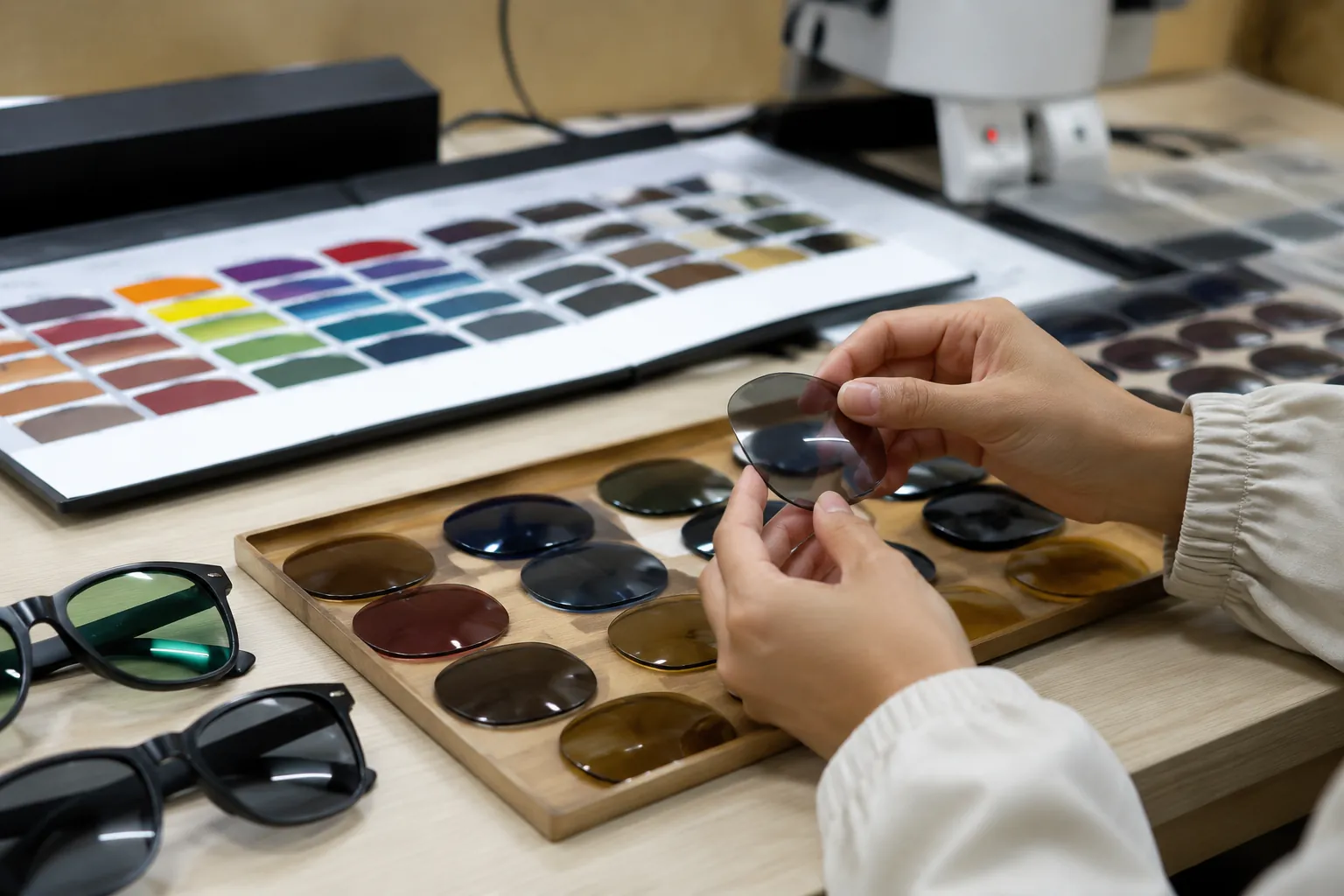
This guide is for brand owners, importers, distributors, and retailers buying custom sunglasses in volume. It explains how solid, gradient, and mirror lenses usually perform by sales channel, then links those choices to MOQ, unit cost, lead time, compliance, and production control. The goal is practical buying guidance. Not trend talk. If you are deciding what to sample first, or trying to reduce problems on repeat orders, this framework will help you ask better questions, approve the right references, and build a cleaner assortment.
Start with channel, not personal taste
Choose lens finish for the selling environment first. Personal preference comes second. Buyers often react to the most eye-catching sample, then discover the channel does not support that finish at scale.
In practice, lens finish affects at least four commercial variables at once: perceived price position, sell-through speed, return or claim risk, and how easily one frame can be repeated across multiple colorways.
Start by sorting the business by channel logic:
- Optical retail and mainstream general retail: solid smoke, solid brown, and a limited gradient offer are usually the safest starting point because these channels tend to prioritize daily wearability and lower return risk.
- Resort, beach, and travel retail: mirror lenses are often more viable because the environment supports impulse buying, brighter frame colors, and a stronger display look.
- Promotional, event, and giveaway programs: solid lenses are usually preferred because they are simpler to match, easier to control, and generally better for deadline-driven bulk runs.
- Fashion boutiques and online fashion brands: gradient and mirror can work well when the frame shape, tint density, and product photography are handled carefully, but SKU discipline matters more because small quantities spread across too many looks make reorders harder to read.
Before choosing a finish, ask three direct questions: where will the product be sold, what price level does that channel support, and what is the main purchase trigger there? Everyday utility, holiday impulse, logo-led promotion, and image-led fashion do not need the same lens plan. Define those conditions clearly. The finish mix gets easier fast.
How solid, gradient, and mirror behave in production
These finishes are not just style choices. They create different production and quality-control demands.
Solid lenses are usually the easiest to control. The main issues are tint consistency, left-right matching, and repeatability from one lot to the next. Because there is no fade pattern or reflective top layer, cosmetic review is simpler than with gradient or mirror.
Gradient lenses require a controlled transition from darker to lighter transmission. That means the supplier must manage process variables consistently and match the visual result to an approved standard. Gradient should usually be approved to a physical sample or controlled reference, not to a digital image. Buyers should expect to review an actual lens standard under consistent lighting.
Mirror lenses add a reflective coating over a base lens. The visual impact is stronger. So is the control burden. Common concerns include reflection consistency, surface scratching during handling, edge rub, and variation in appearance between mirror colors or batches. Mirror programs need clearer packaging and handling instructions than basic solid-lens orders.
Factory structure matters too. If lens tinting or coating is handled inside the supplier's own system, communication and approval are usually more direct. If those steps are outsourced, expect another handoff point and possible extra lead time. Either way, confirm who controls tinting, coating, inspection, and final approval before placing bulk orders.
The commercial takeaway is simple: solid is usually easiest to standardize, gradient needs tighter cosmetic approval, and mirror needs the strongest handling and inspection discipline.
What usually sells best by channel
| Channel | Recommended lens mix | Typical quantity logic | Why it works | Main risk |
|---|---|---|---|---|
| Optical retail | Solid-led, with limited gradient and selective mirror | Depth on a small number of proven lens colors | Daily-wear shades are easier to merchandise and reorder | Too much mirror can make the offer feel novelty-driven |
| Resort and beach shops | Balanced solid and gradient, with a stronger mirror offer | More visual variety for seasonal selling | Mirror has stronger display impact in bright-light environments | High-fashion mirror colors may date quickly |
| Promotional orders | Mostly solid, with limited mirror and little or no gradient | Larger runs on one simplified lens plan | Lower complexity supports cost control and deadline execution | Mirror can add cosmetic reject risk on budget-sensitive rush orders |
| Fashion boutiques | Balanced mix across solid, gradient, and selective mirror | Curated assortment per frame family | Supports styling variety without relying on one finish alone | Too many low-volume SKUs weaken reorder signals |
| Online fashion brands | Solid basics supported by gradient and mirror hero styles | Visual-first assortment with strict photo consistency | Gradient and mirror can create stronger online differentiation | Returns can rise if listing images misrepresent tint density or reflection |
These mixes are not fixed formulas. They are starting points for first orders and seasonal reviews. New buyers often make the same mistake: they treat every finish as commercially equal. It usually is not.
A better approach is to begin with one dependable volume finish, one controlled style finish, and one statement finish only where the channel can support it.
For a new frame family, a practical first sample set is usually:
- One core solid: smoke or brown, depending on the frame and target customer.
- One commercial gradient: a soft smoke or brown gradient that is easy to merchandise.
- One controlled mirror: usually a more commercial mirror tone that can be reviewed for both appearance and handling risk.
That structure keeps sampling focused and makes market feedback easier to read.
Cost, MOQ, and lead-time trade-offs
Lens finish changes cost in three ways: direct process cost, cosmetic reject risk, and execution speed. Keep those factors separate. FOB unit price alone does not tell the full story.
Most suppliers use price ladders, so unit cost usually improves as order volume rises. The exact breakpoints vary by factory, frame construction, lens specification, decoration, and packaging. Ask for quoted price tiers by quantity. Do not assume a low-MOQ order reflects long-run economics.
| Lens finish | Relative cost level | Production sensitivity | Best use case | Lead-time effect |
|---|---|---|---|---|
| Solid | Usually lowest | Low to moderate | Retail basics, promotional programs, repeat orders | Usually the simplest on reorder |
| Gradient | Usually moderate | Moderate | Commercial style upgrade | Can add approval and sorting time |
| Mirror | Usually highest | Highest | Resort, sport, and visual-led fashion | Most likely to increase handling and inspection time |
Lead time follows the same pattern. A solid-lens reorder on an existing frame is usually easier to repeat than a mirrored lens on a new frame with multiple decorations and custom packaging. Late changes make this worse, especially changes to mirror references or protective packing.
Reject cost is the number many buyers underestimate. Mirror can raise perceived value, but it can also require more careful handling, stronger protective packing, and stricter final inspection. If the margin is tight, a solid- or gradient-led assortment may produce a cleaner result than a mirror-heavy order with higher rework or replacement exposure.
How frame material and decoration affect lens choice
Lens finish does not work in isolation. Frame material, surface treatment, and decoration method all change how the product reads at retail.
Injection-molded frames are common in commercial and promotional programs because they support efficient production and broad price access. Solid smoke and solid brown are usually the safest pairings. Mirror can work on sport, beach, or youth-oriented styles, but the frame color and lens color should be reviewed together so the final look does not feel overbuilt or too price-sensitive.
Acetate frames usually carry more visual value through lamination, translucency, crystal effects, or tortoise patterns. Gradient lenses often pair well with acetate because they preserve depth and balance across the front of the frame. Strong mirror finishes on heavily patterned acetate should be sampled carefully. Too much happens at once.
CNC-milled details and metal trim move a frame toward boutique or higher-end fashion positioning. On these styles, small changes in lens density or mirror brightness can change the full front view noticeably. Review should therefore be done on the complete assembled sample, not on isolated lens chips.
Decoration method matters too:
- Pad printing is commonly used for promotional logos and usually fits best with simpler solid-lens programs.
- Laser engraving can support a more permanent and more premium presentation on temples or metal parts.
- Metal logo plates or foil details can raise perceived value, but they also push the style away from low-risk promotional logic and toward a more selective lens plan.
A practical rule is simple: if the frame already has strong visual complexity, keep the lens finish more controlled. If the frame is basic, the lens can do more of the visual work.
Compliance limits what you can sell
Check lens specifications against destination-market requirements before approving final cosmetics. A lens that looks right but does not meet the required standard is not commercially usable.
Relevant supplier and product references in sunglass sourcing can include CE EN ISO 12312-1, ANSI Z80.3, AS/NZS 1067, REACH, FDA registration, ISO 9001, and BSCI. These references do not mean the same thing. Do not treat them as interchangeable.
From a sourcing standpoint, solid, gradient, and mirror lenses can all be compliant if the finished product meets the relevant market requirement. The risk starts when a buyer approves a cosmetic look without confirming the performance standard the actual lens version must satisfy.
- Confirm the market first: define whether the product is intended for the EU, US, Australia/New Zealand, or another destination.
- Confirm the required standard second: align the lens construction and intended use with the applicable performance requirement.
- Approve the exact lens version: compliance should be tied to the actual color, finish, and construction to be sold, not just to the frame shape.
- Keep records by finish: a solid smoke lens and a blue mirror lens on the same frame should be tracked as different approved versions if their specifications differ.
REACH addresses chemical compliance for relevant materials. CE EN ISO 12312-1, ANSI Z80.3, and AS/NZS 1067 relate to sunglass performance, depending on market. FDA registration may appear in supplier documentation requested by some US buyers, but it does not replace product performance verification. ISO 9001 and BSCI relate to management-system or social-audit frameworks rather than sunglass performance approval. Separate these issues early. It saves rework later.
A practical assortment plan for first orders
First orders should be narrow enough to produce usable data. When low quantities are spread across too many finishes, stock depth gets weak, sell-through signals get muddy, and leftovers become more likely. A tighter opening buy usually creates a better base for reorder decisions.
A practical structure looks like this:
- At MOQ level: stay conservative. One solid lens is usually the cleanest test. If style testing matters, place one gradient or one mirror on a separate low-risk design instead of splitting one frame family too thin.
- At mid-volume: add one commercial gradient once the basic frame and target customer are validated, and keep mirror limited unless the channel clearly supports it.
- At higher volume: test frame-color expansion while keeping the lens plan controlled, using the strongest-selling finish as the depth driver and adding style finishes only where the demand case is clear.
Before bulk production, ask for pre-production confirmation on three points: approved lens density, approved mirror reference if used, and the packing method for surface protection. For mirror lenses, that often means clearer instructions on separation and scratch prevention during assembly and carton packing. For gradient lenses, it means approving the fade appearance against a controlled master sample rather than relying on edited images.
Repeat-order discipline matters just as much as the first purchase order. Once a lens standard works, lock the frame color, lens code, decoration method, and packing notes together. That reduces the risk of a reorder being treated as visually similar when the reflection tone, tint depth, or fade appearance has shifted.
Common mistakes that create slow sellers or claims
The same sourcing mistakes show up again and again. Most can be reduced with stronger front-end control.
- Overbuying mirror for mainstream retail: mirror is eye-catching in development, but it can narrow the end-customer audience in more conservative channels.
- Approving gradient from images only: lighting, retouching, and screen settings can distort fade appearance, so digital approval alone is risky.
- Mixing too many finishes at low quantity: shallow depth per SKU makes sell-through harder to read and weakens reorder logic.
- Ignoring compliance until after styling approval: if the selected lens look does not align with the required market standard, development time is lost.
- Using weak packing for mirror lenses: reflective surfaces need better protection during assembly, pouching, and shipping.
- Failing to document the approved standard: when buyers do not tie lens appearance to a physical reference and written packing notes, repeat orders become more vulnerable to drift.
The safest commercial formula for many buyers is simple: solid for volume, gradient for controlled style, and mirror for selective impact.
This approach is not cautious for its own sake. It reflects how these products behave in stores, in production, and on repeat orders. Buyers who treat lens finish as a commercial control point rather than a mood-board choice usually build cleaner assortments and give suppliers clearer execution standards.
Have a custom sunglasses project in mind?
Send us your styles, target market and quantities and we will return a detailed quote with MOQ, lead time and a sample plan.
Get a QuoteWhy source this from Wenzhou with LumiShades
Wenzhou in Zhejiang Province is widely regarded as China’s eyewear manufacturing capital, producing a large share of the world’s sunglasses. That concentration matters to buyers: a deep local supply chain for acetate sheet, hinges, lens blanks, plating and packaging means shorter component lead times, easier color and material matching, and a workforce with decades of eyewear-specific skill. LumiShades has manufactured in this ecosystem since 2009, and our vertical integration — in-house injection molding, acetate cutting, CNC milling, lens tinting, decoration and quality control — means no part of your order is quietly subcontracted to a workshop you cannot audit.
For international buyers, that vertical control translates into accountability. When a single factory owns every step, defects are traced and fixed at source rather than bounced between vendors, and your specifications survive intact from first sample to bulk. We back this with 15+ years of experience, shipments to 60+ countries, more than 5 million pairs produced per year and a 98.5% on-time delivery rate. Our certifications — CE EN ISO 12312-1, FDA registration, ANSI Z80.3, AS/NZS 1067, REACH, ISO 9001 and BSCI audit — mean the compliance documentation your market requires already exists. Explore our manufacturing capabilities and quality control process to see how this works in practice.
Frequently asked questions
Which lens finish is safest for a first bulk order? Solid lenses are usually the safest first choice because they are simpler to color-control, easier to repeat, and generally lower risk in both production and merchandising. For a first order, ask the supplier to quote one solid smoke or solid brown option, confirm the exact lens code on the proforma invoice or specification sheet, and approve a physical reference sample before bulk production.
Do mirror lenses always sell at a higher price? No. Mirror lenses often increase perceived value, especially in resort, sport, and fashion-oriented channels, but that does not guarantee a higher retail price or better sell-through. Buyers should compare the selling environment, target margin, and added handling risk before choosing mirror. A practical step is to test mirror on a limited part of the assortment first, then review sell-through and claim data before expanding it.
How should I split quantities across finishes at MOQ level? At MOQ level, keep the order simple enough to generate clear feedback. The most practical approach is usually one solid lens on the main style. If you want to test a style-led finish, place one gradient or one mirror on a separate low-risk design rather than dividing one frame family into many small finish runs. Ask the supplier to quote each finish separately so you can see the cost difference before committing.
Can gradient lenses meet CE EN ISO 12312-1 or ANSI Z80.3? Yes, if the finished lens construction and performance meet the applicable requirement. Buyers should not assume compliance from appearance alone. Ask the supplier to confirm the target market, identify the exact standard being applied, and link the compliance review to the specific lens color, finish, and construction that will be sold.
What slows down production most: gradient or mirror? Mirror usually creates more production sensitivity because it adds a reflective coating appearance that must also be protected during handling, assembly, and packing. Gradient can also require extra review because the fade must match the approved reference. If speed matters, ask the supplier which finish requires additional inspection or outsourced processing, and confirm the protection method for coated lenses before approving bulk packaging.
Ready to start?
Explore our sport wrap sunglasses or request a quote — our sales team replies within 12 hours.
Request a Quote