
Factory Map for Sunglasses Sourcing
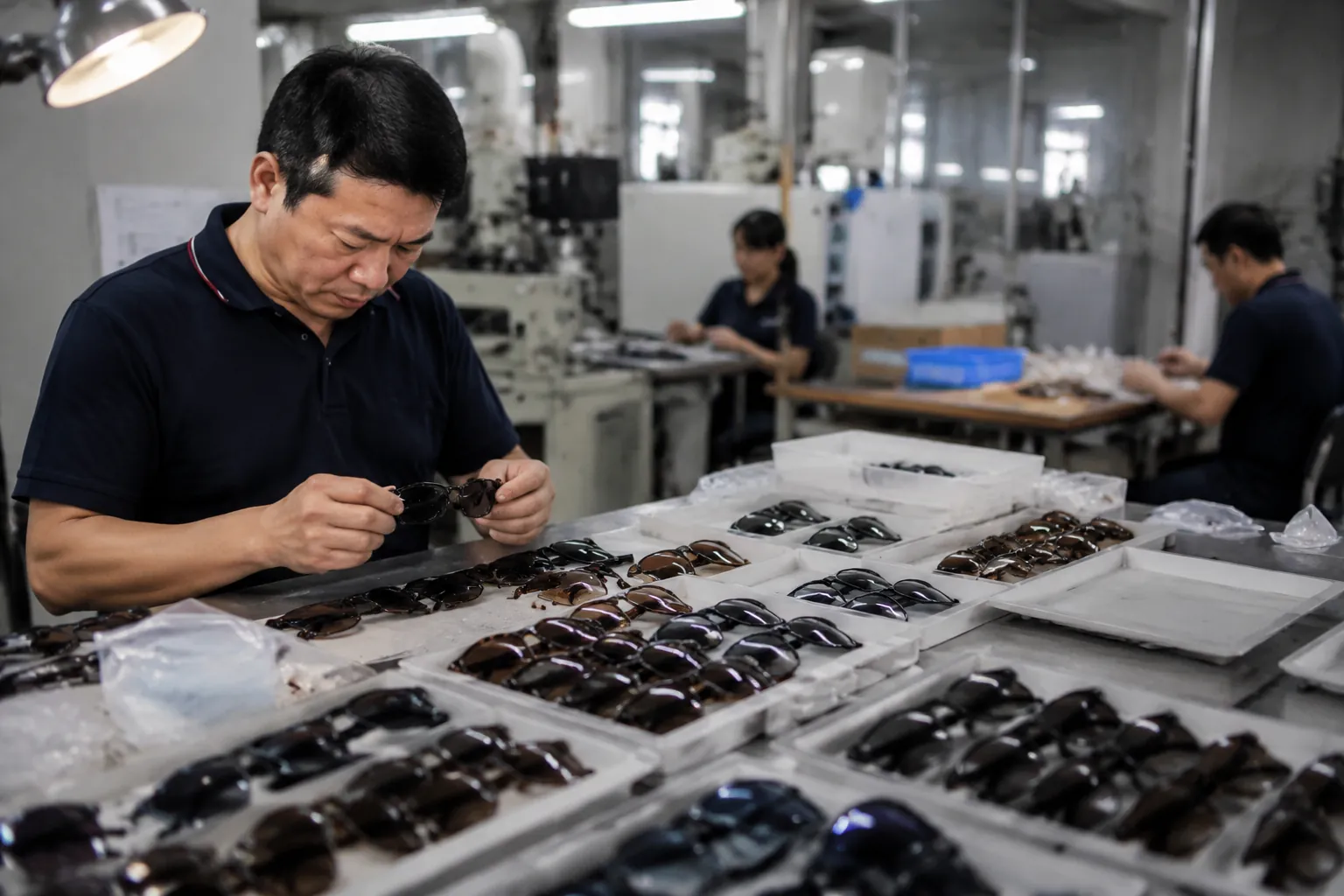
This is for brand owners, importers, distributors, and retailers buying custom sunglasses in volume. The common mistake is structural: acetate, metal, TR90, and mixed-material programs get routed to the same factory even though the tooling, tolerances, decoration methods, and defect modes are different. A better factory map reduces rework, keeps order-size decisions tied to process reality, and lowers the chance that one weak step drags down the whole line. If you source custom sunglasses at scale, this framework helps you match each SKU family to the supplier that can actually control it.
1) Start with material fit, not supplier habit
Most sourcing problems start with a bad assumption: one eyewear factory can handle every frame family with the same control. It cannot. The production physics differ. Acetate depends on cutting accuracy, polishing, and hinge fit. Metal depends on forming, soldering or welding, plating, and straightness. TR90 depends on injection stability, cooling, and mold maintenance. Mixed-material programs add interface risk because two or more process chains have to meet at one assembly point.
Do not start with supplier familiarity. Start with the process the SKU needs. A factory that owns the critical steps can control dimensional drift, surface finish, and final appearance without handing the work to another shop. That matters. Every handoff adds delay, noise, and another place for defects to hide. If the frame warps, the plating peels, or the logo shifts, you want a supplier that can trace the issue back to one process, not three.
Use material fit as the first filter. Then check order size, lead time, compliance coverage, and finishing depth. The lowest unit quote is not the right answer if the process stack does not match the frame type. A factory can be excellent at acetate polishing and weak on plating bath control. It may still produce a good sample and still fail in mass production.
Good suppliers can explain their tolerances and inspection methods without hesitation. For sunglasses, that usually means they can describe how they control front symmetry, temple alignment, hinge feel, lens seating, and surface finish on repeat runs. If they cannot speak in those terms, they are not running a controlled process.
2) Map each frame family to the process it actually needs
Acetate, metal, TR90, and mixed-material SKUs behave differently on the line. The frame family determines the machine set, the defect profile, and the QC checkpoints. Buyers who understand that can split programs cleanly instead of forcing every SKU into one generic RFQ.
| Frame family | Core process needs | Main defect risks | Best-fit supplier profile |
|---|---|---|---|
| Acetate | Sheet cutting, milling, barrel fitting, tumbling or polishing, hinge insertion, lens groove control | Warping after cutting, uneven gloss, hinge pull-out, lens seat inconsistency, left-right mismatch | Factory with stable acetate cutting, finishing, and alignment control |
| Metal | Wire or tube forming, welding or soldering, electroplating, nose pad assembly, temple alignment | Plating inconsistency, weld failure, oxidation, crooked fronts, pad arm drift | Factory with metal forming and plating discipline, plus corrosion testing |
| TR90 | Injection molding, cooling control, gate trimming, hinge reinforcement, flex testing | Short shots, sink marks, brittle hinges, dimensional drift, stress whitening | Factory with stable injection molding, mold maintenance, and process monitoring |
| Mixed material | Injection plus acetate or metal assembly, interface tolerance control, extra inspection stations | Loose interfaces, color mismatch, stress cracks, adhesive failure, fit stack-up errors | Factory that owns multiple processes and final assembly under one QC system |
That table is the starting point, not the whole answer. A supplier can be strong in acetate and weak on plating. Another may make decent metal frames but struggle with lens tint consistency or logo decoration. Ask where the factory actually controls the work. That usually shows what it does well.
Process detail matters. Acetate parts are often cut from sheet stock and then milled before tumbling and hand finishing. Push polishing too hard and edges round off. Hinge pockets loosen. Metal frames depend on consistent welding temperature and plating thickness; thin plating may look fine on day one and fail after sweat or salt exposure. TR90 parts depend on stable mold temperature and proper cooling time. A small change in cooling can move the frame enough to affect lens fit, especially on wrap styles.
If a supplier can show in-process checkpoints, not just final inspection, that is a stronger signal than a polished sales deck. The better factories can explain where scrap is generated and how they keep it from escaping the line.
3) Use order size and pricing bands to split your lineup
Order size is not a side note. It is a production signal. At a small launch size, you are buying flexibility, but you are also paying for setup time, material waste, decoration changeovers, and more manual handling per unit. As volume rises, the line stabilizes. The factory still carries setup burden. At larger repeat sizes, tooling amortization, yield loss, and inspection time spread over more units.
For custom sunglasses, the minimum order usually rises with complexity. A simple one-color acetate style can often launch more easily than a metal style with custom plating or logo engraving. TR90 injection programs may be easy to sample, but a real production run still depends on mold tuning and color lock. Mixed-material programs usually cost more at the low end because assembly is heavier and every interface creates a chance for rework.
Use the bands below as a practical decision tool:
- Put pilot styles, seasonal tests, and color experiments in a small launch band.
- Put proven sellers, repeat colors, and distributor reorders in a repeat band.
- Reserve scale runs for stable shapes, stable lens specs, and low-change programs.
Lead time follows the same logic. Straightforward frames usually move through sample approval faster than decoration-heavy or mixed-material styles. Bulk production should start only after the sample is approved and materials are confirmed. If the order needs new lenses, custom packaging, or special coating, add time. The common mistake is approving a sample, then changing lens tint, logo location, or temple finish after the fact. That resets the schedule.
Pricing should be read as a curve, not a quote. A basic high-volume frame usually improves in unit economics once the factory can run longer without interruption and reduce changeovers. Complex acetate, plated metal, or multi-color mixed-material designs stay above that because the process burden is higher. The buyer job is to separate launch, repeat, and scale programs instead of forcing one price logic onto all three.
4) Build your supplier map around process ownership
The strongest eyewear factories own the steps that create the most variation. That does not mean every process must be in-house, but the critical ones should be close enough to control. The real question is not whether a supplier can source a process. It is whether it can control the process without waiting on another shop and then guessing where the defect came from.
A useful supplier map should show where each SKU family enters, where it is transformed, and where final release happens. If a supplier cannot explain that flow, it is not a specialist. It is a coordinator with a machine list.
- Injection molding: best for TR90 and molded components where shrinkage, cooling, and gate behavior affect fit.
- Acetate cutting: essential for frame shape fidelity, hinge pocket accuracy, and lens seat consistency.
- CNC milling: useful for tighter dimensional control, repeatable profiles, and sharp logo or groove details.
- Lens tinting: important when color consistency and optical appearance need to match across lots.
- Decoration: laser engraving, pad printing, hot stamping, and metal logo plates should be checked for adhesion, placement, and abrasion resistance.
- QC: final inspection should cover dimensions, alignment, surface finish, lens color, torsion, and packaging count.
Process ownership also changes how you read risk. A factory that owns plating can control bath thickness, temperature, and corrosion behavior. A factory that outsources plating can still produce acceptable goods, but the buyer inherits another layer of variability. The same is true for lens tinting and decoration. A supplier that can run those in-house can match color across batches more reliably and correct defects before bulk packing.
The point is not the factory name. The point is that process ownership is where quality control becomes real.
5) Match compliance to the target market before you cut tools
Compliance is not a checkbox at the end. It affects the factory you choose, the lens specification you approve, and the test budget you need. A supplier can make a sample that looks excellent and still be the wrong choice if it cannot support the destination market.
For Europe, buyers typically align to CE marking under EN ISO 12312-1 for sunglasses performance expectations. For the United States, FDA registration may be relevant for the facility or importer, and ANSI Z80.3 is a common product performance reference. For Australia and New Zealand, AS/NZS 1067 is the relevant market standard. REACH matters for chemical restrictions, especially for coatings, plastics, adhesives, and surface finishes. ISO 9001 tells you the factory has a quality system. It does not guarantee that every SKU will be perfect. BSCI matters when social compliance is part of your retail or brand requirement set.
Compliance also touches material choice. Some coatings and printing inks age differently under UV exposure. Some acetate colors vary batch to batch if pigment control is weak. Some metal finishes are more prone to corrosion if the plating stack is thin or the base metal is not properly prepared. These are not abstract concerns. They are the reasons a sample approval can still fail a retailer audit or trigger customer complaints later.
Map the target market first, then confirm the factory can support that market with the right documents, testing routine, and traceability. If you need lab reports, ask whether the factory can supply them for the exact frame family, lens category, and finish you are buying. Do not assume one certificate covers every variant.
6) Read samples like a production manager, not a buyer hoping for the best
Samples tell you more than shape. They tell you how the factory thinks. A sample that looks good but arrives with loose temples, weak printing, or inconsistent tint is not a near miss. It is a warning that the process may be unstable. The supplier may be able to make one pair. The question is whether it can make consistent production lots with the same result.
Inspect samples in a sequence that reflects production risk, not just appearance:
- Frame symmetry and front alignment.
- Temple opening force, hinge feel, and closing consistency.
- Lens seating, edge coverage, and rattle check.
- Decoration placement, sharpness, and adhesion.
- Surface finish under strong light and at oblique angles.
- Packaging fit, count accuracy, and carton protection.
Use measurable checks where possible, and record the actual values against your spec sheet. A temple that opens too loosely may pass visually and still fail in transit. A lens that seats unevenly may not show up until heat exposure or repeated opening and closing. On metal frames, check for plating discoloration, weld marks, and nose pad symmetry. On acetate, look for gate marks, edge polish, and the consistency of left and right temples. On TR90, flex the frame and watch for whitening, hinge stress, or distorted recovery.
First sample cycles for custom sunglasses are usually shorter for straightforward designs and longer when tooling, decoration, or assembly details need adjustment. Bulk production should only begin after the sample is approved, materials are confirmed, and the factory has aligned the final spec with the approved sample. If the supplier promises speed, ask what it is leaving out. Usually the answer is decoration, lens work, or final packing. That is where delays hide.
Do not approve on appearance alone. A sample that only looks good is not enough. It has to prove repeatability in the exact areas that fail at scale: fit, finish, and decoration durability.
7) Use a simple supplier scorecard before awarding the program
Buyers do not need a complicated sourcing model. They need a repeatable one that captures the factors that actually move risk. Score each supplier on process fit, order-size logic, lead-time reliability, compliance readiness, and QC discipline. Keep the weights simple, but adjust them by category. If the line is acetate-heavy, put more weight on cutting, polishing, and hinge insertion. If it is TR90-heavy, put more weight on injection stability, mold maintenance, and dimensional repeatability. If it is mixed-material, weight assembly accuracy and final QC more heavily.
A practical scorecard should include:
- Process fit: Does the factory own the critical steps for your material family?
- Order-size logic: Can it support your launch quantity without distorting unit economics?
- Lead time: Can it hold a realistic schedule once the sample is approved?
- Compliance: Can it support the market standard you actually need?
- QC clarity: Does it show inspection points, defect handling, and release responsibility?
For a new program, the safest route is often to split by family. Put acetate with the factory that cuts and finishes acetate well. Put molded TR90 with the supplier that controls injection well. Put mixed-material or heavily decorated programs with the factory that can manage assembly and decoration without losing alignment. That is how you reduce risk without pretending every factory is the same.
Use sample and bulk data together. If a supplier can show a stable on-time delivery record, low rework, and consistent defect handling, that is more useful than a polished presentation. Delivery discipline matters because it tells you the factory can run a schedule, not just talk about one. For private label sunglasses, consistency is usually worth more than a slightly lower quote.
8) Build the buying decision around repeatability, not one good run
The final mistake is treating an approved sample like proof that the factory is ready for every order. One good run only proves that a specific set of conditions worked once. Repeatability is what matters: the same lens tint, the same hinge tension, the same logo placement, the same packaging count, and the same acceptable defect rate over time.
When a factory is truly matched to the program, it can explain the control points that keep repeatability intact. For acetate, that may mean controlling sheet lots, cutter wear, polishing duration, and hinge press force. For metal, it may mean plating thickness, weld cleanliness, and oxidation checks. For TR90, it may mean mold temperature, cooling time, and dimensional sampling at the start, middle, and end of the run. For mixed-material programs, it may mean interface gauges and extra final inspection at the assembly stage.
That is the real value of a factory specialization map. It helps you place each SKU so you are not paying for the wrong process twice. The right supplier is not the one that says yes to everything. It is the one whose process stack matches your frame family, your target market, and your volume plan.
If you want fewer surprises, keep the buy decision simple: choose the factory that owns the critical process, fits the order-size band, supports the compliance target, and can repeat the result without heroics.
Have a custom sunglasses project in mind?
Send us your styles, target market and quantities and we will return a detailed quote with MOQ, lead time and a sample plan.
Get a QuoteWhy source this from Wenzhou with LumiShades
Wenzhou in Zhejiang Province is widely regarded as China’s eyewear manufacturing capital, producing a large share of the world’s sunglasses. That concentration matters to buyers: a deep local supply chain for acetate sheet, hinges, lens blanks, plating and packaging means shorter component lead times, easier color and material matching, and a workforce with decades of eyewear-specific skill. LumiShades has manufactured in this ecosystem since 2009, and our vertical integration — in-house injection molding, acetate cutting, CNC milling, lens tinting, decoration and quality control — means no part of your order is quietly subcontracted to a workshop you cannot audit.
For international buyers, that vertical control translates into accountability. When a single factory owns every step, defects are traced and fixed at source rather than bounced between vendors, and your specifications survive intact from first sample to bulk. We back this with 15+ years of experience, shipments to 60+ countries, more than 5 million pairs produced per year and a 98.5% on-time delivery rate. Our certifications — CE EN ISO 12312-1, FDA registration, ANSI Z80.3, AS/NZS 1067, REACH, ISO 9001 and BSCI audit — mean the compliance documentation your market requires already exists. Explore our manufacturing capabilities and quality control process to see how this works in practice.
Frequently asked questions
Should I source acetate, metal, and TR90 from one factory or split them? Split them unless one factory clearly owns the critical process for each family and can prove it with in-house control, stable QC, and repeatable output. A strong multi-process supplier is fine, but only if it can show the same discipline on acetate cutting, metal finishing, and TR90 molding, not just a good sample. Ask for a process map, in-process checkpoints, and examples of how it handled past defects.
What order size should I use for a new sunglasses design? Start with the smallest order that still forces the factory to run the real process, not a sample-only shortcut. Use a pilot order to validate fit and finish, a modest launch order to test demand, and a larger repeat order only after the style, lens spec, decoration, and packaging are frozen. The right order size is the one that lets you learn without locking too much inventory into a weak design.
How do I know if a factory is really suitable for TR90? Ask for evidence of injection control, mold maintenance, dimensional inspection, and how the factory manages flex or hinge durability. TR90 is sensitive to cooling, shrinkage, and hinge behavior, so a supplier without stable molding and process monitoring is a weak fit even if the sample looks good. You should also ask how the factory responds when a frame warps or recovers poorly after flexing.
Which compliance documents matter most for overseas buyers? Match the market. Common references are CE marking under EN ISO 12312-1 for Europe, FDA registration where applicable for the U.S., ANSI Z80.3 as a product performance reference for sunglasses, AS/NZS 1067 for Australia and New Zealand, and REACH for chemical restrictions. ISO 9001 and BSCI are useful, but they do not replace product-specific testing or document review for the exact SKU you are buying.
What should I inspect in the first sample? Check symmetry, hinge feel, lens seating, decoration placement, surface finish, and packaging count. Add a flex check for TR90, a plating check for metal, and edge polish plus hinge fit for acetate. Record the actual sample results against your spec sheet and compare them with the factory's promised acceptance criteria. A sample that only looks good is not enough if it cannot hold those details in production.
Ready to start?
Explore our shield & oversized sunglasses or request a quote — our sales team replies within 12 hours.
Request a Quote