
Sunglasses Pricing Ladder for Private Label Buyers
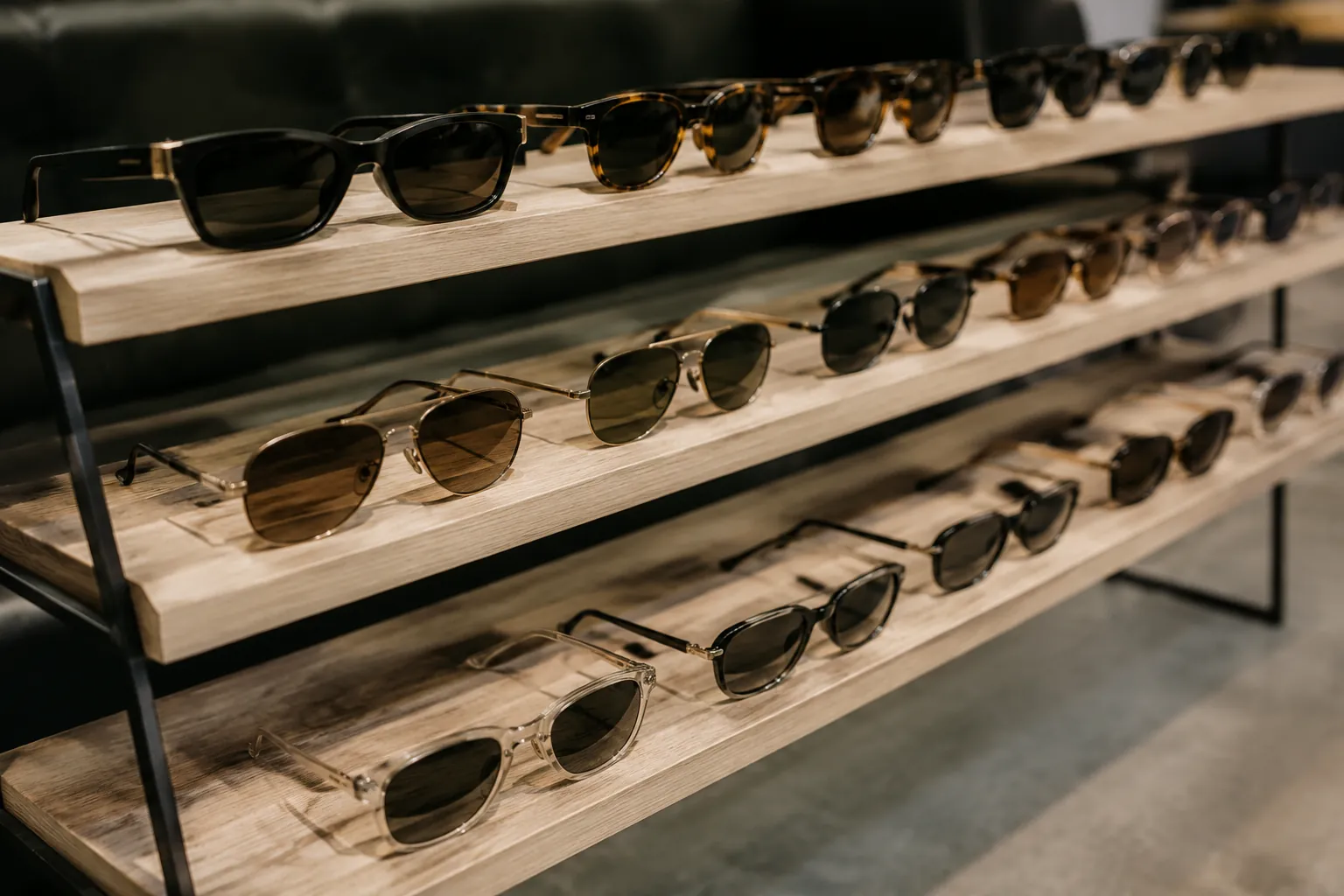
Private-label buyers do not need one sunglasses price. They need a ladder. One price for testing. One for launch. One for volume. One for repeat orders. If you buy for a brand, importer, chain, or online store, the right ladder protects margin and keeps the factory honest on materials, tolerances, decoration, and lead time. This guide shows how to build that ladder using MOQ and production logic sourcing teams can use.
Start With the End Price
A pricing ladder only works if you know the shelf price, wholesale target, or landed-cost ceiling you need to hit. Start there. Work backward. If your retail target is $19.99, $24.99, or $34.99, product cost, freight, duty, packaging, and margin all have to fit inside that number. A low factory quote is useless if it leaves no room for carton packing, inspection, freight swings, or distributor margin.
For sunglasses, the cost ceiling depends on the frame architecture. A basic injected frame with standard TAC lenses, simple temple decoration, and a one-color pouch usually sits in a lower price band. Add acetate, CNC milling, a two-tone temple, polarized lenses, or a metal logo plate, and the cost rises fast. That is fine. It just means the ladder should reflect process reality, not guesses.
Before you quote, separate three numbers: ex-works unit price, landed cost, and gross margin after allowances. A product that lands at $2.80 and sells wholesale at $6.00 may look healthy. It may not be. Inspection, packaging changes, freight variation, and claims can tighten the margin quickly. Leave room.
Buyer rule: price the model, not the sample. Samples are for approval. The ladder is for replenishment.
At LumiShades, the practical starting point is an MOQ of 50 pairs per design. That is enough for a first market test without forcing a large buy. Once the design proves out, the price typically improves at 300, 1000, and 5000+ pairs. Those breakpoints let a buyer launch carefully and improve margin as the style scales.
Use Three Tiers
Most private-label sunglasses programs work better as three tiers rather than one broad catalog. The entry tier covers price-sensitive channels and fast testing. The mid tier is the workhorse. The premium tier carries better materials, tighter finishing, and more room for brand markup. Each tier needs a different process stack. Not just a different price.
| Tier | Typical Build | Process Detail | Buyer Use |
|---|---|---|---|
| Entry | Injected frame, standard TAC lens, one-color print or basic logo | Simple mold, single decoration step, standard pouch or sleeve | Marketplace test, promo drop, opening price point |
| Mid | Injected or acetate frame, improved lens coating, laser engraving or metal plate | More controlled assembly, tighter temple alignment, branded case option | Mainline SKU, repeat order, steady wholesale program |
| Premium | Acetate, CNC milling, polarized or mirrored lens options, upgraded hard case | Higher finish labor, better edge polishing, more detailed QC | Brand collection, gift set, higher ASP channel |
Where buyers go wrong is loading the entry tier with too many embellishments. A laser engraving, metal logo plate, two-color temple tip, and custom packaging on a 50-pair order sounds efficient. It is not. Every extra process adds handling, setup, and reject risk. Keep the entry tier simple. One frame color. One lens color. One logo method. One pack-out. Put the brand story into the mid and premium tiers where the margin can carry it.
Material behavior matters too. Injection-molded frames are usually easier to keep on spec at lower cost, with repeatable geometry and less scrap. Acetate looks richer and polishes well, but it needs longer curing, more trimming, and more finish time. If a supplier says acetate and injection cost the same at the same MOQ, ask how scrap, finishing, and labor are being handled in the quote.
Match MOQ to Risk
An MOQ only matters if it matches launch risk. The real question is simple: does the first buy create enough evidence to justify the next buy? If not, the bottom of the ladder is too expensive.
Private-label sunglasses also need separate MOQs for design, colorway, and decoration. A frame may be feasible at 50 pairs per design, but a custom lens tint or complex logo application can raise the effective MOQ because the factory has to manage additional setup, matching, or cleaning steps across multiple batches. Ask whether the MOQ applies to the frame only, the full colorway, or the full decorated SKU. Do not assume.
- 50 pairs: sample-style launch, niche influencer test, small retail pilot, or a buyer's seasonal check.
- 300 pairs: the first serious production run. Setup work begins spreading across enough units to improve unit cost.
- 1000 pairs: a standard replenishment zone. Packaging, decoration, and assembly usually become more efficient per unit.
- 5000+ pairs: scale buying. This is where pricing often moves close to the low end, depending on spec and pack-out.
Use risk language in your internal planning. A 50-pair order is not a revenue program. It is a validation program. A 300-pair order should answer whether the style converts in your channel. A 1000-pair order should confirm whether the product repeats cleanly across batches. And 5000+ pairs should only happen once the model, color, and packaging are locked.
Do not force every SKU into the same MOQ. If the frame is complex, the lens color count is high, or the logo application needs multiple setups, the effective MOQ rises even if the supplier says 50. Separate design MOQ, colorway MOQ, and artwork MOQ. Otherwise the numbers mislead.
Break Price by Process
Factory price is a sum of processes. Many buyers skip that part. In sunglasses, the gap between one quote and another often comes from process count, scrap rate, and assembly complexity, not the frame alone.
- Injection molding: best for high repeatability and lower unit cost on plastic frames. Tooling tolerances are usually easier to control once the mold is dialed in.
- Acetate cutting: better for thicker, richer-looking frames, but it requires more labor, more polishing, and more waste from trimming and edge finishing.
- CNC milling: used for sharper contours and more controlled shaping, especially where premium edge definition matters.
- Lens tinting: adds cost if you need consistent color matching across batches, especially when the tint target has to stay within a narrow visual window.
- Decoration: laser engraving, pad printing, heat transfer, and metal logo plates each carry different setup and labor loads.
- QC: inspection is not free. Better QC reduces claims, but it still adds labor and time.
Ask the factory to break the quote into frame, lens, decoration, assembly, packaging, and inspection. That is the only way to understand what changes when you move from 300 to 1000 units. If the factory cannot explain the delta, the quote is not transparent enough for comparison.
Process details matter. A simple pad print can be low cost at the machine level, but it can fail visually if the temple surface has residue or if the ink cure window is off. Laser engraving costs more, but it is often cleaner and more durable on matte acetate or coated metal parts. Metal logo plates raise perceived value, but they add adhesive steps and alignment checks. Every method changes the total cost structure.
LumiShades states that injection molding, acetate cutting, CNC milling, lens tinting, decoration, and QC are handled in-house. That matters because fewer handoffs usually mean fewer delays and fewer rework loops. It does not make the product cheap. It gives more control over the build.
Set Margin by Channel
Channel changes the pricing ladder. A distributor does not price like a DTC brand. Retail chains also need room for markdowns, chargebacks, and merchandising support. The same sunglasses frame can work in one channel and fail in another if the margin structure is wrong.
| Channel | Typical Buyer Need | Pricing Priority | Practical Ladder Shape |
|---|---|---|---|
| DTC brand | Healthy gross margin, room for ads and returns | Retail margin protection | Entry SKU to drive traffic, mid SKU for core volume, premium SKU for AOV |
| Importer / distributor | Wholesale resale margin and repeatability | Land cost stability | Fewer SKUs, tighter spec, clearer volume breakpoints |
| Retail chain | Promotion space and planogram control | Consistent fill rate | Three price points with clear visual differences |
| Marketplace seller | Competitive shelf price and fast replenishment | Low landed cost with stable quality | Simple build, minimal decoration, fast reorder path |
Buyers often ask for a premium-looking frame with a low-end margin structure. That fails. If you want a premium story, you need premium cost room. If your target is an aggressive opening price, keep the product simple and build the ladder around repeat orders, not one polished launch sample. Reducing process count is often better than pushing the factory harder on price.
A useful internal rule: if a SKU cannot survive a 10% freight swing and still leave margin, it is too tight. Build the ladder with buffer because freight, duty, carton efficiency, and claims move. Packaging also adds real cost: a simple polybag is very different from a printed carton, microfiber pouch, and rigid case bundle. Packaging belongs in the pricing ladder. Not at the end.
Use Compliance as a Filter
Compliance is not a selling point by itself. It is a gate. If the product cannot pass the required standard for the target market, the price is irrelevant. Build compliance into the spec review before you discuss volume pricing.
Keep the compliance conversation tied to the exact market and product configuration. The references most buyers discuss here are CE EN ISO 12312-1, ANSI Z80.3, AS/NZS 1067, REACH, FDA registration, ISO 9001, and BSCI. CE EN ISO 12312-1 applies to EU sunglasses requirements. ANSI Z80.3 is a key U.S. performance standard. AS/NZS 1067 applies in Australia and New Zealand. REACH addresses restricted substances. FDA registration is part of the U.S. regulatory picture. ISO 9001 and BSCI speak to management-system and social-compliance expectations, but they do not replace product testing.
What buyers often miss is that compliance is tied to the exact configuration. A lens tint, coating, frame resin, or decoration method can affect the approved version. A supplier may show a valid test report, but if your production version uses a different lens material, a darker tint, or a plated logo insert, that report may not map cleanly to the shipped item. Ask which sample was tested, what the material composition was, and whether the decoration or coating method stayed unchanged.
Do not pay for compliance theater. Ask which standard applies to the destination country, whether the report covers the exact model, and how the supplier controls revisions. A good pricing ladder reserves room for compliant materials from the start. Changing lenses or coatings later can hurt margin and delay shipment. It is usually cheaper to build the right spec once than to relabel a questionable batch later.
Tie Price to Lead Time
Price is tied to time. A buyer who needs samples in 7-10 days and bulk in 25-35 days should build the ladder around that timing. Faster changeovers cost more. More decoration steps cost more. Tight color matching costs more. The lower the lead-time risk, the more the quote should reflect it.
For a first program, this timing framework is practical:
- Sample phase: 7-10 days for approval, fit check, and decoration review.
- Pre-production: confirm lens tint, logo placement, packing, and carton marks before bulk.
- Bulk production: 25-35 days depending on material, process count, and order size.
- Reorder: usually shorter if tooling, lens color, and artwork stay unchanged.
That means a pricing ladder should reward repeatability. If the first order is 300 pairs and the reorder is 1000 pairs with the same spec, the second order should usually be priced better. If it is not, ask why. The tooling is already in place and the learning curve has already been paid for. Reorders should not price like first-time experiments.
Lead time also changes with decoration complexity. A single pad print on one temple may add little time. Multi-location branding, serial numbering, or individual retail labeling adds handling and QC. If the artwork requires color matching to a PMS target, the supplier needs a proofing step and possibly an additional press pass. Ask for lead time by process stage, not just one total number.
Watch the calendar too. If a supplier quotes a peak-season or holiday lead time with a low price, ask whether that quote includes decoration, packing, and final inspection. If it does not, the quote is not usable as a planning number.
Use a Ladder You Can Buy
This is a workable structure for many private-label programs. It is not universal. But it gives buyers a clear starting point. The best ladder is one where every step reflects a real operational change: more stable tooling, fewer changeovers, lower decoration complexity, or better packing efficiency.
| Order Size | Spec Level | Price Direction | Best Use |
|---|---|---|---|
| 50 pairs | Simple build, minimal decoration | Highest unit cost | Test market response and confirm fit |
| 300 pairs | Stable build, limited custom work | Noticeable drop | Launch a core SKU |
| 1000 pairs | Repeatable build, fuller branding | Better margin zone | Wholesale and replenishment |
| 5000+ pairs | Locked spec, optimized packing | Best unit cost, depending on spec and pack-out | Scale program and chain supply |
To make the ladder usable, define what is locked at each tier. At 50 pairs, lock only the frame family and one basic logo method. At 300 pairs, lock the lens tint and packaging structure. At 1000 pairs, lock colorway, carton marks, and retail pack. At 5000+ pairs, lock the entire SKU and minimize changes until the next season. That is how the factory becomes more efficient and your cost improves.
Keep the ladder honest. If the price drops but the spec also drops, that is fine. If the price drops and the spec somehow improves, check the quote twice. The goal is not the lowest number. The goal is a structure that lets you launch, validate, and scale without re-sourcing every season.
Have a custom sunglasses project in mind?
Send us your styles, target market and quantities and we will return a detailed quote with MOQ, lead time and a sample plan.
Get a QuoteWhy source this from Wenzhou with LumiShades
Wenzhou in Zhejiang Province is widely regarded as China’s eyewear manufacturing capital, producing a large share of the world’s sunglasses. That concentration matters to buyers: a deep local supply chain for acetate sheet, hinges, lens blanks, plating and packaging means shorter component lead times, easier color and material matching, and a workforce with decades of eyewear-specific skill. LumiShades has manufactured in this ecosystem since 2009, and our vertical integration — in-house injection molding, acetate cutting, CNC milling, lens tinting, decoration and quality control — means no part of your order is quietly subcontracted to a workshop you cannot audit.
For international buyers, that vertical control translates into accountability. When a single factory owns every step, defects are traced and fixed at source rather than bounced between vendors, and your specifications survive intact from first sample to bulk. We back this with 15+ years of experience, shipments to 60+ countries, more than 5 million pairs produced per year and a 98.5% on-time delivery rate. Our certifications — CE EN ISO 12312-1, FDA registration, ANSI Z80.3, AS/NZS 1067, REACH, ISO 9001 and BSCI audit — mean the compliance documentation your market requires already exists. Explore our manufacturing capabilities and quality control process to see how this works in practice.
Frequently asked questions
How many pairs should I order for a first private-label sunglasses test? For a first test, 50 pairs per design is workable if the spec is simple and the goal is market feedback rather than full distribution. If you need multiple colorways, custom lenses, or heavier decoration, the practical quantity often needs to rise because setup and QC are spread across too few units. Before you order, confirm whether the MOQ applies to the frame, the full decorated SKU, or each colorway separately.
What price break should I expect at 300, 1000, and 5000+ pairs? The exact quote depends on frame material, lens tint, decoration, and packaging, but the direction should be consistent: 300 pairs should beat the 50-pair price, 1000 pairs should improve again, and 5000+ should usually be the best unit cost. Ask the supplier to show the price by process line item so you can see whether the lower price comes from volume efficiency or from a spec change.
Which decoration method is cheapest? Simple pad printing is often cheaper than laser engraving or metal logo plates, but the real answer depends on setup size, artwork complexity, and reject risk. If you need low cost, keep the logo simple, reduce process count, and avoid multi-step decoration on a low MOQ. Always compare the total decorated cost, not just the print price.
How do I know if the quote is actually compliant for my market? Ask which exact standard applies to the destination country and request proof tied to the same model configuration. Relevant references for sunglasses in this article are CE EN ISO 12312-1, ANSI Z80.3, AS/NZS 1067, REACH, FDA registration, ISO 9001, and BSCI. Then verify that the tested sample matches your production version for lens material, tint, coating, frame material, and decoration method.
What should I lock before placing a bulk order? Lock the frame material, lens tint, logo method, packaging, carton marks, target delivery window, and approved sample revision before bulk. Also confirm the approved colorway and whether any decoration or coating changes will trigger a new sample or new lead time. If those details move after approval, the price and timeline usually move too.
Ready to start?
Explore our rimless sunglasses or request a quote — our sales team replies within 12 hours.
Request a Quote