
How to Source Interchangeable-Lens Sunglasses
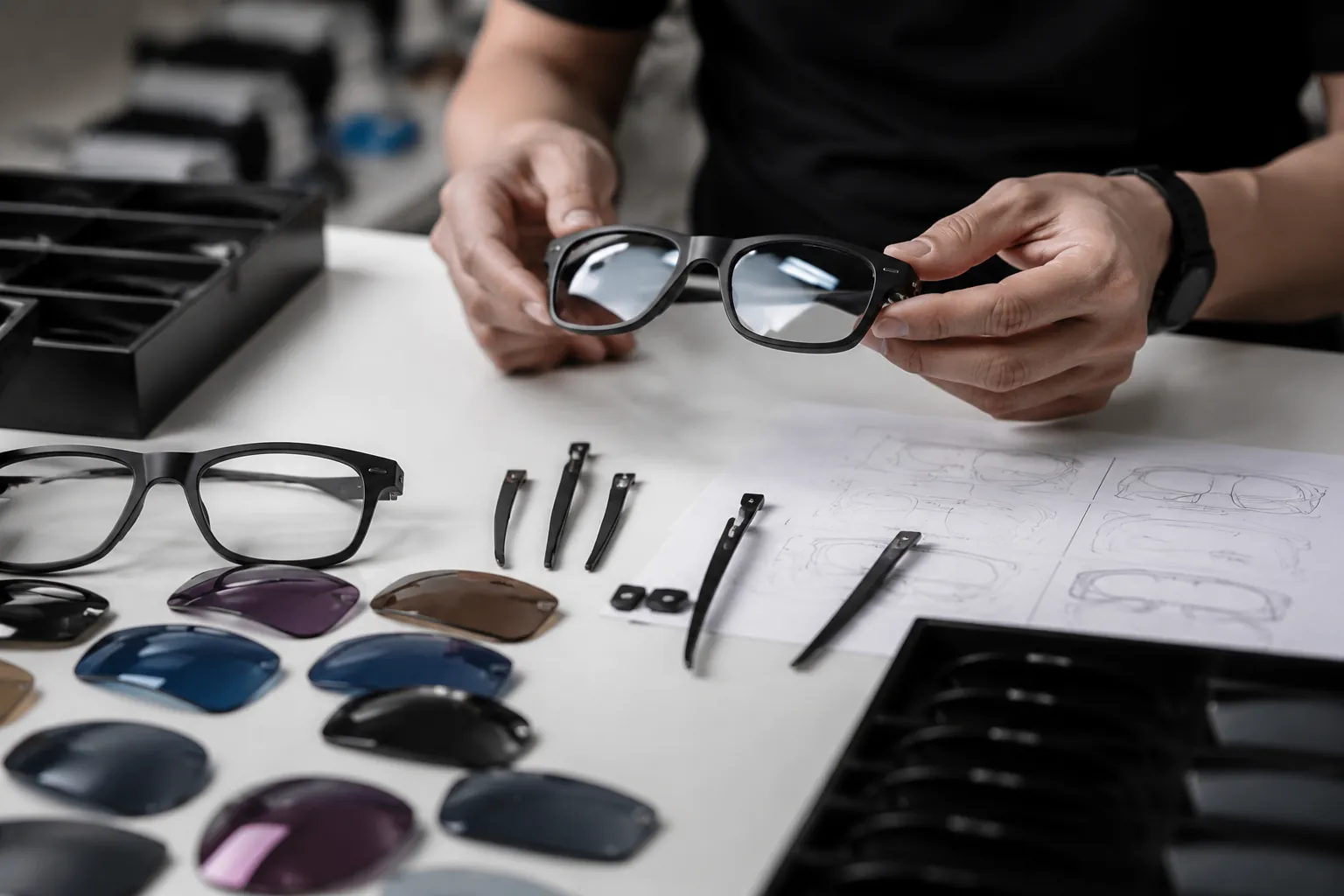
If you buy sunglasses for retail, promo, or private label, interchangeable-lens models can add value without making the product hard to sell—if the frame system is stable. The risk is simple: the wrong build creates loose lenses, poor fit, and returns. This guide covers frame choice, lens-change options, MOQ, pricing, lead times, compliance documents, and QC checks that matter in volume. It also shows where a factory can help control cost, fit, and lead time through repeatable production and clear specifications.
1. Start with the sales job, not the frame
Before you request samples, define the job the sunglasses must do on shelf or in a campaign. Retail and promo buyers may use the same term—"interchangeable lenses"—but they usually need different product behavior. Retail usually needs cleaner fit, stronger lens retention, better optics, and packaging that supports a higher price. Promo usually needs low unit cost, fast decoration, and a frame system that survives handling.
Interchangeable-lens sunglasses are not one product category. In practice, they usually fall into three sourcing jobs:
- Retail core model: one frame, multiple lenses, sold as a higher-ticket SKU with better finish and more consistent fit.
- Seasonal or sport-style add-on: frame plus 2-3 lenses for changing light conditions, usually with stronger retention and a case.
- Promo pack: a simpler frame with one extra lens set, often for events, dealer programs, or loyalty campaigns.
Do not ask for too much. A 4-lens package sounds attractive, but extra lenses increase handling, packing time, breakage risk, and shipping weight. If your target price is low, keep it simple: one frame, one main lens, and one spare lens. Add a hard case only if the margin supports it. Every added lens increases sorting, lint removal, pairing, and packing work.
For private-label buyers, the frame and lens system should match the channel. A distributor selling to optical retailers can justify tighter tolerances, more precise tint control, and stricter cosmetic standards. A school promo or trade-show giveaway usually cannot. Same factory. Different spec. Different acceptance criteria. If you do not define that upfront, you may over-spec a promo item or under-spec a retail one.
A useful sourcing brief should include the target shelf price, intended audience, launch quantity, and the simplest acceptable package. That keeps the factory from quoting against a product you cannot actually sell.
2. Choose the lens-change mechanism that fits your budget
There are four practical mechanisms you will see from eyewear factories. Each has a different cost profile, assembly burden, and failure mode. The right choice depends on how often the user is expected to swap lenses, whether retail staff will handle the product before sale, and how much cosmetic risk you can tolerate.
| Mechanism | Typical use | Cost impact | Typical tolerance target | What can go wrong | Buyer note |
|---|---|---|---|---|---|
| Snap-in front lens | Promo, entry retail | Lowest | Lens opening and lens edge usually need tight control, often around ±0.15-0.25 mm on critical features | Lens can pop out too easily if tolerance is loose; insertion may feel rough if the groove is shallow | Good for simple packs, but requires drop and shake testing before bulk |
| Magnetic lens swap | Mid-tier retail, sport-inspired | Medium | Magnet placement needs consistent polarity and alignment on the critical points | Magnets add cost; alignment must be consistent; corrosion protection must be adequate | Better perceived value, but check pull force, corrosion protection, and any packaging warning language your market may require |
| Side-release frame system | Retail upsell | Medium to high | Clip points and hinge zones usually need tighter process control on critical features | Clip points can wear over time; repeated swaps can loosen retention | Useful where users expect repeated lens changes and are willing to pay for a stronger product story |
| Over-frame insert lens | Promo, safety-style programs | Low to medium | Fit over brow and nose bridge needs broad but stable geometry rather than very fine cosmetic tolerances | Can feel bulky; fit at the nose bridge matters; may look less premium on shelf | Usually easy to source at low MOQ and often the simplest path for a pilot program |
For sunglasses, retention testing matters more than mechanism language. Ask the factory what the pull-out force is, how many open-close cycles they test, and whether they do vibration or drop testing after assembly. The system should survive repeated manual swaps and transit vibration without lenses working loose. If the answer is vague, that is a warning sign.
Ask for the exact assembly method too. Injection-molded frames can hold repeatable geometry well if the mold is stable and the lens opening does not distort during cooling. Acetate frames can look more premium, but lens opening and groove work depend more on cutting and polishing, which adds hand work and cycle time. If you want lower MOQ, injection is usually easier to launch because the geometry is more repeatable from pair to pair. If you want a richer surface finish, acetate can work—but the cutting and finishing spec must be controlled.
As a buyer, ask for three numbers early: the retention target, the acceptable gap or flushness at the lens edge, and the number of cycle tests the factory will run before release. Those details are more useful than marketing terms.
3. Match frame material to your channel and price point
Material choice affects appearance, assembly speed, breakage risk, and how secure the lens change feels. Do not treat acetate, injected plastic, and metal as interchangeable. They behave differently on the line, age differently in wear, and require different QC controls.
- Injection-molded frames: best for repeatable geometry, lower unit cost, and faster scaling. Good for promo and high-volume retail, especially when you need consistent lens retention and shorter lead time.
- Acetate frames: better surface quality and color depth, but they require cutting, edging, polishing, and more hand finishing. Better for retail programs where finish, pattern, and brand perception matter.
- Metal or mixed-material frames: can look premium, but they add assembly steps, solder or screw points, and more risk around alignment. They are usually not the first choice for promo volume.
For interchangeable lenses, the frame material also changes how the retention geometry behaves. Injection-molded plastic frames usually spring back consistently after molding, which helps with snap-in systems. Acetate can deliver a more premium look, but if the bridge, rim, or groove is too thin, the frame can flex during insertion and the lens may feel loose later. If the groove is too deep, the lens swap becomes stiff and the user can chip an edge during insertion.
Here are the practical buyer questions that should be answered before you approve a spec:
- What is the minimum wall thickness at the lens rim and bridge?
- How much flex does the temple-to-front assembly show after lens insertion?
- Will the frame hold retention after repeated swap cycles?
- Can the factory show a cross-section drawing with critical dimensions called out?
For acetate programs, ask whether the lens groove is cut before or after final polishing. If the groove is finished too late, scratches can appear near the rim. If it is cut too early and the final polish changes the geometry, the lens may no longer seat correctly. For injected programs, ask about shrinkage assumptions, because a small shift in the rim can change how the lens clicks into place.
Ask for three things early: frame cross-section photos, retention test results, and a sample pair with the exact intended lens package. A pretty render means little if the lens sits proud, the temple rubs the lens edge, or the swap requires too much force for a retail customer to use comfortably.
4. Build the lens package around actual use, not catalog language
Lens choice drives almost everything customers notice after purchase. For retail, the package often sells because the buyer sees one frame and multiple use cases: bright light, overcast days, driving, or fashion color swaps. For promo, the lens package must be easy to explain in one sentence. "One frame, two looks" works better than a technical description that nobody remembers.
Common lens configurations include:
- Single lens plus spare clear or smoke lens: simple and usually the cheapest to manage. Good for pilot runs and price-sensitive programs.
- 3-lens pack: the most common retail structure; enough variety without turning packing into a problem.
- Mirrored plus tinted mix: looks stronger on shelf, but mirrored coatings need tighter cosmetic control and careful inspection.
Keep tint logic straightforward. Ask for the same base material and vary only color or mirror finish where possible. That reduces changeover risk and helps reorder consistency. If the factory controls lens tint in-house, that can improve repeatability on smoke gray, brown, amber, and gradient tones, because the frame and lens teams can solve fit and color issues in one workflow.
Lens material usually comes down to three practical choices: CR-39 for clarity and good optics, polycarbonate for impact resistance, and TAC for lighter-weight polarized or fashion-oriented builds. For promo and many retail programs, polycarbonate is often the easiest to source because it is durable and widely used. For premium retail, buyers usually care more about optical clarity, surface finish, and coating consistency than material language alone.
Do not overlook thickness. Too thin and the lens can feel flimsy or warp during packing. Too thick and the frame mechanism can bind. In sourcing, lens thickness must match the frame opening, edge bevel, and insertion method. A common risk point is the insert tray: if the tray presses on the lens edge, the product may pass factory fit checks and still fail after heat, compression, or rough transit.
Ask the factory for lens edge finish details, coating stack-up, and whether a polarized build changes lead time. Polarization usually adds cost and inspection time because alignment and cosmetic rejects matter more. If your program is a fashion or promo line, non-polarized tinted lenses may be the better value choice.
5. Know the MOQ, price ladder, and where the real savings come from
For interchangeable-lens sunglasses, cost is not just material. Tooling complexity, extra lens handling, packaging inserts, and QC time all matter. A factory quote only makes sense if it shows how price changes by quantity and by build complexity.
| Order level | Typical buyer use | Cost behavior | Typical lead time | What to optimize |
|---|---|---|---|---|
| 50 pairs/design | Sample run, pilot launch | Highest unit cost because setup and inspection are spread across few units | Usually enough for validation; timing depends on whether tooling, artwork, and lens materials are already ready | Use only to validate fit, colors, logo placement, and packaging |
| 300 pairs/design | Small retail test | Better material and labor spread; enough volume to see real assembly issues | Commonly faster than a larger rollout, depending on decoration and packaging complexity | Limit lens count, keep packaging standard, and avoid multiple frame colors |
| 1,000 pairs/design | Regular purchase | Unit cost usually drops meaningfully as setup and QC are spread more efficiently | Often a standard production window for a final spec with common materials | Standardize frame color and lens set to reduce changeover and rejection |
| 5,000+ pairs/design | Rollout and replenishment | Best unit cost, often near the floor for a simple build | Longer planning may be needed for packaging, coatings, and transport booking | Use one decoration method, one box spec, and repeat orders to lock in process stability |
For a straightforward interchangeable-lens program, a volume price can be competitive when the build is simple and repeatable. Cost increases quickly when you add magnets, extra lenses, molded cases, complex print finishes, or heavy metal branding, because each feature touches more workstations and more QC time.
The fastest way to save money is usually not to slash the frame spec blindly. It is to reduce part count and variability. One lens insert system. One temple print. One pack style. One carton spec. Every extra variant slows production, increases inspection time, and raises the chance of mix-ups during packing.
One more sourcing reality: low MOQ and low price rarely come together unless the product is very simple. If a supplier promises both without explanation, ask how they are covering tooling, sample loss, and QC labor. A reliable factory should explain where the cost comes from instead of pretending it disappeared.
6. Build the sample and QC plan before you place bulk
Samples should prove three things: the lens changes correctly, the frame survives handling, and the decoration looks right. If you skip any of those, bulk risk goes up. The goal is not just a good-looking sample; it is a buildable product that can be repeated without hidden adjustments.
A practical sample plan looks like this:
- Day 1-3: confirm drawings, Pantone or reference colors, lens tint, logo method, and packaging structure.
- Day 4-7: produce the sample frame, lenses, decoration, and any case or pouch.
- Day 7-10: review fit, retention, cosmetics, carton dimensions, and insert instructions.
For bulk, ask for in-process QC at three points: incoming material check, assembly check, and final packing audit. The key checks are simple and should be written into the PO or spec sheet:
- Lens fit and retention force
- Hinge action and temple symmetry
- Surface scratches, sink marks, and flash
- Logo placement and print durability
- Box count, spare lens count, and accessory count
Decoration choice matters more than some buyers expect. Pad printing is usually the lowest-cost logo method for temples or lenses, but it can wear if the surface is heavily handled. Hot stamping can look cleaner on premium acetate, but it needs a compatible finish and a flat enough surface. Laser marking can be durable on some materials, but it is not always the best choice on colored or coated parts. If you want a premium retail feel, soft-touch varnish, metallic inks, or matte spray can help, but each one adds inspection risk and, in some cases, longer drying time.
In-house control over injection molding, acetate cutting, CNC milling, lens tinting, decoration, and QC can reduce handoff errors because the frame, lens, and decoration stages stay in one factory flow instead of moving between multiple suppliers. That does not remove the need for buyer approval, but it makes troubleshooting easier: if a lens is binding, the factory can check the cut, the tint, and the insert geometry in one place.
Ask for an AQL plan if you are buying in volume. For retail, many buyers want tighter cosmetic control than promo buyers, especially on lens scratches and decoration alignment. If the supplier cannot define a reject threshold, the quality system is probably not strong enough for a repeat order.
7. Verify compliance for the target market, not just the sample
Interchangeable-lens sunglasses are still sunglasses. They need the right market compliance, and the paperwork must match the exact product build you actually ship. Do not assume one certificate covers every market or that a report for one lens color covers a different coating or material set.
| Market / buyer need | Relevant compliance | What to check | Common sourcing mistake |
|---|---|---|---|
| EU retail | CE EN ISO 12312-1, REACH | UV protection, general eyewear safety, restricted substances in materials, and whether the report matches the exact SKU | Using a report from a different lens color or frame material |
| U.S. retail / distribution | FDA registration, ANSI Z80.3 | Correct product records and the applicable eyewear performance expectations for the SKU | Assuming marketing claims are enough without the right product documentation |
| Australia / New Zealand | AS/NZS 1067 | Category and lens performance fit for local sale, especially tint and protection class | Reusing an EU file without checking local category requirements |
| Factory system | ISO 9001, BSCI | Quality management and social compliance documentation, audit status, and validity dates | Confusing factory audits with product compliance |
Do not ask for generic "compliant" claims. Ask for the exact standard, the test report or registration type, the issuing lab or authority, the report date, and which SKU it applies to. If the lens package changes, the test relevance can change too. This is especially important with mirrored coatings, tinted inserts, polarized films, and frame materials that may affect material declarations or testing scope.
Simple rule: if the sample looks right but the documents do not match the build, you do not have a sellable product. That is true even if the factory says paperwork can be updated later. In eyewear, later often means after the shipping deadline.
Blunt rule: a product is only compliant when the exact shipped configuration is covered by the exact test file and market document.
8. Use a buyer checklist that prevents expensive mistakes
Interchangeable-lens sunglasses are easy to overcomplicate. Keep the sourcing brief tight and the factory answers concrete. The best programs are usually the boring ones: simple, repeatable, and easy to reorder without changing the build.
- State the sales channel first: retail, promo, distributor, or mixed.
- Lock the lens-change mechanism before artwork.
- Choose injection or acetate based on volume, finish, and repeatability, not preference alone.
- Request sample-fit photos, cross-section drawings, and one physical pair with the exact final lens set.
- Set the MOQ target early: 50, 300, 1,000, or 5,000+.
- Ask how the factory controls lens tint consistency, retention, and scratch rejection.
- Confirm only the compliance documents that apply to the target market: CE EN ISO 12312-1, ANSI Z80.3, AS/NZS 1067, REACH, FDA registration, ISO 9001, and BSCI as relevant.
- Write down acceptance standards for lens fit, print quality, and accessory count before bulk.
For overseas buyers, the useful supplier is the one that keeps the program stable after reorder number two. That means repeatable tooling, clear QC, realistic lead times, and no surprises in packing. If a factory can sample quickly and bulk on a normal production schedule, that is only useful if the same spec can be held across production. If lead time drops because the factory is skipping checks, the savings are false.
The best outcome comes from a tight brief: fixed mechanism, fixed lens package, fixed decoration method, and a clearly defined target price. Buyers who specify clearly usually get fewer revisions, fewer defects, and a product that can be reordered without re-engineering it.
Short version: start with the channel, simplify the mechanism, keep the lens package honest, and build around a price point you can reorder. Fancy is easy to promise. Consistency is what buyers pay for.
Have a custom sunglasses project in mind?
Send us your styles, target market and quantities and we will return a detailed quote with MOQ, lead time and a sample plan.
Get a QuoteWhy source this from Wenzhou with LumiShades
Wenzhou in Zhejiang Province is widely regarded as China’s eyewear manufacturing capital, producing a large share of the world’s sunglasses. That concentration matters to buyers: a deep local supply chain for acetate sheet, hinges, lens blanks, plating and packaging means shorter component lead times, easier color and material matching, and a workforce with decades of eyewear-specific skill. LumiShades has manufactured in this ecosystem since 2009, and our vertical integration — in-house injection molding, acetate cutting, CNC milling, lens tinting, decoration and quality control — means no part of your order is quietly subcontracted to a workshop you cannot audit.
For international buyers, that vertical control translates into accountability. When a single factory owns every step, defects are traced and fixed at source rather than bounced between vendors, and your specifications survive intact from first sample to bulk. We back this with 15+ years of experience, shipments to 60+ countries, more than 5 million pairs produced per year and a 98.5% on-time delivery rate. Our certifications — CE EN ISO 12312-1, FDA registration, ANSI Z80.3, AS/NZS 1067, REACH, ISO 9001 and BSCI audit — mean the compliance documentation your market requires already exists. Explore our manufacturing capabilities and quality control process to see how this works in practice.
Frequently asked questions
What is the best interchangeable-lens system for a promo program under a tight budget? For a tight-budget promo program, start with the simplest system that still passes handling checks: a snap-in front lens or an over-frame insert lens. Keep the package to one frame and one spare lens unless the campaign clearly needs more. Before bulk, ask the factory to show the lens retention result and to confirm the product survives shake and drop handling without the lens loosening. If the answer is vague, the design is probably too risky for promo volume.
How many lenses should I order for a retail SKU? For most retail programs, two or three lenses is the practical range. One main lens plus one or two alternates gives shoppers enough value without making the box, labeling, and fit control too complicated. If you are building a premium sport-style item, you can test a 3-lens package first and only add more if your channel can support the extra cost and packing complexity. More lenses means more labor, more inspection, and more opportunities for mismatch.
Can I start with 50 pairs and still get a workable custom sample? Yes. Fifty pairs is useful for a pilot run or market test, especially if you need to confirm lens fit, decoration, packaging, and basic handling. Treat it as a validation order, not a final commercial setup. Before you approve it, make sure the drawings, lens specification, decoration method, and packaging are already fixed so the pilot tells you something meaningful about the production version.
What lead time should I expect for samples and bulk? A normal sample cycle is often about 7-10 days once artwork, colors, and tooling are ready. Bulk timing depends on quantity and complexity, but a standard build commonly needs several weeks after approval. The more useful question is not just "how fast" but "what changes when the order goes from sample to bulk." Ask whether the same lenses, decoration, and packaging will be used in production, because changes there can extend lead time.
Which documents should I ask for on compliance? Ask for the exact document that matches the exact product you plan to ship. For the relevant market, that may include CE EN ISO 12312-1, REACH, FDA registration, ANSI Z80.3, AS/NZS 1067, ISO 9001, and BSCI where applicable. Check the report date, the issuing body, and the SKU details. If the frame material, lens color, coating, or package changes, confirm whether the same document still applies before you place the order.
Ready to start?
Explore our wayfarer sunglasses or request a quote — our sales team replies within 12 hours.
Request a Quote