
ODM vs Custom Mold Sunglasses: Buyer Decision Guide
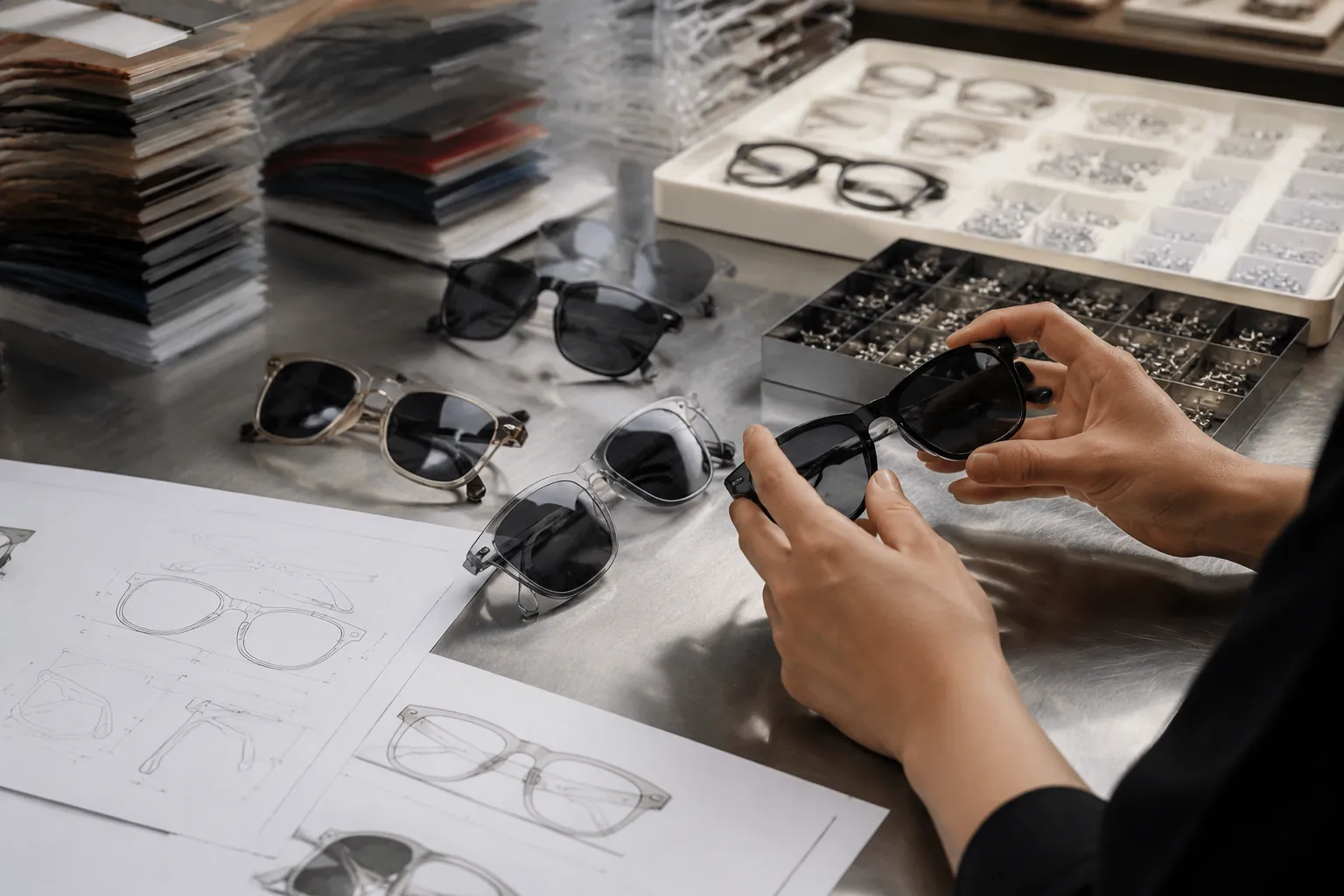
This guide is for overseas brands, importers, distributors, and retailers choosing between an existing factory frame and a new sunglasses design. The better route is not the one that sounds more premium. It is the one that fits your order size, launch date, target cost, destination market, compliance needs, and need for exclusivity. ODM usually protects speed and cash flow. Custom molding gives more control and stronger differentiation, but only when the buyer has enough volume, budget, and repeat-order confidence to support the engineering work.
The Basic Difference: Existing Frame or New Tool
ODM sunglasses use an existing frame shape from a manufacturer's catalog or developed range. The mold, CNC program, or production method already exists. The buyer mainly chooses available materials, colors, lenses, decoration, packaging, and compliance targets. That lowers development risk because the main geometry has already been tested in production: bridge fit, temple opening, hinge seat depth, lens groove, screw position, rim strength, and assembly method.
Custom mold sunglasses start with a new frame shape or a major change to an existing one. The factory must turn a sketch, reference sample, 2D drawing, or 3D file into a frame that can be made at scale. For injection frames, that means checking draft angles, wall thickness, shrinkage, gate position, parting lines, polishing access, and likely deformation. For acetate frames, it means confirming CNC cutting paths, hinge reinforcement, tumbling allowance, polishing loss, lens groove consistency, and heat-adjustment behavior.
The right route depends on the commercial purpose. A short seasonal launch, promotional program, or first category test usually fits ODM. A signature silhouette expected to repeat for several seasons may justify custom tooling or a dedicated acetate program. Start with the business case. Then choose the production route.
Use ODM When Speed, MOQ, and Cash Control Matter
ODM is usually the lower-risk route when the buyer needs a faster launch, wants to test a new category, or cannot yet forecast sell-through by frame and lens color. Sample timing depends on the project, but ODM samples are usually faster than custom-mold samples because the base frame already exists. Bulk timing is also shorter when the buyer uses standard lenses, standard decoration, and standard packaging.
ODM helps control inventory risk. Sunglasses demand is rarely even across SKUs. A buyer may plan several frame colors and lens colors, but the market may reorder only two or three combinations. ODM lets the buyer test color, fit, lens category, packaging, and price position before committing to deep stock or private tooling.
- Good ODM use case: a seasonal retail launch split across several colors or lens options.
- Good ODM use case: testing polarized versus non-polarized lenses before placing a larger reorder.
- Good ODM use case: private label sunglasses with logo printing, pouch, barcode label, and carton marks.
- Poor ODM use case: a protected hero frame that competitors must not be able to buy in similar form.
Do not approve ODM from catalog photos only. Ask for frame width, lens width, bridge size, temple length, hinge type, frame material, lens material, lens category, UV claim, decoration method, and packaging specification. Photos can hide problems: a tight bridge, loose hinge, weak temple return, uneven temple height, or a lens groove that creates assembly stress.
Use a Custom Mold When the Shape Is a Business Asset
A custom mold makes sense when the frame shape is part of the brand identity, when similar catalog frames are not acceptable, or when expected volume can absorb the development cost. If the buyer expects repeat orders over several seasons, tooling or engineering cost becomes easier to spread across units. If the first order is small and there is no repeat plan, private tooling can tie up cash before demand is proven.
The custom route starts with design intake. A factory may receive a physical sample, hand sketch, AI-generated concept, 2D technical drawing, or STEP/STL file. Engineering then checks whether the shape can be produced consistently. Common changes include thickening weak temple zones, widening the lens groove, adjusting the bridge contact area, increasing draft angle for mold release, moving a logo away from a curved stress point, or changing hinge-seat depth so screws hold correctly.
For injection frames, plastic behavior matters. PC, TR90, TPEE, and other materials can shrink, flex, and polish differently during production. Uneven wall thickness can cause sink marks, twisting, poor lens fit, or temple imbalance. For acetate frames, the risk is different. Sheet selection, CNC cutting, tumbling, hand polishing, hinge insertion, and heat adjustment can all change the final fit and surface finish. Leave too little material around the hinge or rim, and the frame may look elegant but fail during assembly, adjustment, or normal wear.
Practical rule: tool your own frame only when the design supports repeat orders, clear brand differentiation, or written commercial protection.
Cost, MOQ, and Lead-Time Comparison
The numbers below are planning ranges only. They are not a substitute for a project quote. Material, lens type, decoration, packaging, inspection, compliance testing, sample revisions, and order allocation all affect price and schedule. The pattern is clear: ODM reduces upfront cost and first-order risk; custom molding gives more control but slows the first launch.
| Route | Typical MOQ | Sample Timing | Bulk Timing | Cost Logic |
|---|---|---|---|---|
| ODM catalog frame | Often lower than custom projects; confirm by frame and color | Usually the fastest route when materials are available | Shorter when using standard lenses, decoration, and packaging | Lowest setup cost; best for fast tests and seasonal orders |
| ODM with custom decoration | Usually depends on logo method, lens, packaging, and color split | Slightly longer than plain ODM if logo tools, print films, or packaging proofs are needed | Similar to ODM if decoration and packing files are approved early | Logo, lens tint, pouch, card, label, and carton customization add moderate cost |
| Modified existing frame | Usually higher than standard ODM because engineering or tooling changes are needed | Depends on whether the change affects tooling, hinge position, lens shape, or decoration placement | Longer than standard ODM if revised parts require trial fitting | Useful for temple changes, logo plates, color exclusivity, or small fit adjustments |
| Full custom injection mold | Best suited to programs with repeat-volume potential | Longer because CAD, tooling, trials, and corrections are required | Starts after approval samples meet fit, lens, color, and compliance requirements | Higher upfront tooling; stronger control over shape, fit, and exclusivity |
| Custom acetate program | Can suit smaller custom runs than injection, but still needs realistic repeat demand | Depends on acetate sheet sourcing, CNC programming, hinge work, and polishing approval | Depends on handwork capacity, color yield, and final adjustment requirements | Less steel tooling than injection, but more handwork, polishing, and fit control |
Separate tooling cost from unit price. A low unit price is not useful if mold cost, sample revisions, inspection, freight, or unsold stock make the first shipment unprofitable. A higher ODM unit price may be smarter if it avoids tooling risk and lets the buyer test demand. Compare landed cost per sellable pair, including tooling amortization, packaging, testing, freight, inspection, duty, and expected defect allowance.
What Changes Technically When You Tool Your Own
Custom mold work is not simply "make this shape." The factory must make a frame that molds or cuts cleanly, accepts lenses without stress, assembles consistently, meets the buyer's compliance plan, and survives normal handling and shipment. Small engineering decisions show up later as scrap, loose hinges, lens popping, crooked temples, coating failure, or returns. That gets expensive fast.
- Design review: confirm lens base curve, bridge fit, pantoscopic angle, temple opening, hinge size, screw length, and logo location.
- 3D engineering: build or clean CAD files, add draft angles, check wall thickness, define parting lines, and estimate shrinkage.
- Prototype: make a CNC or rapid prototype to check silhouette, face fit, decoration placement, and lens shape before cutting mold steel.
- Tooling: cut and polish cavities, test injection flow, confirm gate marks, and correct sink marks, flash, or warpage.
- Trial run: mold or cut a small batch, assemble lenses and hinges, then check temple balance, screw torque, opening resistance, and lens retention.
- Approval sample: lock color, lens tint, UV claim, logo method, packaging, warnings, and compliance test plan before bulk production.
Agree useful tolerance targets before tooling, not after the first trial. Define critical dimensions such as lens groove, hinge location, temple height, screw fit, lens size, and overall front width. Tolerances depend on frame material, lens material, lens thickness, frame construction, and test requirement. The approval process should also include physical checks for temple balance, hinge resistance, lens retention, logo placement, surface finish, and decoration adhesion after normal handling.
Decoration, Lens, and Packaging Choices Affect the Route
Many projects are called "custom" when they are only decoration customization. That may be the right sourcing choice, but name it correctly. Common decoration methods include pad printing for simple logos, laser marking for subtle temple branding, hot stamping for metallic effects, metal logo inlay for a higher-end look, lens logo printing, and custom temple tips or plaques. Each method has its own MOQ, durability, tooling, surface limits, and positioning limits.
Lens choices also affect lead time, cost, and compliance. Standard tinted lenses are usually simpler than polarized, mirror-coated, gradient, or specialty fashion lenses. Polarized lenses require orientation control. Mirror coatings need careful handling because scratches and color variation are more visible. Category claims, UV claims, visible light transmission, and warnings must match the destination market. Approve physical lens color under real light, not only by Pantone reference or screen image.
Packaging can be simple or complex. A polybag and microfiber pouch are faster than retail boxes, printed cards, barcode stickers, instruction leaflets, hangtags, anti-scratch sleeves, and retail-ready carton marks. If the buyer needs marketplace labels, retail barcodes, importer details, country-specific warnings, or language-specific user information, check those files before bulk packing. After cartons are sealed, fixes are slow and costly.
Exclusivity and Compliance Must Be Written Down
Adding a logo to an ODM frame makes the product private label, not private mold. Another buyer may still order the same base frame with a different logo, lens, or packaging unless exclusivity is agreed in writing. If exclusivity matters, define the level before paying the deposit: exclusive color, exclusive decoration, regional exclusivity, fixed-term exclusivity, category exclusivity, or full mold ownership.
Full mold ownership should specify who pays for the tool, where it is stored, whether the factory can use it for other buyers, what happens after a long period with no orders, whether the buyer can move the mold, how repair costs are handled, and whether the mold includes related components such as temples, nose pads, decorative pieces, or lens shape data. Be careful with modified ODM frames. A new temple print or small logo plate does not create true product exclusivity. A redesigned bridge, rim, temple, hinge area, and silhouette supported by dedicated tooling is a stronger case.
Compliance should be decided before sampling. Relevant eyewear requirements may include CE EN ISO 12312-1 for many European sunglass programs, ANSI Z80.3 for non-prescription sunglasses in the United States, AS/NZS 1067 for Australia and New Zealand, REACH for restricted substances in the European market, FDA registration where applicable for U.S. eyewear suppliers or import pathways, ISO 9001 for quality management systems, and BSCI for social compliance audits. The correct requirement depends on product type, lens category, sales market, importer responsibility, and retailer requirements.
- Confirm lens category: identify fashion tint, general-purpose sun lens, polarized lens, mirror coating, or gradient tint.
- Confirm UV claim: do not print UV400 or similar claims unless the tested lens and final batch support them.
- Confirm market labeling: warnings, category marks, importer details, and language requirements differ by destination.
- Confirm material restrictions: check painted parts, metal trims, nose pads, packaging inks, and surface coatings.
A Practical Decision Rule for Buyers
Use ODM if the order is small, timing is tight, the frame is not meant to be protected, or the buyer needs to test demand before committing to tooling. Use a custom mold if the product will repeat, the shape is central to the brand, and the forecast can absorb tooling, sampling, testing, and revision cost without pushing the retail price out of position. The mistake is not choosing ODM or custom. The mistake is choosing before the business case is clear.
For many buyers, the safer path is staged. Start with ODM to test lens color demand, bridge fit, packaging response, return reasons, and reorder speed. Track complaints about hinge tension, temple pressure, nose fit, lens scratches, lens color, coating durability, and color sell-through. If one shape becomes a repeat seller, develop a custom mold around the proven fit while changing enough geometry to create a distinct product.
Reduce procurement risk step by step. Do not guess with a mold if a catalog test can answer the demand question. Do not stay on catalog frames forever if the best seller is easy for competitors to copy. The right answer changes as volume, brand confidence, and exclusivity needs increase.
Have a custom sunglasses project in mind?
Send us your styles, target market and quantities and we will return a detailed quote with MOQ, lead time and a sample plan.
Get a QuoteWhy source this from Wenzhou with LumiShades
Wenzhou in Zhejiang Province is widely regarded as China’s eyewear manufacturing capital, producing a large share of the world’s sunglasses. That concentration matters to buyers: a deep local supply chain for acetate sheet, hinges, lens blanks, plating and packaging means shorter component lead times, easier color and material matching, and a workforce with decades of eyewear-specific skill. LumiShades has manufactured in this ecosystem since 2009, and our vertical integration — in-house injection molding, acetate cutting, CNC milling, lens tinting, decoration and quality control — means no part of your order is quietly subcontracted to a workshop you cannot audit.
For international buyers, that vertical control translates into accountability. When a single factory owns every step, defects are traced and fixed at source rather than bounced between vendors, and your specifications survive intact from first sample to bulk. We back this with 15+ years of experience, shipments to 60+ countries, more than 5 million pairs produced per year and a 98.5% on-time delivery rate. Our certifications — CE EN ISO 12312-1, FDA registration, ANSI Z80.3, AS/NZS 1067, REACH, ISO 9001 and BSCI audit — mean the compliance documentation your market requires already exists. Explore our manufacturing capabilities and quality control process to see how this works in practice.
Frequently asked questions
Can I start with an ODM frame and later make it exclusive? Sometimes, but it must be agreed in writing. Ask the factory whether exclusivity can cover color, decoration, region, sales channel, time period, or the full frame. If you need full shape exclusivity, expect dedicated tooling or a separate mold-ownership agreement rather than a standard ODM order.
What is the smallest practical order for custom mold sunglasses? There is no universal number. It depends on tooling cost, frame material, lens type, selling price, and repeat potential. As a buying rule, do not start private tooling until you have a realistic forecast showing how tooling, sampling, testing, inspection, freight, and defect allowance will be recovered across repeat orders.
How fast can I get samples for an ODM sunglasses order? ODM sampling is usually faster than custom-mold sampling because the base frame already exists. Timing still depends on frame availability, lens choice, logo method, packaging proof, and whether compliance samples are needed. To avoid delay, confirm the exact frame code, color, lens category, UV claim, logo artwork, packaging files, and destination market before sampling starts.
Which compliance documents should I request for Europe and the U.S.? For Europe, ask about CE documentation aligned with EN ISO 12312-1 and check whether REACH applies to frame materials, coatings, inks, trims, and packaging. For the U.S., ask whether ANSI Z80.3 testing is relevant for the sunglass type and whether FDA registration applies to the supplier or import route. Match every document to the exact product, lens, coating, and production batch.
Does a custom logo make an ODM frame private? It makes the product private label, not private mold. Other buyers may still buy the same base frame unless your agreement restricts use of that frame, color, decoration, market, or tooling. If exclusivity matters, put the restriction, territory, term, and penalties in the purchase agreement before paying a deposit.
What details should I approve before bulk production? Approve a physical pre-production sample, not only photos. Check fit, bridge comfort, temple balance, hinge tension, screw security, lens color, lens category, UV claim, logo position, decoration durability, packaging, barcode labels, carton marks, importer information, and market warnings. Keep one approved sample as the production reference.
Ready to start?
Explore our cat-eye sunglasses or request a quote — our sales team replies within 12 hours.
Request a Quote