
Sunglasses Factory RFQ: Capabilities Buyers Must Check
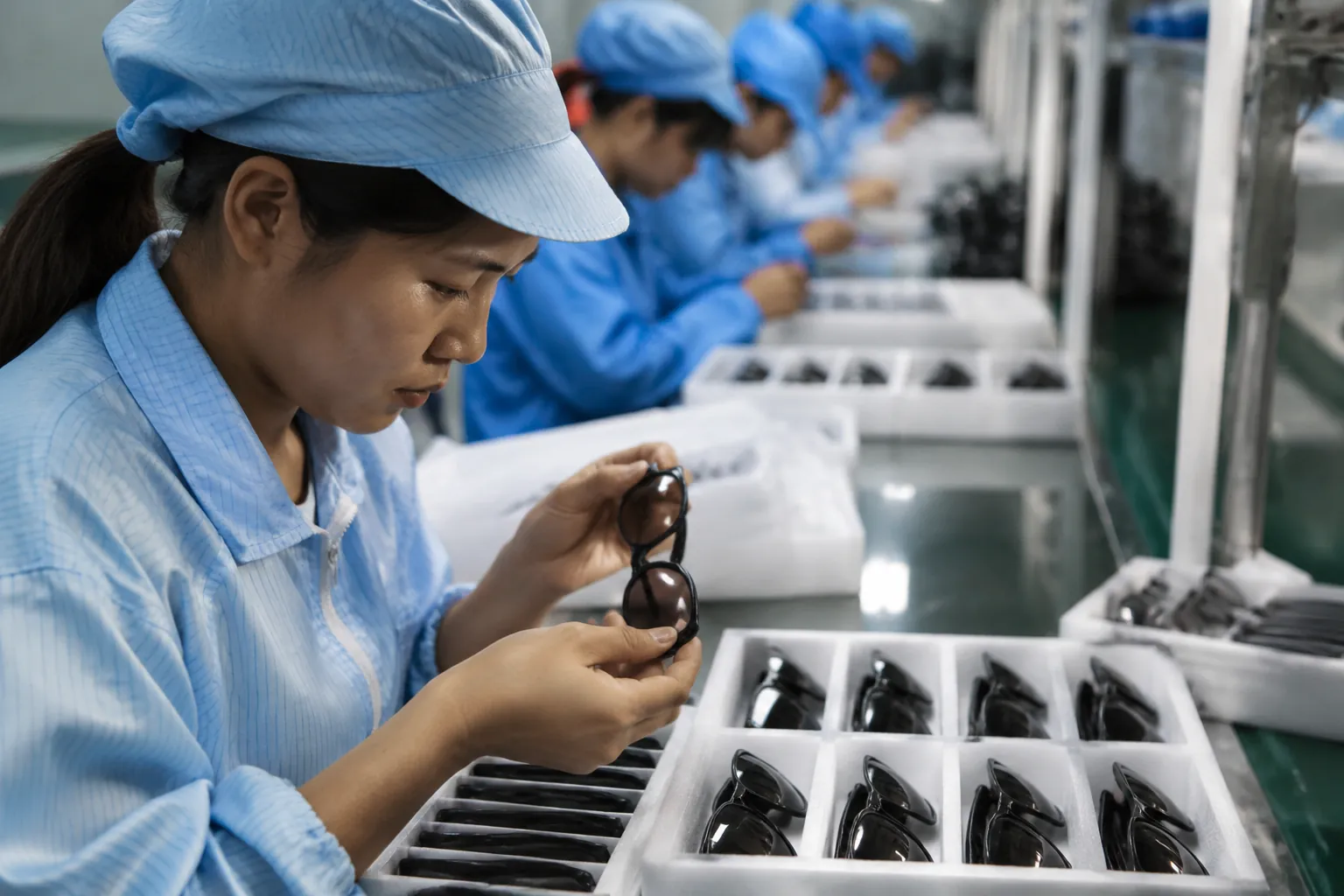
This guide is for overseas brands, importers, distributors, and retailers preparing an RFQ for a sunglasses factory. Use it to check the capabilities that affect unit price, lead time, consistency, compliance risk, and defect responsibility before production starts. It is most useful before you send drawings, reference samples, Pantone targets, lens requirements, packaging files, or logo artwork, especially when comparing low-MOQ suppliers with larger-volume manufacturers in China.
Start With Factory Processes, Not Photos
A catalog shows what a supplier has sold before. It does not prove what the factory controls in production. Before asking for a quote, confirm which processes are in-house and which are subcontracted. For sunglasses, the main chain may include injection molding, acetate cutting, CNC milling, lens sourcing or tinting, decoration, assembly, packing, and QC.
This matters. Every handoff can add delay, communication errors, and dispute risk. Frames may be molded in one workshop, lenses tinted by another supplier, and logos printed by a third party. That can work. But if the temple color is wrong, the polarized lens fails a check, or the logo rubs off after cleaning, responsibility becomes harder to assign unless the process map is clear.
A better RFQ starts with production responsibility, not product photos. Ask which mold will be used, which raw material grade is quoted, which lens material and curve are included, which coating is specified, which logo method is planned, which packing standard applies, and which inspection points are written into the order.
- Ask for a process map for your order, not only a general factory introduction.
- Confirm whether tooling, frames, lenses, decoration, packaging, and final QC are in-house or outsourced.
- Ask where approval samples are produced. A sample made outside the bulk production route is a risk signal.
- Request QC checkpoints by stage, including incoming material, first-piece approval, decoration, assembly, and packed-goods inspection.
Injection Molding Drives Cost and Repeatability
Injection molding is a common route for PC, TR90, and many economy or mid-range sunglass frames. Tooling cost is paid upfront or built into the price structure. Once the mold is stable and the process is controlled, molding is fast, repeatable, and efficient. That is why the unit price usually improves as quantity rises.
Low-MOQ orders often carry a higher unit price. Setup, color matching, machine changeover, lens matching, decoration setup, and QC labor are spread across fewer units. Larger orders can improve material purchasing, fixture use, line planning, and inspection efficiency. Still, the final price depends on frame size, material, mold type, lens material, coating, decoration, packaging, inspection requirements, and freight terms.
Ask practical molding questions. Is the color compounded into the raw material, sprayed after molding, or produced through two-color injection? What is the mold cavity count? How does the factory control shrinkage, hinge insertion, trial shots, and first-piece approval? For TR90, drying and temperature control are critical. Poor control can cause weak parts, surface defects, or dimensional instability. For PC, impact resistance is useful, but surface hardness, warpage control, and lens-fitting precision still need proof.
| Capability | Buyer Impact | Questions to Ask |
|---|---|---|
| Single-color injection | Lower frame cost, shorter cycle time, and stronger repeat-order efficiency | Is the color mixed into the raw material, painted, or coated after molding? |
| TR90 molding | Lightweight flexible frames, with tighter drying and temperature control needed | What drying time, molding temperature range, and shrinkage allowance are used? |
| Two-color or insert molding | Better design effect, higher tooling cost, and more sampling risk | How many mold trials are included before bulk approval, and what changes cost extra? |
| Custom mold development | Higher upfront cost, stronger product ownership, and more repeatable geometry | Who owns the mold, how many cavities are built, where is it stored, and how is maintenance handled? |
Acetate and CNC Decide Finish Quality
Acetate frames are not made like injected plastic frames. Sheets are cut, CNC milled, tumbled, polished, pinned, fitted with hinges, adjusted, and assembled. Acetate can give richer color depth and a more premium hand feel than many injected plastics. It is also less forgiving. Poor cutting leaves uneven rims. Poor polishing rounds off edges that should stay crisp. Poor hinge fitting creates loose temples or uneven opening angles.
For acetate orders, specify sheet thickness, lamination style, color reference, CNC file or approved shape, hinge type, pin position, and finish expectation. A 4 mm sheet and an 8 mm sheet do not behave the same. Thicker acetate usually needs more cutting time, longer tumbling, more polishing labor, and tighter heat control during fitting. If a quote for thick acetate is close to a quote for thin acetate, ask what has changed. It may be material grade, finishing time, tolerance, or another hidden assumption.
CNC milling also matters for metal bridges, logo plates, nose pads, decorative parts, and rim grooves. Small errors are easy to see and feel: a lens sitting proud of the rim, a temple that opens too tightly, or a metal plate that is slightly off-center. Buyers may call the result cheap. The root cause is often tolerance, fixture, or finishing control.
Keep tolerance discussions concrete. For lens fitting, ask how the factory controls groove depth, lens edge size, and frame heating. For temples, ask how left-right balance and opening angle are checked. For acetate polishing, confirm whether logo engraving happens before or after polishing because heavy polishing can soften shallow marks. For premium acetate, approve one raw cut part and one polished part as well as the final assembled sample.
Lens Tinting Is More Than Color
Lenses affect compliance, comfort, product claims, and returns. A dark lens is not automatically a protective lens. Separate lens material, filter category, UV protection, polarization, coating, curvature, thickness, and impact requirements before asking for a price.
Common sunglass lens materials include PC, TAC, nylon, and CR39. PC is widely used where impact resistance and low weight matter. TAC is common for polarized lenses and cost-effective glare reduction. CR39 can offer good optical clarity but is heavier and less impact resistant than PC. Nylon is used in some performance and shield styles and usually costs more than basic PC or TAC options. Lens thickness depends on material, curve, frame construction, and test requirements. Do not assume it.
If you need repeatable lens color across frame colors or repeat orders, write the tint specification clearly. Use terms such as brown gradient category 3, smoke solid category 3, UV400, polarized TAC, mirror coating, anti-scratch coating, or oleophobic coating only when those features are included in the approved sample and test plan. Avoid vague color words such as coffee, tea, or fashion grey unless they are tied to a physical sample or measurable reference.
- CE EN ISO 12312-1: relevant for general-use sunglasses sold into European markets.
- ANSI Z80.3: relevant for non-prescription sunglasses in the United States.
- AS/NZS 1067: relevant for sunglasses sold into Australia and New Zealand.
- FDA registration: relevant for eyewear products entering the U.S. system, but not a substitute for product testing.
- REACH: relevant for restricted substances in frame materials, coatings, inks, and components for the EU market.
Do not rely on "standard lens" as a specification. Ask for lens material, filter category, UV claim, polarization status if applicable, applicable standard, and written confirmation that bulk lenses will match the approved sample and test requirement.
Decoration Changes Scrap Rate and Lead Time
Logos look simple on a PDF. On a curved temple, bridge, lens, pouch, or case, they become a production process. Laser engraving, pad printing, hot stamping, metal logo plates, enamel badges, lens marking, and foil marks all have limits. The right method depends on material, surface curve, order quantity, color contrast, durability expectation, and budget.
Laser engraving can be clean on many acetate, metal, and selected coated parts, but visible contrast depends on the base material and finish. Pad printing is economical for temple logos and color marks, but ink adhesion must be checked on coated, oily, or flexible surfaces. Hot stamping can look premium, but it needs suitable flatness, foil selection, and pressure control. Metal logo plates add perceived value, but they require tooling, positioning fixtures, glue or rivet decisions, plating control, and extra inspection. Lens logos need care. Poor placement can interfere with vision or fail rubbing tests.
For low-MOQ orders, decoration setup can be a large part of the cost. A small trial order with a custom metal plate may look expensive because plate tooling, fixture setup, and alignment labor are spread across few units. At higher quantities, the same method may become more efficient, but only if the process is stable and the defect rate is controlled.
Ask for one decorated pre-production sample before bulk, not only a blank frame. Check logo size, color, position, edge sharpness, adhesion, and resistance to normal cleaning. For printed marks, request a rub check. For metal parts, inspect glue overflow, burrs, plating color, and left-right alignment. If packaging is branded, approve it at the same time. Pouch, case, cloth, barcode, insert card, and carton mistakes can delay shipment as much as frame defects.
QC Must Start Before Final Inspection
Final inspection catches defects late. Stage QC prevents them earlier. A serious sunglasses supplier should be able to explain how it checks incoming materials, first molded or cut parts, lenses, decoration, assembly, and packed goods. If QC only appears at the end, the buyer carries more rework and shipment-delay risk.
For frames, first-piece approval should check color, weight, surface marks, hinge strength, screw tightness, temple symmetry, bridge width, lens fit, and opening angle. For lenses, checks should include tint, filter category, UV performance, surface scratches, polarization if applicable, coating appearance, and optical distortion requirements for non-prescription sunglasses. For decoration, factories should run adhesion and rub checks suited to the method. For packing, barcode, SKU, pouch, cloth, case, instruction sheet, carton mark, country label, and warning label all need confirmation.
Written QC standards matter more than broad promises. Do not accept phrases such as full inspection or strict QC without knowing what is inspected, when it is inspected, who approves it, and what defect limits apply. Many export orders use AQL final inspection, but AQL does not replace first-piece approval, in-process checks, or a signed golden sample.
Practical rule: approve a golden sample, keep one at the factory, keep one with the buyer, and record all accepted deviations in writing. Memory is not a QC system.
Lead Time Depends on Approvals
Lead time should be quoted from clear starting points: sample lead time after complete files are received, and bulk lead time after sample approval, deposit, material confirmation, and packaging approval. A supplier may give a normal timing range. That range only means something when the RFQ package is complete and approval responsibilities are clear.
The slow parts are predictable. New molds need design review, tooling, trial shots, adjustment, and sample confirmation. Custom acetate colors may require sheet sourcing or minimum sheet production. Polarized, mirror, nylon, high-curve, or specialty lenses may need separate lead time. Metal logo plates need tooling and plating approval. Complex packaging needs print proofing and may require carton-size or drop-test checks, depending on the buyer's requirements.
Protect the schedule by sending a complete RFQ package: frame drawing or reference sample, material, Pantone or physical color target, lens material, lens filter category, UV and polarization requirement, logo artwork, decoration method, packing details, compliance market, target quantity, inspection requirement, and shipment destination. Missing details force the supplier to quote with assumptions or pause for clarification. Both create risk.
- Approve frame shape, material, and color first.
- Approve lens material, filter category, UV claim, coating, and curve second.
- Approve logo placement, decoration method, and durability expectation third.
- Approve pouch, case, cloth, barcode, insert card, and carton artwork before bulk assembly starts.
- Book inspection and freight before final cartons are finished.
Compare Quotes Line by Line
The lowest quote is often missing something. The lens may not be polarized. The logo may be printed instead of metal. The MOQ may exclude custom color. The quoted packing may be a polybag instead of a case. Compliance testing may not be included. Normalize quotes before choosing a sunglasses factory.
Put each quote into one sheet with the same columns: frame material, lens material, filter category, UV claim, polarization, coating, decoration method, packaging, MOQ, sample time, bulk time, tooling cost, certification or test support, payment terms, inspection method, defect policy, and freight term. Then compare line by line. It is not exciting work. It prevents expensive misunderstandings.
A practical buying pattern is to use a small order for market testing, retailer presentation, influencer seeding, or a limited drop; move to a larger order after sales proof; and reserve complex tooling or expensive decoration for designs with clearer demand. Do not overcustomize the first test unless the product concept depends on it. Custom metal plates, special lenses, heavy cases, and new molds can make a trial order expensive before the market has validated the style.
Check compliance documents carefully. Relevant standards and systems may include CE EN ISO 12312-1, ANSI Z80.3, AS/NZS 1067, REACH, FDA registration, ISO 9001, and BSCI, depending on the market and buyer requirement. Ask for current documents. Check the holder name, scope, validity date, issuing body, and whether the document applies to the factory system, the material supplier, or the actual sunglass model. A certificate that does not cover your product does not protect your shipment.
Have a custom sunglasses project in mind?
Send us your styles, target market and quantities and we will return a detailed quote with MOQ, lead time and a sample plan.
Get a QuoteWhy source this from Wenzhou with LumiShades
Wenzhou in Zhejiang Province is widely regarded as China’s eyewear manufacturing capital, producing a large share of the world’s sunglasses. That concentration matters to buyers: a deep local supply chain for acetate sheet, hinges, lens blanks, plating and packaging means shorter component lead times, easier color and material matching, and a workforce with decades of eyewear-specific skill. LumiShades has manufactured in this ecosystem since 2009, and our vertical integration — in-house injection molding, acetate cutting, CNC milling, lens tinting, decoration and quality control — means no part of your order is quietly subcontracted to a workshop you cannot audit.
For international buyers, that vertical control translates into accountability. When a single factory owns every step, defects are traced and fixed at source rather than bounced between vendors, and your specifications survive intact from first sample to bulk. We back this with 15+ years of experience, shipments to 60+ countries, more than 5 million pairs produced per year and a 98.5% on-time delivery rate. Our certifications — CE EN ISO 12312-1, FDA registration, ANSI Z80.3, AS/NZS 1067, REACH, ISO 9001 and BSCI audit — mean the compliance documentation your market requires already exists. Explore our manufacturing capabilities and quality control process to see how this works in practice.
Frequently asked questions
What should I send to get an accurate sunglasses quote? Send a frame drawing, tech pack, or physical reference sample; target material; Pantone code or physical color sample; lens material; lens filter category; UV, polarization, coating, and curve requirements; logo artwork in vector format; decoration method; packaging details; order quantity tiers; destination market; required standards; inspection method; and shipment term. If any detail is unknown, ask the supplier to list its assumptions in the quotation.
Is 50 pairs per design enough for a custom sunglasses order? It can be enough for market testing, retailer presentations, influencer samples, or a small retail drop, but it is usually not enough to judge mass-production cost. Expect a higher unit price because setup, material preparation, decoration, machine changeover, sampling, and QC labor are spread across a small quantity. Confirm whether the 50 pairs use stock tooling, custom color, custom lenses, branded packaging, or a simplified specification.
Why does the price drop when order quantity increases? The price often drops because setup work, tooling use, decoration fixtures, color matching, material purchasing, line planning, and QC preparation are shared across more units. The drop is not automatic for every design. It depends on frame size, material, lens type, coating, decoration, packaging, defect rate, inspection level, and whether the factory can run the order without frequent changeovers.
How do I know if the lens meets my market requirement? Specify the target market and standard before sampling, such as CE EN ISO 12312-1 for Europe, ANSI Z80.3 for the United States, or AS/NZS 1067 for Australia and New Zealand. Ask the supplier to confirm lens material, filter category, UV protection claim, polarization result if applicable, coating specification, and the test document that will support the shipment. Make sure the tested lens matches the approved sample and bulk specification.
Should I choose injection molded or acetate sunglasses? Choose injection molded frames when you need lower cost, low weight, faster repeatability, and better efficiency at volume. Choose acetate when you want richer color depth, layered patterns, and a more premium hand feel. Acetate usually needs more cutting, tumbling, polishing, hinge fitting, and adjustment, so compare the finish requirement and production time as well as the unit price.
What is the biggest cause of delay in custom sunglasses orders? Late or incomplete approvals are the most common preventable cause. Frame shape changes, unclear lens specifications, logo revisions, material changes, packaging artwork delays, and missing compliance requirements can stop sampling or bulk production. To reduce risk, approve the frame, lens, decoration, packaging, inspection plan, and shipment details in writing before the factory starts bulk work.
Ready to start?
Explore our aviator sunglasses or request a quote — our sales team replies within 12 hours.
Request a Quote