
Wholesale Sunglasses Price Breaks by Quantity
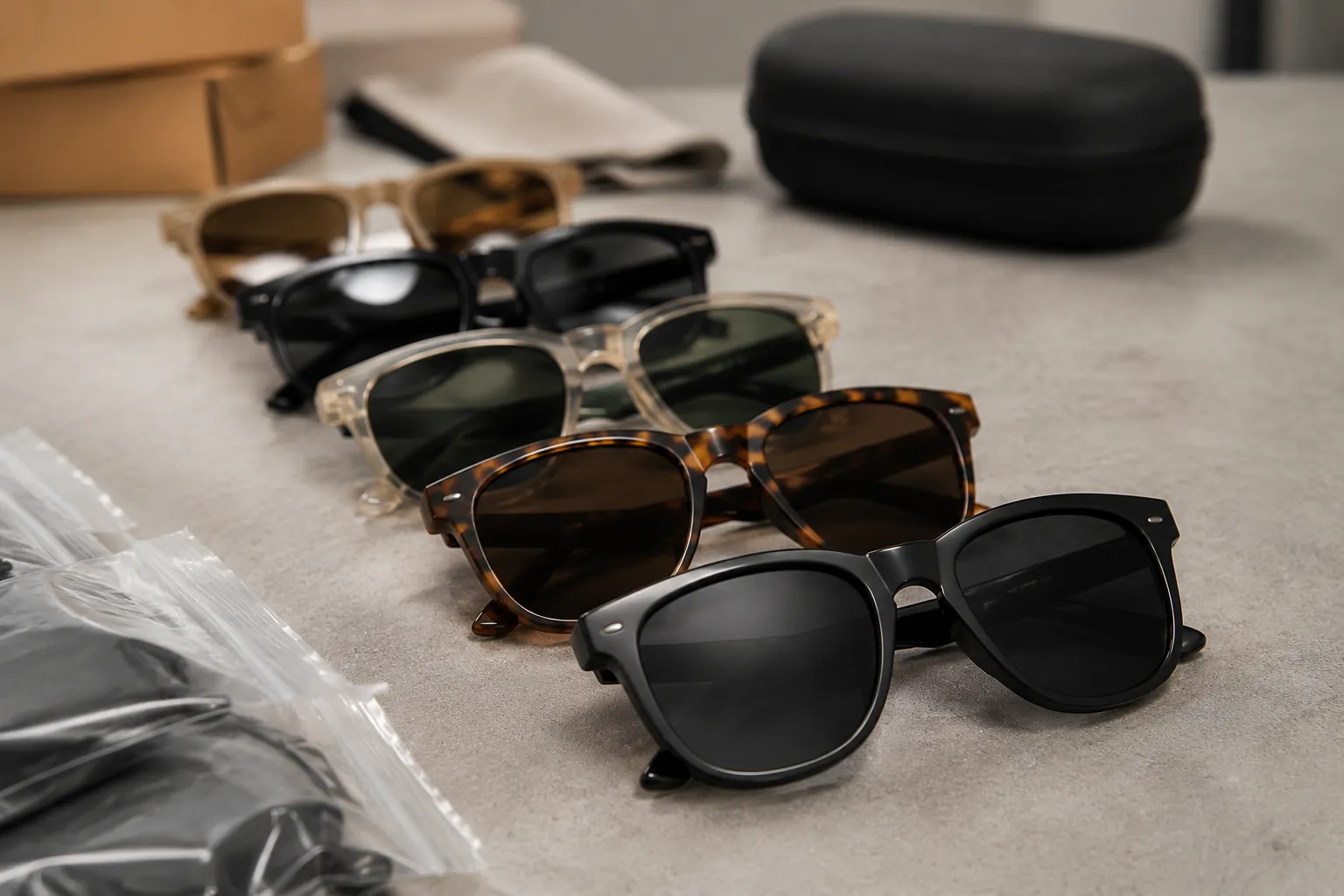
This guide is for overseas eyewear brands, importers, distributors, and retailers planning custom sunglasses orders from China. It explains how 50, 300, 1000, and 5000 pair quantities change factory pricing, production risk, lead time, tooling use, decoration setup, QC workload, compliance planning, and landed margin. The aim is simple: choose an order size that fits confirmed demand and cash flow, not the lowest quoted unit price on paper.
Why Sunglasses Price Breaks Exist
Factory price breaks are not random discounts. They come from spreading fixed work across more pairs: order engineering, material purchasing, mold setup, acetate sheet allocation, lens cutting or tinting, logo setup, packing layout, line QC, carton handling, and export paperwork. Even a 50 pair order needs a specification sheet, artwork confirmation, sample approval, job card, component checks, assembly, inspection, and export packing. Small order. Same basic process.
At LumiShades in Wenzhou, MOQ starts at 50 pairs per design. That tier works for market testing, influencer drops, launch photography, boutique retail trials, and checking fit before a larger buy. Pricing usually improves at 300, 1000, and 5000+ pairs because the factory can buy components more efficiently, reduce changeovers, and keep production running longer. For large basic programs, unit pricing can fall sharply. But the final quote still depends on frame material, lens type, decoration method, packaging, inspection requirements, compliance documents, and color allocation.
Lowest unit price is not always the best deal. If you expect to sell 800 pairs in a season, buying 5000 pairs to save a small amount per unit can create dead stock, storage cost, cash pressure, and markdown risk. A better purchase plan balances unit price, landed cost, sell-through speed, color risk, freight method, and reorder timing.
What Each Quantity Tier Is For
Do not treat 50, 300, 1000, and 5000 pairs as the same project with different totals. Each tier behaves differently at the factory and in your warehouse. Small runs buy flexibility and data. Large runs buy efficiency. But only if demand is real.
| Order tier | Best use | Typical factory logic | Main buyer risk |
|---|---|---|---|
| 50 pairs per design | Fit check, market test, sample launch, niche color | High setup cost per pair; limited color splitting; decoration usually kept simple | Higher unit cost, but low inventory exposure |
| 300 pairs per design | First commercial run, small distributor order, DTC launch | Better material use; logo setup spread across more units; practical first price break | Moderate stock risk if color or channel forecast is wrong |
| 1000 pairs per design | Core style reorder, retailer program, importer batch | Stable line planning; stronger component purchasing; more efficient QC sampling | Requires proven channels, confirmed orders, or reliable sell-through history |
| 5000+ pairs | Chain retail, national promotion, distributor stock, repeat program | Best production efficiency; stronger leverage on packing, lenses, and repeat-volume planning | High cash and inventory exposure if sell-through is weak |
For a new DTC brand with real traffic or retail partners, 300 pairs is often more useful than 50. It gives enough stock to test ads, displays, replenishment, returns, and customer reviews. For importers selling to many small accounts, 1000 pairs can work when the frame is conservative: black, tortoise, smoke lens, brown gradient, or another proven combination. A 5000+ pair order belongs to buyers with retailer commitments, historical reorder data, distributor preorders, or a promotion calendar already agreed.
How MOQ, Color Splits, and Setup Charges Work
Many buyers ask whether 1000 pairs can be split across ten colors or ten models. Technically, maybe. Commercially, it often hurts the quote. Each split adds work. A frame color change may require a resin purge for injection frames or separate acetate sheet allocation for acetate frames. A lens color change means tint control, visible light transmission checks when required, and matching against the approved sample. A different logo color may mean pad-print ink changes, plate handling, or laser parameter adjustment. Too many small splits push the order back toward sample-run economics.
A cleaner quote separates design, color, lens, and decoration as different cost drivers. One frame shape in three colors is usually easier than three frame shapes with three lens colors each. For injection PC or TR frames, resin color changes and mold scheduling matter. For acetate frames, sheet yield matters because small lots can waste material during cutting and CNC milling. For metal temples, hinge parts, or logo plates, plating color and assembly control can affect both cost and lead time.
- 50 pair tier: keep one design tight, usually one color or two colorways, unless you accept a higher unit cost.
- 300 pair tier: two or three colors can work when lenses, hinges, logo method, and packaging stay common.
- 1000 pair tier: use two main colors plus one test color instead of many unproven color guesses.
- 5000+ tier: allocate color by sales data or buyer commitments; do not divide evenly unless demand is actually even.
Ask the factory to quote by line item, not only by total PO quantity. A quote for 1000 pairs in one black frame is not the same as 1000 pairs split into eight colors with different lenses and logo colors. Line-item pricing prevents awkward surprises after sample approval.
Materials and Lens Choices That Move Price
Two orders at the same quantity can land at very different prices. PC and TR injection frames suit volume and promotional programs because molding is repeatable and cycle time is predictable. PC is common for cost-sensitive orders. TR can improve flexibility and comfort. Acetate costs more because sheets are cut, CNC milled, tumbled, polished, pinned, hinged, and hand-finished. Metal details add more steps: stamping, welding, plating, screw assembly, and corrosion-control checks.
Lens choice can move the quote just as much. Basic tinted lenses cost less than polarized lenses. Mirror coating, gradient tinting, category-specific visible light transmission, and special colors need tighter control. A basic promotional lens may be simple to source. Polarized lenses need axis control and distortion checks. Mirror lenses need careful surface inspection because coating scratches and pinholes are easy to see. Gradient lenses need shade consistency from pair to pair, especially for retail displays.
Quote every style with the same specification format: frame material, lens material, lens category, lens color, coating, hinge type, logo method, packaging, labeling, compliance standard, and quantity per color. Without that, you are not comparing prices. You are comparing assumptions. A cheaper quote may exclude better hinges, defined lens performance, reinforced cartons, barcode labels, or compliance support.
Decoration, Packaging, and Tolerances
Logo and packaging choices can change both price and timing. Common decoration methods include pad printing on the temple, laser engraving on metal or coated parts, hot stamping on cases, debossing on pouches, UV printing on packaging, metal logo plates, and custom temple inserts. Pad printing is practical for many small and mid-size runs, but each color needs artwork control and ink setup. Laser engraving looks clean, but the result depends on material surface and contrast. Metal logo plates can look premium, but they require part sourcing, plating, placement control, and stronger QC.
Specify packaging early. A microfiber pouch, paper box, barcode label, hang tag, instruction leaflet, retail sleeve, or display-ready carton can affect cost, carton size, freight weight, and packing labor. For small air shipments, bulky boxes can damage landed cost fast. For sea shipments, carton strength and inner packing matter because poor packing can cause lens scratches, bent temples, and crushed retail boxes.
Tolerances should be realistic and written down. Sunglasses are not aerospace parts. Still, consumers notice crooked fit, uneven temples, loose hinges, sharp edges, and visible lens flaws. Typical QC checks include temple opening consistency, lens seating, hinge smoothness, screw tightness, frame symmetry, logo position, edge finishing, polishing quality, and lens surface defects. For branded orders, define the approved pre-production sample as the control standard and record acceptable visual differences for color, lens tint, and logo placement.
Plan Margin With Landed Cost
Factory price is only the starting point. Your buying decision should use landed cost: product, packaging, inland handling, inspection if separate, export charges, freight, duty, import brokerage, warehousing, and local delivery. A low factory price can rise quickly after air freight, duty, and domestic handling. Sea freight reduces cost on volume orders, but it needs earlier planning and a longer cash cycle.
Build margin from the shelf price backward. If a retailer sells a pair at $19.99, the brand may sell wholesale at $8 to $10 depending on channel and retailer margin. If landed cost is $3.20, the program may work. If small-run complexity, premium packaging, air freight, and decoration push landed cost to $6.00, the same retail price gets tight. Decoration should raise perceived value or support brand recognition. If it does neither, cut it.
- Set target retail and wholesale price by channel.
- Estimate landed cost by order tier, not only FOB or EXW price.
- Separate packaging costs: pouch, box, barcode, hang tag, manual, carton marks, and inserts.
- Check whether polarized lenses, mirror coating, custom plates, or premium hinges justify the added cost.
- Reserve margin for defects, returns, markdowns, slow colors, retailer chargebacks, and replacement stock.
For distributors, a 300 pair commercial test followed by a 1000 or 5000 pair reorder is often safer than jumping straight to volume. The first run costs more per pair, but it buys sales data. That data matters if it keeps the wrong color out of your warehouse.
Sample Timing, QC, and Compliance
LumiShades typically makes samples in 7 to 10 days and bulk orders in 25 to 35 days after approval. Treat those as planning ranges, not fixed promises. Timing depends on clear artwork, available materials, confirmed lenses, approved packaging, testing needs, and no late specification changes. Custom acetate colors, special metal parts, new packaging, strict retailer labeling, or third-party testing can add time. For 50 or 300 pairs, the critical path is usually sample approval and logo setup. For 1000 and 5000+ pairs, material procurement, production scheduling, lens processing, and final inspection matter more.
A normal project flow is straightforward: confirm design and specification sheet, make pre-production sample, approve frame fit and logo placement, confirm lens category and compliance needs, release bulk materials, produce frames, process lenses, assemble, inspect, pack, and book shipment. It works when approvals are clean. Problems start when buyers approve the frame but keep changing lens tint, logo size, packaging text, barcode format, or carton marks.
QC should be built into the order, not reduced to a final photo. LumiShades runs in-house QC across molding, acetate processing, CNC work, lens tinting, decoration, assembly, and packing. Common inspection points include lens scratches, frame deformation, loose hinges, sharp edges, incorrect logo placement, color mismatch, poor pad printing, lens popping, barcode errors, and carton damage. For larger orders, use an AQL plan or the retailer inspection standard written into the purchase order.
Compliance must match the destination market and the product claim. For Europe, sunglasses are commonly checked against CE requirements and EN ISO 12312-1. For the United States, buyers should confirm FDA registration requirements and align performance with ANSI Z80.3 where applicable. Australia and New Zealand programs may require AS/NZS 1067. REACH matters for restricted substances in frame materials, coatings, and components. LumiShades can support CE EN ISO 12312-1, FDA registration, ANSI Z80.3, AS/NZS 1067, REACH, ISO 9001, and BSCI documentation when the order requires them.
Buyer rule: approve the sample, specification sheet, packaging file, inspection standard, and compliance requirement before deposit. Change any of them after production starts, and cost or timing may change too.
A Practical Buying Plan for Growth
A sensible buying path starts with the smallest run that proves demand, then moves volume into the styles that sell. For a new DTC brand, that may mean 50 pairs for content, fit testing, and early customer feedback, then 300 pairs for a controlled launch. For an importer with existing accounts, it may mean skipping the tiny test and ordering 1000 pairs across two or three proven colorways.
At 5000+ pairs, negotiate the full program, not just one SKU. Discuss annual forecast, repeat-order timing, color allocation, spare parts, carton packing, inspection timing, payment schedule, delivery windows, and any certification or retailer compliance file needed before shipment. These talks are only useful when the purchase order is clean: fixed specs, approved samples, realistic delivery dates, and a shipping plan that matches the sales calendar.
Use a tiered forecast. Put confirmed orders in one column, likely orders in another, and speculative stock in a third. Buy confirmed and likely demand first. Keep speculative stock in safe colors and classic shapes. Fashion colors, unusual lens tints, and experimental silhouettes should prove themselves in smaller tests.
Strong buyers do not simply ask for the lowest price. They ask what changes at 300, 1000, and 5000 pairs, then structure the PO around real factory efficiency. That protects margin without filling a warehouse with sunglasses nobody asked for.
Have a custom sunglasses project in mind?
Send us your styles, target market and quantities and we will return a detailed quote with MOQ, lead time and a sample plan.
Get a QuoteWhy source this from Wenzhou with LumiShades
Wenzhou in Zhejiang Province is widely regarded as China’s eyewear manufacturing capital, producing a large share of the world’s sunglasses. That concentration matters to buyers: a deep local supply chain for acetate sheet, hinges, lens blanks, plating and packaging means shorter component lead times, easier color and material matching, and a workforce with decades of eyewear-specific skill. LumiShades has manufactured in this ecosystem since 2009, and our vertical integration — in-house injection molding, acetate cutting, CNC milling, lens tinting, decoration and quality control — means no part of your order is quietly subcontracted to a workshop you cannot audit.
For international buyers, that vertical control translates into accountability. When a single factory owns every step, defects are traced and fixed at source rather than bounced between vendors, and your specifications survive intact from first sample to bulk. We back this with 15+ years of experience, shipments to 60+ countries, more than 5 million pairs produced per year and a 98.5% on-time delivery rate. Our certifications — CE EN ISO 12312-1, FDA registration, ANSI Z80.3, AS/NZS 1067, REACH, ISO 9001 and BSCI audit — mean the compliance documentation your market requires already exists. Explore our manufacturing capabilities and quality control process to see how this works in practice.
Frequently asked questions
Can I order 50 pairs with my own logo? Yes. LumiShades MOQ starts at 50 pairs per design. Before quoting, confirm the frame model, color, lens type, logo size, logo position, logo method, and packaging. For small runs, pad printing and laser engraving are usually the most practical options. Metal plates, multi-color logos, and complex packaging can raise cost or extend timing.
At what quantity does sunglasses pricing usually improve meaningfully? Pricing usually starts improving at 300 pairs, improves again at 1000 pairs, and is strongest at 5000+ pairs. The actual break depends on whether the order uses one design or many, how colors are split, whether lenses and packaging stay common, and whether the factory can reduce setup changes. Ask for line-item quotes at 50, 300, 1000, and 5000 pairs using the same specification.
Can I split 1000 pairs across many colors? You can split the order, but too many colors reduce factory efficiency and may increase unit cost. A practical structure is two main colors plus one test color, using the same lens type, hinge, logo method, and packaging. Ask the factory to confirm the minimum quantity per color before approving artwork or paying a deposit.
How long should I plan from sample to shipment? Plan samples at about 7 to 10 days and bulk production at about 25 to 35 days after final approval, before freight, customs clearance, and local delivery. Add time for custom materials, special packaging, third-party testing, retailer labeling, or late artwork changes. Do not book launch dates until the approved sample, specification sheet, packaging file, and shipping method are confirmed.
Which compliance documents should I ask for? Ask based on destination market and sales channel. For Europe, request CE documentation and EN ISO 12312-1 support. For the US, confirm FDA registration requirements and ANSI Z80.3 alignment where applicable. For Australia and New Zealand, check AS/NZS 1067. For restricted substances, request REACH support. If a retailer has its own standard, share it with the factory before sampling.
Should I start with 300 pairs or go straight to 1000 pairs? Use 300 pairs if demand is not proven, if you are still testing colors, or if your sales channel is new. Use 1000 pairs when you have confirmed retailer orders, distributor commitments, historical sales, or ad data that supports the quantity. Compare landed cost, not just factory price, and make sure cash flow can cover production, freight, duty, storage, and possible markdowns.
Ready to start?
Explore our aviator sunglasses or request a quote — our sales team replies within 12 hours.
Request a Quote