
Sourcing sunglasses with interchangeable temples
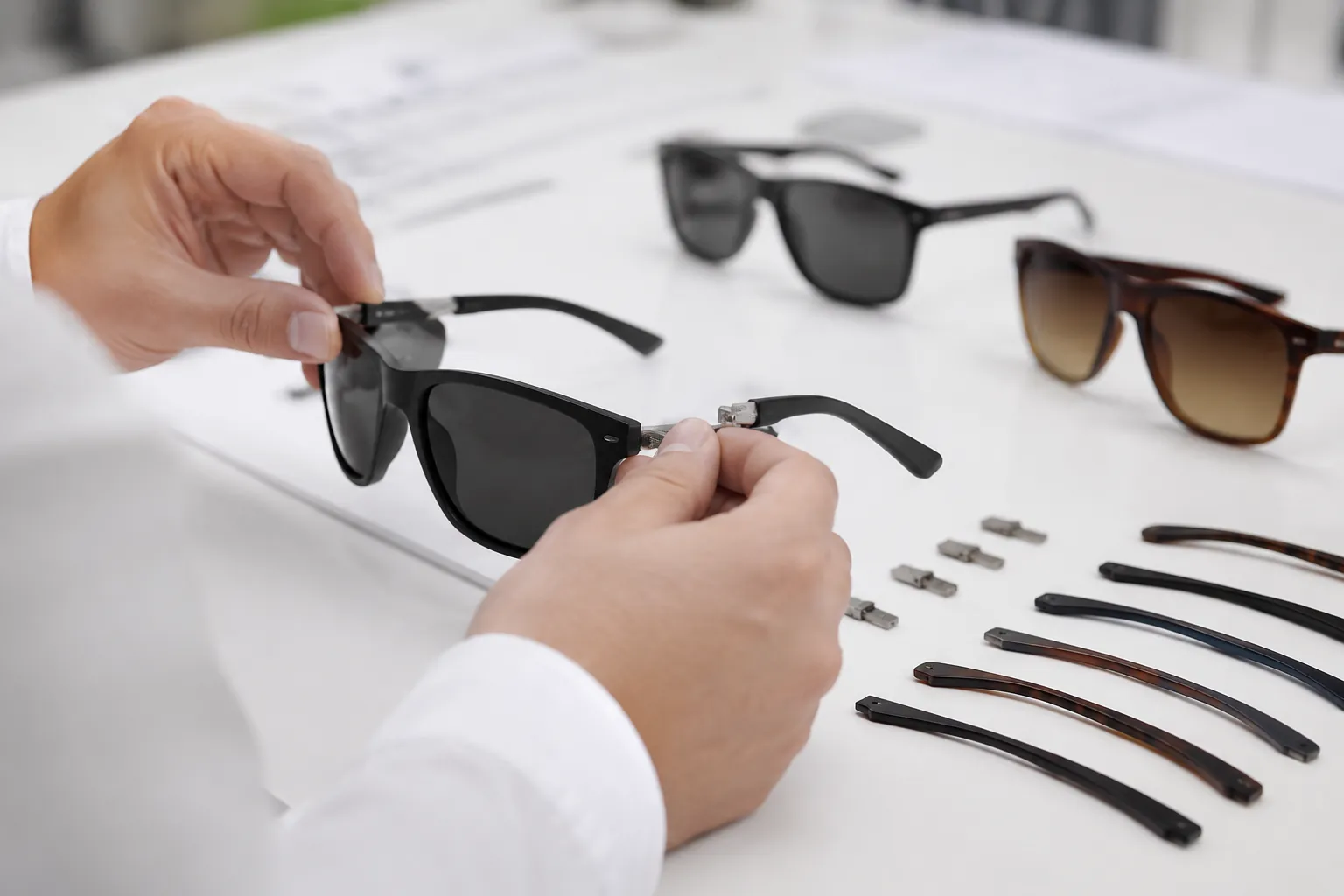
If you buy sunglasses for a brand, chain, or distributor, interchangeable temples can help you build more colorways, fit options, and market-specific versions from one core frame. That is useful, but only if the hinge interface, tolerances, materials, decoration, and QC are treated as one system. This guide covers how to source interchangeable-temple sunglasses, what to specify in your tech pack, and where the savings are real versus where they disappear into rework.
Why interchangeable temples are worth sourcing
Interchangeable temples let you keep the front frame stable while swapping side arms for different colors, finishes, logos, or fit details. For B2B buyers, the main value is SKU expansion without paying for a full new front tool for every variation. You reuse the same lens size, bridge geometry, and silhouette. Only the parts meant to change actually change.
This helps brands testing a new market, importers building a seasonal line, and retailers who need more shelf variety from one platform. A single base style can become a product family: one front, several temple colors, different logo treatments, and alternate surface finishes. That setup improves sourcing efficiency because the expensive development work stays shared.
But interchangeable does not mean simple. The temple-to-front interface must be tight enough to avoid wobble, but not so tight that assembly slows down or damages the hinge area. In practice, the best programs control three things together: geometry, finish build-up, and assembly repeatability.
Most buyers save more by reusing the front platform than by chasing small cuts across every colorway.
Volume changes the math. At low quantities, the platform approach still helps, but the savings are limited because setup and sampling are spread across fewer pairs. At higher volume, the benefit becomes clearer. Tooling, approval, and changeover effort are amortized across more units.
The three common construction options
Factories usually build interchangeable temples in one of three ways. The wrong choice can create fit problems or rework, so the construction should match the channel, volume, and price target.
| Option | Best for | Typical tooling impact | Main trade-off |
|---|---|---|---|
| Standard hinge + swap temple set | Low to mid volume, simple private label programs | Lowest | Temple alignment and screw torque must be controlled |
| Quick-release temple design | Fashion lines, promotional sets, color-swap retail programs | Medium | More moving parts and more wear points over time |
| Modular frame system with replaceable side arms | Premium programs, fit-focused collections, repeat-purchase concepts | Highest | More engineering, slower sampling, stricter tolerance stack-up |
For many overseas buyers, the standard hinge + swap temple set is the safest starting point. It uses normal eyewear hardware, stays close to a factory's standard flow, and lowers the chance that the order turns into a development project. The exact interface gap, torque, and fit target should be defined by the supplier's engineering team for the chosen material and hinge type.
Quick-release parts can work in fashion programs, but only if the supplier already has a proven mechanism and can show repeatable samples. Otherwise, expect more sample rounds and a longer development cycle. Modular systems fit better when fit performance or premium positioning matters, but they need more engineering and tighter tolerance control.
What to specify on your tech pack
If you want interchangeable temples to work in production, your tech pack must define the control points clearly. A visual sketch is not enough. The factory needs measurable targets so engineering, tooling, decoration, and QC are aligned.
At minimum, specify:
- Temple length: nominal length plus tolerance, for example 145 mm ± 1.0 mm
- Temple opening angle: the intended opening range for the style
- Hinge type: fixed metal hinge, spring hinge, or screw-fixed hinge
- Temple end shape: straight, curved, or wrapped tip
- Interchange method: screw swap, snap fit, pin release, or detachable arm
- Material pairing: acetate front with acetate temples, injection front with TR90 temples, or mixed-material build
- Finish requirement: glossy, matte, rubberized, soft-touch, or UV-coated surface
- Logo method: laser engraving, pad printing, hot stamping, or metal logo plate
Also specify the assembly sequence. Ask whether the hinge is installed before or after polishing, before or after painting, and before or after final QC. That matters because a part that fits on paper can bind after coating adds thickness, or after polishing changes the contact surface. Laser engraving on a finished surface can also affect the coating if the mark is too deep or placed too close to a structural edge.
A strong factory should explain how it controls those steps. If the supplier handles injection molding, cutting, finishing, decoration, and QC in-house, process control is usually easier because there are fewer handoffs. Fewer handoffs mean less dimensional drift, fewer chipped edges, and less chance that a temple looks fine before decoration but wobbles after assembly.
Ask for drawings with reference dimensions, not just style images. The key points are hinge center-to-center distance, barrel outer diameter, temple slot width, and the offset from the lens plane to the temple arm. If the supplier cannot explain those numbers, they may be sampling by eye instead of to specification.
Materials and fit: what changes with each temple type
Interchangeable temples behave differently depending on material. Do not assume one interface works equally well across acetate, TR90, and metal. Each material moves differently during molding, cutting, polishing, or bending, and that movement affects the hinge interface.
Injection-molded temples, often in TR90 or similar nylon-based materials, are common in higher-volume programs because they are lightweight, flexible, and relatively consistent when color and molding conditions are controlled. They also suit lower-cost interchangeable systems because the mold can produce multiple colorways without changing the geometry. Still, the fit has to be designed properly. Forcing the part too far during assembly can mark or stress the material.
Acetate temples can offer a richer surface, deeper polish, and a more premium retail feel. The trade-off is process sensitivity. Cutting, tumbling, polishing, and edge finishing can change final dimensions enough to affect hinge fit if the process is not controlled. That is why acetate interchange programs often need more sample review than molded parts.
Metal temples create a slimmer profile and a cleaner premium look, but they introduce bending and surface-treatment issues. If the finish is not stable, wear may appear near the bend or at the hinge area after repeated swapping. Metal also makes left-right symmetry more important because a small bend difference is easy to see when the frame is worn.
Fit is where buyers often get burned. A temple that is too tight at the barrel slows assembly and raises cracking risk. Too loose, and the pair develops sideways play that customers notice after a few uses. For wrap styles and larger frames, even a small mismatch in opening angle can change how the sunglasses sit on the face.
The practical rule is simple: keep the front geometry stable and vary the visible surface more than the interface geometry. Color, texture, and logo treatment are easier to control than structural redesign.
How interchangeable temples affect MOQ, pricing, and lead time
MOQ and pricing depend on how much of the style is shared across variants. If the front frame stays common and only the temples change, the economics improve. If each temple color needs its own tooling correction or fit adjustment, the advantage shrinks.
| Program size | Typical buyer result | Cost behavior | Lead time impact |
|---|---|---|---|
| 50 pairs/design | Useful for concept testing or showroom sampling | Higher unit cost because setup dominates | Samples can usually be reviewed quickly; bulk depends on approval and material availability |
| 300 pairs/design | First meaningful cost break for small private-label programs | Tooling and setup start to spread out | Usually manageable if temple variants share the same base tooling |
| 1,000 pairs/design | Strong balance for private label and chain-store programs | Price can improve materially as production stabilizes | Predictable scheduling if colors and decoration are frozen early |
| 5,000+ pairs/design | Best volume pricing for repeat programs | Can support lower unit cost depending on build, finish, and packing | Most stable, but only if color control and assembly tolerances are locked |
The real sourcing task is to separate base style cost from option cost. Treat the front frame as the platform and the temples as configurable add-ons. That gives your purchasing team a clearer way to compare supplier quotes and understand where pricing changes come from: mold amortization, color changeovers, decoration complexity, or extra QC time.
Lead time also depends on whether components are made in-house or by separate vendors. If front and temple parts come from different factories, one delayed batch can hold up final assembly. If one factory controls molding, cutting, decoration, and QC internally, coordination is simpler and scheduling is easier to manage. The key is to freeze the approved sample before bulk production starts. Every change after that adds time and often adds cost.
Do not ignore hidden cost centers. A cheaper temple option can become expensive if it causes rework at packing, sorting, or final inspection. Mixed temple cartons need clear labeling and packing control to avoid warehouse confusion. A small saving on decoration is not worth a pallet of mismatched SKUs.
QC checks that matter before mass production
Interchangeable-temple programs need more than visual inspection. The supplier should inspect the interface, not just the finish. A good-looking sample that feels loose in the hand is not production-ready.
- Measure left-right hinge alignment and centerline symmetry
- Check temple insertion force or screw torque consistency across a sample set
- Open and close each sample pair repeatedly to spot looseness, squeaking, or binding
- Confirm temple length and opening angle are matched across all variants
- Inspect decoration after assembly, not only before it
- Verify color batch consistency between replacement temples and the base frame
- Check surface durability around hinge areas after a basic rub or cycle test
For decoration, insist on process details. Laser engraving usually gives a clean permanent mark, but the depth should be controlled so it does not cut through a painted layer. Pad printing is flexible for logos and icons, but it needs ink adhesion testing, especially on soft-touch or rubberized surfaces. Hot stamping can look sharp on acetate, yet edge lifting may appear if surface preparation is poor. Metal logo plates can create a premium look, but they add complexity and should be checked for secure attachment.
For compliance, do not confuse business paperwork with product testing. If the sunglasses are going into regulated markets, ask for the correct standard by destination: CE EN ISO 12312-1 for Europe, ANSI Z80.3 for the U.S. where applicable, AS/NZS 1067 for Australia and New Zealand, plus REACH documentation for chemical restrictions. FDA registration may appear in a supplier profile, but it is not a substitute for product-specific test reports.
ISO 9001 and BSCI can support process control and supplier management, but the buyer file still needs the right test reports for the exact style and market. Ask for reports by style code, not by assumption, and confirm whether the replacement temples are part of the tested configuration.
Sourcing strategy: how to avoid tooling waste
The cleanest way to source interchangeable temples is to build a platform style. Freeze the front shape, bridge, lens size, and hinge position first. Then create temple variants around that platform. This gives you a repeatable base that can move across channels, seasons, and price tiers without reworking the whole product.
A practical sourcing sequence looks like this:
- Approve the core frame and fit target on a physical sample
- Freeze hinge position, barrel size, and temple interface dimensions
- Release 2 to 4 temple variants for the first season
- Test one dark color and one light color for finish consistency
- Run a short wear test for looseness, stress whitening, coating cracks, and hinge wear
- Only then scale to larger order quantities or more colorways
Keep the first order disciplined. If you launch too many temple colors before fit is proven, you multiply risk across every carton and every warehouse count. Start with a narrow mix and expand after sell-through. The best programs usually prove one base frame in one market, then add colors, logo treatments, or lens tints in the next round.
From a factory perspective, in-house control can improve speed and consistency because the same team handles multiple process steps. That helps keep the platform stable while decoration or surface treatment changes. It also makes it easier to manage the path from sample approval to bulk production, provided the design is frozen and the material supply is ready.
Source the system, not just the sunglasses. The platform model reduces tooling waste, simplifies replenishment, and gives your sales team more sellable combinations from the same core product. Done right, interchangeable temples are a margin tool. Done badly, they are just extra parts.
A practical buying checklist for overseas teams
Before placing the order, pressure-test the supplier with operational questions. Do not skip this just because the sample looks good on a desk.
- Can the same front accept all proposed temple colors without refitting?
- Are temple screws, barrels, springs, or quick-release parts standardized?
- What tolerance range is accepted on the hinge interface?
- How many temple versions can be produced without new tooling?
- What is the packing plan for mixed-temple cartons?
- Which market standards and reports are available for this exact style?
- What is the cycle test target for the hinge or release mechanism?
If the supplier answers vaguely, ask for a physical sample set and a measured spec sheet. Interchangeable temple programs are won or lost in the hand. Photos hide a lot. A real sample shows whether the parts click together properly, whether the finish chips at the hinge, whether the pair sits level, and whether repeated swapping causes visible wear.
That is why serious buyers should treat this as a sourcing system, not just a design feature. Done right, it lets you launch more sellable combinations from one platform and keep tooling spend under control. Done badly, it leaves you with mismatched parts, slow packing, and a warehouse full of nearly identical SKUs that do not actually interchange.
Have a custom sunglasses project in mind?
Send us your styles, target market and quantities and we will return a detailed quote with MOQ, lead time and a sample plan.
Get a QuoteWhy source this from Wenzhou with LumiShades
Wenzhou in Zhejiang Province is widely regarded as China’s eyewear manufacturing capital, producing a large share of the world’s sunglasses. That concentration matters to buyers: a deep local supply chain for acetate sheet, hinges, lens blanks, plating and packaging means shorter component lead times, easier color and material matching, and a workforce with decades of eyewear-specific skill. LumiShades has manufactured in this ecosystem since 2009, and our vertical integration — in-house injection molding, acetate cutting, CNC milling, lens tinting, decoration and quality control — means no part of your order is quietly subcontracted to a workshop you cannot audit.
For international buyers, that vertical control translates into accountability. When a single factory owns every step, defects are traced and fixed at source rather than bounced between vendors, and your specifications survive intact from first sample to bulk. We back this with 15+ years of experience, shipments to 60+ countries, more than 5 million pairs produced per year and a 98.5% on-time delivery rate. Our certifications — CE EN ISO 12312-1, FDA registration, ANSI Z80.3, AS/NZS 1067, REACH, ISO 9001 and BSCI audit — mean the compliance documentation your market requires already exists. Explore our manufacturing capabilities and quality control process to see how this works in practice.
Frequently asked questions
What minimum order makes interchangeable temples worthwhile? There is no universal cutoff, but the concept is usually easiest to justify once the same front platform can support multiple temple versions across a meaningful run. For smaller programs, use a sample or pilot order to confirm fit and sell-through first, then expand the color count only after the platform is proven. A supplier quote should separate front tooling, temple variation cost, and decoration cost so you can see where the economics improve.
Can one front frame use acetate and injection-molded temples? Yes, but the interface must be engineered carefully because acetate and injection-molded materials behave differently during finishing and assembly. Ask the supplier to confirm the hinge design, insertion force, and dimensional tolerances for the mixed-material build, and request a fitted sample rather than relying on drawings alone. If the fit is marginal, keep the same material family for the first production run.
Do interchangeable temples need separate compliance testing? If the final product differs materially, the safe approach is to confirm whether the configuration is covered by the existing test report. For regulated markets, the relevant documents may include CE EN ISO 12312-1, ANSI Z80.3, AS/NZS 1067, and REACH records, depending on destination and product claims. FDA registration may be listed by the supplier, but you should still request the exact product test reports for the style you are buying.
How much lead time should I expect for samples and bulk? Lead time depends on design maturity, material availability, and whether the supplier controls the key processes in-house. A sample-and-approval cycle usually takes longer if the interchange mechanism is still being refined, and bulk moves faster once the design is frozen and the components are ready. Ask the factory to quote lead time from approved sample, not from first inquiry, so you are comparing the same milestone.
What is the biggest failure point in these programs? Loose or misaligned temple fit is the most common issue. Buyers often focus on color and decoration, but hinge tolerance, insertion force, left-right symmetry, and repeatable assembly are what usually determine whether the product feels solid in use. Before bulk, insist on repeated swap testing on the actual production sample set, not just on the first prototype.
Ready to start?
Explore our square sunglasses or request a quote — our sales team replies within 12 hours.
Request a Quote