
Custom Sunglasses Tooling: When a New Mold Pays
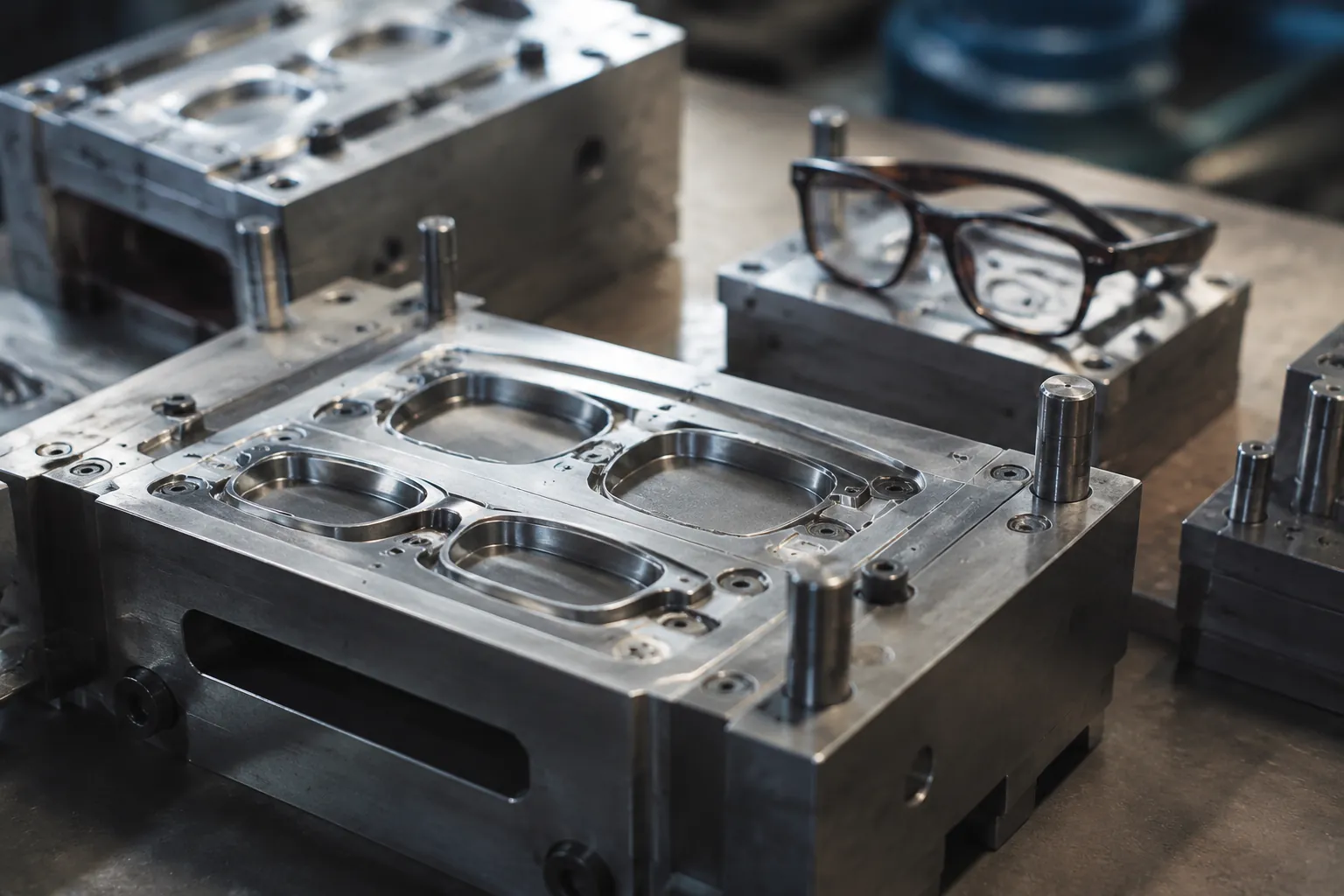
This guide is for brands, importers, distributors, and retailers deciding whether to use an existing sunglasses mold, modify a current platform, or pay for dedicated tooling. The right answer is rarely "always tool" or "never tool." It depends on repeat volume, fit requirements, design ownership, compliance markets, and how long the style is expected to sell. Tool too early and you tie up cash before demand is proven. Tool too late and you may keep selling a generic frame with weak fit control and little protection from copycat products.
Stock, semi-custom, or dedicated tooling
Most buyers do not need a new mold for the first order. If the goal is to test a market, a stock frame with custom lens color, logo, temple print, pouch, hangtag, and packaging is usually the lower-risk option. It lets a buyer test sell-through before paying for injection tooling, acetate development, CNC programming, or dedicated fixtures.
For selected programs, LumiShades offers low-MOQ development options starting from 50 pairs per design. Buyers should confirm the MOQ for the exact frame, lens, decoration, and packaging combination. Minimums can change when special materials, custom colors, metal parts, polarized lenses, or complex decoration are involved. Samples based on existing frames are usually faster than new-tooling samples. Production lead time should be confirmed after the approved sample, order details, and packaging are finalized.
New tooling is worth discussing when one of four triggers appears: stable repeat volume, a shape that must be exclusive, a fit problem stock frames cannot solve, or a structural brand detail that printing, color, lens treatment, or packaging cannot create.
| Route | Best use | Typical MOQ logic | Development impact |
|---|---|---|---|
| Stock mold + custom color/logo | Market testing, events, low-volume launches, retailer trials | Often the lowest MOQ route; confirm by frame and decoration method | Fastest route because frame structure already exists |
| Stock mold + component changes | Different lenses, hinges, temple tips, metal logo plates, color blocking | Usually higher than simple logo orders because parts, setup, and matching work add cost | Moderate; extra sampling may be needed for parts, color, lens, and decoration approval |
| Semi-custom tooling | Modified temple, revised logo area, adjusted bridge, small front change | Best considered when repeat orders are likely and the change has commercial value | Adds drawing review, tool or fixture review, sampling, and possible correction time |
| Dedicated new mold | Exclusive frame shape, special fit, custom hinge seat, signature front or temple geometry | Most rational for repeat programs where lifetime volume can absorb tooling cost | Longest route; requires drawing, engineering review, tooling, trials, corrections, and approval |
Volume math: when tooling stops looking expensive
A mold is not just a design expense. It is also a unit-cost, repeatability, and account-protection decision. If a buyer is placing a small one-time run, full dedicated tooling usually makes no sense unless exclusivity is central to the product value. If the same frame is expected to run across several seasons, colorways, countries, or retail programs, the math changes.
The practical method is simple: amortize the tooling fee across realistic lifetime volume, not only the first purchase order. If tooling costs USD 3,000 and the buyer orders only 500 pairs, the tooling burden is USD 6.00 per pair before unit production cost is added. If the same tooling supports 20,000 pairs over its selling life, the tooling burden drops to USD 0.15 per pair. That is a big difference. This example is only for illustration. Actual tooling cost depends on frame type, mold complexity, material, number of cavities, surface finish, hinge structure, lens interface, and correction work.
Ask the supplier to quote the same specification at several quantities and separate the tooling charge from the unit production price. Then compare three figures: tooling amortization per pair, unit production cost, and the commercial value of owning a distinctive shape. A distributor protecting a key retail account may justify tooling even if the direct per-pair saving is small. A short seasonal promotion usually cannot.
- Under 300 pairs: use stock tooling unless the project is a premium launch where shape exclusivity is essential.
- 300-1000 pairs: prioritize color, lenses, hinges, temple logos, metal badges, soft-touch finishes, and packaging before opening a full dedicated mold.
- 1000-5000 pairs: consider semi-custom or dedicated tooling if the style will repeat, support multiple colorways, or solve a clear fit problem.
- 5000+ pairs: dedicated tooling is easier to justify, especially when the frame is part of a long-term collection or retail program.
A staged approach is often the safest route: test at low volume, refine the spec using real sales and fit feedback, then tool once reorder demand and brand direction are clear.
Design and fit triggers that justify a new mold
Decoration can help a stock frame look more branded. It cannot change the frame architecture. Pad printing, laser engraving, lens logos, temple prints, hot stamping, rubber coating, gradient lenses, mirror coating, and metal logo plates are useful tools. But they do not create a new brow line, bridge shape, hinge seat, lens groove, temple curve, front wrap, or molded surface geometry.
Dedicated tooling makes sense when the signature feature is structural. That might be a sculpted thick temple, a proprietary bridge profile, a shield-style lens interface, a custom keyhole bridge, a defined sport wrap base curve, an oversized fashion front, a raised logo molded into the temple, or a hinge construction that must sit flush with a special front shape. If the feature is part of the plastic or acetate geometry, it belongs in the mold, CNC program, or fixture plan. Not just in artwork.
Fit is another strong trigger. Some markets need wider fronts, longer temples, lower bridge pressure, flatter fronts, higher nose contact, or less temple squeeze. A frame can photograph well and still fail on the face. Common fit complaints are predictable: nose pressure, lenses touching cheeks, slipping during movement, pressure behind the ears, and temples flaring outward. These problems usually come from geometry, material behavior, and adjustment limits. Not packaging. Not logos.
For injection frames, tooling decisions affect shrinkage, gate location, parting lines, hinge alignment, screw boss strength, surface polish, and warpage risk. For acetate frames, development involves sheet selection, CNC milling, tumbling, polishing, hinge installation, lens edging, and heat adjustment. The supplier discussion should cover the full build, not just the silhouette.
What a factory needs before quoting tooling
A reference photo is not a tooling brief. It shows style direction. It does not support accurate pricing or engineering by itself. To quote properly, the factory needs dimensions, materials, lens requirements, decoration methods, compliance targets, and packing assumptions. Without that, the first quote is only a rough estimate and the first sample is more likely to miss the target.
A serious brief should include frame category, target measurements, material plan, lens specification, branding method, compliance market, launch quantity, reorder forecast, color split, delivery date, and target price. CAD files are better than sketches. A physical sample is especially helpful when the goal is to improve fit from an existing product because the supplier can measure lens width, bridge, temple length, front curve, hinge position, nose contact area, and temple spread.
- Frame dimensions: lens width, bridge, temple length, lens height, total front width, temple thickness, front curve, and target weight.
- Fit market: adult unisex, narrow fit, wide fit, kids, low-bridge fit, sport wrap, or flat fashion fit.
- Material: PC, nylon/TR90-style material, acetate, stainless steel parts, rubberized tips, or mixed construction.
- Lens spec: UV400 requirement, polarized or non-polarized, lens category, tint, mirror coating, gradient, base curve, impact expectation, and optical clarity requirement.
- Branding: pad print, laser engraving, molded logo, metal plate, embossed mark, temple insert, lens logo, or custom packaging.
- Compliance: CE EN ISO 12312-1, ANSI Z80.3, AS/NZS 1067, REACH, FDA registration support, or the required market-specific combination.
Good briefs also define acceptable tolerances and flag critical dimensions. In eyewear, small changes matter. A 1-2 mm shift in bridge width, temple length, pantoscopic angle, or temple spread can be noticeable in wear. Critical dimensions should be agreed before sampling so QC knows what must be measured and what can still be adjusted.
Lead time: tooling adds work before bulk production
Many buyers focus on bulk production lead time and underestimate the development work that happens first. Stock-frame orders can move quickly after sample approval because the structure already exists. Dedicated molds add specification confirmation, drawing review, tool design, machining, polishing, first trial, fit review, correction, approval samples, and only then bulk production.
A realistic new-mold flow looks like this: confirm the spec, create or refine a 3D drawing, approve the structure, design the mold, cut the mold, polish the cavities, run T1 samples, check assembly and fit, correct the tool or process if needed, make T2 approval samples, confirm color and lenses, approve packaging, and start bulk production. If the first trial is acceptable, time is saved. Do not build the launch calendar around that assumption.
For a simple injection frame, tooling development can add several weeks before bulk production. Complex frames with multiple parts, special hinge seats, high-polish surfaces, two-color effects, rubberized components, or shield lenses may need more sampling rounds. Acetate styles may avoid injection mold cutting, but they still require CNC programming, sample cutting, tumbling, polishing, hinge setting, lens fitting, and adjustment before bulk parameters are stable.
Approvals are often the hidden delay. If the buyer takes extra time to approve CAD, choose lens color, confirm logo placement, or finalize packaging artwork, the supplier cannot recover all of that time later. Build in buffer. At least one correction round is the safer assumption.
Fit, tolerance, and material behavior to control
Sunglasses are small products, but tolerance control matters. A temple that is slightly tight can create pressure after a short period of wear. A lens groove that is too loose can cause lens rattle. A front curve that is too aggressive can create visual discomfort if the lens base curve and frame wrap do not match. A bridge that is slightly too narrow or too wide can turn a good-looking sample into a return problem.
Injection plastic frames need shrinkage planning. Wall thickness should be balanced where possible because thick-to-thin transitions can cause sink marks, warpage, or uneven cooling. Gate location affects visible marks and flow lines. Hinge screw bosses need enough surrounding material because repeated opening and closing will expose weak construction fast. Parting lines should be placed where they can be polished, hidden, or at least accepted without hurting appearance or strength.
Acetate behaves differently. It is cut and milled from sheet, then tumbled and polished. It can feel premium and substantial, but hinge setting and lens fitting still need tight control. Thin acetate fronts may look elegant but can be more sensitive to lens groove design, bridge strength, and assembly pressure. Thick acetate improves visual presence but adds weight. More weight can hurt all-day comfort.
Lens control matters just as much. Polarized lenses require axis alignment so the polarization direction is consistent between left and right lenses. Tint samples should be approved in daylight and indoor light, not only from a digital color reference. Mirror coating changes perceived tint. Lens category, UV performance, impact expectations, and labeling must match the target market before bulk production is approved.
Compliance must be set before the mold is frozen
Compliance should be discussed before tooling approval. Lens size, coverage, impact expectations, labeling, and material choices can affect test results. LumiShades can support buyer documentation requests for commonly used eyewear and factory compliance items, including CE EN ISO 12312-1, ANSI Z80.3, AS/NZS 1067, REACH, FDA registration, ISO 9001, and BSCI. Buyers should confirm which documents apply to the exact product, factory, shipment, and sales market.
For Europe, CE EN ISO 12312-1 is the main performance standard for general-purpose sunglasses, while REACH is relevant for restricted substances in plastics, coatings, paints, and metal parts. For the United States, buyers often request ANSI Z80.3 for non-prescription sunglasses and FDA registration where applicable. For Australia and New Zealand, AS/NZS 1067 is the key standard.
Do not assume one test report covers every design forever. A lens material change, coating change, tint category change, frame material change, or major structural redesign may require new confirmation. If the same frame will be sold in the EU, US, and Australia/New Zealand, say so in the brief. That gives the supplier time to plan lens category, filter performance, labeling, warnings, documentation, and packaging artwork from the start.
Procurement rule: freeze the selling markets and compliance targets before cutting the mold. Changing markets later can force lens changes, artwork changes, retesting, relabeling, or shipment delays.
A practical go/no-go checklist for new tooling
Use this checklist before approving a dedicated mold. If most answers are weak, stay with stock or semi-custom options. If most answers are strong and documented, dedicated tooling is probably justified.
- Volume: Do we have a credible reorder plan beyond the first purchase order?
- Exclusivity: Would a similar stock shape hurt margin, retail placement, or account protection?
- Fit: Are we solving a real comfort or sizing problem that existing frames cannot fix?
- Design: Is the signature feature structural rather than only a logo, color, coating, or lens tint?
- Compliance: Have we named the selling markets and required standards before development?
- Timing: Can the calendar absorb CAD approval, tooling trials, corrections, final samples, and packaging approval?
- Budget: Have we calculated tooling cost across realistic lifetime volume, not only the first order?
- Decision speed: Can our team approve drawings, colors, lenses, samples, and packaging without long internal delays?
For many growing brands, the best route is staged. Start with an existing mold. Learn from real sales and fit feedback. Move to stronger customization when demand is clearer. Open a dedicated mold only once repeat volume and brand direction are documented. Less dramatic. Much safer.
Have a custom sunglasses project in mind?
Send us your styles, target market and quantities and we will return a detailed quote with MOQ, lead time and a sample plan.
Get a QuoteWhy source this from Wenzhou with LumiShades
Wenzhou in Zhejiang Province is widely regarded as China’s eyewear manufacturing capital, producing a large share of the world’s sunglasses. That concentration matters to buyers: a deep local supply chain for acetate sheet, hinges, lens blanks, plating and packaging means shorter component lead times, easier color and material matching, and a workforce with decades of eyewear-specific skill. LumiShades has manufactured in this ecosystem since 2009, and our vertical integration — in-house injection molding, acetate cutting, CNC milling, lens tinting, decoration and quality control — means no part of your order is quietly subcontracted to a workshop you cannot audit.
For international buyers, that vertical control translates into accountability. When a single factory owns every step, defects are traced and fixed at source rather than bounced between vendors, and your specifications survive intact from first sample to bulk. We back this with 15+ years of experience, shipments to 60+ countries, more than 5 million pairs produced per year and a 98.5% on-time delivery rate. Our certifications — CE EN ISO 12312-1, FDA registration, ANSI Z80.3, AS/NZS 1067, REACH, ISO 9001 and BSCI audit — mean the compliance documentation your market requires already exists. Explore our manufacturing capabilities and quality control process to see how this works in practice.
Frequently asked questions
What order volume usually justifies a custom sunglasses mold? There is no universal break point because tooling cost depends on frame complexity, material, number of parts, surface finish, hinge structure, and correction work. As a practical rule, a one-time order under 1000 pairs is usually better suited to stock or semi-custom options. Dedicated tooling becomes more rational when the frame will repeat, run in multiple colorways, support several retail programs, or protect a shape with clear commercial value. Ask for the tooling cost, unit price at several quantities, and expected lifetime volume, then calculate tooling cost per pair.
Can I start with 50 pairs and later move to a custom mold? Yes. This is often the lower-risk route. On selected programs, LumiShades supports MOQ from 50 pairs per design, subject to the chosen frame, lens, decoration, and packaging. Use the first order to test sell-through, fit feedback, lens color, logo position, packaging, and price point. If reorders are strong and customers want a more distinctive shape or better fit, turn that feedback into a semi-custom or dedicated tooling brief.
Will a new mold make my sunglasses cheaper per pair? Sometimes, but do not assume it. A dedicated mold may improve efficiency when the design is engineered for the intended material, hinge, lens, and assembly process. But the tooling charge still has to be amortized across expected lifetime volume. In most cases, the main reasons to open a mold are control and differentiation: exclusive shape, better fit, repeatable construction, structural branding, and stronger account protection.
What information should I send for an accurate mold quote? Send CAD files if available, or a clear physical sample if the goal is to match or improve an existing frame. Include target dimensions, fit market, material, lens specification, branding method, color plan, packaging, selling markets, required compliance standards, launch quantity, reorder forecast, delivery date, and target price. If any dimension is critical for fit or retail approval, mark it clearly so the supplier can assess tooling feasibility and tolerance control.
How long should I allow for a new mold project? Allow time for specification review, 3D drawing, tooling design, mold cutting, polishing, T1 samples, fit and assembly review, corrections if needed, T2 approval samples, lens and color approval, packaging approval, and then bulk production. The exact schedule depends on frame complexity and approval speed. Build in buffer for at least one correction round if the launch date is fixed.
What compliance standards should I request for custom sunglasses? Start by naming the selling markets. Common requirements include CE EN ISO 12312-1 for Europe, ANSI Z80.3 and FDA registration where applicable for the United States, AS/NZS 1067 for Australia and New Zealand, and REACH for restricted substances. ISO 9001 and BSCI relate to management systems and social compliance expectations rather than sunglass lens performance. Confirm which documents apply to the exact frame, lens, coating, packaging, and shipment.
Ready to start?
Explore our rimless sunglasses or request a quote — our sales team replies within 12 hours.
Request a Quote