
Promotional vs Retail Sunglasses: Spec Gaps That Matter
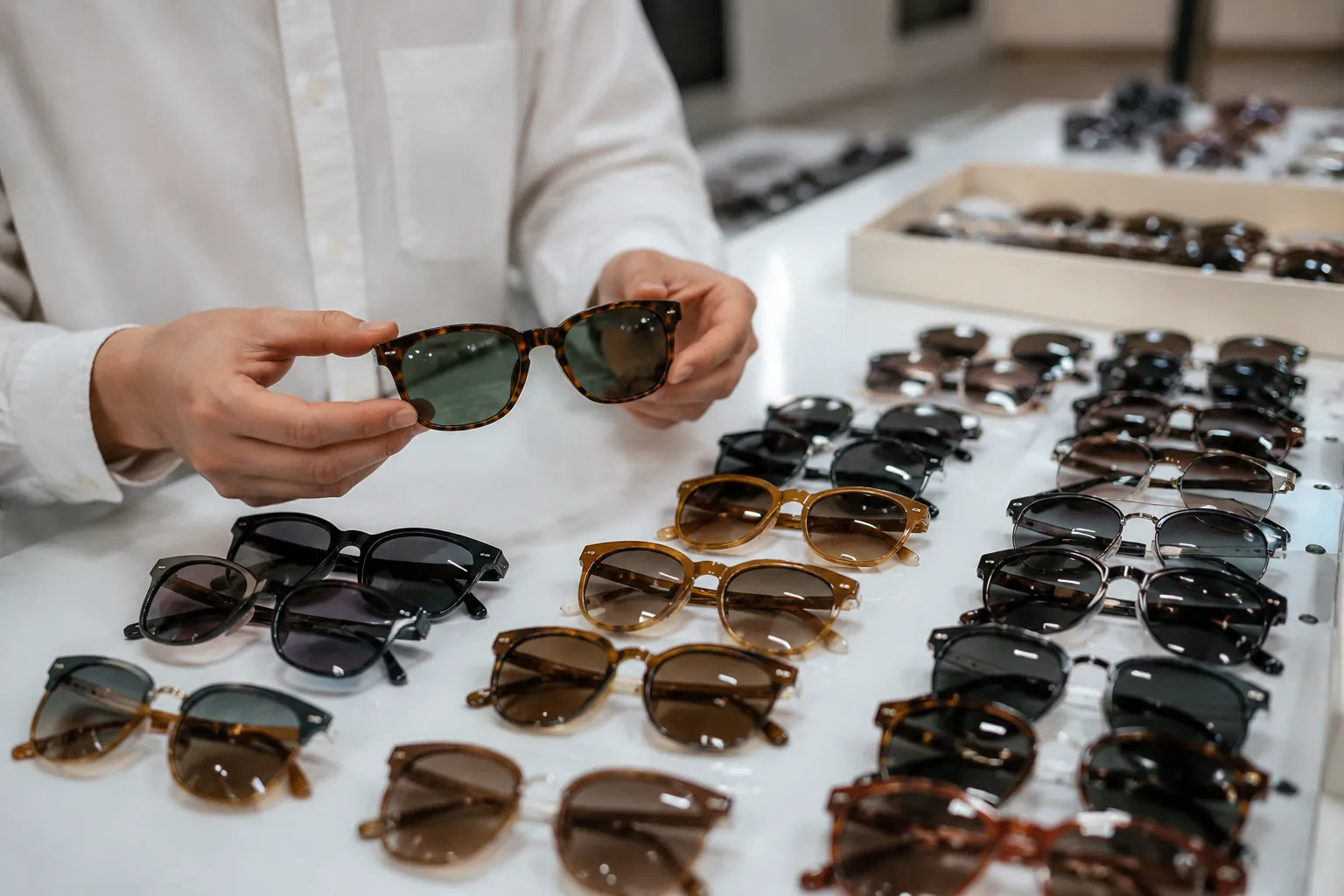
This guide is for brand owners, importers, distributors, and retailers sourcing custom sunglasses in volume. The point is simple: promotional eyewear and retail-grade sunglasses may look similar in photos, but they are usually built to different standards. If you over-spec a giveaway, you add cost without much commercial gain. If you under-spec a resale product, you raise the risk of complaints, returns, and compliance trouble. Below is a practical, line-by-line guide to where the gaps usually sit and what buyers should confirm before asking for quotes.
Start with the use case, not the frame shape
Many buyers start with a silhouette, color, or trend reference. Useful, but not first. The first sourcing decision is how the sunglasses will be used: event giveaway, branded merchandise, promotional resale item, or retail product. That use case sets the minimum standard for materials, decoration durability, inspection, documentation, and packaging.
Promotional sunglasses are usually built to hit a target budget while keeping the brand visible. Retail-grade sunglasses are expected to survive repeated wear, hold a more consistent fit and finish, and meet the documentation and testing requirements for the destination market.
A giveaway does not always need the same hinge performance, lens consistency, decoration durability, or packaging detail as a retail SKU. The bigger mistake is the reverse one. Using a giveaway-level build for resale is where problems start: loose temples, scratched lenses, uneven fit, weak logo durability, or compliance paperwork that does not match the product.
- Giveaway: cost-led build, logo visibility, simple packing, limited wear-life expectation.
- Promotional merch: improved finish and decoration, still price-sensitive, often intended for repeat casual use.
- Retail-grade: tighter consistency, more durable materials and decoration, fuller testing documentation, and packaging suited for resale.
Simple rule: the more often the product will be worn, cleaned, folded, shipped, and sold through formal channels, the more important it becomes to specify stronger hinges, better lens control, and more protective packaging.
The spec-sheet differences that actually matter
The gap between promotional and retail-grade sunglasses is rarely one feature. It is the stack of choices: frame material, lens spec, hinge construction, decoration method, cosmetic standard, and QC tolerance. Any one line may look minor. Together, they decide whether the product behaves like a short-cycle giveaway or a resale-ready item.
| Spec area | Promotional sunglasses | Retail-grade sunglasses |
|---|---|---|
| Frame material | Usually basic injection-molded plastic selected for cost and speed | Higher-grade injected material, flexible nylon-based material such as TR90, or acetate depending on target positioning |
| Lens build | Standard tinted lens with limited coating options | Tighter tint consistency, optional polarization where required, optional scratch-resistant coating, stricter visual checks |
| Hinges | Basic hinge construction suitable for light-duty use | More consistent hinge setting, better screw retention, smoother opening and closing feel, optional spring hinge on some programs |
| Decoration | Simple pad print or other basic logo application | More durable methods such as improved pad print systems, laser marking where compatible, debossing, or applied logo components |
| Finish tolerance | Broader acceptance for minor cosmetic variation | Stricter limits on flash, burrs, alignment, color variation, and lens fit |
| Packaging | Simple pouch, polybag, or basic carton | Retail carton, barcode label, care or warning insert where needed, and more protective presentation packaging |
These choices change the factory process too. A basic promotional frame may move from molding to logo application to packing with limited secondary finishing. A retail program usually needs tighter finishing control, more detailed lens inspection, more careful assembly and alignment, and a more formal final audit. That is why two sunglasses that look similar in a photo can differ a lot in both cost and lead time.
Ask the supplier to define the tolerance band they will work to. Useful examples include temple alignment tolerance, lens-fit acceptance, color-matching standard, and cosmetic defect criteria. If those points are not written down, the quote is still too vague to compare.
Materials and construction: where the split starts
Material choice is one of the first places buyers misread a program. A frame can photograph well and still be wrong for the job. Appearance matters, but behavior matters more: how the material molds, finishes, ships, and wears over time.
For promotional programs, injection-molded plastic is common because it supports lower tooling risk, faster output, and lower unit cost. That can be the right choice for campaign SKUs, school events, hospitality promotions, and short-term brand activations. The tradeoff is clear. Lower-cost builds may show more visible parting lines, broader weight variation, less refined surface feel, or weaker long-term screw retention, depending on the material and construction.
Retail-grade programs usually step up in one or more ways. Higher-grade polycarbonate can improve impact performance and give a more solid feel than cheaper alternatives. TR90 is often chosen for flexibility and comfort in lightweight frames. Acetate is common when the brand wants a more premium look, richer polish, and higher perceived value, but it also needs a more involved process: cutting, shaping, finishing, and polishing. Because acetate is a laminated sheet material, natural pattern variation from sheet to sheet should be expected and managed, not treated as a defect by default.
Lens material matters just as much. A basic tinted lens may be enough for a promotional brief. Resale programs often need tighter tint matching, clearer optics, better surface durability, or polarization. In retail, left-right tint mismatch or defects in the viewing area are common complaint triggers even when the frame looks fine.
Better material does not fix a weak process. It never does. Material choice and process control need to be specified together.
Decoration, finish, and cosmetic standards
Decoration is often under-specified. A logo method should match the substrate, the expected wear pattern, and the level of brand presentation required. The cheapest method is not always the cheapest outcome if the product will be cleaned often, handled in-store, or sold as branded merchandise.
For promotional sunglasses, one-color pad printing on the temple is common because it is simple, cost-effective, and suitable for high-volume distribution. It can perform well under normal handling if the ink system and curing process are matched to the frame material. But that does not make it the right choice for repeated abrasion or a higher-end presentation.
Retail-grade programs may need more durable or more premium-looking options, depending on the material: upgraded pad print systems, laser marking on compatible surfaces, debossing on suitable materials, or applied logo components. These methods usually cost more because they add setup, manual handling, or tighter positioning control. They also raise the visual bar. A logo placement shift that passes on a giveaway can look unacceptable on a retail shelf.
Write finish standards into the brief. Do not ask for good quality. Define what the product must pass under normal inspection conditions. Specify the viewing distance, lighting condition, and which surfaces are critical. That reduces disputes because both buyer and supplier are working to the same cosmetic standard.
- Pad print: cost-effective, fast, suitable for simple logos, but durability depends on substrate and curing.
- Laser marking: clean and generally durable on compatible surfaces, often used to improve premium perception.
- Applied logo component: stronger visual impact, additional assembly step, often used for higher retail presentation.
- Deboss / emboss: useful on suitable materials where tactile branding is part of the product concept.
Compliance is product-specific, not factory-wide
Once sunglasses are sold, distributed, or imported, compliance cannot be treated as a generic factory claim. It is product-specific. It depends on the actual construction, lens category, labeling, and destination market. A compliant factory does not make every SKU compliant by default.
Standards and documents commonly requested in this category include CE EN ISO 12312-1 for Europe, ANSI Z80.3 for the United States, and AS/NZS 1067 for Australia and New Zealand. Chemical compliance requests often include REACH. Some U.S. buyers also ask for FDA registration information during supplier qualification. System and social compliance documents such as ISO 9001 and BSCI can help during supplier review, but they do not replace product-specific test reports.
Check exactly what a report covers. A report for one lens construction, coating, or category does not automatically apply to another version of the same frame. If the mirrored coating, polarization, base material, or lens darkness changes, confirm whether new testing or updated documentation is required for the target market.
At minimum, request the report date, sample photos, product description, test standard, and identification of the tested construction. Then check that the approved production sample matches that tested construction. Many compliance disputes start with a small mismatch between the tested sample and the bulk product.
- Ask for the report date and full product description.
- Confirm that the standard matches the destination market.
- Check whether polarized, mirrored, or alternate lens versions are covered.
- Make sure declarations, markings, and labels match the tested product.
Cost, MOQ, and quote structure
Buyers often overspend because the brief mixes cost-led and retail-led requirements without ranking them. Ask for premium packaging, stronger decoration, upgraded lenses, and a small run, and the unit cost will climb fast even if the frame shape is simple. That does not mean the quote is wrong. It means the spec has moved beyond a pure promotional build.
MOQ is not just a sales threshold. It reflects setup work, tooling logic, material preparation, decoration setup, and packing efficiency. A simple promotional style based on an existing platform may work at a lower quantity. Add custom color matching, multiple logo operations, or dedicated retail packaging, and the economics usually improve at higher volumes because setup cost is spread more efficiently.
Use a landed-cost view, not ex-works price alone. Freight mode, duty exposure, transit protection, repacking risk, and inspection cost can change the real economics. A cheaper pair is not always the better buy if it arrives with a high scratch rate, inconsistent packing, or missing documents that delay receipt.
Practical rule: if the product will be sold, build the brief around compliance, repeatability, and acceptable customer experience before pushing for the lowest possible unit price.
To make quotes comparable, require the same line items from each supplier: frame material, lens type, lens treatment, decoration method, packaging configuration, compliance documents, inspection standard, MOQ, sample lead time, and production lead time. If those items are not aligned, the lowest quote may simply be missing requirements.
Lead time and common failure modes
Lead time is driven less by quantity alone than by process count. Artwork approval, material confirmation, lens options, decoration steps, and packaging all change the production path. A basic injected frame with one logo operation and simple packing will usually move faster than a style that needs acetate processing, specialized lenses, multiple branding steps, and retail pack assembly.
A typical sequence looks like this:
- Artwork, labeling, and color confirmation
- Material and lens specification lock
- Sample build and approval
- Bulk frame production
- Lens production and insertion
- Decoration application
- Assembly, alignment, and final adjustment
- QC, packing, and shipment preparation
Each added touchpoint creates another delay risk if the brief is still moving. Late edits to artwork, barcode labels, warning copy, or carton markings often slow production more than buyers expect. If packaging matters to the selling proposition, freeze it early.
Failure modes also differ by tier. In promotional programs, the most common issues are cosmetic or logistical: print rub, small lens scratches from basic packing, broader color variation, or looser alignment standards. In retail programs, the bigger problem is often a mismatch between appearance and build. Nice packaging. Weak hinge durability. Good photos. Poor lens inspection.
- Loose screws: often linked to hinge setting consistency and post-assembly checks.
- Lens rattle: usually a lens-fit or frame-variation issue.
- Left-right tint mismatch: points to weak lens sorting or insufficient final inspection.
- Logo wear-off: often caused by choosing the wrong decoration method for the substrate and use case.
- Warped fit: can result from molding variation, heat exposure, or packing pressure.
Before approving bulk, inspect the pre-production sample for hinge feel, temple symmetry, logo placement, lens seating, visible defects, and labeling accuracy. That is usually the cheapest point in the process to catch a mismatch between the brief and the actual product.
A practical framework for choosing the right grade
If you need a quick sourcing decision, choose the grade based on sales channel and wear expectation first. Then adjust finish level and packaging around that choice. It is easier to simplify a retail brief than to rescue an underbuilt promo spec after samples arrive.
| If your priority is... | Choose | Specify at minimum |
|---|---|---|
| Lowest campaign cost | Promotional build | Basic tinted lens, simple logo method, simple pack, and compliance documents appropriate for the destination market |
| Branded merchandise worn repeatedly | Upper promotional or entry retail build | Improved material choice, better logo durability, tighter lens QC, and better transit protection |
| Retail shelf sale | Retail-grade build | Market-specific test reports, tighter cosmetic standard, durable decoration, and retail-ready labeling and packaging |
| Premium brand presentation | Retail-grade acetate or upgraded molded frame | Higher finish standard, upgraded branding method, protective presentation pack, and a fully approved pre-production sample |
If needed, ask suppliers to quote two clear versions side by side: a true promotional spec and a true retail spec. Avoid vague phrases such as good quality or best price with better finish. They make comparison harder and leave too much open to interpretation.
A usable quote should state material, lens spec, decoration, packaging, compliance basis, MOQ, sample timing, production timing, and inspection standard. If one of those items is missing, the quote is not complete enough to compare on a like-for-like basis.
Have a custom sunglasses project in mind?
Send us your styles, target market and quantities and we will return a detailed quote with MOQ, lead time and a sample plan.
Get a QuoteWhy source this from Wenzhou with LumiShades
Wenzhou in Zhejiang Province is widely regarded as China’s eyewear manufacturing capital, producing a large share of the world’s sunglasses. That concentration matters to buyers: a deep local supply chain for acetate sheet, hinges, lens blanks, plating and packaging means shorter component lead times, easier color and material matching, and a workforce with decades of eyewear-specific skill. LumiShades has manufactured in this ecosystem since 2009, and our vertical integration — in-house injection molding, acetate cutting, CNC milling, lens tinting, decoration and quality control — means no part of your order is quietly subcontracted to a workshop you cannot audit.
For international buyers, that vertical control translates into accountability. When a single factory owns every step, defects are traced and fixed at source rather than bounced between vendors, and your specifications survive intact from first sample to bulk. We back this with 15+ years of experience, shipments to 60+ countries, more than 5 million pairs produced per year and a 98.5% on-time delivery rate. Our certifications — CE EN ISO 12312-1, FDA registration, ANSI Z80.3, AS/NZS 1067, REACH, ISO 9001 and BSCI audit — mean the compliance documentation your market requires already exists. Explore our manufacturing capabilities and quality control process to see how this works in practice.
Frequently asked questions
Can promotional sunglasses still meet compliance requirements? Yes. Promotional sunglasses can meet compliance requirements if the specific product is built and tested for the destination market. Do not rely on a general factory statement. Ask for the exact report or declaration tied to your construction and market, such as CE EN ISO 12312-1, ANSI Z80.3, or AS/NZS 1067, and request REACH documentation where chemical compliance is required. Verify that the tested sample matches your final lens type, coating, and labeling.
What is the biggest technical difference between promo and retail-grade sunglasses? Usually it is not one feature but the combination of material quality, lens control, hinge consistency, decoration durability, and inspection tolerance. A retail-grade build is typically defined by tighter control across all of those points, not by one premium add-on. When comparing products, ask the supplier to show the differences line by line rather than describing both as simply 'good quality'.
At what volume does it make sense to upgrade from promo to retail-grade? The main trigger is sales channel, not volume. If the sunglasses will be sold at retail, listed online as branded merchandise, or expected to support repeat use and lower complaint rates, retail-grade specifications usually make more sense even at modest quantities. Higher volume can improve the economics of upgrading, but it does not change the underlying requirement for the end use.
How should I compare quotes from different eyewear factories? Standardize the brief first. Require each supplier to quote the same frame material, lens type, lens treatment, decoration method, packaging, compliance basis, inspection standard, MOQ, sample lead time, and production lead time. Also ask which version of the product their compliance documents cover. If those details are not aligned, the lowest quote may not be comparable and may exclude cost-driving requirements such as retail labeling, upgraded decoration, or market-specific testing.
What should I check on a pre-production sample before approving bulk? Check five areas: 1) construction and fit, including hinge feel, temple symmetry, and lens seating; 2) cosmetics, including scratches, burrs, color consistency, and logo placement; 3) decoration durability expectations based on the chosen method; 4) packaging and labels, including barcode, warning, and market markings; and 5) compliance alignment, meaning the approved sample should match the product covered by the test report or declaration. Record any acceptance criteria in writing before bulk production starts.
Ready to start?
Explore our square sunglasses or request a quote — our sales team replies within 12 hours.
Request a Quote