
How Low-MOQ Custom Sunglasses Reduce Launch Risk
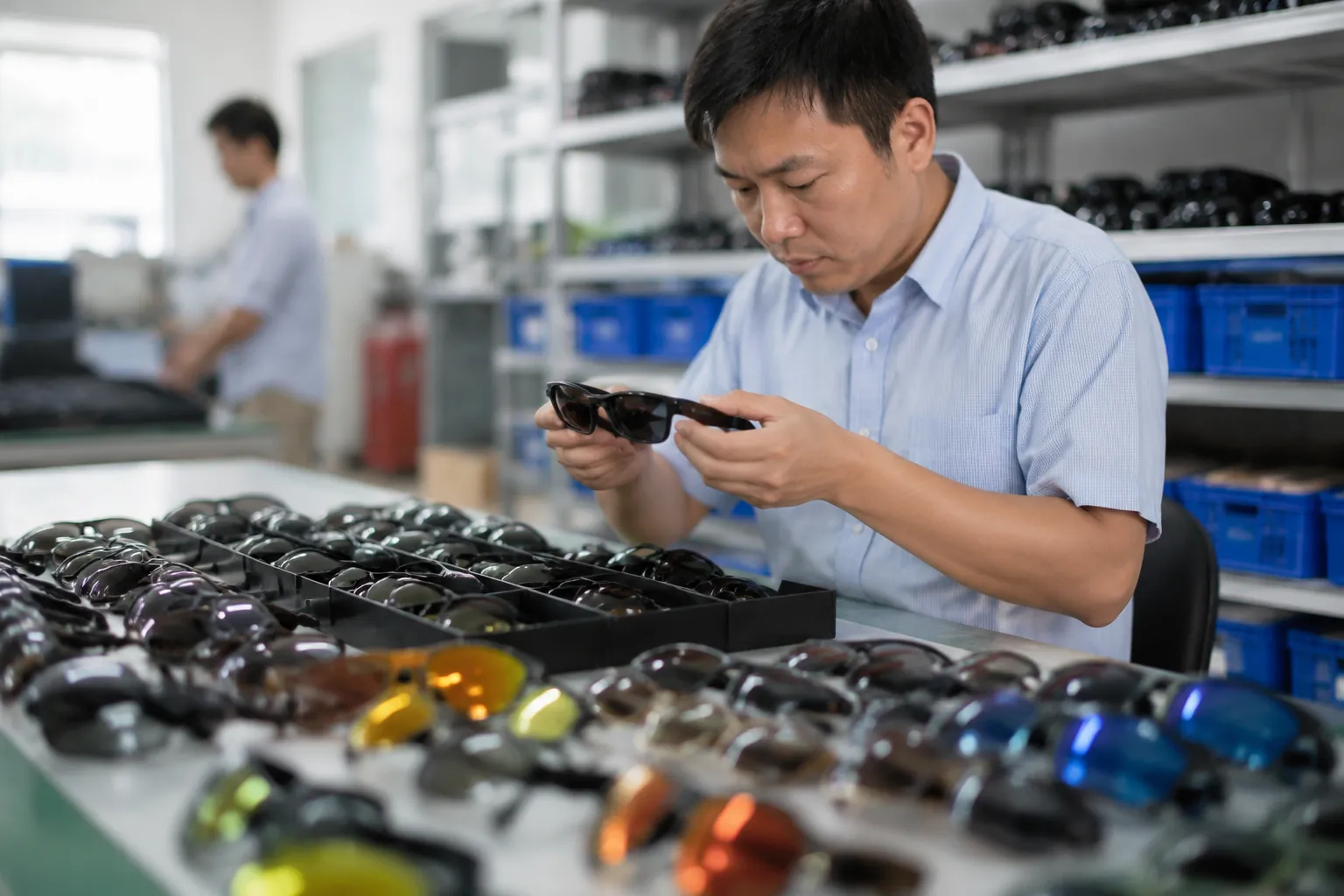
This article is for eyewear startups, importers, distributors, and retailers that want to launch new sunglass styles without overcommitting cash on the first order. Low-MOQ production changes the decision. Instead of buying several hundred units per SKU before seeing real demand, buyers can start at 50 pairs per design, measure sell-through, and scale only the frames that earn a reorder. That means less inventory risk, faster market feedback, and tighter control of working capital. But low MOQ is not automatically safer. It works only if the buyer understands the trade-offs in unit cost, process control, tolerances, and compliance. The main benefit is not the lowest first-run price. It is avoiding expensive mistakes early.
The old launch model is breaking down
For years, new eyewear brands were often expected to buy like established labels. Factories set minimums at several hundred pairs per color per style. Buyers had to commit before they had solid data on fit, retail price acceptance, return risk, or channel demand. The result was predictable: too many SKUs, too much stock, and too many weak colors or shapes in the opening range.
That model fits fewer launches now. Demand is harder to predict. Online-first brands, marketplace sellers, boutique retailers, and seasonal capsule programs need to test with less inventory and react faster. A 50-pair test order is not a smaller version of a 500-pair opening order. It is a different commercial decision. Even with a higher unit cost, the smaller run can be the better move if it prevents dead stock.
That is how many launches work now. Brands test through direct-to-consumer campaigns, influencer seeding, small wholesale placements, and limited drops. They want to know which lens color sells, whether a narrow frame drives fit complaints, or whether a matte black style can support the target margin after freight and duty. Guesswork is not enough. They need evidence.
On the factory side, short runs put more pressure on process control. More setup changes. More fixture adjustments. More chances for inconsistency. A supplier that manages key steps in-house—frame production, lens processing, logo application, assembly, and QC—usually handles a 50-pair program better than one relying on several subcontracted handoffs. Buyers should verify real capability, not broad claims. Useful signs include documented QC procedures, ISO 9001 certification, and social compliance programs such as BSCI if those matter to the sourcing policy.
What low MOQ changes in the buyer's risk profile
Low MOQ is not just convenient. It changes launch economics in practical ways.
- Lower cash exposure per SKU: Instead of putting most of the opening budget into one style, a buyer can test several clearly different silhouettes in small quantities.
- Better demand data: Weak styles fail faster and with less damage. Strong styles earn reorder capital through actual sell-through, return, and margin performance.
- Faster decision cycles: Shorter sampling and production cycles help a brand react within a season instead of planning too far ahead on assumptions.
- Cleaner pricing tests: Buyers can compare retail price points using real conversion data, not internal debate.
The trade-off is simple: unit cost at 50 pairs will usually be higher than at 300, 1000, or more. Tool setup, lens prep, color matching, logo fixtures, and packing changes are spread over fewer units. That does not make low MOQ a bad option. It just means the buyer should compare total outcome, not only ex-factory price.
The better measure is the landed result after inventory risk is included. A large opening order may show a lower unit cost on paper, then lose that advantage through markdowns, storage, and slow cash recovery. A smaller test order may cost more per piece, sell through faster, and lead to a better-timed reorder. That often produces the healthier result. Smart buyers do not chase the cheapest first PO. They aim for validated reorders.
A practical launch framework: test, read, reorder
Brands that use low-MOQ factories well usually follow a controlled sequence. They do not treat the first order like a full collection build.
- Start with 2 to 4 styles, not 10 to 12. Choose clearly different shapes such as one square, one narrow rectangle, one oversized fashion frame, and one sport-influenced wrap. Distinct silhouettes create cleaner demand signals than minor color variations of the same frame.
- Keep the first lens package standardized. Use one lens material, one UV claim, and a narrow tint family. That keeps technical variation from muddying the sales read.
- Approve samples against written checkpoints. Review front width, temple length, bridge fit, hinge resistance, lens tint consistency, logo position, labeling, and packaging layout.
- Use the first bulk order as a market test. At 50 pairs per design, a buyer can collect data on conversion, returns, customer reviews, and fit complaints without building a heavy stock position.
- Move quickly on winners. If one SKU performs, prepare the reorder before stockout and step into the next quantity bracket only after confirming margin and sales pace.
The discipline is not just ordering small. It is reading the data fast and acting on it. If a frame draws fit complaints, misses the price point, or cannot hold margin after landed costs, cut it. Stop defending weak products.
Lead time is part of that discipline too. Sample and bulk timing depends on construction, decoration, packaging, and factory load, so any quoted lead time should be treated as project-specific. Many delays start in the spec file, not on the production floor: late artwork approval, unresolved lens specs, missing warning text, or repeated packaging revisions.
Where cost, lead time, and MOQ meet
Buyers often ask whether low MOQ saves money. The better answer is this: it reduces risk first and can improve the financial result if the reorder is handled well. The cost logic gets clearer when the order stages are compared side by side.
| Order stage | Typical quantity | Main purpose | Unit cost trend | Lead time |
|---|---|---|---|---|
| Development sample | 1-5 pcs | Check fit, finish, lens color, hinge feel, logo position | Highest per piece due to setup and manual handling | Project-specific; commonly shorter than bulk |
| Market test order | 50 pairs per design | Validate demand with limited inventory risk | Higher than volume run; setup spread over few units | Project-specific; depends on materials, decoration, and packing |
| Early scale reorder | 300+ pairs | Improve margin on proven sellers | Lower as purchasing and line efficiency improve | Project-specific; often more stable once specs are locked |
| Core volume program | 1000-5000+ pairs | Build stable margin on repeat SKUs | Lowest relative cost on repeat builds | Project-specific; subject to complexity and material availability |
Process complexity matters too. Simple builds scale more easily than decorative ones, especially in a first run.
| Feature choice | Impact on cost | Impact on lead time | Common risk in low MOQ |
|---|---|---|---|
| Standard injection frame + basic tint | Lowest relative cost | Fastest relative timeline | Color matching still needs approval |
| Acetate frame + CNC detailing | Higher due to material waste and labor | Longer | Variation in polishing, bevel depth, and pattern consistency |
| Metal logo plate + custom rigid box | Higher due to extra components | Longer | Alignment errors and packing delays |
| Multiple colorways in one style | Higher through more setups | Longer | Shade inconsistency, mixed packing, approval confusion |
The common mistake is comparing only ex-factory price between 50 pairs and a larger run. That is too narrow. The real comparison is total inventory outcome: dead stock risk, markdowns, storage, freight planning, and how fast cash comes back into the business.
Why process control matters more at small volumes
Low MOQ is harder to manufacture than it looks. Small runs mean more line changeovers, shorter batches, more color swaps, and more packaging variation. That raises the need for process discipline.
For injection-molded sunglasses, repeatability is usually stronger once tooling and color formulation are stable. Even then, short runs still need close control of mold condition, part shrinkage, hinge insertion consistency, temple alignment, and front symmetry. Small deviations can turn into visible fit problems. On a 50-pair order, rework is harder to absorb.
Acetate frames bring a different profile. They can deliver a more premium look and deeper pattern variation, but they add steps: sheet selection, cutting, CNC milling, beveling, tumbling, polishing, hardware fitting, lens insertion, and hand adjustment. Acetate also behaves differently from injected plastic. Pattern placement varies by sheet. Polishing can soften edges if overdone. Color consistency should be approved against a physical sample, not assumed from artwork on a screen.
Lens processing is another control point. A gradient tint or Category 3 lens may look simple in a rendering, but production consistency matters. Practical QC checks should include shade comparison against the approved standard, scratch inspection, UV performance confirmation, and insertion review to make sure mounting stress does not crack or distort the lens.
Decoration is where visible failures often show up first. Pad printing can shift if the fixture is unstable. Laser engraving visibility changes with substrate color and surface finish. Metal logo plates need accurate placement, proper pocket depth where needed, and controlled adhesive use. None of this is unusual. But it needs a clear job sheet and QC checks before final packing.
That is why in-house process depth matters. If frame making, lens processing, decoration, and QC are split across multiple suppliers, low-volume orders often lose time between steps and become harder to standardize. Process control is not a slogan here. It decides whether a 50-pair trial order arrives usable, consistent, and on time.
Compliance should be built into the launch plan
Many first-time buyers treat compliance like paperwork for later. That slows projects down. For sunglasses, the destination market and technical standard should be defined before bulk approval because lens category, UV claim, warnings, and packaging marks all depend on them.
Relevant standards and frameworks may include CE EN ISO 12312-1, ANSI Z80.3, AS/NZS 1067, REACH, and FDA registration where applicable to the market and product category. These are not generic claims to print on a box. They must match actual lens performance, materials, labeling, and destination-market requirements.
In practical sourcing terms, buyers should lock these points early:
- Destination market: The U.S., EU, Australia/New Zealand, and other markets may require different labeling, documentation, and test references.
- Lens category and visible light transmission: Tint level must match intended use and any stated category. A mismatch creates both compliance and customer-use problems.
- UV protection claim: If packaging or listings state UV400 or similar protection, the specification and supporting test evidence must match.
- Material restrictions: REACH-related restrictions matter for applicable markets and should be checked before mass production.
- Labeling and warnings: Market-specific wording, traceability details, and warning statements should be approved before boxes, stickers, or inserts are printed.
Compliance planning also affects speed. If a buyer waits until after sampling to confirm lens category or required warning text, the project can stall even when packaging and bulk materials are otherwise ready. A supplier familiar with export requirements can help reduce basic mistakes, but the buyer still has to define the project correctly from the start and request the right documents.
Common low-MOQ launch mistakes
Most low-MOQ failures are not caused by the MOQ itself. They come from vague specifications, uncontrolled variation, and poor SKU discipline.
- Too many colors in the first drop: Every extra frame color or lens shade adds another matching, approval, and packing variable.
- No written tolerances: If logo placement, lens tint range, temple alignment, or packaging dimensions are not documented, disputes usually start after production.
- Overdesigned test orders: Premium boxes, multiple decoration methods, and special hardware raise cost before the style has proved demand.
- Approving by render only: A frame can look good in CAD and still fail in wear because temple tension, bridge fit, nose feel, or front curvature is wrong.
- Waiting too long to prepare the reorder: The model works best when the second PO is planned while the first run is still selling, not after stock is gone.
Good buyers keep the first run simple enough to learn from. Test shape, fit, price acceptance, and sell-through first. Add expensive packaging, extra decoration, or more colorways only after the frame proves itself.
Simple rule: Use the first 50 pairs to validate demand and fit. Use the next volume step to improve margin. Move to a larger core program only when the style behaves like a repeat SKU rather than a one-off guess.
What this means for launches in the next 12 months
The brands gaining ground are not always the ones launching the most products. Often, they are launching less, reading results faster, and reallocating budget with less emotion. Low-MOQ custom sunglasses support that approach because they let a buyer move from concept to sample, then into a controlled bulk run, without a heavy opening commitment.
That changes how the first purchase order should be viewed. The first PO is not the main margin play. It is a market test. The second PO is where cost structure often improves. The third PO is where a style may start to behave like a stable program.
Supplier selection changes too. A useful partner is not just one willing to accept 50 pairs per design. It is one that can keep the product consistent at low volume, then scale the same style to larger quantities without unnecessary changes. Buyers should verify this through sample quality, documented QC, compliance support, and the supplier's ability to provide relevant records such as test reports, FDA registration details where applicable, ISO 9001 certification, or BSCI audit status if those items matter to the project.
For emerging brands, importers, and retailers testing private-label lines, low-MOQ sourcing is no longer a niche request. It is a practical launch model for uncertain demand. Used well, it is not just a manufacturing option. It is a lower-risk way to build an eyewear collection.
Have a custom sunglasses project in mind?
Send us your styles, target market and quantities and we will return a detailed quote with MOQ, lead time and a sample plan.
Get a QuoteWhy source this from Wenzhou with LumiShades
Wenzhou in Zhejiang Province is widely regarded as China’s eyewear manufacturing capital, producing a large share of the world’s sunglasses. That concentration matters to buyers: a deep local supply chain for acetate sheet, hinges, lens blanks, plating and packaging means shorter component lead times, easier color and material matching, and a workforce with decades of eyewear-specific skill. LumiShades has manufactured in this ecosystem since 2009, and our vertical integration — in-house injection molding, acetate cutting, CNC milling, lens tinting, decoration and quality control — means no part of your order is quietly subcontracted to a workshop you cannot audit.
For international buyers, that vertical control translates into accountability. When a single factory owns every step, defects are traced and fixed at source rather than bounced between vendors, and your specifications survive intact from first sample to bulk. We back this with 15+ years of experience, shipments to 60+ countries, more than 5 million pairs produced per year and a 98.5% on-time delivery rate. Our certifications — CE EN ISO 12312-1, FDA registration, ANSI Z80.3, AS/NZS 1067, REACH, ISO 9001 and BSCI audit — mean the compliance documentation your market requires already exists. Explore our manufacturing capabilities and quality control process to see how this works in practice.
Frequently asked questions
Is 50 pairs per design enough to test a new sunglass style properly? Yes, if the test is tightly controlled. Fifty pairs is enough to measure early sell-through, return reasons, fit complaints, and price acceptance on one clearly defined SKU. To make the test useful, limit variables: one frame color or a very small color set, one lens material, one UV claim, and one packaging format. Track at least four things during the test: sales pace, gross margin after landed cost, return or defect rate, and customer feedback on fit. If you change too many variables at once, the result will be hard to read.
When should a buyer move from a 50-pair order to 300 or 1000 pairs? Move up only after the style shows repeatable demand and acceptable margin after freight, duty, packaging, and returns are included. A practical checklist is simple: the first run sells at the intended price with limited discounting, fit complaints are manageable, defect rate is acceptable, and reorder timing can be estimated before the selling window closes. Before increasing quantity, also confirm that the approved sample, packaging file, labeling text, and compliance requirements are fully locked. Scaling too early usually creates bigger problems than running one more test cycle.
What usually slows down a low-MOQ custom order? Most delays start with incomplete specifications, not factory capacity. Common causes are late artwork approval, unclear color references, too many color combinations in one run, packaging details finalized too late, and compliance questions raised after sampling. To reduce delays, send a complete tech pack before sampling: frame dimensions, material, lens spec, color references, logo file, logo size and position, packaging dieline, barcode or SKU rules, destination market, and required warning text. A low-MOQ order moves faster when approvals happen in sequence and in writing.
Are low-MOQ orders limited to simple plastic frames? No. Low-MOQ orders can include injection-molded styles, acetate frames, CNC details, tinted lenses, and decoration methods such as pad printing, laser engraving, or metal logo plates. The real issue is not whether the style is possible. It is how much complexity the first run can absorb without creating delays or variation. As complexity increases, buyers should expect higher unit cost, longer lead time, and a greater need for written approvals and physical sample confirmation.
Which compliance points should be confirmed before bulk production? Confirm five items before bulk approval: destination market, applicable standard or regulatory reference, lens category or visible light transmission, UV protection claim, and final labeling or warning text. Depending on the market, the project may need alignment with CE EN ISO 12312-1, ANSI Z80.3, AS/NZS 1067, REACH, or FDA registration requirements where applicable. Ask the supplier to specify what documents they can provide, such as test reports, material declarations, or registration details, and make sure those documents match the exact product specification being ordered. Do this before printing packaging and before releasing bulk materials.
Ready to start?
Explore our round sunglasses or request a quote — our sales team replies within 12 hours.
Request a Quote