
Custom Nose Pads: When Adjustable Fit Is Worth It
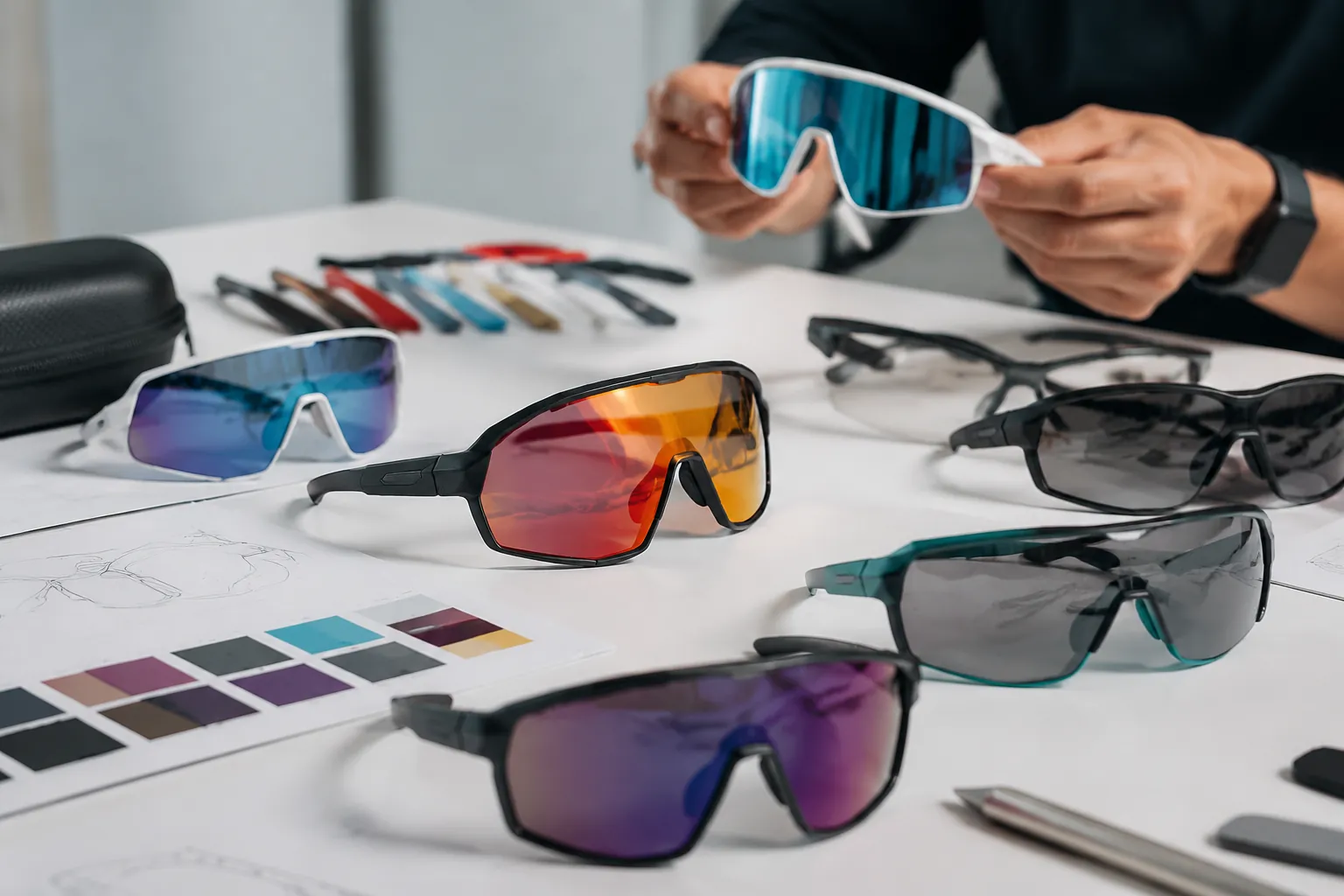
Adjustable nose pads help a sunglass frame fit more faces. That does not make them the right choice for every order. For brands, importers, distributors, and retailers, the question is commercial: will the pad system reduce fit complaints, improve bridge comfort, lift the frame, increase cheek clearance, improve grip, or support after-sales repair enough to justify extra parts, labor, inspection, and failure risk? This guide explains where adjustable nose pads earn their place, where a molded bridge is better, and what buyers should confirm before sampling or bulk production.
The Fit Problem Adjustable Pads Solve
Most sunglasses use either a fixed molded bridge or a formed bridge built into the frame front. This is efficient for injected PC, TR90, and many acetate fashion frames. It also limits fitting range.
If the bridge sits too low, the lenses may touch the cheeks or the frame may rest on the face instead of the nose. If it sits too high, too narrow, or at the wrong angle, the frame can pinch, slide forward, or tilt away from the intended lens position. Small geometry errors become real return reasons.
Adjustable nose pads give the factory, retailer, optician, or wearer a limited fitting window. Depending on pad-arm length, bridge shape, lens curve, and frame material, a good system may change frame height by a few millimeters and slightly adjust front angle. It can also move pressure away from a hard molded bridge and onto softer contact points. Do not guess the range. Measure it on samples.
The strongest case appears in Asian-fit, global-fit, optical-ready sun, driving, sport, and premium retail programs where fit complaints can hurt sell-through. The weakest case is a low-cost giveaway, souvenir, or short-season fashion frame where the buyer is competing mainly on unit price. If pads do not solve a measured fit issue, support service, or help one SKU fit more buyers, they add cost without enough value.
Nose Pad Systems and Trade-Offs
There is no universal best nose pad system. The right choice depends on frame material, target price, replacement needs, fitting range, and the stress the frame will face during assembly, shipping, retail display, and daily wear.
| System | Typical Use | Concrete Advantage | Main Risk | Buyer Specification |
|---|---|---|---|---|
| Molded fixed bridge | Injected PC, TR90, low-cost acetate | Lowest unit cost; no pad stock, screws, sockets, or pad-arm labor | Limited fit range on low, narrow, or flatter bridges | Confirm bridge width, bridge height, cheek clearance, frame tilt, and sample fit on several face profiles |
| Integrated silicone insert | Sport and active sunglasses | Improves grip without exposed metal arms; suitable for sweat and movement | Insert can loosen if groove depth, undercut, or adhesive process is weak | Specify Shore A hardness, insert dimensions, retention test, sweat exposure check, and groove tolerance |
| Screw-in pad arm | Metal, optical-ready sun, premium acetate with inserts | Good adjustability and repairability; replacement pads are easier to source when standard sizes are used | Screws can loosen, pad boxes can crack, and arms can bend during packing or adjustment | Control screw size, pad box type, torque range, left-right height tolerance, and final symmetry inspection |
| Push-in or clip pad | Mid-range metal and mixed-material frames | Faster assembly than screw pads; fewer small screws to manage | Stem compatibility varies; loose sockets can cause pad loss | Approve the pad stem standard and run push-pull retention checks before bulk production |
| Embedded metal nose bridge with pads | Acetate, TR90, or combination frames needing adjustable fit | Plastic-frame appearance with more fit control than a molded bridge | Higher tooling and alignment risk; insert position can drift in production | Use a dedicated jig, define insert depth and angle, and inspect bridge cracking after adjustment |
Silicone is the common pad material because it grips skin and compresses comfortably. Many sunglass nose pads sit around Shore A 20 to 40, but the best hardness depends on pad size, contact area, climate, and replacement expectations. Softer pads can feel better at first. They may also deform, attract dust, or yellow faster. Harder pads hold shape better but can feel less forgiving on the bridge.
PVC pads are usually cheaper. Treat them carefully. Buyers should verify aging, odor, discoloration, and chemical restrictions before approving them for export markets.
Attachment Method: Where Failures Start
Many nose pad failures start at the attachment point, not at the pad surface. A soft pad still fails if the arm is crooked, the socket is loose, the solder joint is weak, the screw is stripped, or plating buildup blocks the pad box. The approval sample must prove repeatability, not just comfort on one piece.
- Screw-mounted pads: Useful for repair and replacement. The screw should match the pad box and be tightened with a controlled driver. Over-tightening can crack the box; under-tightening allows rotation. Define screw size, material, head type, and torque range with the factory.
- Push-in pads: Efficient for assembly, but stem and socket tolerance must be stable. A small mismatch can cause pads to fall out during cleaning, retail handling, or courier vibration.
- Welded or soldered pad arms: Common on metal frames. Main risks include weak joints, uneven left-right height, plating buildup in the pad box, visible solder marks, and heat distortion during repair.
- Inserted structures on plastic frames: Require enough material around the insert. Thin acetate, TR90, or injected bridge areas can crack if the pad arm is adjusted too aggressively or if the insert sits too close to an edge.
A practical production target is an allowable left-right pad height difference, often around 0.5 mm unless the design needs another tolerance. Pad-arm spread should match the approved reference sample. The distance from pad edge to lens edge also needs checking so pads do not rub the lens or look uneven through the front.
Visual inspection alone is weak. Use a fitting head, bridge gauge, or factory jig so inspectors judge the same geometry on every lot.
Cost, MOQ, and Lead-Time Logic
Adjustable pads rarely decide the whole sunglass budget, but they change the cost structure. Cost comes from pads, screws or clips, pad arms, soldering or insertion labor, alignment checks, packaging protection, replacement parts, and higher rejection risk.
On small orders, setup and sampling often matter more than pad price. On large orders, process control and stable QC matter more than the individual component cost.
Supplier-stated MOQs should be confirmed by frame material, tooling status, pad standard, color, and decoration. Existing screw-in, push-in, or silicone insert systems usually support lower trial quantities than a new embedded insert or custom pad-arm geometry. A standard metal frame with screw pads is normally easier to sample than an acetate or TR90 frame that needs CNC bridge work, insert placement, or mold changes.
| Order Size | Best Pad Strategy | Cost Behavior | Lead-Time Expectation | Approval Focus |
|---|---|---|---|---|
| Small trial order | Use an existing screw, push-in, or silicone insert system | Higher unit impact because setup and inspection are spread over fewer pieces | Fastest when pads, arms, screws, and frame fronts are already available | Fit trial, comfort feedback, sample consistency, and packaging protection |
| Mid-size order | Standard silicone pads with controlled geometry | Better unit efficiency, still sensitive to manual assembly labor | Stable if no new mold, plating, special pad stock, or nonstandard color is needed | Pad symmetry, screw retention, push-in retention, and carton handling |
| Larger program | Custom pad color, refined arm shape, logo component, or model-specific insert | Good economics if tooling and fixtures are reused across colors or repeat orders | Additional time may be needed for tooling, plating, color matching, or custom components | Pilot run, written AQL criteria, replacement pad availability, and defect tracking |
| High-volume repeat program | Optimized system with dedicated jig and documented QC plan | Lowest relative unit impact after the first run is stabilized | Predictable only after first-run issues are corrected and the approved process is locked | Process control, operator training, incoming component checks, and vibration-resistant packing |
Do not change the pad mechanism late. Switching from a molded bridge to embedded pad arms after tooling can affect bridge thickness, lens tilt, lens clearance, logo position, and packing method. A mechanism approved shortly before shipment may look fine in a small sample and still fail in bulk. Fixtures, operator training, and inspection limits need time to prove themselves.
Materials, Decoration, and Frame Interaction
Nose pads are small, but they touch many visible and functional parts of the frame. Pad position affects bridge appearance, lens clearance, front tilt, and how a logo plate or printed mark appears when the frame is worn. On plastic frames, added pad structures may require more bridge thickness or a metal insert. On metal frames, pad-arm shape must work with plating thickness, solder flow, lens groove accuracy, and the required lens curve.
For silicone pads, specify length, width, thickness, hardness, color, transparency, surface finish, and any aging or anti-yellowing requirement. Common pad lengths vary by frame type. Smaller pads suit slim metal frames. Larger pads make sense where comfort and grip matter more.
Clear pads work for many retail sunglasses. Black, smoke, or matched-color silicone can look cleaner on sport frames. Very glossy pads show fingerprints. Matte or lightly textured pads hide handling marks but may collect dust.
Decoration choices can also affect the pad decision. Pad printing and heat-transfer logos near the bridge may distort if the frame needs adjustment after decoration. Laser engraving on metal bridges is more stable, but plating quality must be controlled so adjustment marks do not expose base metal. Metal logo plates can add perceived value, but they may crowd the bridge area if pad arms are also visible.
Check lens tinting, mirror coating, polarized lenses, and category markings after pad installation. Assembly tools should not scratch the lens or leave silicone residue. For premium programs, review the nose pad system together with acetate cutting, CNC bridge shaping, injection molding, lens tinting, lens coating, laser engraving, pad printing, metal logo plates, and packaging. Separate approvals can hide tolerance stack-up. The final frame still has to match the approved sample.
Customer Segments That Will Pay
Adjustable pads are worthwhile when the end user feels the benefit or the buyer avoids a measurable problem. A distributor selling one sunglass model across several regions has a different fit risk from a local retailer selling one low-price style for a short season.
- Asian-fit and global-fit programs: Pads can help lift the frame, improve cheek clearance, and reduce lash contact. This is often the clearest reason to add adjustable pads to plastic or combination frames.
- Sport and outdoor sunglasses: Grip, sweat behavior, and stability matter more than delicate adjustability. Integrated silicone inserts or larger soft pads may work better than thin metal pad arms, depending on the activity.
- Driving and polarized collections: Comfort over longer wear matters. A small bridge pressure point or unstable frame angle can become a return reason during extended driving.
- Optical-ready sun frames: Opticians usually expect fitting range, especially on metal and combination frames that may receive prescription sun lenses.
- Premium retail programs: Clean pad-arm alignment, clear silicone, replaceable components, and consistent symmetry support the product story, but only if hinges, lenses, plating, and packaging are also controlled.
For festival, souvenir, and low-cost promotional sunglasses, a fixed bridge is often the better sourcing decision. Spend the budget where it matters more: UV protection verification, lens category compliance, logo durability, hinge stability, and packaging strong enough for the shipping route.
Spec Details for the Tech Pack
A note that says adjustable silicone nose pads is not a specification. It leaves the factory to choose pad size, hardness, color, attachment standard, screw, replacement method, and symmetry target. That is how good samples become inconsistent bulk shipments.
A complete tech pack should include pad length and width, pad thickness, silicone hardness, pad color, transparency level, surface finish, attachment type, screw size or stem standard, pad-arm material, plating finish, left-right height tolerance, pad distance from lens edge, replacement pad requirement, and packing protection. If replacement pads must be available in retail or optical channels, confirm the pad standard before production. A nonstandard stem or screw can make after-sales service difficult.
For metal components, specify corrosion expectations and restricted substance requirements. Sweat and skin contact can expose weak plating around pad arms, screws, and solder joints.
For EU sales, review REACH requirements and nickel release where applicable. For sunglass performance, keep documentation market-specific: CE marking supported by EN ISO 12312-1 for EU sunglasses, ANSI Z80.3 for the US market, AS/NZS 1067 for Australia and New Zealand, FDA registration where applicable for US eyewear import handling, and REACH for chemical restrictions. ISO 9001 and BSCI are factory management or social compliance documents. They do not prove that a specific sunglass model meets lens, UV, chemical, or mechanical requirements.
Ask for current documents that match the factory name, product type, material, and destination market. Reject unrelated certificates, expired reports, and reports for a different model. The proof must match the actual frame, lens, coating, pad, and packaging materials.
Factory Checks Before Bulk Approval
The sample stage should prove fit, durability, and repeatability. One attractive sample is not enough. Ask for multiple samples from the same setup. Compare them on a flat surface, on a fitting head, and after packing and shipping.
Adjustable pads can bend in poor packaging. A hand-carried sample may not represent real freight conditions.
- Measure left-right pad height difference and confirm it meets the tech pack tolerance.
- Check pad distance from lens edge so the pad does not rub the lens or look uneven through the front.
- Open and close temples repeatedly and watch whether pad arms twist under normal handling.
- Rub pads with a clean cloth to see whether they rotate, shed residue, collect oil, or show discoloration.
- Inspect screw heads under magnification for stripping, uneven seating, corrosion, or plating damage.
- Run a push-pull retention check on clip-in and inserted pad systems using an agreed force and method.
- Inspect the bridge area after adjustment for cracking, whitening, coating damage, or insert movement.
- Test packed samples after courier transit or vibration because pad arms can bend when the frame is compressed.
- Confirm lens category marking, UV claim, and compliance documents match the destination market and the approved sample.
For bulk QC, define AQL level and defect categories before production starts. Missing pads, sharp pad boxes, loose screws, cracked bridge inserts, and lens scratches from pad assembly are usually major or critical defects, depending on the buyer standard. Crooked pads, yellowed silicone, uneven height, poor screw seating, weak retention, visible solder marks, and pad residue should also be listed.
Buyer shortcut: approve adjustable pads only after checking fit on several bridge profiles, confirming attachment durability, reviewing the exact production components, and seeing the QC standard the factory will use in bulk.
If the buyer waits until final inspection to debate what counts as crooked or loose, the shipment is already at risk. The best results come from clear specifications, realistic sampling, controlled approvals, and no late change to the pad system after tooling, materials, or fixtures are locked. Adjustable pads work when they are engineered into the frame from the start. They are risky when added as a late cosmetic feature.
Have a custom sunglasses project in mind?
Send us your styles, target market and quantities and we will return a detailed quote with MOQ, lead time and a sample plan.
Get a QuoteWhy source this from Wenzhou with LumiShades
Wenzhou in Zhejiang Province is widely regarded as China’s eyewear manufacturing capital, producing a large share of the world’s sunglasses. That concentration matters to buyers: a deep local supply chain for acetate sheet, hinges, lens blanks, plating and packaging means shorter component lead times, easier color and material matching, and a workforce with decades of eyewear-specific skill. LumiShades has manufactured in this ecosystem since 2009, and our vertical integration — in-house injection molding, acetate cutting, CNC milling, lens tinting, decoration and quality control — means no part of your order is quietly subcontracted to a workshop you cannot audit.
For international buyers, that vertical control translates into accountability. When a single factory owns every step, defects are traced and fixed at source rather than bounced between vendors, and your specifications survive intact from first sample to bulk. We back this with 15+ years of experience, shipments to 60+ countries, more than 5 million pairs produced per year and a 98.5% on-time delivery rate. Our certifications — CE EN ISO 12312-1, FDA registration, ANSI Z80.3, AS/NZS 1067, REACH, ISO 9001 and BSCI audit — mean the compliance documentation your market requires already exists. Explore our manufacturing capabilities and quality control process to see how this works in practice.
Frequently asked questions
Are adjustable nose pads always better than a molded bridge? No. Adjustable pads increase fitting range and serviceability, but they also add parts, assembly labor, inspection points, and possible failure modes. Choose them when fit range, cheek clearance, replacement, or return reduction matters. Choose a molded bridge when the frame already fits the target wearer group, the order is price-sensitive, and bridge comfort is verified on approved samples.
What nose pad material is best for sunglasses? Silicone is the usual choice because it provides grip and cushioning. Specify Shore A hardness, size, color, transparency, surface finish, and aging requirements instead of simply writing silicone pad. Softer silicone may feel more comfortable but can deform, attract dust, or yellow faster. Harder silicone may last longer but can feel less comfortable. For PVC or other materials, ask for chemical compliance and aging checks before approval.
How much fitting adjustment can nose pads provide? The adjustment range depends on pad-arm length, bridge shape, lens curve, and frame material. A well-made adjustable system may change frame height by a few millimeters and slightly alter front angle, but the exact range should be measured on samples. Ask the factory to record the approved pad height, pad spread, pad angle, and left-right tolerance so bulk production can be inspected against the same geometry.
Will adjustable pads increase lead time? They can. If the factory uses an existing pad, arm, screw, and frame construction, the effect may be small. New embedded inserts, custom pad colors, special plating, logo parts, CNC bridge changes, or mold changes can add sampling and tooling time. Before placing the order, ask which parts are standard, which parts are custom, whether replacement pads are available, and whether a pilot run is needed before bulk production.
What compliance documents should buyers check? Match documents to the sales market and product type. For sunglasses, check CE marking supported by EN ISO 12312-1 for the EU, ANSI Z80.3 for the US, AS/NZS 1067 for Australia and New Zealand, REACH for restricted substances in the EU, and FDA registration where applicable for US eyewear import handling. ISO 9001 and BSCI may support factory evaluation, but they do not replace product-level sunglass testing or chemical compliance.
What should be inspected in bulk production? Inspect missing pads, loose screws, crooked pad arms, uneven left-right height, sharp pad boxes, poor screw seating, weak push-in retention, pad discoloration, silicone residue, cracked bridge inserts, solder marks, plating damage, lens scratches near the pad area, and packaging protection. Put these items into the QC checklist before production starts and define whether each issue is minor, major, or critical under the buyer's AQL plan.
Is a low MOQ enough to test a custom nose pad design? A low MOQ can be enough for fit trials when existing pads, screws, arms, and frame structures are used. It is usually not enough to prove a new embedded insert, custom pad-arm geometry, or new mold process. For new construction, ask for multiple samples from the same setup, a small pilot run if possible, retention checks, packed-sample testing, and written tolerances before approving a larger order.
Ready to start?
Explore our aviator sunglasses or request a quote — our sales team replies within 12 hours.
Request a Quote