
Custom Grip Details That Improve Sunglass Fit
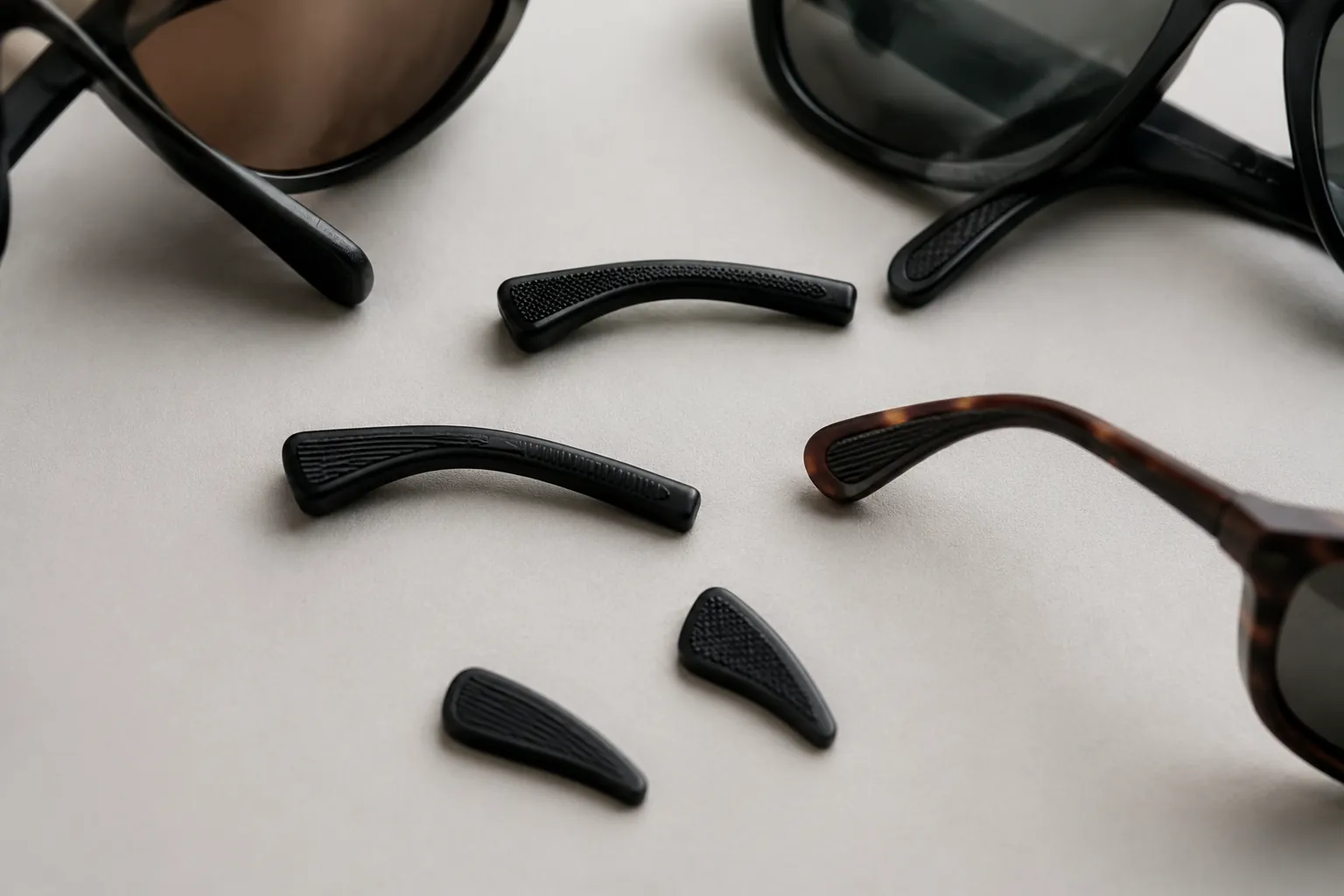
If a buyer wants a frame to feel more proprietary without funding a new platform, grip details are usually the first place to look. Nose-contact geometry, temple tips, inner-temple textures, and small overmolded or inserted grip zones change comfort, slip behavior, and perceived quality fast. They also let you keep the core front and temple structure from an existing platform. That limits tooling exposure and usually shortens development compared with a full new mold program. These are small parts. They are not minor parts. Once the frame is on the face, they often drive the first real comfort judgment, and that affects fit complaints, sell-through confidence, and repeat orders.
Why secondary parts matter more than buyers expect
Most sunglass development talks stay fixed on front shape, lens color, and logo placement. Those choices matter. They do not decide whether the frame is comfortable enough to wear for hours.
The wear decision is often set by the parts that touch skin directly: the bridge contact area, the inner temple, and the terminal tip behind the ear. Small geometry changes in those zones can shift pressure distribution, friction against skin, and the overall sense of refinement.
A stock frame with better nose contact and a better temple-end shape can feel noticeably different even if the front mold, hinge layout, and lens shape stay the same. For a private label buyer, that makes these parts useful. They add differentiation without forcing a full platform redesign.
On the factory side, these changes are often more contained than altering front architecture. Depending on construction, a nose-contact revision may be handled through a mold insert change, CNC adjustment, or tighter finishing control. A temple-tip update may need a new insert, an overmold tool, or a separate decoration step rather than a full new temple tool. The exact impact depends on the original tooling layout, material, and process sequence. Ask the factory which part of the tool or process will actually change.
The practical takeaway is simple: if you need better wear performance and more product identity, start with the parts that control skin contact and retention.
What you can change without a new frame platform
The range depends on frame construction. Injection sunglasses usually offer more flexibility for molded bridge geometry, texture, TPR overmold zones, and dual-material temple ends. Acetate gives a more premium hand feel and finish, but soft-contact features are usually created through shape, bevel, milling, and finishing rather than true overmolded grip zones.
- Nose area: saddle bridge contour, molded nose bumps, pad width, pad height, pad angle, bridge-contact radius, and surface texture on the contact area.
- Temple tip: terminal curvature, section thickness, ear-contact length, end profile, ribbed or matte anti-slip zone, dual-material tip, and embedded decorative hardware.
- Inner-temple grip: shallow rib texture, pebbled texture, laser-marked pattern, rubber insert strip, soft-touch patch, or local matte finish.
- Branding tie-in: custom pad shape, repeating texture motif, color-blocked tip, metal logo plate at the outer tip, or a signature end profile visible in side view.
The safest rule is to leave load-bearing geometry alone unless there is a clear reason to change it. Hinge placement, lens groove dimensions, front curvature, and temple fit at the hinge area affect assembly stability and lens retention. Contact-point revisions usually change perceived fit more than structural performance. That is why they are often the lower-risk first move for brands trying to avoid long revision loops.
There is no universal adjustment that fixes every frame. Material shrinkage, original design, and fit target all matter. Ask the factory to show the revised drawing, the sample, or both, and explain why that geometry should improve fit for the intended user.
Cost and lead-time trade-offs by component
Buyers often ask, “How much for custom nose pads?” That question is too narrow. The real issue is whether the change fits the current mold set, assembly process, and material family. That is where most cost and timing differences sit.
| Component change | Typical development impact | Unit cost effect | Lead-time effect | Main risk |
|---|---|---|---|---|
| Change pad texture or pad angle on existing insert | Low | Usually modest, but depends on tooling and finish control | May be limited to one new sample round if no new tool is needed | Improvement may be too subtle if base bridge geometry is poor |
| New molded temple-tip profile on existing temple platform | Low to medium | Usually modest, but depends on whether a new insert or new tip tool is required | Tool or insert revision can extend development | Frame balance can shift if the tip profile or mass changes too much |
| Add TPR or rubber grip insert | Medium | Higher than a simple shape change because of added material and process steps | Material matching and bonding checks can add development time | Bonding failure, color migration, insert fit inconsistency |
| Add metal logo plate at tip or grip area | Medium | Higher than standard decoration because of hardware, labor, and QC | Hardware sourcing and placement control can extend development | Pull-out risk, sharp edge feel, higher cosmetic reject rate |
| Completely new frame platform with integrated contact-point redesign | High | Highest upfront tooling cost | Longest development cycle | Tooling revisions, fit misses, lens and hinge issues |
MOQ logic matters here. A factory may accept low quantities for simple private label work, but secondary-part customization becomes easier to justify as volume rises because sampling, setup, and material-control costs spread across more units. A low-volume project is still possible. Just ask for a clean cost split: sample cost, tooling or insert cost, setup cost, and recurring unit cost.
If you are testing a market, use a staged approach. Prove sell-through and wear comfort on an existing frame with one or two grip revisions first. Add more custom work only after the base platform proves itself.
How to choose the first part to customize
Treat this as failure analysis, not just styling. Start with the complaint, the wear environment, or the target user profile. The right first modification depends on where the current frame is underperforming.
- If the frame slides on humid skin: start with inner-temple texture, a slightly longer ear-contact zone, and a more secure terminal-tip curve. Overmold inserts can help, but only if the base temple shape already retains the frame correctly.
- If the frame leaves nose marks: widen the contact area, soften edge transitions, reduce localized pressure at the bridge, and review front weight before adding texture.
- If the style feels too generic on shelf: use visible temple-tip geometry, controlled color blocking, or a repeatable grip pattern that the consumer can recognize by touch and side profile.
- If returns come from uneven fit: check left-right pad symmetry, temple opening angle, and whether the frame sits level when the contact points engage the face.
- If the target channel is sport or outdoor retail: prioritize sweat stability and retention first. Decorative hardware should come second.
A common mistake is applying soft-touch or rubberized treatments too broadly. Large soft zones attract dirt, sunscreen residue, and abrasion, especially on darker colors. They also make cosmetic QC harder because wear marks show quickly. In most cases, a controlled functional zone works better than coating large areas just to create a technical look.
Material behavior: where comfort parts fail in production
This is where many buyer assumptions break down. A CAD file or approval photo can look convincing. Production performance depends on how the part behaves through molding, finishing, assembly, packing, transport, and repeated skin contact.
Injection frames: aggressive texture on molded nose contact can improve grip, but if the texture is too sharp it may create visible molding variation, whitening, or uncomfortable drag against skin. For overmolded TPR on temple tips, hardness and bonding must match the geometry and base material. If the material is too soft, the part can deform during assembly or storage. If it is too hard, the grip benefit may be weak.
Acetate frames: CNC-milled bridge contours can improve fit, but acetate is still a hard material. It does not behave like a true soft pad across a broad fit range. Polishing control matters too. Over-polishing the bridge or inner tip can reduce the edge definition that was supposed to help stabilize the frame.
Inserted metal details: tip logo plates can raise perceived value, but they add another tolerance stack. Pocket depth, adhesive control, hardware flatness, edge finishing, and pull-test requirements should all be defined before production. If they are not, alignment drift and cosmetic rejects are common.
Coatings and decoration: pad printing is fast and economical, but it wears quickly on temple tips. Laser marking is usually more durable, though it creates a different visual effect and does not add color unless another process is used. Spray soft-touch coatings can feel premium at first, but they may be vulnerable to abrasion, skin oils, and sunscreen. For real anti-slip performance, decoration is not a substitute for physical geometry or material choice.
Good factories treat these details as a process interaction issue, not an isolated part change. A grip revision can affect polishing time, assembly speed, reject thresholds, and final inspection criteria. Review production control, not appearance alone.
Compliance and documentation buyers should not skip
Comfort details still sit inside a regulated consumer product. If you change skin-contact materials, coatings, inserts, adhesives, or decoration methods, the compliance file should be checked against the exact bill of materials that will ship. Small part change. Real documentation risk.
For sunglasses, buyers commonly reference CE EN ISO 12312-1, ANSI Z80.3, AS/NZS 1067, REACH, FDA registration, ISO 9001, and BSCI. These do not serve the same purpose. Product standards such as CE EN ISO 12312-1, ANSI Z80.3, and AS/NZS 1067 relate to sunglass performance and market requirements. REACH covers restricted substances in materials and finishes. FDA registration may be relevant depending on product classification and market handling. ISO 9001 and BSCI address quality-management and social-compliance systems, not optical product performance.
If a standard temple tip becomes a rubber insert, or a bridge-contact material changes, do not assume the old documentation still matches the new part. Ask for material specifications, restricted-substance declarations where relevant, and confirmation that the reviewed or tested configuration matches the production bill of materials, including color when that affects the compound or coating system.
- Ask for: material specifications for skin-contact components, color-specific declarations where relevant, adhesive or coating declarations, and confirmation of the exact BOM used for compliance review.
- Check: whether added coatings, painted tips, insert adhesives, or logo plates introduce new chemical-compliance exposure.
- Confirm: that lens category, transmission, labeling, and market markings remain correct if the frame revision is bundled with a lens change.
Buyers who verify this before bulk production reduce the risk of receiving goods whose paperwork no longer matches the shipped construction.
A practical sourcing route for low-risk customization
For a brand, importer, or retail chain, the cleanest route is staged development with tight control over variables. The goal is to prove fit and repeatability before adding complexity.
- Start with an existing proven frame platform. Choose a front and temple construction with stable lens fit and hinge performance.
- Choose one primary comfort objective. Better anti-slip performance, lower nose pressure, more premium hand feel, or stronger visual identity.
- Limit round one to 1-3 secondary changes. For example: revised nose-contact geometry, ribbed inner temple, and a custom-color temple tip.
- Sample fast and compare against control samples. A short sample cycle only helps if the revised sample is evaluated directly against the stock version.
- Wear-test on multiple face shapes. Ask users to wear the frame for hours, not minutes, including warm conditions or light activity when relevant.
- Lock measurable specifications before bulk. Approve texture standard, hardness where applicable, color standard, placement tolerance, and acceptable flash or edge condition.
- Scale once the fit is proven. Better pricing and smoother execution usually come after the construction is stable and the spec is clear.
The purchase order and approval sheet should reflect that discipline. Define component material, Shore hardness where applicable, color reference, finish, attachment method, and visual standard. If the nose area is changed, state whether the revision is geometric, textural, or both. If the temple tip is overmolded, define the transition-line requirement and allowable flash. If a logo plate is inserted, specify pull requirement, alignment tolerance, and acceptable edge feel.
One rule is worth keeping: if a factory inspector cannot verify the feature quickly at final QC, the specification is still too vague.
Have a custom sunglasses project in mind?
Send us your styles, target market and quantities and we will return a detailed quote with MOQ, lead time and a sample plan.
Get a QuoteWhy source this from Wenzhou with LumiShades
Wenzhou in Zhejiang Province is widely regarded as China’s eyewear manufacturing capital, producing a large share of the world’s sunglasses. That concentration matters to buyers: a deep local supply chain for acetate sheet, hinges, lens blanks, plating and packaging means shorter component lead times, easier color and material matching, and a workforce with decades of eyewear-specific skill. LumiShades has manufactured in this ecosystem since 2009, and our vertical integration — in-house injection molding, acetate cutting, CNC milling, lens tinting, decoration and quality control — means no part of your order is quietly subcontracted to a workshop you cannot audit.
For international buyers, that vertical control translates into accountability. When a single factory owns every step, defects are traced and fixed at source rather than bounced between vendors, and your specifications survive intact from first sample to bulk. We back this with 15+ years of experience, shipments to 60+ countries, more than 5 million pairs produced per year and a 98.5% on-time delivery rate. Our certifications — CE EN ISO 12312-1, FDA registration, ANSI Z80.3, AS/NZS 1067, REACH, ISO 9001 and BSCI audit — mean the compliance documentation your market requires already exists. Explore our manufacturing capabilities and quality control process to see how this works in practice.
Frequently asked questions
Can I customize nose pads and temple tips on a stock frame and still call it a private label product? Yes, if the product is produced under your brand and to your approved specification. Many private label sunglasses start from an existing frame platform and are differentiated through contact-point geometry, texture, color, decoration, packaging, or a combination of those elements. The key is documentation. Make sure the revised parts are recorded on the approved drawing, sample record, and purchase specification so the product is clearly your defined SKU rather than an untracked stock variant.
What is the lowest-risk grip upgrade for a first order? Usually a revised temple-tip shape or a controlled inner-temple texture on an existing frame platform. Those changes are easy for the wearer to notice, but they usually involve less process risk than adding a new rubber insert or broad soft-touch coating. Ask the factory for two or three sample variants based on the same base frame, then compare them side by side for slip, pressure behind the ear, cosmetic consistency, and ease of QC.
Will custom grip parts push MOQ too high? Not automatically, but they can change the order economics. MOQ depends on the type of change, whether new tooling or mold inserts are required, whether a new material color must be matched, and how many process steps are added. Ask the supplier to break the quote into four parts: sample cost, tooling or insert cost, setup cost, and recurring unit cost. That structure shows whether the project makes commercial sense at your target volume.
Do I need new compliance documents if I only change temple-tip material or nose-contact parts? You should at least re-check the compliance file against the revised bill of materials. Changes to skin-contact materials, coatings, inserts, pigments, adhesives, or decorative hardware can affect the supporting documentation, especially for REACH-related declarations and any market file tied to the exact shipped construction. Ask the supplier which documents are linked to the old BOM, which must be updated for the new BOM, and whether the approved sample and bulk specification match the paperwork exactly.
How should I evaluate samples for comfort details? Use side-by-side wear testing with multiple users for at least a few hours, ideally in warm conditions or light movement if that reflects the product use case. Check nose marks, slip during head movement, pressure behind the ear, frame level on the face, left-right balance, and whether the texture feels helpful or simply rough. Record findings against each sample code, and ask the factory to map the preferred result back to a drawing or process description. Without that step, it is easy to approve a sample feel that cannot be repeated consistently in bulk.
Ready to start?
Explore our aviator sunglasses or request a quote — our sales team replies within 12 hours.
Request a Quote