
Custom Sunglasses Pricing: Injection vs Acetate vs Metal
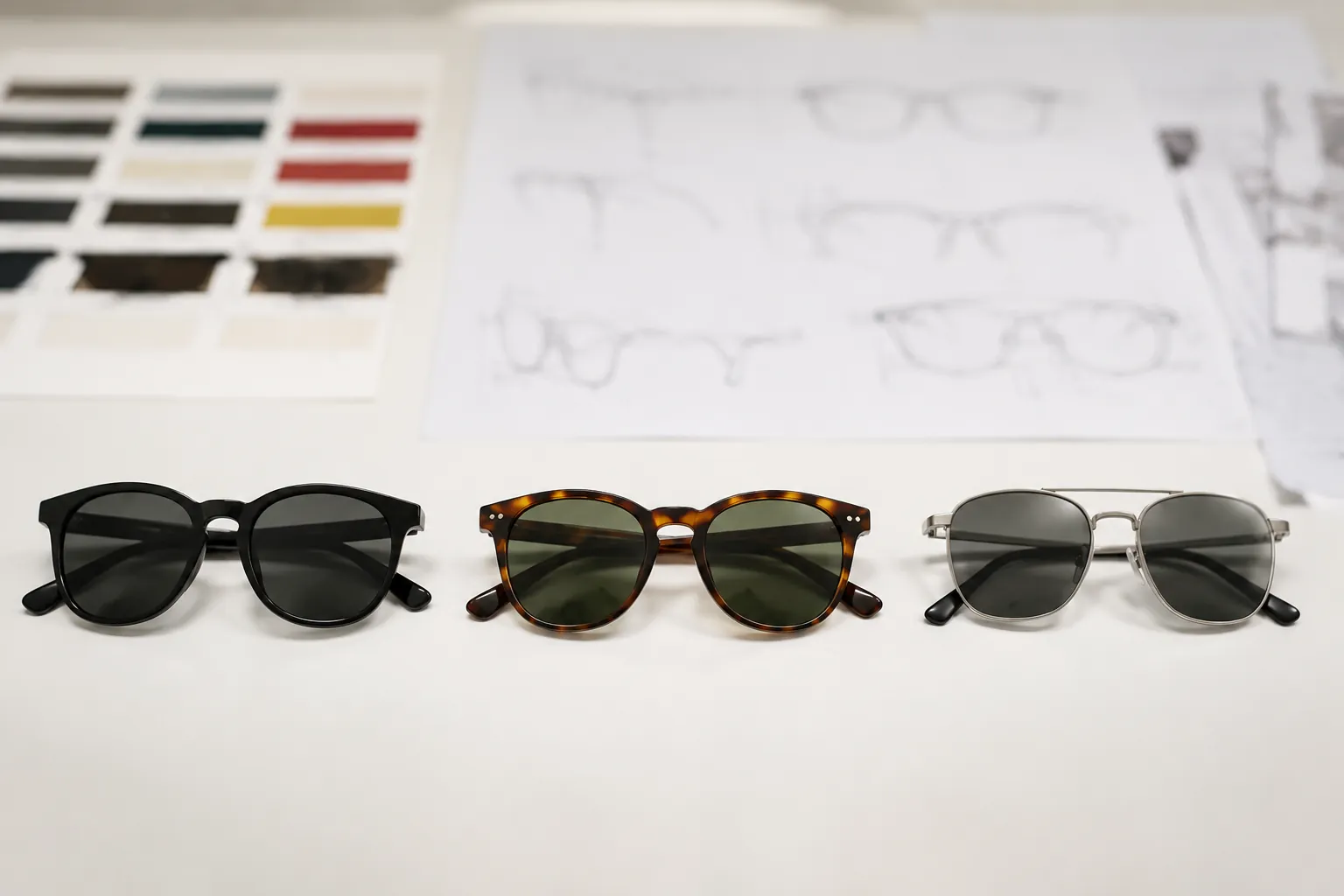
If you buy sunglasses in volume, frame material affects far more than appearance. It changes tooling cost, MOQ pressure, unit price, lead time, scrap risk, decoration options, and how much abuse the product will take in the field. This comparison breaks down injection, acetate, and metal frames so you can pick a tier that fits your margin target and sales channel. The guidance is for overseas brands, importers, distributors, and retailers ordering custom product from established eyewear factories.
The short version: which tier fits which buyer
Injection frames are usually the entry tier. They fit promo programs, mass retail, and buyers who need a low landed cost with consistent shape control. Acetate sits in the middle. It costs more, needs more handwork, and usually reads as more premium on shelf. Metal is the most process-sensitive of the three. It can be slim and polished, but it adds assembly steps, tighter handling requirements, and more places where quality can drift if the factory is not disciplined.
The material choice is not the whole decision. It is material plus target price, finish standard, and order size. A clean, simple injection design can often move from sample to bulk in about 25 to 35 days after approval, depending on mold status, decoration, and the factory queue. Acetate usually needs a similar or slightly longer window because cutting, tumbling, and polishing take time. Metal can run longer if plating, soldering, or special logo parts are involved. MOQ matters too. Smaller orders are possible, but the economics change fast as the run grows because setup and QC are spread differently across each batch.
Buyer rule: choose the material first by channel and price ceiling, then check whether the design can survive production without hidden compromises.
If your channel is price-led, injection usually wins. If your channel is style-led and wants a more premium shelf read, acetate is often the better middle ground. If your brief depends on a thin profile, finer detailing, or a more technical look, metal is worth the extra process cost, but only when the market will pay for it.
Cost bands, MOQ behavior, and lead-time logic
The same design can price very differently depending on material, decoration method, and how much handwork it needs. Tooling, polishing, assembly time, plating yield, and reject rate all matter. The real question is not just unit price. It is whether the factory can hold the target quality at the order size you plan to place.
For injection, mold cost is the main front-loaded expense. A basic frame mold can be efficient once the cavity is stable, but custom color matching, rubberized finishes, or metal logo inserts add cost. For acetate, the cost sits in labor: cutting, milling, tumbling, hand polishing, and fitting consume time. For metal, the cost rises through parts count: front, temples, hinges, pads, screws, plating, and extra inspection steps. Small runs usually carry the steepest premium because setup is similar whether you order 50 pairs or 5000.
| Frame type | Typical MOQ behavior | Unit price position | Lead-time pressure | Best fit |
|---|---|---|---|---|
| Injection | Lowest friction at 50-300 pairs/design; scales best at 1000+ | Lowest | Fastest once the mold is approved; simple runs can often ship in 25-30 days after sample sign-off | Promo, retail volume, aggressive margin targets |
| Acetate | Works at 50 pairs/design, but economics improve from 300+ | Mid | More sensitive to cutting and polishing queues; plan 28-35 days after approval | Fashion retail, better shelf appeal, higher ASP |
| Metal | Possible at 50 pairs/design, but small runs can be slower and more labor-intensive | Mid to high | Plating and assembly can push timing to 30-40 days depending on finish complexity | Premium-lite, optical-inspired styles, slimmer silhouettes |
Decoration changes the price curve too. A plain frame costs less than a frame with hot-stamped logo, in-mold logo plate, laser marking, custom temple printing, or embedded metal badge. Many buyers underprice that decision. It is not a small surcharge. It can add a full process step.
Injection frames: the low-cost workhorse
Injection molding is the right call when you need predictable geometry and low per-unit cost. The factory injects plastic into a mold, trims the part, then moves to finish work, hinge installation, and decoration. The upside is speed and consistency. Once the mold is tuned, the frame shape repeats well. That matters for reorder programs and long-running retail SKUs.
Injection works best when wall thickness is designed sensibly. Thin walls can feel light and may flex too much around the hinge. Too much thickness can create sink marks, heavy temples, or cooling issues that warp the geometry. A strong factory watches gate placement, parting lines, and cooling balance. Tolerances on a commercial sunglasses frame need to stay tight enough that lenses seat correctly and both temples close evenly. If the eyewear sits out of square by even a small amount across the front, fit issues and a crooked shelf appearance can follow.
For buyers, the main tradeoff is feel. Injection can look clean, but low-quality injection looks cheap fast if wall thickness is wrong, surface polish is weak, or the hinge area flexes too much. Good factories control sink marks, parting lines, and gate marks. Poor ones leave all three visible. Surface finish options usually include high gloss, matte, soft-touch coating, rubber paint, and two-tone color molding. Each one affects consistency. Gloss shows flaws more easily. Matte can hide small surface variation but may wear faster if the coating is weak.
- Pros: lowest unit cost, fast bulk production, strong repeatability, good for color runs
- Cons: less premium hand feel, mold cost up front, weaker luxury perception
- Watch points: hinge reinforcement, temple flex, surface gloss, tint consistency, print adhesion
The main advantage of injection is not only price. It is also the ability to move quickly through prototype, correction, and mass production without excessive handwork.
Acetate frames: more labor, better shelf presence
Acetate is a different product. It is cut from sheet, stacked or laminated if the design calls for it, then milled, tumbled, polished, and fitted. This is not a spray-and-go process. The material rewards factories that know how to control edge finishing and surface clarity. It also punishes sloppy drying, poor cutting, and rushed polishing. If the sheet stock is unstable or not cured correctly, shrinkage, warping, or lens-groove mismatch can show up later in the run.
Buyers usually move to acetate for better perceived value. It has more depth in the material, more visual weight, and generally a more premium feel in hand. It also gives more room for color-story work, especially marble, tortoiseshell, crystal, and layered looks. But that value costs labor. Expect more steps and more hand checks. Small defects are easier to see because the material is visually richer. A stray sanding line, cloudy edge, or uneven polish is harder to hide on acetate than on a basic injected frame.
Typical acetate QC includes blank cutting, front shaping, temple drilling, tumble polishing, hinge fitting, lens-groove inspection, and final alignment. The fit needs to stay within tight visual limits: the front should not twist, the temple tips should close evenly, and the lens seat should not pinch or rattle. On a decent production line, the critical dimensions are checked at multiple stages, not only at final inspection. That is the difference between a stable run and a batch that looks fine in photos but creates returns later.
- Cutting must follow the template closely or lens alignment can drift.
- Tumbling and polishing must be controlled or the edges look cloudy.
- Hinge alignment needs careful fitting because the frame is less forgiving than injection.
- Color consistency across a batch matters because acetate patterning can vary by sheet and cut position.
If you want a mid-tier product that does not read as mass promo, acetate is often the practical answer. It is also the material where a strong QC team pays for itself, because the same visual detail that makes it attractive also makes defects easier to spot.
Metal frames: thin profile, more assembly risk
Metal frames usually sell on profile and detail. They can look lighter, sharper, and more technical than plastic. That is useful for fashion, optical-style sunglasses, and buyers who want a finer silhouette. The tradeoff is manufacturing complexity. Metal frames introduce welding, plating, nose pad assembly, temple-end finishing, screw control, and more dimensional points that can go out of spec.
On a factory floor, metal is where weak process control becomes obvious. A slight plating issue shows up as color inconsistency. A poor solder joint shows up in returns. A loose pad arm becomes a service problem. Metal is not harder only because of the material. It is harder because there are more places to fail. Common finishes include nickel-free plating, matte black, brushed metal, gunmetal, and dual-plating effects. Each finish has its own rejection profile, and each one can change the final unit cost more than a buyer expects.
Metal frames also tend to carry more small parts. Spring hinges, adjustable nose pads, end tips, and decorative temple pieces all add assembly time and inspection burden. If the design uses laser etching or a custom metal logo plate, the factory has to manage both appearance and durability. A nice-looking finish that scratches easily is not premium. It is a quality problem.
For price tiers, metal generally sits above basic injection and can sit near or above acetate once assembly labor and finish requirements are included. That is especially true if you want two-tone plating, spring hinges, or custom metal logo plates. Those details add time and raise reject risk. Buy metal if the product story needs it. Do not buy it only to avoid plastic.
Durability and field performance
Durability is not one thing. It is impact resistance, hinge life, surface wear, and how the frame behaves after heat and handling. Different channels care about different failures. A discount chain cares about breakage on shelf and in transit. A fashion retailer cares about return rate and finish quality. A distributor cares about reorder consistency and whether the next batch matches the last one.
Heat exposure matters too. Frames left in a car or under direct sun can deform, especially if the resin, coating, or temple geometry is weak. A buyer shipping into hot climates should ask about heat resistance, stress whitening, and whether the frame has been tested under realistic storage and transport conditions. That is especially relevant for injection, where low-grade resin can soften or creep faster than expected.
| Material | Impact / flex behavior | Surface wear | Field risk |
|---|---|---|---|
| Injection | Good flex if engineered well; low-quality parts can crack at stress points | Can scratch and gloss over with poor resin or finish | Hinge stress, warped temples, cheap feel if resin grade is wrong |
| Acetate | Stiff, solid feel; less forgiving on impact than some injected styles | Polish can hold up well, but edge wear shows if finishing is rushed | Misfit lenses, finish haze, shrink issues if curing is poor |
| Metal | Strong in thin sections, but bends and deforms rather than springs back forever | Plating wear and corrosion risk if process control is weak | Pad failure, solder weakness, plating defects, alignment drift |
For many buyers, injection wins on rough handling, acetate wins on perceived quality, and metal wins on refined appearance. None of them is automatically best. The right choice depends on where the product will live and how it will be sold. If the product needs to survive a rough channel and still hold cost, injection usually has the edge. If the product needs to signal quality at first touch, acetate often pays back. If the product needs a slim premium story, metal is the right tool, but only with disciplined process control.
Decoration methods and finish choices that change the tier
Decoration is where many projects drift off budget. A frame material may be affordable, but the decoration spec can turn it into a different product. Buyers should separate the base frame cost from the finish stack. Common methods include silk-screen printing, pad printing, hot stamping, laser marking, laser engraving, metal logo plates, in-mold logo details, and custom temple tips. Each method interacts differently with each material.
Injection is the most flexible for printed logos, two-color molding, and soft-touch coating. Acetate usually performs best with engraving, metal inlays, or subtle print rather than heavy surface graphics. Metal supports laser marking and plated logos well, but deep custom decoration can force extra tooling or manual assembly. A small logo on a temple tip may look minor on paper, yet it can add an extra check point, a curing step, or an adhesion risk that affects the whole run.
- Use pad print or silk-screen when you want low-cost brand marking with moderate detail.
- Use laser engraving when the surface should stay clean and the mark needs better wear resistance.
- Use metal plates or inserts when the buyer expects a premium tactile cue and can pay for added assembly.
- Use two-tone or layered acetate only when the design language justifies the extra cutting and QC load.
As a rule, the more the decoration has to stay visually consistent over time, the more it should be built into the product instead of sitting on top of it. That is why some premium programs spend more on a molded detail or engraved mark and less on surface print. The decoration survives better, and the batch looks more consistent.
Compliance and QC: what buyers should ask for
Do not confuse a material choice with compliance. The frame type does not replace testing. Buyers shipping to different markets should ask for the right documentation against the right standard. The certifications and registrations to work from are CE EN ISO 12312-1, ANSI Z80.3, AS/NZS 1067, REACH, FDA registration, ISO 9001, and BSCI. Nothing else should be assumed unless the factory can document it clearly.
For sunglasses, confirm the intended market before finalizing lens and frame specs. CE EN ISO 12312-1 matters for the EU. ANSI Z80.3 matters for the US safety context. AS/NZS 1067 matters for Australia and New Zealand. REACH is about chemical compliance, which affects materials, coatings, and certain decorations. FDA registration is not a product performance certificate, so it should not be treated as one. ISO 9001 and BSCI are management-system and social-compliance signals, not product-performance proof.
Good QC on frames should include dimensional checks, hinge-torque checks, lens-fit checks, finish inspection under controlled light, and packaging inspection. Buyers should also ask for AQL terms in writing. If the factory can explain its critical QC gates, the buyer should want to hear the sequence: incoming material check, in-process inspection, final inspection, and shipment sampling. If the factory cannot describe that flow in plain language, that is a problem.
For tighter programs, ask for the actual tolerance window on key points such as lens groove width, temple opening, bridge symmetry, and front alignment. The exact spec varies by style, but the factory should be able to tell you where it is measuring and what it is rejecting. That is how you separate a real production line from a vendor that only knows how to quote samples.
How to choose the right tier for your order
Start with margin math. Then check channel, then quality target. Most bad buying decisions happen when the buyer starts with appearance and works backward. That is the wrong order.
- Set the target landed cost and expected retail or wholesale price.
- Pick the channel: promo, mass retail, online DTC, fashion retail, or distributor stock.
- Choose the material tier that fits the channel. Injection for cost pressure, acetate for shelf value, metal for slimmer premium styling.
- Confirm MOQ against your launch plan. If you are only testing one colorway, do not pretend a high-volume structure makes sense.
- Lock the compliance market early: EU, US, Australia/New Zealand, or mixed.
- Ask for sample timing and bulk timing. Sample windows often run around 7 to 10 days for straightforward projects, while bulk can run 25 to 35 days or longer depending on approvals, decoration, and queue.
- Check decoration early. Print, engraving, logo plates, and special finishes all change both unit cost and lead time.
If you are launching a new program, a practical route is to start with one injection design for price entry, one acetate design for a better margin tier, and one metal design only if you have evidence the channel will pay for it. Do not overbuild the line on the first order. Buy the tier your channel can actually absorb. The best frame is the one that can be made repeatedly, inspected consistently, and sold at the margin you need.
Have a custom sunglasses project in mind?
Send us your styles, target market and quantities and we will return a detailed quote with MOQ, lead time and a sample plan.
Get a QuoteWhy source this from Wenzhou with LumiShades
Wenzhou in Zhejiang Province is widely regarded as China’s eyewear manufacturing capital, producing a large share of the world’s sunglasses. That concentration matters to buyers: a deep local supply chain for acetate sheet, hinges, lens blanks, plating and packaging means shorter component lead times, easier color and material matching, and a workforce with decades of eyewear-specific skill. LumiShades has manufactured in this ecosystem since 2009, and our vertical integration — in-house injection molding, acetate cutting, CNC milling, lens tinting, decoration and quality control — means no part of your order is quietly subcontracted to a workshop you cannot audit.
For international buyers, that vertical control translates into accountability. When a single factory owns every step, defects are traced and fixed at source rather than bounced between vendors, and your specifications survive intact from first sample to bulk. We back this with 15+ years of experience, shipments to 60+ countries, more than 5 million pairs produced per year and a 98.5% on-time delivery rate. Our certifications — CE EN ISO 12312-1, FDA registration, ANSI Z80.3, AS/NZS 1067, REACH, ISO 9001 and BSCI audit — mean the compliance documentation your market requires already exists. Explore our manufacturing capabilities and quality control process to see how this works in practice.
Frequently asked questions
Which frame material gives the lowest starting cost for a custom sunglasses order? Injection usually gives the lowest starting cost, especially for simple designs and smaller launches. The economics improve as volume rises because the mold cost is spread over more pairs. If the decoration is limited and the shape is straightforward, injection is usually the most efficient entry tier.
Is acetate always better quality than injection? No. Acetate often feels more premium and can look better on shelf, but quality depends on the build, not the material label. A well-made injection frame can be more durable in rough handling than a poorly made acetate frame. What matters is resin or sheet quality, tooling, hinge design, finish control, and QC discipline.
Which material is best for 50 pairs per design? Injection is usually the most practical starting point at 50 pairs. Acetate and metal can be done, but the unit price is usually higher because setup, cutting, plating, and assembly are spread across a very small run. Small orders also leave less room to absorb rework or decoration changes.
What compliance documents should I ask for on sunglasses shipments? Match the market and ask for the relevant documentation: CE EN ISO 12312-1 for the EU, ANSI Z80.3 for the US, AS/NZS 1067 for Australia and New Zealand, and REACH where chemical compliance is relevant. Ask for the factory's ISO 9001 and BSCI status if you need management-system or social-compliance evidence. Treat FDA registration as a registration status, not a product test certificate, and ask which standard the approved sample was tested against.
Why do metal frames often cost more than they look like they should? Because the cost is not just the metal itself. It includes forming, soldering, plating, assembly, pad installation, alignment, and more QC checkpoints. More parts mean more chances for rework. Decorative finishes like dual plating, brushed effects, or laser details can add both time and reject risk. Buyers should price metal by the finished assembly, not by the raw material alone.
Ready to start?
Explore our aviator sunglasses or request a quote — our sales team replies within 12 hours.
Request a Quote