
Frame Core, Temple Wire, and Reinforcement
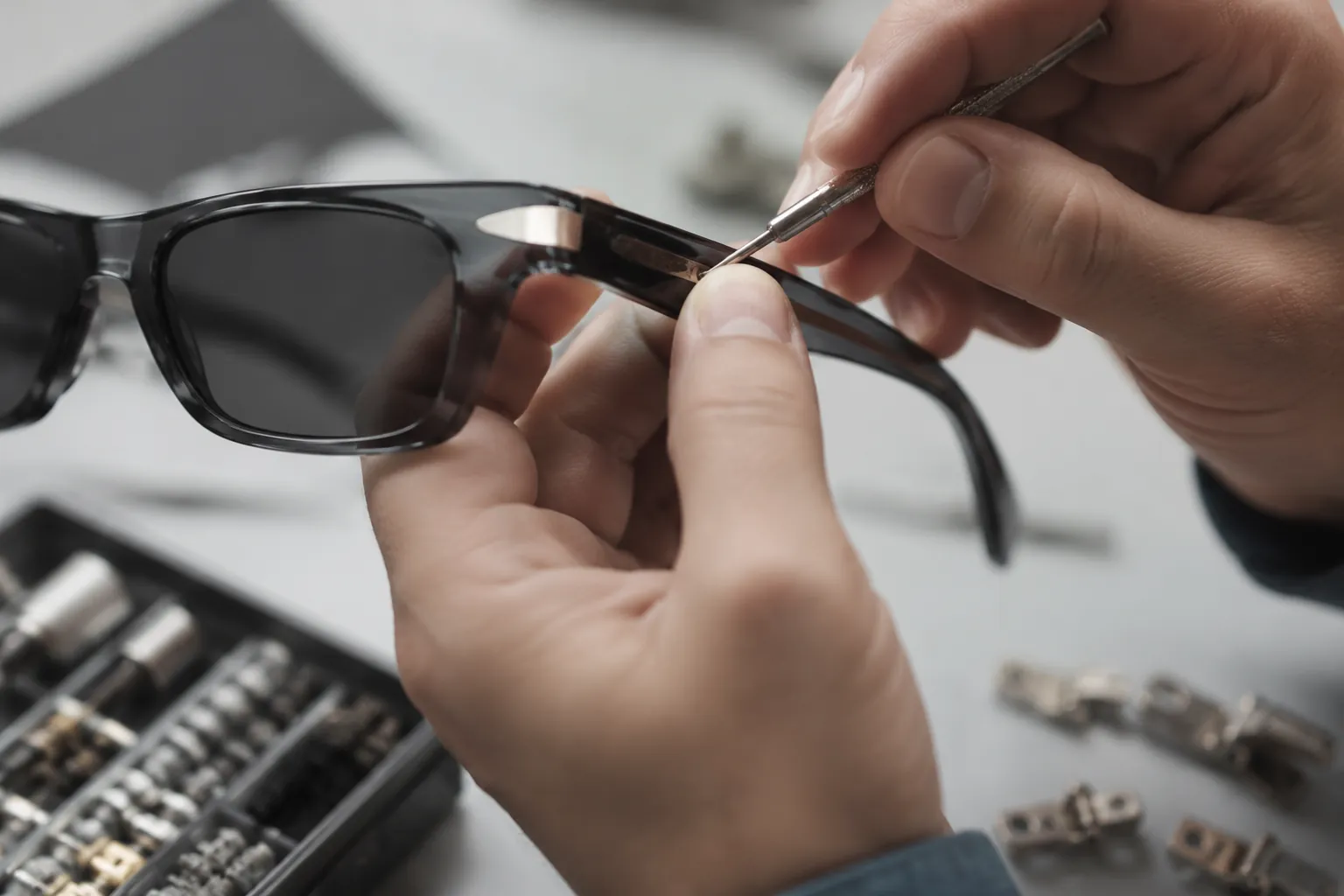
If you buy custom sunglasses in volume, the hidden parts inside the frame matter almost as much as the visible design. Frame core, temple wire, and reinforcement decide whether a pair keeps its shape, opens cleanly after repeated wear, and feels solid instead of flimsy. This guide is for brands, importers, distributors, and retailers that need the right build without paying for structure they do not need—or underbuilding a frame that later becomes a warranty problem.
1) What these hidden parts do
A frame can look the same outside and perform very differently inside. The frame core is the structural insert inside acetate temples and, in some designs, thick front sections. Temple wire is the metal insert that helps the temple hold shape and stay adjustable. Reinforcement is added structure at stress points such as hinges, bridges, or temple ends.
These parts affect three things buyers notice quickly: fit stability, adjustability, and hand-feel. A temple that is too soft may spread after repeated try-ons. A temple that is too stiff may resist adjustment or stress the acetate shell. An overbuilt frame may be durable, but it can also feel heavy and front-loaded.
The first question is not "more metal or less metal?" It is simpler than that. What failure are we trying to stop? If the frame will be handled by retail staff, tried on often, and adjusted in store, hinge-zone reinforcement and stable temple construction matter. If the design is a lightweight fashion style, weight control and clean finishing may matter more than maximum rigidity.
LumiShades handles acetate cutting, injection molding, CNC milling, decoration, lens tinting, and QC in-house, so structure choices can be reviewed in one development process. A change in core wire size or bend geometry can affect temple milling, hinge fit, assembly time, and reject rate. That is why structure should be approved during sampling, not after bulk production has started.
Practical rule: if the frame is meant to sell above entry level, specify the internal structure with the same care as the visible design.
2) Match structure to the frame material
The right reinforcement depends on whether you are building acetate, injected plastic, or a mixed-material frame. The same insert that works in a thick acetate temple may be unnecessary in a molded injected temple. It may also create fitting or cosmetic issues if the channel is not designed for it.
Material choice sets the baseline. Reinforcement fine-tunes the feel. Acetate can accept a visible internal insert and still feel premium. Injection molding relies more on wall thickness, rib design, and hinge bosses built into the mold. Mixed-material frames need the most careful balancing because the front and temples may flex and age differently.
| Frame type | Typical internal structure | What it improves | Main trade-off |
|---|---|---|---|
| Acetate full frame | Temple core wire, optional front reinforcement at hinges | Shape retention, hinge stability, premium hand-feel | Higher material and labor cost; tighter milling tolerances needed |
| Injected frame | Localized metal reinforcement or thicker molded sections | Stiffness without adding too much weight | Tooling decisions matter more; fewer post-fixes once the mold is locked |
| Acetate front + injected temples | Core only where needed, often in temples | Cost control with stable wear comfort | Mismatch in texture, color, and weight if not balanced in sampling |
| Full metal or mixed metal-acetate style | Dedicated hinge blocks, wire inserts, soldered or screwed reinforcement | High durability and premium perception | More assembly steps and stricter plating/corrosion control |
For acetate, the core wire is usually stainless steel inserted inside the temple channel before lamination or closure. The wire size is not fixed by trend. It depends on temple width, bend geometry, and target opening force. A narrow, curved temple may need a pre-bent insert so the shell does not fight the wire during closing. Too thin and the temple twists. Too thick and the temple becomes hard to adjust cleanly or may show stress around the insertion zone.
For injected products, structure is often built into the mold instead of added later. That saves assembly time, but it raises the importance of tooling precision. A hinge boss offset by a small amount can create left-right asymmetry, uneven screw engagement, or a temple that opens with a different feel on each side. So acetate and injection are not just two materials. They are two different manufacturing paths.
LumiShades works on both injection molding and acetate cutting, so buyers can compare a fully injected build against an acetate build with core wire before committing to production. That helps if you are balancing cost, weight, and perceived quality.
3) Frame core choices: what you pay for
Not every frame core does the same job. Some are there for basic rigidity. Others keep the temple springy and adjustable. Others are needed because the design has a deep curve, a thick acetate profile, or a large lens shape that could creep over time.
Buyers often ask for "more metal" as if that automatically means better quality. It does not. More metal can improve shape retention, but it can also make fitting harder and add little value if the weak point is the hinge screw, the hinge block, or the temple tip.
The better question is simple: what performance change are we buying? If the answer is "less twisting after repeated retail try-on," a stronger wire and better insertion control may be the right fix. If the answer is "the temple feels too floppy in a thick acetate profile," a shaped or pre-bent wire may work better than a heavier straight one.
- Standard straight core wire: Common in acetate temples. Suitable for straightforward designs and moderate price points.
- Pre-bent or shaped core: Used when the temple has a strong curve or thick profile. Better control, more labor, and greater dependence on consistent wire forming.
- Reinforced hinge-zone core: Adds strength where the temple meets the hinge. Useful for heavier fronts, larger lenses, and frequent retail handling.
- Partial reinforcement: Metal only where needed. Saves cost, but the design must be checked carefully for balance and warp after heat exposure.
Pricing should treat structural complexity as a defined cost item. A simple build costs less than a reinforced one because every extra operation adds material handling, assembly time, and inspection steps. In OEM programs, those extra steps matter as much as raw material.
- 50 pairs: Best for proof-of-concept sampling and fit validation, not for price optimization.
- 300 pairs: Often enough volume to justify modest reinforcement if it reduces returns.
- 1000 pairs: A practical point where tooling and setup costs are easier to spread across units.
- 5000+ pairs: Better for custom wire bends, special hinge blocks, or multi-step decoration because process setup is spread across more units.
LumiShades' pricing improves with volume, but heavier structure, special hinge parts, and multi-step decoration still add material and labor. Treat structure as part of the target FOB, not as a vague quality upgrade.
4) Temple wire: small part, big returns
Temple wire is one of the most overlooked items in eyewear. It is small, relatively inexpensive, and easy to specify badly. Yet it strongly influences fit stability, serviceability, and perceived quality.
The wire must allow adjustment without cracking the temple shell or springing back too hard. If it is too soft, the temple can lose shape after repeated adjustments or heat exposure. If it is too hard, the technician may struggle to fit the pair and may create an uneven bend or stress at the exit point. If the wire is not seated consistently, the left and right temples can open with different resistance. That is one of the fastest ways to make a frame feel wrong.
The insertion process matters as much as the wire itself. A reliable factory controls channel depth, wire straightness, and the closing or lamination operation so the insert stays centered. In acetate, the wire should not be visible through the surface under normal viewing conditions. If you can already see a warp, bump, or shadow line before packing, the pair is unlikely to feel consistent in wear.
Temple wire selection also depends on channel and profile. A narrow temple may perform well with a thinner wire if the bend radius is gentle. A thick, flat temple can hide a stronger insert without adding visual bulk. That is why "same material, same cost" rarely holds across different styles.
The main QC checks are channel control, opening force, and symmetry. For many fashion sunglasses, the target is a smooth, balanced opening feel that is firm but not stiff. For sport-oriented styles, a higher retention force may be acceptable. The key is consistency. A mixed batch of soft and stiff temples creates service complaints because retail staff cannot adjust around uneven springback.
Temple wire should be checked before final polishing and again after decoration. A temple may look fine before pad printing or hot stamping, then shift slightly under heat. QC should verify not only finish but also:
- temple opening symmetry,
- left-right matching resistance,
- hinge torque,
- wire exposure at the tip,
- and any warp after heat or pressure testing.
LumiShades' in-house QC matters here because wire problems are much cheaper to catch before bulk packing than after cartons leave the factory.
5) Reinforcement options: add strength where it matters
Reinforcement should go where the product actually fails, not everywhere. Common stress points include the hinge area, the nose bridge on some styles, and the temple end where consumers twist the frame during daily wear or cleaning.
A useful way to think about reinforcement is by failure mode. If the issue is loose hinges, reinforce the hinge zone or add a stronger front block. If the issue is temple twist, improve the internal wire or the temple cross-section. If the issue is bridge stress on wide fronts, add structural support near the bridge or adjust lens cutouts to reduce stress concentration.
| Reinforcement method | Best use case | Effect on feel | Production impact |
|---|---|---|---|
| Thicker acetate around hinge | Classic fashion frames | Solid, slightly heavier | Easy to tool, modest cost increase |
| Metal front reinforcement | Large lenses, wider fronts | Very stable, more premium in hand | More assembly steps, higher cost, tighter alignment control |
| Temple tip strengthening | High-usage retail styles | Better durability, less twist | Low material cost, needs good insertion control |
| Mixed-material build | Price-sensitive collections with target weight control | Balanced if engineered well | Needs careful sampling, fit testing, and decoration planning |
One practical rule: reinforce only if you can name the failure you are preventing. "Looks premium" is not enough. "Prevents hinge pull-out after repeated adjustment" is a valid reason. That reason can be tested with hinge cycling, heat exposure, and drop handling.
If you want a lighter feel, reinforcement is not always the answer. Sometimes the better move is changing the temple profile, improving hinge placement, reducing over-thick front walls, or switching to a more stable injection geometry. Those changes can be cheaper than adding metal everywhere and may produce a cleaner cosmetic result.
Decoration also affects reinforcement decisions. A metal logo plate, deep laser engraving, or thick pad print near a hinge can interfere with the wire channel or create a stress point. Hot stamping on acetate is usually low profile, while pad printing adds a surface layer that can wear if it is placed on a flex zone. Laser engraving is precise, but it may expose the underlying texture and change the perceived finish. These choices should be locked after the structure is approved, not before.
6) How structure changes MOQ, sampling, and lead time
Hidden structure changes the schedule. A clean acetate temple with standard core wire is faster to sample than a new hinge reinforcement, a special wire bend, or a mixed-material build. When structure changes, the first sample rarely fits perfectly because bend radius, screw torque, wire seating depth, and cosmetic finish all have to be checked together.
LumiShades typically provides samples in 7 to 10 days and bulk production in 25 to 35 days, depending on design complexity and material availability. That timeline works best when the structure is already defined. If you are changing core wire gauge, hinge reinforcement, and decoration at the same time, expect at least one extra sample cycle for revisions.
MOQ is a planning tool, not just a buying constraint. Lower quantities let you test whether the structure feels right in retail handling. Higher quantities let you optimize cost and consistency once the design is proven.
- 50 pairs per design: Good for testing a new internal structure before a larger order.
- 300 pairs: A useful level where pricing and durability can be balanced for a small launch.
- 1000+ pairs: Better for custom reinforcement or mixed-material programs that need tighter consistency.
- 5000+ pairs: Better for amortizing tooling, decoration setup, and more complex assembly.
Lead time depends on what is changing. Standard core wire with standard hinge tooling is the fastest path. Custom wire bends, new hinge blocks, special plating, or a logo plate placed close to a stress zone will slow the schedule because the factory must verify fit after each step. If the structure affects polishing, coating, or decoration, that also adds time.
Quality and compliance should be defined up front. For export programs, the relevant references may include CE EN ISO 12312-1, ANSI Z80.3, AS/NZS 1067, REACH, FDA registration, ISO 9001, and BSCI, depending on market and buyer requirements. If your market needs a specific standard or document set, define it before tooling. Structural strength does not replace eyewear safety compliance.
7) Spec what you want, not just the look
Buyers get better results when they specify measurable build points. A brief that says "strong temples" is too vague to quote or test. A brief that says "acetate temple with stainless core wire, stable opening force, no visible warp, hinge alignment within tolerance, and no sharp edges at insertion points" is a production brief.
The best specs describe both appearance and behavior. That means dimensions, force, finish, and acceptable visual limits. If you want a premium acetate frame, specify temple width, wire target, acceptable springback, screw retention, and the decoration method near the structural zone.
Useful tolerance topics to discuss with a supplier include:
- Temple opening symmetry: left/right difference should be visually minimal and within the agreed process tolerance.
- Hinge alignment: no obvious cant or twist when the temples are opened flat.
- Wire placement: no exposed metal at the temple edge or tip.
- Surface quality: no sink marks, bumps, or print distortion around reinforcement zones.
- Heat stability: frame should hold shape after normal adjustment conditions.
Decoration should be selected after the structure is defined. LumiShades can support laser engraving, pad printing, and metal logo plates in-house. That matters because each method interacts differently with reinforcement. Laser engraving is precise and low-build, pad printing is efficient for branding but less durable on flex points, and metal logo plates add perceived value but require enough flat area and clearance from the hinge or wire channel. If a logo plate sits too close to a screw boss, the design may become harder to assemble and more likely to fail during handling.
For volume buyers, a two-step sample process is usually the cleanest approach: first confirm structure and fit, then confirm decoration, color, and packaging. That avoids blaming the wrong variable when a temple feels off and keeps technical changes from being hidden by cosmetic approvals.
8) Buyer takeaway: choose durability with intent
Do not buy internal frame structure by habit. Buy it for a reason. A simple fashion style may only need a standard core wire and clean hinge reinforcement. A higher-end retail line may need a stronger temple insert, better seating control, and tighter QC. A more active style may need greater retention and a different balance of stiffness and weight.
If you are sourcing from Wenzhou and want to keep the commercial side controlled, ask three questions before you approve the sample: What failure are we preventing? What does this do to unit cost? What does it do to lead time and adjustment risk? Those three answers usually tell you whether the structure is worth it.
The most efficient build is rarely the most reinforced one. It is the one that survives real wear, real retail handling, and your target margin with the fewest surprises. If you get the frame core, temple wire, and reinforcement right at the sampling stage, the rest of the program becomes much easier to control.
With LumiShades, the practical advantage is not just factory scale. It is that injection molding, acetate cutting, CNC milling, lens tinting, decoration, and QC are already under one roof. That makes it easier to compare structural options without moving the project across multiple vendors. For overseas buyers, that can mean fewer sample loops, fewer handoff errors, and fewer surprises later.
Short version: choose the least complicated structure that still survives real use, retail handling, and your target margin.
Have a custom sunglasses project in mind?
Send us your styles, target market and quantities and we will return a detailed quote with MOQ, lead time and a sample plan.
Get a QuoteWhy source this from Wenzhou with LumiShades
Wenzhou in Zhejiang Province is widely regarded as China’s eyewear manufacturing capital, producing a large share of the world’s sunglasses. That concentration matters to buyers: a deep local supply chain for acetate sheet, hinges, lens blanks, plating and packaging means shorter component lead times, easier color and material matching, and a workforce with decades of eyewear-specific skill. LumiShades has manufactured in this ecosystem since 2009, and our vertical integration — in-house injection molding, acetate cutting, CNC milling, lens tinting, decoration and quality control — means no part of your order is quietly subcontracted to a workshop you cannot audit.
For international buyers, that vertical control translates into accountability. When a single factory owns every step, defects are traced and fixed at source rather than bounced between vendors, and your specifications survive intact from first sample to bulk. We back this with 15+ years of experience, shipments to 60+ countries, more than 5 million pairs produced per year and a 98.5% on-time delivery rate. Our certifications — CE EN ISO 12312-1, FDA registration, ANSI Z80.3, AS/NZS 1067, REACH, ISO 9001 and BSCI audit — mean the compliance documentation your market requires already exists. Explore our manufacturing capabilities and quality control process to see how this works in practice.
Frequently asked questions
How do I know if my sunglasses need temple wire at all? Check the material and the function of the temple. If the temple is acetate and must be adjusted by a dispenser or optician, temple wire is usually appropriate because it gives the temple shape retention and adjustability. If the temple is fully molded and the design is intended to be non-adjusted, a wire insert may not be necessary. Ask your supplier for a sample and test three things: opening force, whether the temple holds shape after adjustment, and whether there is visible warp or surface distortion after heat exposure.
Does more reinforcement always mean better quality? No. Extra reinforcement only helps if it addresses a real failure point. Too much metal or an overly rigid structure can add weight, make fitting harder, and raise cost without improving the customer experience. A better approach is to define the failure you want to prevent—hinge loosening, temple twist, or bridge stress—then reinforce that area only. Validate the choice with samples and basic cycling or adjustment testing.
What should I specify for a custom acetate temple? Specify the temple core material, the wire size or stiffness target, the temple width, the expected bend geometry, the hinge reinforcement area, and the cosmetic standard. Also state what is not acceptable: visible metal, sharp edges at the insertion point, warp, sink marks, or left-right mismatch. If you plan to add printing, engraving, or a logo plate, tell the factory before sampling so they can check whether the decoration interferes with the wire channel or hinge zone.
Can reinforcement change the lead time? Yes. A standard build is faster to sample and produce than a design with new core shapes, new hinge structures, or mixed materials. If the structure changes, the first sample often needs revision because fit, opening force, and cosmetic finish all have to be checked together. Build enough time into the schedule for at least one adjustment round when you are changing structure and decoration at the same time.
What compliance items matter for frame structure? Structure does not replace compliance. Depending on your market and product type, confirm the relevant requirements such as CE EN ISO 12312-1, ANSI Z80.3, AS/NZS 1067, REACH, FDA registration, ISO 9001, and BSCI. Ask for the documentation your market requires before production starts, because structural changes can affect testing and approval plans. If you are unsure which standard applies, confirm it with your importer, testing partner, or local compliance advisor before tooling.
Ready to start?
Explore our cat-eye sunglasses or request a quote — our sales team replies within 12 hours.
Request a Quote